The Last Request
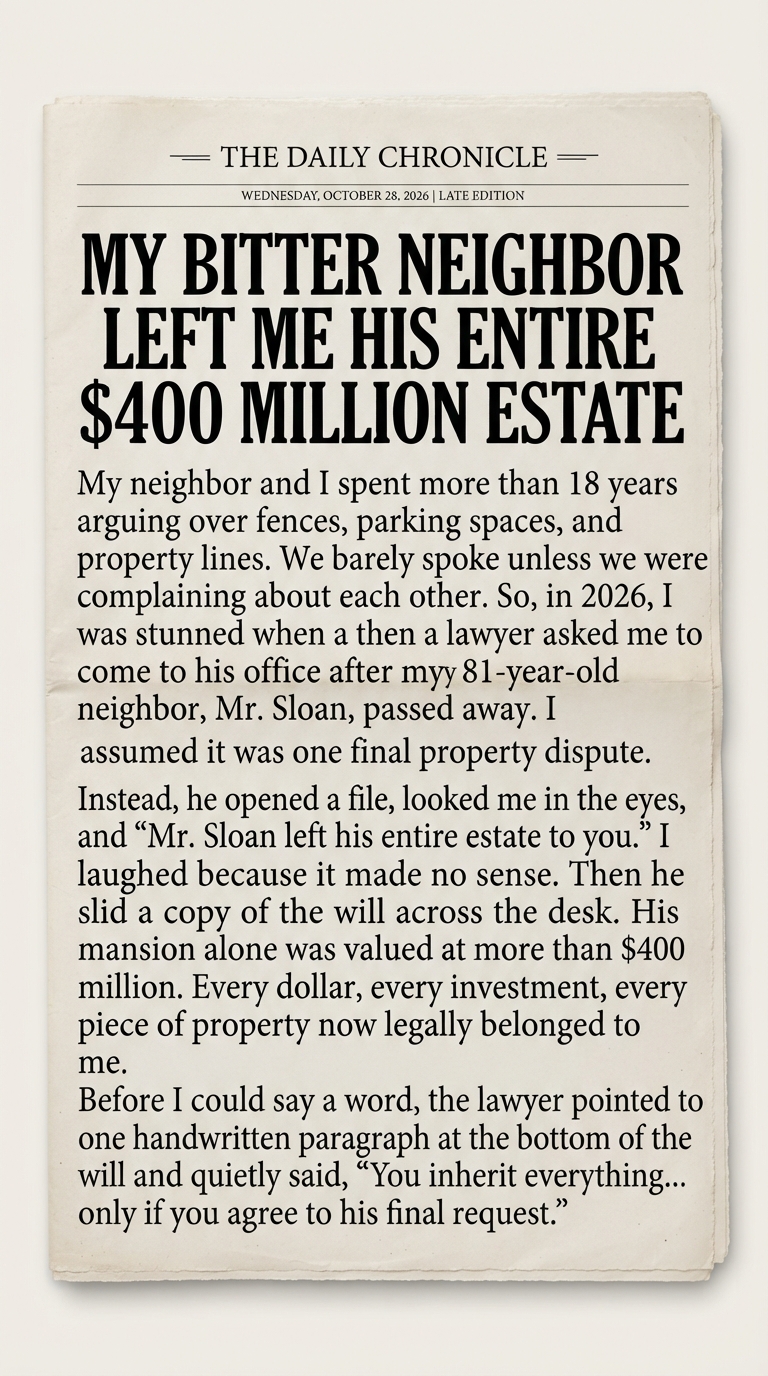
My neighbor and I spent more than eighteen years arguing over fences, parking spaces, trees, noise, and property lines.
His name was Mr. Sloan.
He was the kind of man who could turn a two-inch difference in a fence post into a three-week war.
And I wasn’t much better.
The first argument started over a maple tree.
Its branches hung slightly over my side of the property, dropping leaves into my driveway every autumn. I asked him to trim them.
He told me leaves were a natural part of life.
I told him so were chainsaws.
From that moment on, we became enemies.
After that came the parking dispute.
Then the security camera he claimed was pointed at his driveway but somehow always seemed to capture my front porch.
Then the fence.
Then the fence again.
Then the surveyor.
Then the lawyer.
For eighteen years, we barely spoke unless we were complaining about each other.
If Mr. Sloan saw me outside, he went back into his mansion.
If I saw him checking the property line, I suddenly found something else to do.
People in the neighborhood thought our feud was ridiculous.
Honestly?
So did I.
But after enough years, the arguments became part of our lives.
We didn’t even remember how to stop.
Then, one morning in 2026, I saw an ambulance outside Mr. Sloan’s house.
By noon, the curtains were closed.
By evening, I learned he had died.
He was eighty-one years old.
I stood by my window that night, staring at his dark house.
For the first time in eighteen years, I realized how quiet the neighborhood felt without him.
I expected the next few weeks to involve relatives, estate agents, or contractors.
What I didn’t expect was a phone call from a lawyer.
“Mr. Harris?” the voice asked.
“Yes.”
“My name is Daniel Reed. I represented Mr. Sloan.”
I nearly hung up.
“What does he want now?”
There was a pause.
“Mr. Sloan has passed away.”
“I know.”
“I need you to come to my office.”
“Why?”
“I believe it would be better to discuss that in person.”
I laughed.
“If this is about the fence, I can assure you Mr. Sloan no longer has the advantage.”
The lawyer didn’t laugh.
That should have warned me.
The following morning, I drove to his office.
I expected paperwork.
Maybe one final complaint.
Maybe a dispute over our shared property line that somehow survived longer than Mr. Sloan himself.
Instead, Mr. Reed led me into a conference room and placed a thick file on the table.
He looked at me carefully.
Then he said words that made absolutely no sense.
“Mr. Sloan left his entire estate to you.”
I stared at him.
Then I laughed.
Not because it was funny.
Because my brain refused to process it.
“Very funny.”
“I’m serious.”
“No.”
“Yes.”
“Mr. Sloan hated me.”
Mr. Reed folded his hands.
“That is not how his will describes you.”
I shook my head.
“You have the wrong person.”
“I assure you, I do not.”
He opened the file and slid a copy of the will across the desk.
I read it once.
Then again.
Then a third time.
My hands began to shake.
His mansion alone was valued at more than four hundred million dollars.
There were investment accounts.
Commercial properties.
Land.
Companies.
Art.
Everything.
Every dollar.
Every investment.
Every piece of property.
All of it had been left to me.
I looked at Mr. Reed.
“This has to be a mistake.”
“It isn’t.”
“Where is his family?”
“He had none remaining.”
“No children?”
“No.”
“Brothers? Sisters?”
“None living.”
I leaned back in my chair.
“Then why me?”
Mr. Reed was silent.
Then he pointed toward the final page.
At the bottom was a handwritten paragraph.
The handwriting was shaky but unmistakably deliberate.
He quietly said, “You inherit everything… only if you agree to his final request.”
I read the paragraph.
My mouth went dry.
It said:
To the man who spent eighteen years believing I was his enemy: You may have everything I own, but only if you agree to live in my house for one full year and never enter the locked room on the third floor until the final day.
Below that was one more sentence.
When the year ends, you will finally understand why I chose you.
I looked at the lawyer.
“What is in the room?”
“I don’t know.”
“You’re his lawyer.”
“I was instructed not to know.”
“That’s ridiculous.”
“Mr. Sloan was a very private man.”
I pushed the will away.
“No.”
Mr. Reed raised an eyebrow.
“No?”
“I don’t want his money.”
That was a lie.
Of course I wanted the money.
Anyone would.
But something about the condition made my stomach turn.
A locked room.
One year.
And a dead man who had spent nearly two decades fighting with me.
Mr. Reed reached into the file and handed me another envelope.
“Mr. Sloan asked me to give you this if you hesitated.”
My name was written on the front.
I opened it.
Inside was a single piece of paper.
It said:
You were never as good at walking away as you pretended to be.
I hated that sentence.
Because he was right.
Three days later, I signed the agreement.
The mansion became mine.
At least, legally.
But living there felt strange.
Mr. Sloan’s house stood beside mine like it always had, except now I was walking through his front door.
His furniture was still there.
His books.
His old photographs.
His favorite chair.
Even the coffee mug he had used every morning sat upside down beside the sink.
At first, I thought I would renovate everything.
Sell the furniture.
Paint the walls.
Make the house feel like mine.
But I didn’t.
Not immediately.
And every night, before going to bed, I looked toward the staircase leading to the third floor.
The locked room waited at the end of the hallway.
The door was dark wood.
No windows.
No markings.
Just a brass lock.
The lawyer had been clear.
If I opened it before the year was over, I would lose everything.
The mansion.
The money.
The properties.
Every part of the inheritance.
So I left it alone.
The first month was difficult.
The second was worse.
By the third month, curiosity became an obsession.
What could possibly be inside?
A secret?
A crime?
Evidence of something terrible?
I started remembering every strange thing Mr. Sloan had ever done.
The nights he stood at his upstairs window.
The times I caught him watching my house.
The questions he asked my other neighbors about me.
Had he been spying on me?
Was there something in that room connected to our eighteen years of fighting?
Then one evening, while searching for a flashlight in his study, I found an old photograph.
It had been hidden inside a drawer.
I pulled it out.
My heart stopped.
The photograph showed two young men standing beside an old truck.
One of them was Mr. Sloan.
The other was my father.
I sat down so quickly that the chair nearly fell over.
My father had died when I was twenty.
I knew almost everything about his life.
Or at least I thought I did.
But I had never seen that photograph.
On the back were four words.
Brothers until the end.
I stared at it for hours.
The next morning, I called my mother.
“Did Dad know Mr. Sloan?”
There was silence.
Long silence.
Then she whispered, “Where did you hear that name?”
I told her everything.
When I finished, she began crying.
My mother had not cried when my father died.
Not in front of me.
But now she cried.
Finally, she said, “Your father and Richard Sloan were best friends.”
I couldn’t speak.
“They grew up together,” she continued. “They were closer than brothers.”
“Why didn’t you ever tell me?”
“Because after what happened, your father never wanted to talk about him again.”
“What happened?”
She took a deep breath.
“Money.”
Of course.
Money.
It always seemed to be money.
My father and Mr. Sloan had once started a small business together.
My father had trusted him completely.
But when the company began making real money, something went wrong.
There were accusations.
Arguments.
Lawyers.
My father believed Mr. Sloan had betrayed him.
And Mr. Sloan believed my father had abandoned him.
They never spoke again.
Years passed.
Then my father died.
“And Mr. Sloan?” I asked.
My mother’s voice trembled.
“He came to the funeral.”
I froze.
“What?”
“He stood across the street.”
“Why didn’t you tell me?”
“Your father had already forgiven him.”
That sentence confused me.
“What do you mean?”
“The night before your father died, he told me something. He said if Richard ever came back, I should tell him he was forgiven.”
My mother began crying again.
“But Richard never came back.”
For months after that conversation, I couldn’t stop thinking about Mr. Sloan.
Had he chosen to live beside me on purpose?
Had our property dispute really been an accident?
Then, one rainy afternoon, I found something else.
A survey document.
It showed that eighteen years earlier, Mr. Sloan had purchased the property next to mine.
But the previous owner had been willing to sell him several other lots.
He had specifically chosen that one.
The house beside mine.
The one closest to me.
Suddenly, our entire feud looked different.
Had he known exactly who I was?
The answer came in a letter I found behind an old painting.
It was addressed to no one.
Just dated eighteen years earlier.
I bought the house beside Daniel’s son today.
I sat on the floor.
My father’s name was Daniel.
The letter continued.
I saw him outside with his father last summer. He looks just like him. I wanted to speak to him. I couldn’t. What would I say? That I waited twenty years to apologize?
I read the next lines with tears in my eyes.
So I did what cowards do. I stayed close enough to watch and far enough to remain safe.
That was the beginning of our eighteen-year war.
Mr. Sloan had known me from the start.
Every argument.
Every complaint.
Every fence dispute.
He had been my father’s best friend.
And instead of telling me the truth, he had hidden behind anger.
Maybe because anger was easier than grief.
Easier than guilt.
Easier than admitting that he had lost his best friend and never found the courage to make things right.
As the months passed, I found more letters.
None were addressed to me.
They were things he had written but never sent.
Apologies to my father.
Memories from their childhood.
Stories about mistakes.
Regrets.
And one sentence appeared again and again.
I don’t know how to ask his son to forgive me for something his father already forgave.
Finally, the year came to an end.
Three hundred and sixty-five days.
I stood outside the locked room on the third floor.
My hand rested on the brass key the lawyer had given me that morning.
I had imagined this moment for an entire year.
A fortune was waiting.
A secret was waiting.
Maybe an explanation.
I unlocked the door.
Slowly, I pushed it open.
The room was not filled with money.
It wasn’t filled with evidence.
There were no hidden safes.
No terrifying secrets.
There was only a small wooden table.
And on it sat an old tape recorder.
Beside it was a note.
Press play.
My hands trembled.
I pressed the button.
For several seconds, there was only static.
Then I heard Mr. Sloan’s voice.
Older.
Weaker.
But unmistakably his.
“If you’re hearing this, then you stayed.”
I closed my eyes.
“I knew you would.”
I almost laughed.
Even dead, the old man was still irritating me.
Then his voice continued.
“You spent eighteen years thinking I was your enemy. The truth is, I spent eighteen years trying to find the courage to tell you that I loved your father like a brother.”
My throat tightened.
“I knew who you were the day I moved next door. I wanted to introduce myself. I wanted to tell you everything. But every time I saw you, I saw Daniel. And every time I remembered Daniel, I remembered my greatest failure.”
There was a pause in the recording.
“I thought if I stayed close, maybe one day I would find the courage.”
Another pause.
“Instead, I argued with you about fences.”
I laughed through my tears.
His voice softened.
“I’m sorry.”
Then the recording stopped.
For a moment, I stood alone in the room.
Then I noticed something beneath the table.
A box.
Inside were dozens of photographs.
My father and Mr. Sloan fishing.
Laughing.
Working.
Growing older.
There were letters too.
And at the very bottom was a final envelope with my name.
I opened it.
Inside was one last message.
I am leaving you everything not because you fought me, but because you stayed.
You stayed beside me for eighteen years, even when I gave you every reason to hate me.
Take care of what I built. Sell it. Give it away. Keep it. It no longer matters to me.
But before you decide what to do with my money, do one thing for me.
Forgive someone before it’s too late.
I read that sentence again.
And again.
Then I sat in the empty room until sunset.
A month later, I sold part of the estate.
I didn’t need four hundred million dollars.
Nobody does.
I created a foundation in my father’s name.
And in Mr. Sloan’s name too.
It helped families who were struggling, funded scholarships, and supported people who needed a second chance.
Some people asked why I honored the man I had spent eighteen years fighting.
I usually smiled.
Because the truth was too complicated to explain in a sentence.
Mr. Sloan had been my enemy.
Then he became a mystery.
And finally, after he was gone, he became something else.
A reminder.
That sometimes people don’t know how to apologize.
Sometimes regret disguises itself as anger.
Sometimes the people who hurt us are carrying wounds we cannot see.
And sometimes, the last thing a person leaves behind isn’t money.
It’s the truth they were too afraid to tell while they were alive.
I still live in the smaller house next to the mansion.
I never moved.
And the fence between the two properties?
I had it removed.