The Evidence Hidden in My Backpack
My twin sister and I learned very young that silence could be dangerous.
But speaking could be worse.
Our stepfather, Grant, had a way of making the whole house feel like a trap.
A door closing too loudly could set him off.
A glass left on the counter could become an excuse.
A question he didn’t like could turn into a punishment.
And when he hurt us, he always made sure we understood one thing:
Nobody would believe us.
“You’re teenagers,” he would say afterward. “You exaggerate everything.”
Our mother rarely looked at us during those moments.
She would stand in the kitchen with her hands trembling, staring at the floor.
Sometimes I wondered whether she was afraid of Grant.
Sometimes I wondered whether she was afraid of the truth.
My twin sister, Emma, and I stopped talking about it between ourselves.
We didn’t need to.
We knew.
We had each other’s eyes.
Each other’s silence.
Each other’s promise that someday we would get out.
We were seventeen.
And we had been counting the days until we turned eighteen.
The night everything changed began like any other.
Grant came home angry.
I don’t remember what started it.
Maybe it didn’t matter.
With Grant, there was always a reason.
By the time the attack ended, Emma and I were both unconscious.
When I woke up, bright lights were above me.
My head hurt.
My ears were ringing.
I couldn’t move properly.
I heard my mother talking.
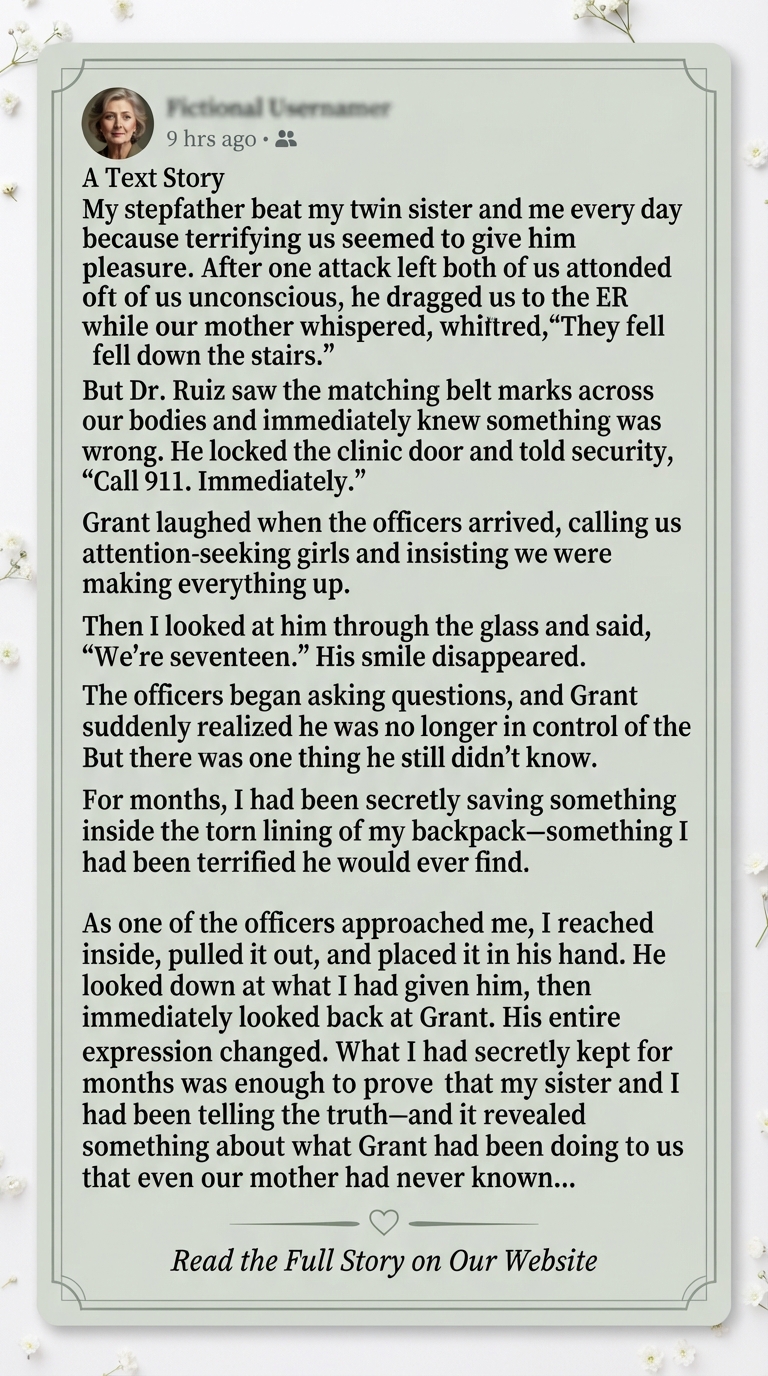
“They fell down the stairs.”
Her voice was shaking.
“Both of them?”
“Yes.”
The nurse asked something.
My mother repeated herself.
“They fell.”
I closed my eyes.
I wanted to scream.
But I couldn’t.
Then a man stepped into the room.
He was wearing a white coat.
“I’m Dr. Ruiz,” he said.
He looked at Emma.
Then at me.
Then back at Emma.
His expression changed.
He didn’t say anything immediately.
He simply looked.
The matching marks.
The injuries.
The patterns.
Two sisters.
The same explanations.
The same injuries.
Something wasn’t right.
Dr. Ruiz quietly asked my mother to step outside.
Grant followed her.
A few seconds later, I heard his voice.
“She told you. They fell down the stairs.”
Dr. Ruiz didn’t respond.
Instead, he walked toward the nurses’ station.
Then I heard him say something that I will never forget.
“Lock the clinic door.”
A nurse looked startled.
Dr. Ruiz continued.
“Call security.”
Then, more firmly:
“Call 911. Immediately.”
Grant laughed.
He actually laughed.
“You people are unbelievable.”
Then he looked through the glass toward us.
“You girls are always looking for attention.”
For the first time that night, I opened my eyes.
Grant saw me.
I looked directly at him.
“We’re seventeen.”
His smile disappeared.
Police arrived within minutes.
Two officers entered the treatment area.
One spoke with Dr. Ruiz.
The other approached us carefully.
“Can you tell me what happened?”
My throat tightened.
I looked at Emma.
She looked back at me.
Then she nodded.
I told them.
Not everything.
Not at first.
But enough.
I told them the stairs weren’t involved.
I told them Grant had hurt us.
I told them it had happened before.
The officer asked:
“How many times?”
I looked down.
“I don’t know.”
“Days?”
I nodded.
“Months?”
I nodded again.
“Years?”
My eyes filled with tears.
“Yes.”
Behind the glass, Grant began shouting.
“They’re lying!”
The officer turned toward him.
“Sir, step away from the door.”
Grant laughed again.
“You don’t know these girls.”
Then he pointed at our mother.
“She knows exactly what happened.”
Our mother began crying.
And for a moment, I thought she would agree with him.
Instead, she whispered:
“I lied.”
Grant’s face changed.
“I was afraid.”
He stared at her.
“You’d better think carefully about what you’re saying.”
She looked at me.
Then at Emma.
“I should have protected them.”
It was the first time my mother had said those words.
And somehow, hearing them hurt almost as much as everything else.
Because I had needed her to say them years earlier.
While the officers continued questioning everyone, one of them returned to my bedside.
“Is there anything else?”
My heart started pounding.
I looked toward Grant.
Then toward the door.
Then at my backpack.
It was sitting in the corner.
The backpack was torn along one side.
The zipper had been broken for months.
Grant had never cared about it because he thought it was worthless.
That was exactly why I had chosen it.
I reached inside.
My fingers found the torn lining.
I pulled out a small plastic memory card wrapped in tissue.
I handed it to the officer.
He looked at it.
“What is this?”
“My insurance.”
He frowned.
“Insurance?”
I nodded.
“I’ve been saving things.”
His expression became serious.
“What kind of things?”
“Recordings.”
He looked at me.
I swallowed.
“I started months ago.”
The first recording was only thirty seconds long.
Grant’s voice was unmistakable.
The second was longer.
The third included him threatening us.
There were photographs.
Dates.
Notes.
Copies of messages.
And recordings of arguments in which Grant repeatedly admitted that he had hurt us.
But the most important file wasn’t a recording of an attack.
It was a recording of a conversation between Grant and our mother.
I had made it months earlier.
I had been hiding in the hallway.
Grant was angry because Emma had threatened to tell someone at school.
I heard him say:
“She won’t say anything.”
My mother whispered:
“She could.”
“She won’t.”
“What if she does?”
Grant laughed.
“Then I’ll tell them she’s unstable. You know how easy that is.”
My mother didn’t answer.
Then Grant said something that made my blood run cold.
“And if they ask about the hospital last winter, you tell them the same thing.”
My mother whispered:
“The stairs.”
“Exactly.”
The officer stopped the recording.
He looked at me.
“When did you make this?”
“Five months ago.”
“Why didn’t you tell anyone?”
I looked down.
“Because I didn’t know who would believe us.”
He nodded slowly.
Then he asked:
“Is there more?”
I handed him the memory card.
“There are copies.”
“Where?”
“I sent them to an email account Grant doesn’t know about.”
The officer looked toward Grant.
For the first time, Grant wasn’t yelling.
He was silent.
The investigation changed immediately.
Police collected the recordings and photographs.
The hospital documented our injuries.
Dr. Ruiz provided his observations and medical records.
Other evidence was gathered from our home.
The officers also discovered that some of the dates in my notes matched previous medical visits that our mother had explained away as accidents.
That mattered.
Because one accusation could be dismissed.
A pattern was harder to erase.
Grant was arrested that night.
Our mother was not arrested.
Instead, she was interviewed separately.
She eventually admitted that she had known about some of the abuse and had repeatedly told doctors and relatives that the girls were clumsy or accident-prone.
But she also told investigators something else.
Something I hadn’t known.
Grant had been threatening her too.
He had told her that if she left him, he would make sure she lost everything.
He had convinced her that nobody would believe her.
It didn’t excuse what she had done.
But for the first time, I understood that fear could make people make terrible choices.
Understanding it didn’t mean forgiving her.
Not yet.
Emma and I were placed somewhere safe.
For the first few nights, neither of us slept properly.
Every unfamiliar sound woke us.
A door closing made us flinch.
Someone raising their voice made my heart race.
But there was something different about being safe.
Nobody was waiting for us to make a mistake.
Nobody was listening for footsteps.
Nobody was telling us what we had imagined.
We were allowed to breathe.
A victim advocate helped us through the investigation.
Then came the hardest part.
Court.
Grant pleaded not guilty.
His attorney argued that the evidence had been misunderstood.
They questioned the recordings.
They questioned our memories.
They suggested we were angry teenagers who wanted to destroy our stepfather.
But the evidence kept speaking.
Medical records.
Photographs.
Dates.
Recordings.
Messages.
Witness statements.
And the memory card I had hidden inside my backpack.
The same backpack Grant had ignored for months.
The evidence he never knew existed.
Months later, Emma and I sat together in the courtroom.
Grant looked smaller than I remembered.
Not because he had changed.
Because he no longer controlled the room.
He couldn’t make the doors lock.
He couldn’t decide what people believed.
He couldn’t tell us what to say.
And he couldn’t erase what had happened.
The court eventually found him guilty of the charges supported by the evidence.
When the proceedings ended, Emma and I walked outside together.
It was raining.
She looked at me.
“Do you remember the backpack?”
I smiled faintly.
“Every day.”
She laughed.
“The stupid torn backpack.”
“It saved us.”
“No.”
She looked at me.
“We saved us.”
I thought about that.
Then I nodded.
She was right.
The backpack hadn’t saved us.
The memory card hadn’t saved us.
The police hadn’t saved us.
Those things helped.
But the first thing that saved us was the moment we decided that what was happening to us deserved to be known.
Our mother spent a long time trying to repair the damage.
She entered counseling.
She apologized.
Not once.
Many times.
She never asked us to forgive her.
That mattered.
Instead, she said:
“I know saying I’m sorry doesn’t give you back those years.”
Emma eventually began speaking with her again.
I wasn’t ready.
For a long time, I couldn’t sit in the same room with my mother without remembering all the times she had said nothing.
But slowly, over the years, things changed.
Not because we forgot.
Because we learned that healing didn’t require pretending nothing had happened.
After graduating, Emma studied social work.
I studied criminal justice.
People sometimes asked why.
The answer was simple.
We knew what it felt like to be seventeen years old and believe that nobody would listen.
We wanted to become the people we had needed.
Years later, I volunteered with a youth support organization.
One afternoon, a frightened teenager sat across from me.
She kept looking at the floor.
“I don’t think anyone will believe me,” she whispered.
I knew that sentence.
I had lived inside it.
So I didn’t tell her everything would magically be fine.
I didn’t make promises I couldn’t keep.
I simply told her:
“You deserve to be safe.”
Her eyes lifted.
“And someone will listen.”
I still have the torn backpack.
It’s old now.
The fabric is faded.
The zipper barely works.
But I keep it in a box in my closet.
Inside is nothing dangerous anymore.
Just the old memory card.
The one that changed everything.
Sometimes I take it out and remember the girl I was at seventeen.
Terrified.
Exhausted.
Convinced she had no power.
She was wrong.
She had more courage than she knew.
So did Emma.
We didn’t win because Grant suddenly became powerless.
We won because the truth finally became louder than his lies.
And the thing he feared most wasn’t the police.
It wasn’t the courtroom.
It wasn’t the evidence.
It was the moment two terrified girls finally realized that their story belonged to them.
He could control our house.
He could control what our mother said.
He could frighten us into silence.
But he could never control the truth.
And once that truth was finally placed in someone else’s hands, he couldn’t take it back.