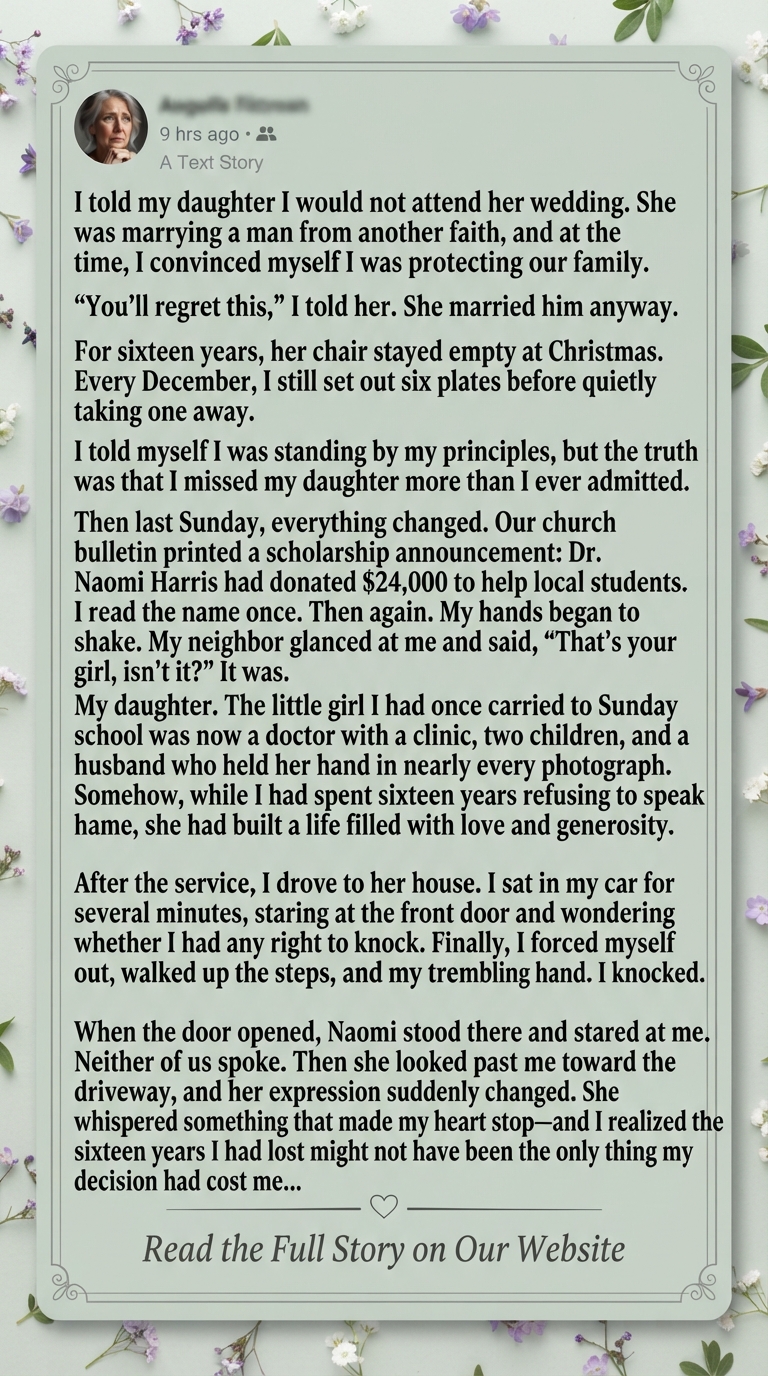
I told my daughter I would not attend her wedding.
She was marrying a man from another faith, and at the time, I convinced myself I was protecting our family.
“You’ll regret this,” I told her.
She looked at me with tears in her eyes.
“Maybe I will,” she whispered. “But I would rather regret marrying the man I love than spend my life regretting that I let fear decide whom I could love.”
I remember those words because they were the last words my daughter ever said to me as my daughter.
After that, she left.
She married him anyway.
That was 2010.
For sixteen years, her chair stayed empty at Christmas.
Every December, I still set out six plates before quietly taking one away.
I told myself I was standing by my principles.
The truth was much simpler.
I missed my daughter.
I missed her laugh.
I missed the way she used to leave her shoes in the hallway no matter how many times I told her not to.
I missed Sunday mornings when she would sit beside me in church, swinging her legs because they barely touched the floor.
But pride is a strange thing.
After enough years, you stop admitting that you’re lonely because admitting it means admitting you were wrong.
So I convinced myself Naomi had chosen her husband over me.
I never allowed myself to consider that perhaps I had forced her to choose at all.
Then, one Sunday morning, everything changed.
I was sitting near the front of our church when Pastor Williams announced a new scholarship program for local students.
A woman had donated twenty-four thousand dollars to fund scholarships for young people who wanted to pursue medicine, nursing, and community health.
The bulletin was passed down the row.
I glanced at the announcement without much interest.
Then I saw the name.
Dr. Naomi Harris.
I stopped breathing.
I read it again.
Dr. Naomi Harris.
My Naomi.
My little girl.
The child I had carried to Sunday school.
The girl who used to fall asleep against my shoulder during Christmas services.
The teenager who once told me she wanted to become a doctor because, in her words, “People shouldn’t have to be scared just because they’re sick.”
My hands began to shake.
My neighbor, Margaret, looked at me.
“That’s your girl, isn’t it?”
I couldn’t answer.
I just nodded.
Margaret put her hand over mine.
“She sounds like a wonderful woman.”
I stared at the photograph beside the announcement.
Naomi stood outside a medical clinic, wearing a white coat.
Beside her was a man I recognized from an old photograph I’d once seen years ago.
Her husband.
He was holding her hand.
Behind them stood two children.
My grandchildren.
Children I had never met.
Sixteen years.
I suddenly understood how long sixteen years really was.
A baby could be born, learn to walk, start school, lose teeth, grow taller—and I had missed every part of it.
I left church before the service ended.
I drove to Naomi’s house.
For several minutes, I sat in my car staring at the front door.
I almost drove away.
What right did I have to knock?
I had made my decision sixteen years ago.
Naomi had respected it.
Perhaps she had finally stopped needing me.
But something inside me whispered that if I drove away again, I might never forgive myself.
So I got out.
I walked up the steps.
And I knocked.
The door opened.
Naomi stood there.
She looked older than the girl I remembered, of course.
But somehow I still saw the little girl.
Her eyes widened.
Neither of us spoke.
Then she looked past me toward the driveway.
Her face suddenly changed.
She whispered,
“Dad?”
I turned.
An older man was standing beside my car.
For a second, I didn’t recognize him.
Then I did.
My brother, Daniel.
He had driven me to the hospital sixteen years earlier when I had been sick. He had been there when Naomi got married.
He had always been the one person in our family who told me I was making a terrible mistake.
Daniel looked at Naomi.
Then he looked at me.
“It’s true,” he said quietly.
Naomi’s eyes filled with tears.
“What is?”
Daniel walked toward us.
“You never told him?”
Naomi shook her head.
“No.”
My stomach tightened.
“Told me what?”
Naomi looked down at the floor.
Then she stepped aside.
“Come inside.”
I followed her.
The house was warm and bright.
Photographs covered the walls.
Naomi with her husband.
Naomi in medical school.
Naomi holding two babies.
Naomi receiving an award.
Naomi standing beside the clinic she had founded.
There was a whole lifetime on those walls.
A lifetime that had happened without me.
Then I saw a framed photograph on a shelf.
It was from her wedding.
Naomi was smiling.
Her husband was beside her.
And behind them stood an empty chair.
I stared at it.
“What is that?”
Naomi swallowed.
“My wedding.”
“I know.”
She shook her head.
“No. I mean the chair.”
I looked closer.
A small white ribbon was tied around the back.
My initials were written on it.
I couldn’t speak.
Naomi wiped her eyes.
“I left that chair there because I kept hoping you’d change your mind.”
My chest tightened.
“For how long?”
She gave a sad little smile.
“Three years.”
Three years.
She had left a chair for me for three years.
And I had never known.
Then Daniel spoke.
“There is something else you need to hear.”
Naomi looked at him.
“Uncle Daniel—”
“You can’t keep protecting him from the truth.”
I looked between them.
“Protecting me from what?”
Naomi sat down.
For the first time since I had arrived, she looked afraid.
“Dad, after the wedding, I wanted to come home.”
My heart broke.
“I didn’t know.”
“I know.”
She looked at her hands.
“I came to your house once.”
I stared at her.
“When?”
“December 2010.”
I remembered that Christmas.
I remembered sitting alone at the dining table.
Six plates.
Then five.
I remembered telling myself I was perfectly fine.
Naomi continued.
“I stood outside for almost twenty minutes.”
My throat tightened.
“Why didn’t you knock?”
She looked at me.
“Because I saw you through the window.”
I felt the blood leave my face.
“You were sitting at the table.”
I remembered.
I had been angry.
I had been hurt.
And I had convinced myself she had abandoned me.
Naomi’s voice cracked.
“I thought you didn’t want me there.”
I closed my eyes.
“I wanted you there.”
“Then why didn’t you open the door?”
I couldn’t answer.
Because I knew.
I had been too proud to admit I was waiting.
Too stubborn to make the first move.
And she had been standing outside, believing I had rejected her again.
I sat down.
“I thought you chose him.”
Naomi shook her head.
“I chose my husband. I never stopped choosing you.”
Silence filled the room.
Then I noticed two small faces watching us from the hallway.
A boy and a girl.
My grandchildren.
The boy looked at Naomi.
“Mom, is this Grandpa?”
Naomi closed her eyes.
Then she nodded.
“Yes.”
The little girl stepped forward.
“Why haven’t we met him?”
That question broke whatever was left of my pride.
I looked at Naomi.
“I don’t have a good answer.”
She didn’t look away.
Neither did I.
Then the little boy walked over and held out his hand.
“My name is Daniel.”
I laughed through my tears.
“Your name is Daniel?”
He nodded proudly.
“Mom named me after someone important.”
I looked at my brother.
He was crying too.
Naomi smiled.
“I named him after Uncle Daniel.”
For the first time in sixteen years, I laughed with my daughter.
Then I cried.
Not quietly.
Not with dignity.
I cried the way a person cries when they finally realize exactly what they have lost.
“I was wrong,” I said.
Naomi didn’t answer immediately.
She simply sat beside me.
“I know,” she said.
“I wasted sixteen years.”
“Yes.”
“I don’t expect you to forgive me today.”
She looked at me.
“I forgave you a long time ago.”
My heart stopped.
“But forgiveness isn’t the same as pretending nothing happened.”
“I know.”
“You missed everything.”
“I know.”
“You missed my graduation. My residency. My wedding anniversary. My children’s births.”
“I know.”
Her voice softened.
“But you are here now.”
That was the sentence I had been waiting sixteen years to hear.
Not everything is fine.
Not you did nothing wrong.
Just:
You are here now.
I reached for her hand.
She let me hold it.
That evening, her husband came home.
I stood when he entered.
For sixteen years, I had thought of him as the man who took my daughter away.
But he wasn’t.
I was.
He walked toward me cautiously.
“Sir.”
I held out my hand.
“I owe you an apology.”
He looked surprised.
“For what?”
“For blaming you for a decision that was mine.”
He stared at me for a moment.
Then he took my hand.
“Thank you.”
There was no dramatic speech.
No perfect reconciliation.
Just two men standing in a kitchen, finally choosing honesty over pride.
Before I left that night, Naomi walked me to the door.
“Will you come back?”
I looked at her.
“If you’ll have me.”
She smiled.
“You’re my dad.”
Then she hugged me.
I held my daughter like I had held her when she was five years old.
And for a few seconds, sixteen years disappeared.
The next Christmas was different.
I still set six plates on the table.
But this time, I didn’t remove one.
There were actually seven.
Naomi.
Her husband.
My two grandchildren.
My brother.
And me.
Seven plates.
Seven chairs.
And no empty place.
Before dinner, my granddaughter handed me a small envelope.
Inside was a photograph.
It showed Naomi and me standing outside her medical clinic.
On the back, she had written:
“We can’t get the sixteen years back. But we can make sure the next sixteen count.”
I folded the photograph carefully and put it in my wallet.
I had spent sixteen years believing that standing by my principles meant refusing to bend.
I finally understood something different.
Sometimes humility isn’t abandoning what you believe.
Sometimes it’s admitting that your fear made you treat someone you loved as though they were your enemy.
My daughter had built a life filled with love while I had been sitting in an empty chair, waiting for her to come back.
She had already come back.
I was the one who had been too proud to open the door.
And that was the truth I carried with me for the rest of my life.
Not that I had lost sixteen years.
But that I had been given the grace to stop losing any more.