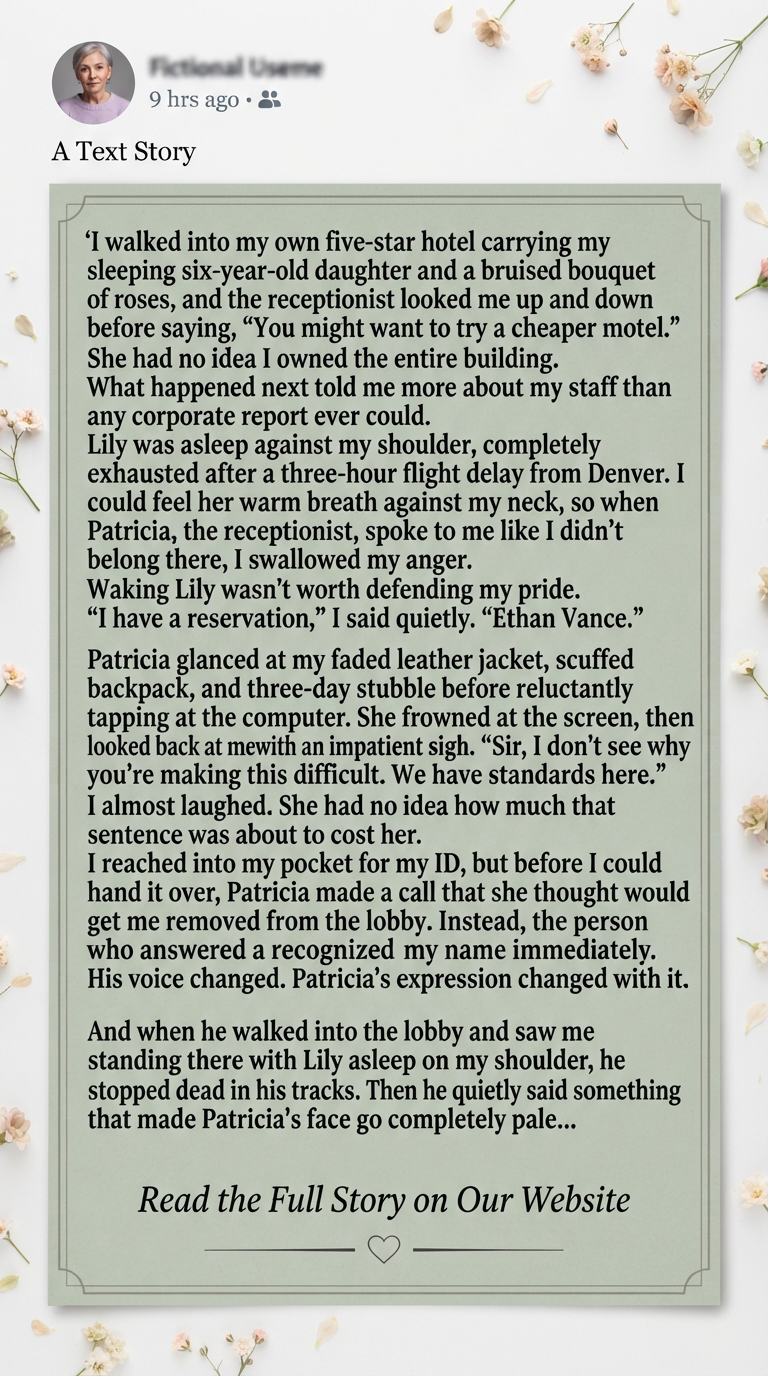
I walked into my own five-star hotel carrying my sleeping six-year-old daughter and a bruised bouquet of roses, and the receptionist looked me up and down before saying, “You might want to try a cheaper motel.”
She had no idea I owned the entire building.
What happened next told me more about my staff than any corporate report ever could.
Lily was asleep against my shoulder, completely exhausted after a three-hour flight delay from Denver. I could feel her warm breath against my neck, so when Patricia, the receptionist, spoke to me like I didn’t belong there, I swallowed my anger.
Waking Lily wasn’t worth defending my pride.
“I have a reservation,” I said quietly. “Ethan Vance.”
Patricia glanced at my faded leather jacket, scuffed backpack, and three-day stubble before reluctantly tapping at the computer.
She frowned.
Then she looked back at me with an impatient sigh.
“Sir, I don’t see why you’re making this difficult. We have standards here.”
I almost laughed.
She had no idea how much that sentence was about to cost her.
I reached into my pocket for my ID, but before I could hand it over, Patricia picked up the phone.
“I’m calling security.”
I stared at her.
“Security?”
“Yes.” She lowered her voice as though she were doing me a favor. “We’ve had people try to walk in here pretending they have reservations before.”
“I have a reservation.”
“Of course you do.”
The sarcasm was unmistakable.
Lily stirred against my shoulder.
I immediately lowered my voice.
“Please. My daughter is sleeping.”
Patricia rolled her eyes.
Then she made the call.
“Hi, this is Patricia at the front desk. I have a gentleman here who claims he has a reservation under Ethan Vance. He’s refusing to leave.”
I didn’t correct her.
I simply stood there.
Waiting.
Thirty seconds later, a man came rushing through the lobby from the executive offices.
It was Daniel Brooks, our general manager.
Daniel had worked for Vance Hospitality for eleven years.
He was the kind of man who normally walked slowly, spoke carefully, and never showed panic.
But the moment he saw me, he stopped.
His face drained of color.
“Mr. Vance?”
Patricia’s fingers froze over the keyboard.
Daniel walked toward me.
Then his eyes moved to Lily sleeping against my shoulder.
“Sir… I didn’t know you were arriving tonight.”
“I wasn’t planning to announce it.”
His expression told me he understood exactly what that meant.
I hadn’t told anyone I was coming.
Not Daniel.
Not the regional manager.
Not the staff.
Not even my assistant.
For the last six months, I’d been quietly conducting an experiment.
Our occupancy numbers were excellent.
Guest satisfaction scores were high.
Corporate reports showed almost no employee complaints.
Every monthly report described the hotel as “exceptional.”
But something had been bothering me.
The reports were too perfect.
So I decided to see what happened when nobody knew the owner was watching.
And now I knew.
Daniel looked at Patricia.
“Did you tell Mr. Vance to leave?”
Patricia swallowed.
“I… I thought he was—”
“A guest?” Daniel asked.
She nodded.
Daniel’s voice became very quiet.
“He isn’t just a guest.”
Patricia looked at me.
Daniel continued.
“This is Ethan Vance.”
Patricia stared blankly.
“Yes,” she whispered.
“The Ethan Vance?”
Daniel nodded.
“The owner.”
The silence that followed seemed to swallow the entire lobby.
Patricia’s face went completely pale.
But Daniel wasn’t finished.
He looked at her name tag.
“Patricia, how long have you worked here?”
“Eight months.”
“And in those eight months, how many guests have you told they didn’t meet our standards?”
Her mouth opened.
No words came out.
I shifted Lily slightly on my shoulder.
“Let’s not do this in front of my daughter,” I said.
Daniel immediately nodded.
“Of course.”
He turned toward Patricia.
“Please bring Mr. Vance’s luggage up to the penthouse.”
“I can carry it,” I said.
“No, sir.”
Daniel’s voice was firm.
“You’ve carried enough tonight.”
He then looked at Patricia again.
“And get someone to prepare the family suite.”
Patricia whispered, “Yes, sir.”
Daniel started walking with me toward the elevator.
I stopped him.
“Daniel.”
“Yes?”
“Don’t change anything because I’m here.”
He looked at me.
I could tell he understood.
“You want to see how things normally operate.”
“Exactly.”
He nodded.
“Then I’ll make sure they do.”
That night, Lily and I stayed in the family suite.
She never knew what had happened.
She woke around midnight and asked for water.
I sat beside her until she fell asleep again.
The next morning, I began reviewing the hotel’s security footage.
What I saw made my stomach turn.
Patricia wasn’t simply rude to me.
She was rude to almost everyone she considered beneath her.
A delivery driver waited nearly forty minutes while she chatted with another employee.
An elderly couple struggled with their luggage while she watched without offering help.
A young mother asked where the children’s pool was, and Patricia pointed in the wrong direction.
But the worst footage was from three days earlier.
A homeless veteran had walked into the lobby during a rainstorm.
He wasn’t asking for a room.
He was asking to use the restroom.
Patricia told him the restroom was “for paying guests only.”
Then she called security.
He left soaked.
Five minutes later, an elderly woman entered carrying two heavy bags.
Patricia immediately smiled.
“Good afternoon, Mrs. Harrison! Welcome back!”
I paused the video.
There was the answer.
Patricia didn’t treat people based on the hotel’s standards.
She treated them based on what she thought they were worth.
And suddenly I understood why our corporate reports had never caught it.
Our surveys measured rooms.
Cleanliness.
Breakfast.
Check-in speed.
They didn’t measure kindness.
They didn’t measure dignity.
They didn’t measure whether an employee made someone feel small.
That afternoon, I called Daniel into my office.
“Patricia is being terminated.”
He nodded.
“I agree.”
“But that’s not all.”
I slid a folder across the desk.
Inside were transcripts from guest complaints that had been buried by supervisors.
Daniel’s expression hardened.
“You knew about these?”
“I knew some complaints existed. I didn’t know they were being filtered.”
He looked through the pages.
Then he stopped.
“Who approved this?”
“That’s what I want you to find out.”
For the next two weeks, we investigated quietly.
What we discovered was bigger than Patricia.
Several supervisors had been deleting negative reports because they feared losing their bonuses.
Employees had been discouraged from reporting abusive behavior from senior staff.
One housekeeping employee had been repeatedly mocked by a supervisor for her accent.
A night auditor had been threatened with reduced hours after reporting a manager who screamed at guests.
The hotel wasn’t failing financially.
It was failing morally.
And I had allowed the numbers to convince me everything was fine.
So I changed the system.
We created anonymous employee reporting.
Guest complaints could no longer be deleted by hotel management.
Management bonuses were tied partly to employee retention and verified service complaints.
Every supervisor had to complete a hospitality leadership program.
And we created one rule that mattered more than all the others:
Every person who enters this hotel must be treated with dignity.
Two months later, I returned to the lobby.
This time I wore a suit.
I walked toward the front desk.
A new receptionist smiled.
“Good afternoon, Mr. Vance. Welcome home.”
I smiled.
“Thank you.”
Then I heard a familiar voice behind me.
“Mr. Vance?”
I turned.
It was Patricia.
She looked different.
Not because of her clothes.
Because she looked humbled.
She had been fired, but Daniel had later helped her get an administrative position at another property after she completed a customer-service training program.
She approached cautiously.
“I wanted to apologize.”
I nodded.
“You don’t owe me an apology.”
Her eyes dropped.
“I do.”
She took a breath.
“I judged you because of your clothes. But that’s not what I’m most ashamed of.”
“What is?”
She looked toward the lobby.
“I realized I had been doing it to other people for months. Maybe years.”
I said nothing.
She continued.
“I thought my job was deciding who belonged here.”
I shook my head.
“No, Patricia.”
She looked at me.
“Your job was making people feel like they belonged.”
Her eyes filled with tears.
“I understand that now.”
I believed her.
Not because she said it.
Because she had changed her behavior.
And that was enough.
That evening, Lily and I sat in the hotel’s restaurant.
She had a plate of pasta in front of her and a strawberry milkshake beside it.
She looked around at the enormous chandelier.
“Daddy?”
“Yes?”
“Do you own this place?”
I smiled.
“Yes.”
She thought about it.
Then she pointed toward the restaurant.
“Does that mean you own the spaghetti too?”
I laughed.
“I guess technically I do.”
She took another bite.
“Then can I have dessert?”
“Absolutely.”
She grinned.
“Being the boss is pretty useful.”
I laughed again.
But later that night, after Lily was asleep, I stood alone in the lobby.
I looked at the polished marble floors, the chandeliers, the expensive furniture, and the employees moving quietly through the building.
I had spent years measuring success through revenue.
Occupancy.
Profit margins.
Expansion.
Market share.
But that night, I realized something.
A five-star hotel wasn’t defined by its chandeliers.
Or its thread count.
Or the number of stars printed beside its name.
It was defined by how it treated the person nobody important was watching.
The exhausted mother.
The elderly traveler.
The delivery driver.
The housekeeper.
The nervous first-time guest.
The person wearing a faded jacket.
The person who couldn’t afford the most expensive room.
And sometimes, the person carrying a sleeping child on their shoulder after a long flight.
I had walked into my own hotel looking like someone who didn’t belong.
And because of that, I finally discovered who actually belonged there.
Not the people who looked important.
The people who understood that everyone deserved to be treated with dignity.
That was the report no spreadsheet had ever been able to give me.
And it was worth far more than any five-star rating.