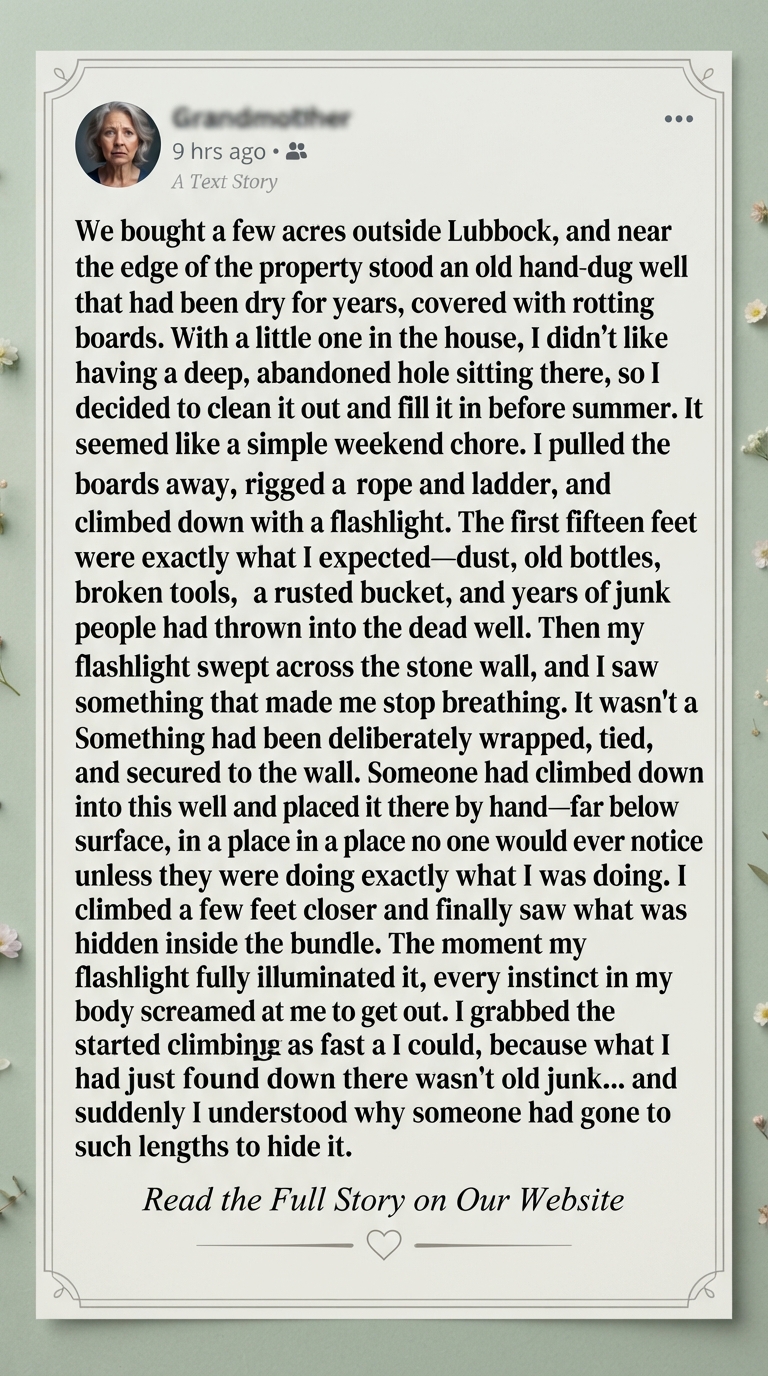
We bought a few acres outside Lubbock because we wanted space.
Space for our little girl to run.
Space for a garden.
Space to breathe without hearing traffic every time we stepped outside.
The property wasn’t fancy. There was an old farmhouse, a weather-beaten shed, a line of mesquite trees along the fence, and an abandoned hand-dug well near the eastern edge of the land.
The well had been dry for years.
At least, that’s what the previous owner told us.
It was covered with several rotting boards that looked like they had been sitting there since before I was born.
The first time I saw it, I immediately thought about our daughter.
She was three years old.
Curious.
Fearless.
And completely incapable of seeing a dangerous hole as anything other than an exciting adventure.
So I decided the well had to go.
My wife thought we should hire someone.
I said I’d clean it out first.
“Just old junk,” I told her.
I was wrong.
Very wrong.
It was a Saturday morning when I pulled the boards away.
Dust rose into the air.
I coughed and leaned over the opening.
The smell was surprisingly dry and earthy.
I tied a rope around a heavy metal post nearby, lowered a ladder into the opening, and grabbed a flashlight.
My wife stood several feet away with our daughter.
“Be careful,” she called.
“I will.”
I climbed down.
The first fifteen feet were exactly what I expected.
Dust.
Old bottles.
Broken tools.
A rusted bucket.
A cracked shovel handle.
Pieces of wood.
At one point I found what looked like an old leather boot.
Nothing unusual.
Just decades of things people had thrown into a hole because they didn’t want to carry them to the trash.
Then my flashlight moved across the stone wall.
And I stopped.
Something was attached to the stones.
It wasn’t a root.
It wasn’t a rock.
It wasn’t trash.
It was a bundle.
Someone had wrapped it tightly in thick canvas and tied it with wire.
A rusted metal hook had been driven between two stones, and the bundle was secured to it.
I stared at it.
Why would anyone climb down here to hide something?
I moved closer.
The wire was old.
Very old.
But whoever had tied it had been deliberate.
Careful.
Almost obsessive.
I looked up.
The opening of the well was now a small circle of daylight above me.
My first thought was that someone had hidden stolen property.
My second thought was much worse.
I reached toward the bundle.
Then stopped.
Something about it felt wrong.
I climbed back up.
My wife looked at me.
“What happened?”
“I found something.”
“What?”
“I don’t know.”
She glanced toward the well.
“Is it dangerous?”
“I don’t think so.”
But I wasn’t sure.
I called the Lubbock County Sheriff’s Office.
An officer arrived about forty minutes later.
His name was Deputy Harris.
He looked inside the well, then looked at me.
“You say this was attached to the wall?”
“Yes.”
“Don’t touch it again.”
That was enough to make my stomach tighten.
He called another deputy.
Then they called a detective.
Eventually, they brought specialized equipment and carefully lowered themselves into the well.
The bundle came out sealed inside another container.
The detective opened it on the ground.
The first thing we saw was a small metal box.
Inside the box were three objects.
A wedding ring.
A photograph.
And a folded piece of paper sealed inside plastic.
The photograph showed a young woman standing beside an older man.
The woman’s face was scratched and faded, but she looked terrified.
The older man was smiling.
On the back of the photograph were two words:
Martha — 1987.
The detective unfolded the paper.
It was a handwritten letter.
Only a few lines remained readable.
If anyone finds this, please tell someone what happened to Martha.
Then there was a name.
Elias Carter.
The detective’s expression changed.
“Do you know that name?”
I shook my head.
He looked at the other deputy.
“I’ve heard it.”
They moved away and spoke quietly.
A few minutes later, the detective returned.
“Elias Carter owned this property before the man who sold it to you.”
“How long ago?”
“Late eighties.”
My wife looked at me.
“What happened to Martha?”
The detective didn’t answer immediately.
Instead, he asked:
“Did the previous owner say anything about a woman disappearing?”
“No.”
He looked back toward the well.
“We’re going to have to investigate this.”
That afternoon, the property became a crime scene.
They brought dogs.
They searched the surrounding land.
They dug in several places near the well.
Then one of the dogs stopped near an old mesquite tree about forty yards away.
The investigators found fragments of clothing buried beneath the soil.
But there were no human remains.
For two days, nothing else happened.
Then the detective called.
“Mr. Carter’s daughter has been located.”
I frowned.
“Elias Carter had a daughter?”
“No.”
He paused.
“Martha was his daughter.”
My wife and I looked at each other.
The story slowly began to emerge.
In 1987, Martha Carter was twenty-one.
She had planned to leave Texas with her boyfriend.
Her father didn’t approve.
According to old newspaper reports, Martha disappeared three days before she was supposed to leave.
Her boyfriend was questioned.
So was her father.
But no one was ever charged.
The boyfriend eventually left town.
The case went cold.
Elias Carter died in 2002.
His property changed hands twice.
And Martha was never found.
Until someone discovered the well.
The ring was identified as Martha’s.
The photograph was from her boyfriend.
But the letter raised the biggest question.
Who had written it?
The detective eventually found an answer.
The handwriting belonged to Martha.
The paper had been written shortly before her disappearance.
But the letter wasn’t a confession.
It was a warning.
Martha had discovered that her father had been secretly taking money from a local construction company.
She had found financial records proving he had been falsifying invoices.
She threatened to report him.
He threatened her.
Then she disappeared.
The police searched his house in 1987 but never found enough evidence to charge him.
What they didn’t know was that Martha had hidden copies of the documents.
She had wrapped them with the ring and photograph and hidden them in the well.
She apparently planned to retrieve them later.
She never got the chance.
But the documents were still there.
And that changed everything.
The old financial records connected Elias to a series of fraudulent transactions worth hundreds of thousands of dollars.
More importantly, they identified several other people who had helped him.
One of those people was still alive.
And living only twenty miles away.
Investigators questioned him.
At first, he denied everything.
Then they showed him the documents.
He broke down.
He admitted Elias had confronted Martha the night she disappeared.
He said he wasn’t present when Martha was killed, but he knew Elias had threatened her.
He also admitted something else.
Elias had told him afterward that Martha was “never coming back.”
The investigation expanded.
Months later, authorities found human remains on land that had once belonged to Elias Carter.
DNA confirmed they were Martha.
She had been buried beneath an old concrete slab, far from the well.
The bundle in the well hadn’t contained her remains.
It contained the evidence Martha had hidden before she disappeared.
Evidence that had survived thirty-seven years.
The case was eventually closed with the identification of the person responsible.
Elias was dead, so there would never be a courtroom trial.
But the truth finally had a name.
Martha’s surviving family came to our property one afternoon.
Her younger sister, Susan, was seventy years old.
She stood beside the old well for several minutes without speaking.
Then she turned to me.
“My parents stopped talking about her,” she said.
“I was fifteen when she disappeared. For years, I thought maybe she’d run away.”
She touched the stone wall.
“I wish we’d kept looking.”
I told her something I had thought about ever since we found the bundle.
“We didn’t find her.”
She looked at me.
“We found what she left behind.”
Susan nodded.
Sometimes, that distinction matters.
Before they left, she gave my wife and me a small photograph.
It was Martha as a little girl.
Susan had made copies for everyone involved in the investigation.
“We want you to have one,” she said.
I took it.
The photograph now hangs in our hallway.
Our daughter is older now.
She’s nine.
She knows there was once a young woman named Martha who lived on our land.
She knows Martha was brave.
She knows she tried to leave evidence behind because she believed someday someone would find it.
And she knows the old well is gone.
We filled it in properly after the investigation ended.
Before we covered it, I stood at the bottom one last time.
My flashlight swept across the stone wall.
The hook was still there.
The place where Martha had hidden the bundle.
I touched the stone.
Then I climbed out.
We filled the well with gravel, concrete, and soil.
We planted a small tree nearby.
Underneath it, we placed a simple stone.
It doesn’t say much.
Just:
MARTHA CARTER
SHE WAS NOT FORGOTTEN.
Sometimes, when the wind moves through the branches, I think about that Saturday morning.
If I had ignored the old well…
If I had simply covered it with new boards…
If I had decided it wasn’t worth the trouble…
The truth might have remained hidden for another generation.
Instead, a little girl’s safety project led to the discovery of a secret someone had tried to bury for nearly forty years.
And that’s the part I remember most.
The thing hidden at the bottom of that well wasn’t just evidence.
It was a message from a woman who knew she might not get another chance.
She had trusted that someday, someone would look closely enough.
Someone did.
And finally, someone listened.