The Secret Beneath My Mother’s Plant
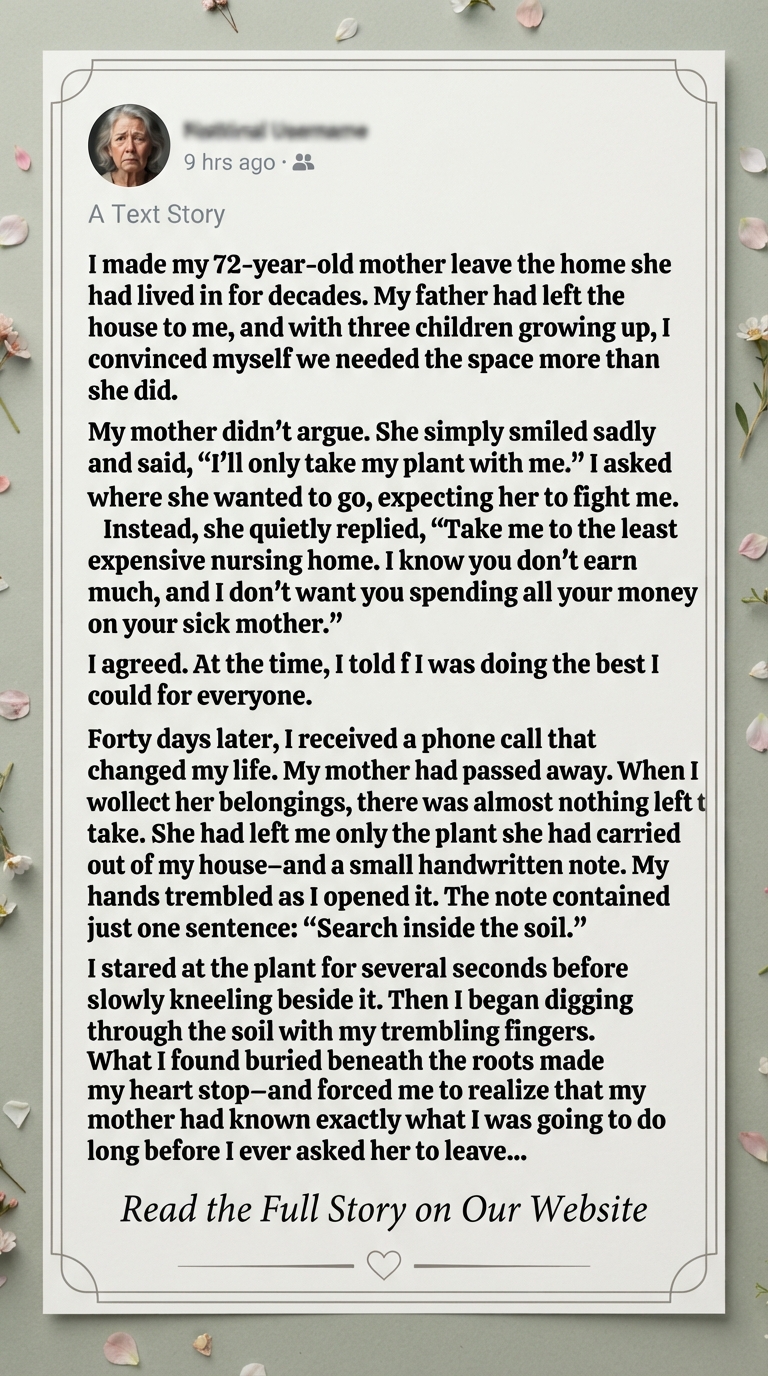
I made my seventy-two-year-old mother leave the home she had lived in for decades.
Even writing that sentence now makes my stomach twist.
But at the time, I convinced myself I was doing the right thing.
My father had left the house to me.
It was a large old house with four bedrooms, a wide kitchen, a finished basement, and a backyard where my three children could run around.
My mother had lived there for nearly forty years.
After my father died, she stayed in the house alone.
For a while, everything was fine.
Then my marriage became strained.
Money became tight.
My oldest son needed his own room.
My daughter was entering high school.
My youngest was sleeping in a cramped corner of our bedroom.
Every time I walked through the house, I started thinking the same thought.
We need this house more than Mom does.
I never said it that way out loud.
Instead, I told myself my mother was getting older.
I told myself the house was too much for one person.
I told myself a nursing home would be safer.
Eventually, I sat across from her at the kitchen table.
“Mom, I need to talk to you.”
She looked up from her tea.
“I know.”
Those two words surprised me.
“You know?”
She smiled sadly.
“I’ve watched you walk around this house for three months looking at walls instead of people.”
I didn’t know what to say.
Then I said the words I’d been rehearsing.
“I think you should move.”
She lowered her eyes.
“Where?”
“Somewhere smaller.”
“You mean a nursing home.”
I nodded.
My mother was silent for a long time.
I expected anger.
I expected tears.
I expected her to remind me that this had been her home long before it was mine.
Instead, she simply smiled.
“I’ll only take my plant with me.”
I frowned.
Her plant was an old jade plant that had sat beside the kitchen window for as long as I could remember.
“That’s all?”
“That’s all.”
I felt relieved.
Then she asked me something I will never forget.
“Where will you take me?”
“The least expensive nursing home I can find.”
She nodded.
“I know you don’t earn much.”
Her voice was gentle.
“I don’t want you spending all your money on your sick mother.”
I should have stopped.
I should have hugged her.
I should have said, You’re not a burden.
Instead, I thanked her for understanding.
Three days later, I drove her to the nursing home.
She carried one small suitcase and the plant.
Before she walked inside, she turned around and looked at the house.
She didn’t cry.
She just whispered,
“Take care of it.”
I thought she meant the house.
I didn’t understand until much later.
Forty days later, the nursing home called me.
My mother had died in her sleep.
There had been no dramatic final moments.
No last conversation.
No chance for me to say the things I should have said.
Just forty days after I had taken her away from the home she’d lived in for decades, she was gone.
I drove to the nursing home feeling numb.
There wasn’t much to collect.
A few clothes.
A pair of slippers.
Some old photographs.
A small wooden box.
And the plant.
The nurse handed it to me.
“Your mother took wonderful care of that,” she said.
I nodded.
I couldn’t speak.
When I got home, I placed the plant beside the kitchen window.
Then I noticed a folded piece of paper tucked beneath the pot.
My mother’s handwriting.
My hands began trembling.
I opened it.
There was only one sentence.
Search inside the soil.
I stared at the words.
Then I looked at the plant.
For several seconds, I couldn’t move.
Finally, I carried it to the table.
I pulled off the decorative stones covering the soil.
Then I began digging.
My fingers hit something hard.
I froze.
I dug deeper.
My fingertips touched metal.
I pulled out a small, rusted tin box.
It was wrapped in a plastic bag.
Inside were several envelopes.
All of them had my name on them.
The first envelope was dated twelve years earlier.
I opened it.
The letter began:
My dear son,
If you are reading this, then you finally discovered what I couldn’t bring myself to tell you.
I stopped breathing.
I read on.
My mother explained that when my father died, he had not simply left the house to me.
He had left something else.
A locked box had been hidden beneath the floorboards in the old study.
My father had instructed my mother to give it to me only when she believed I was ready.
Inside were documents.
Bank statements.
Property records.
Investment certificates.
And a letter from my father.
I pulled the next envelope from the box.
My father’s handwriting stared back at me.
Son,
I know you believe this house is your inheritance. Legally, it is. But I want you to understand what it cost us to keep it.
He explained that decades earlier, he had nearly lost the house.
The mortgage had become overwhelming.
My mother had taken a second job.
She worked nights cleaning offices.
My father worked construction during the day.
They had sold jewelry.
They had borrowed money.
They had gone without vacations.
Everything they had went into keeping the house.
Then came the sentence that made my hands go cold.
Your mother was the reason this house stayed in our family.
I read the next page.
Years before my father died, my mother had received a modest inheritance from her own parents.
Instead of keeping it, she had used almost all of it to pay off the remaining mortgage.
My father had wanted to put her name on the deed.
She refused.
She told him the house belonged to the family.
But there was more.
My mother had quietly continued saving money for years.
She had created an account for me.
Not a fortune.
Not millions.
But enough to make a difference.
The account had grown substantially because she had invested it carefully.
The latest statement showed more money than I had ever imagined she could have.
I sat there staring at it.
Then I found another envelope.
This one was dated only six weeks before I asked her to leave.
My mother’s letter was shorter.
I know why you are asking me to leave.
You think the house is what your children need.
I don’t blame you.
My eyes filled with tears.
I kept reading.
But I need you to know something.
I was never afraid of losing the house.
I was afraid you would lose yourself trying to justify taking it from me.
I covered my mouth.
Then came the line that broke me.
The money in this box is yours. I saved it because I always believed you would need help one day.
But I didn’t give it to you while I was alive because I wanted to know whether you would still choose your mother when there was nothing left to gain.
I dropped the letter.
My mother had known.
She had known exactly what I was going to do.
Not because she could predict the future.
Because she knew me.
She knew how easily fear could turn into selfishness.
She knew I would convince myself that taking her home was necessary for my children.
And she had still chosen not to fight me.
The final envelope contained one last note.
My son,
Please don’t sell the house.
Raise your children there if you can. Let them know that their grandmother loved them enough to give them more than a bedroom.
And if you ever wonder whether I forgave you, don’t.
You don’t need my forgiveness.
You need to forgive yourself by becoming the kind of father you want your children to remember.
I couldn’t stop crying.
That night, I sat in the kitchen until morning.
The same kitchen where I had told my mother she had to leave.
The same kitchen where she had quietly accepted the decision.
The same kitchen where she had once made pancakes for my children every Sunday.
The next morning, I called the nursing home.
I asked if there were any unpaid bills.
There were.
I paid them immediately.
Then I went to the house.
I stood in the hallway and looked at my children’s bedrooms.
Suddenly, they didn’t feel like rooms we had needed.
They felt like rooms my mother had given us.
Every wall seemed to contain something I had forgotten.
My son’s first height marks.
My daughter’s school photographs.
My youngest’s crayon drawings.
And in the kitchen window sat the plant.
The plant my mother had carried away because it was the only thing she had asked to keep.
I called my children into the room.
They were confused.
“Why are we here?”
I sat them down.
“I need to tell you something about Grandma.”
I told them everything.
When I finished, my daughter started crying.
“But Grandma gave us this house?”
I shook my head.
“No.”
I looked around.
“Grandma gave us much more than a house.”
That afternoon, I moved the plant from the kitchen window to the dining room table.
I decided it would stay there permanently.
I also made another decision.
I would not use the money my mother had saved for me to make my life easier.
I used part of it to settle the debts that had been crushing our family.
Then I created a small education fund for my children.
And I set aside money to help elderly people in our community who were struggling to afford housing and care.
I wanted my mother’s final gift to become what she had always been.
A way of helping someone else.
Years passed.
My children grew up.
They never forgot their grandmother.
Every Christmas, we placed a small photograph of her beside the plant.
And every year, on the anniversary of her death, we gathered around that same dining table.
One evening, my youngest son—now a grown man—looked at the plant and asked,
“Do you think Grandma knew you’d find the box?”
I smiled.
“She knew me better than anyone.”
He looked at the old jade plant.
“Why did she hide it in there?”
I thought about that for a moment.
Then I said,
“Because she knew I would take the plant.”
My son smiled.
“She tricked you.”
I laughed through my tears.
“Yes.”
Then I looked at the photograph of my mother.
“And I think it was the kindest trick anyone ever played on me.”
I had once believed my mother was the person standing between my family and the life we deserved.
I was wrong.
She had been the person quietly giving us that life all along.
I thought I had taken her home away from her.
In reality, she had spent her final days making sure I understood that a home was never just walls, bedrooms, or a deed.
A home was where someone loved you enough to give without keeping score.
And my mother had done that until the very end.
The plant is still alive today.
It sits by the window.
Every spring, I trim the old branches and watch new leaves appear.
Sometimes I still touch the soil.
Not because I expect to find another secret.
But because I remember the trembling hands that once dug through it.
The hands of a son who finally understood what he had almost lost.
And whenever I see that plant, I remember my mother’s final lesson:
You can inherit a house from someone and still fail to inherit their heart.
But if you’re lucky, you can learn before it’s too late.