The Woman I Called a Nobody
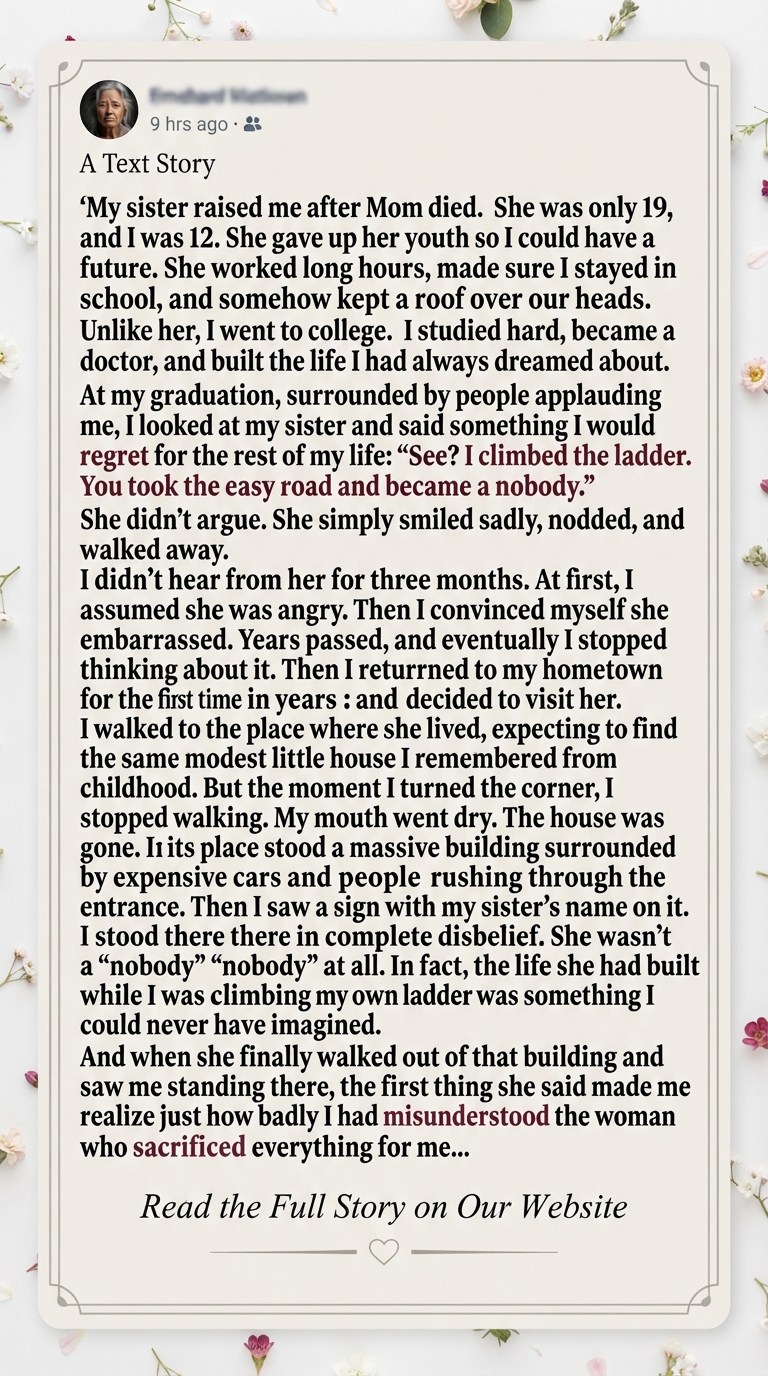
My sister raised me after Mom died.
She was nineteen.
I was twelve.
And neither of us was ready for what came next.
Mom died unexpectedly one rainy November morning.
One day she was complaining about a headache.
The next day, she was gone.
I remember standing in the hospital hallway, staring at the floor while adults whispered around me.
I remember asking where Mom was.
Nobody answered.
My sister, Claire, did.
She wrapped both arms around me and said:
“I’m here.”
She was nineteen years old.
She had just started community college.
She had plans.
She wanted to become a teacher.
She wanted to travel.
She wanted to get married someday.
Instead, she became my parent.
She worked mornings at a grocery store.
Then she cleaned offices at night.
On weekends, she took whatever extra shifts she could find.
She learned how to stretch twenty dollars across an entire week.
She learned how to repair leaking faucets.
She learned how to negotiate with landlords.
She learned how to make three meals out of almost nothing.
And she made sure I never felt poor.
When I needed new shoes, somehow there were new shoes.
When I needed school supplies, they appeared.
When I wanted to join the science club, she found the money for the membership fee.
When I told her I wanted to become a doctor, she didn’t laugh.
She said:
“Then become one.”
I studied.
I worked hard.
And whenever I thought about giving up, Claire pushed me forward.
“Keep going.”
“You’re almost there.”
“You don’t get to quit now.”
Eventually, I earned a scholarship.
Then another.
I went to college.
Claire stayed home.
I went to medical school.
Claire kept working.
I got an apartment.
Claire was still living in the little house where we’d grown up.
I started wearing expensive suits.
She wore the same faded jacket she’d had for years.
I began meeting professors, surgeons, executives, and people who talked about careers and investments.
Claire talked about grocery prices and whether the roof needed repairs.
The farther I climbed, the more I began seeing our lives differently.
I convinced myself that I was becoming successful.
And, somehow, I convinced myself that Claire wasn’t.
Then came my graduation.
The auditorium was packed.
Professors shook my hand.
My classmates cheered.
Photographers took pictures.
My name was announced.
I walked across the stage and received my medical degree.
My sister sat in the front row.
She was crying.
I remember looking at her and feeling proud.
But pride can be a dangerous thing when it’s mixed with arrogance.
After the ceremony, everyone gathered outside.
People congratulated me.
My professors told me how bright my future was.
A classmate asked about my residency.
Someone handed me champagne.
And then I saw Claire standing alone near the parking lot.
She was smiling.
I walked toward her.
She hugged me.
“I knew you could do it,” she whispered.
And instead of thanking her, I said the cruelest thing I’d ever said to anyone.
“See?”
She looked at me.
I laughed.
“I climbed the ladder.”
She didn’t understand.
I continued.
“You took the easy road and became a nobody.”
Her smile disappeared.
For a second, I thought she would yell.
She didn’t.
She simply looked at me.
There was sadness in her eyes.
Not anger.
Not hatred.
Sadness.
She nodded.
“Congratulations, Daniel.”
Then she walked away.
I didn’t stop her.
Three months passed.
I didn’t hear from her.
At first, I assumed she was angry.
Then I told myself she was embarrassed.
Eventually, I stopped thinking about it.
My residency began.
My career took off.
I became a physician.
I moved to another city.
I bought a beautiful house.
I traveled.
I met people.
I built the life I’d dreamed about.
Years passed.
Then, one autumn, I returned to my hometown for a medical conference.
For the first time in years, I found myself driving past the old neighborhood.
I remembered Claire.
I remembered Mom.
I remembered the little house.
And suddenly, I felt guilty.
I hadn’t spoken to Claire in years.
So I decided to visit.
I drove to the old street.
But when I reached the corner, I stopped.
The house was gone.
Completely gone.
In its place stood a massive modern building.
Glass walls.
Stone columns.
A large entrance.
Expensive cars filled the parking lot.
People in suits hurried through the doors.
I checked the address.
It was correct.
Then I saw the sign.
THE CLAIRE BENNETT CENTER FOR CHILDREN AND FAMILIES
I stared at it.
My mouth went dry.
A second sign beneath it read:
Founded by Claire Bennett
I walked toward the entrance.
Inside was a reception area larger than some hospitals I’d worked in.
There were children’s drawings on the walls.
Photographs of families.
A library.
A counseling wing.
A medical clinic.
A classroom.
And a plaque describing the organization’s mission.
It provided free medical care, tutoring, food assistance, temporary housing, and educational support for children who had lost parents or were living in unstable homes.
I read the plaque twice.
Then I saw a photograph.
Claire.
Standing beside a group of children.
I whispered:
“What happened?”
A receptionist smiled.
“You know Claire?”
I nodded.
“She founded this place.”
“How?”
The receptionist looked surprised.
“You really don’t know?”
“No.”
She smiled.
“Claire started a cleaning company when she was twenty-two.”
I stared at her.
“She did?”
“She worked three jobs. Eventually she realized businesses were willing to pay reliable crews more than she was earning as an employee. So she started her own company.”
The receptionist continued.
“Within ten years, she had dozens of contracts.”
I looked around.
“And then?”
“She sold part of the company.”
“For how much?”
The receptionist smiled.
“Enough to build this.”
I couldn’t speak.
Then she pointed toward another hallway.
“She still comes in every day.”
I followed the sound of children’s laughter.
And there she was.
Claire.
She was older.
Her hair had silver in it.
But she still had the same eyes.
She was sitting on the floor with a little girl who was building something with colored blocks.
Claire looked up.
Our eyes met.
She froze.
The little girl continued playing.
Claire slowly stood.
For several seconds, neither of us moved.
Then she walked toward me.
I expected anger.
I expected questions.
Instead, she stopped in front of me and said:
“Are you taking care of yourself?”
I almost laughed.
After all these years, that was what she asked.
I nodded.
“Yes.”
She smiled.
“Good.”
I looked around.
“Claire…”
She waited.
“This place…”
She nodded.
“I built it.”
“How?”
She shrugged.
“I worked.”
I stared at her.
“Why didn’t you ever tell me?”
She looked toward the children.
“Because you never asked.”
The words hit harder than I expected.
I lowered my head.
“I was cruel to you.”
“Yes.”
“I was arrogant.”
“Yes.”
“I thought because I became a doctor, I was better than you.”
She nodded again.
“You did.”
I swallowed.
“I was wrong.”
Claire looked at me for a long moment.
Then she said something I would never forget.
“You didn’t climb a ladder, Daniel.”
I looked at her.
“You climbed one kind of ladder.”
She pointed toward the children.
“I built a staircase.”
I didn’t understand.
She continued.
“You wanted to get to the top.”
“I wanted to become a doctor.”
“I know.”
“And you?”
She smiled.
“I wanted to make sure nobody behind me had to climb alone.”
I felt something break inside me.
Claire took me through the building.
She showed me the free clinic.
The tutoring rooms.
The small apartments upstairs where families could stay temporarily.
The scholarship office.
The kitchen where volunteers prepared meals.
There was even a program that helped teenagers apply to college.
I stopped in front of one wall.
Hundreds of photographs covered it.
Children.
Graduates.
Families.
People who had been helped by Claire.
I noticed something.
Many of the children had lost a parent.
I turned toward her.
“Is this why?”
She nodded.
“When Mom died, I knew what it felt like to be twelve years old and terrified.”
She touched one of the photographs.
“I couldn’t save Mom.”
Her voice softened.
“But I could make sure other kids didn’t have to face everything alone.”
I started crying.
Claire didn’t.
She had already cried those tears years earlier.
“I thought I was the one who sacrificed everything,” I whispered.
“You did sacrifice things.”
She looked at me.
“So did I.”
“I didn’t understand.”
“No.”
She smiled gently.
“But you understand now.”
I apologized.
Not once.
Not dramatically.
I apologized for every year I had allowed my pride to separate us.
For calling her a nobody.
For forgetting that every achievement I had was built partly on sacrifices she had made.
For thinking her life was smaller simply because it didn’t have the titles mine did.
Claire listened.
When I finished, she said:
“I forgave you a long time ago.”
I looked up.
“Why?”
“Because I knew you were wrong.”
She smiled.
“And because I knew you weren’t a bad person.”
I laughed through my tears.
“You’re still my big sister.”
She smiled.
“Unfortunately for you.”
We both laughed.
That afternoon, she took me into her office.
On the wall was a photograph of us as children.
I was twelve.
She was nineteen.
We were standing outside the little house.
She had one arm around me.
I looked miserable.
She looked exhausted.
But we were smiling.
I stared at the picture.
“You kept this?”
“Of course.”
“Why?”
She looked at me.
“Because that was the beginning.”
“The beginning of what?”
She smiled.
“Everything.”
I stayed in town for three days.
Before I left, Claire asked if I’d like to volunteer at the center whenever I was back home.
I said yes.
Years later, I still do.
I provide medical consultations for families who can’t afford them.
Claire handles the organization.
I handle the medicine.
Together, we’ve helped hundreds of children.
Sometimes I think about the words I said at my graduation.
I climbed the ladder. You became a nobody.
If I could go back, I’d take them back immediately.
Because I finally understand something I was too arrogant to see at twenty-eight.
Success isn’t always the person standing at the top.
Sometimes success is the person holding the ladder.
Sometimes it’s the person building the staircase.
And sometimes the person you called a nobody is the very person who made it possible for you to become somebody at all.
My sister didn’t take the easy road.
She took the road that led back to everyone else.
And when I finally understood that, I realized I hadn’t returned to my hometown to visit my sister.
I had returned to meet the woman who had been my hero all along.