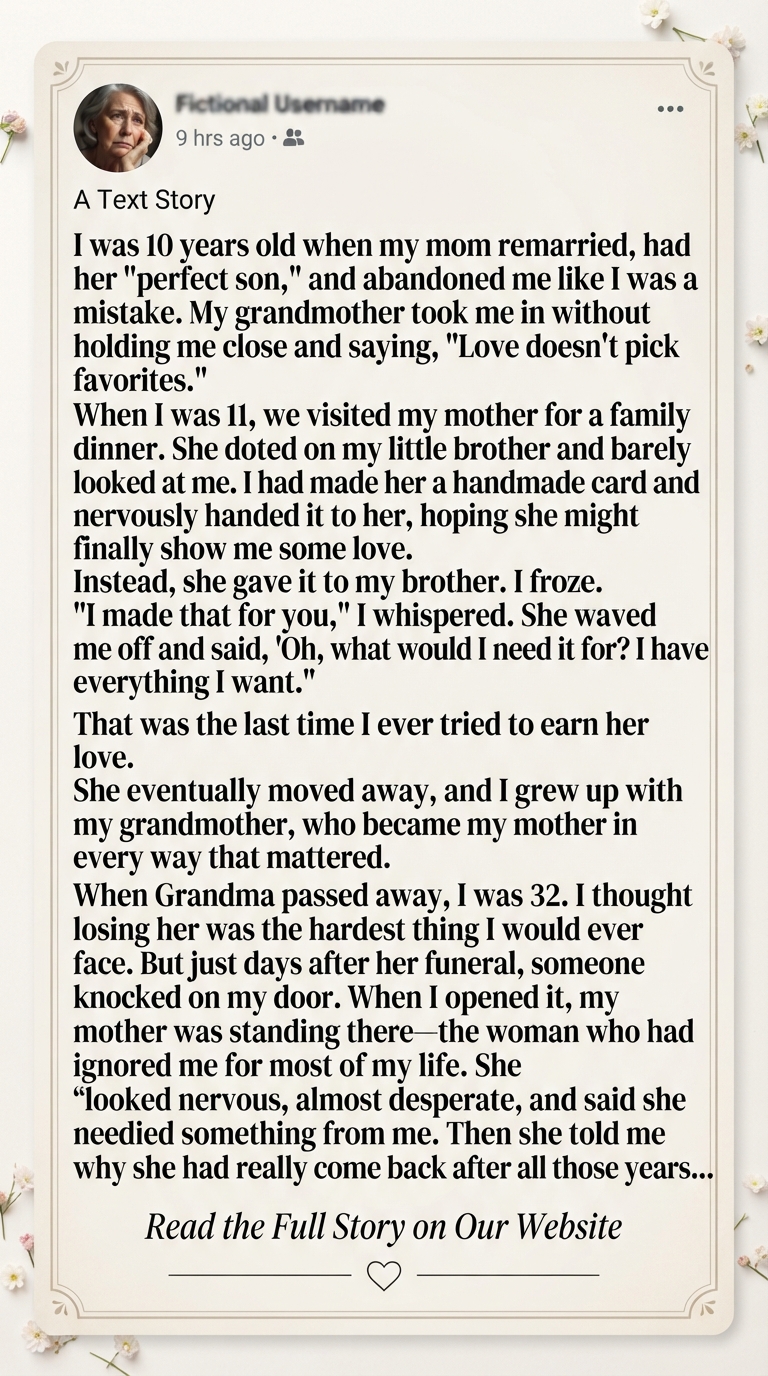
I was ten years old when my mother remarried.
I remember standing in the doorway of our apartment with a suitcase beside me, watching her hug the man who would become my stepfather.
She looked happy.
Really happy.
I wanted to be happy for her.
Then, less than a year later, she had a baby boy.
My little brother.
The moment she held him for the first time, something changed.
She called him her “perfect son.”
She bought him clothes before he needed them.
She took pictures of everything he did.
His first smile.
His first steps.
His first birthday.
His first day of school.
I watched all of it from the edges of the room.
I wasn’t jealous of him.
At least, I tried not to be.
He was a baby.
None of it was his fault.
What hurt was watching my mother become the mother I had always wanted—just not for me.
When I was ten, she started leaving me with Grandma more often.
At first, she said it was temporary.
“Just until things settle down.”
Then it became weekends.
Then weeks.
Then entire summers.
Eventually, Grandma stopped asking when I was going home.
I think she already knew.
One night, I finally asked her.
“Does Mom not want me anymore?”
Grandma put down the dish towel in her hands.
She walked over and knelt in front of me.
Then she wrapped her arms around me.
“Listen to me.”
I nodded against her shoulder.
“Love doesn’t pick favorites.”
I pulled back.
“What does that mean?”
“It means if someone chooses not to love you properly, that doesn’t mean you are harder to love.”
I started crying.
Grandma wiped my face.
“Some people simply don’t know how to give the love they have.”
I didn’t understand it then.
I would spend years trying to.
When I was eleven, Grandma took me to my mother’s house for a family dinner.
I remember standing outside holding a handmade card.
I had spent three days making it.
It was blue.
I had drawn flowers around the edges.
Inside, I had written:
To Mom.
I love you.
Thank you for being my mom.
I hope you love me too.
I was terrified to give it to her.
But I thought maybe this time would be different.
My mother was sitting at the table with my stepfather and my little brother.
She was laughing.
She had made my brother his favorite dessert.
When I walked in, she barely looked at me.
“Hi, Mom.”
“Hi.”
That was it.
I stood there holding the card.
Then I slowly walked over and handed it to her.
She glanced at it.
Then at my brother.
“Here.”
She handed it to him.
He took it.
I froze.
“I made that for you,” I whispered.
My mother waved her hand dismissively.
“Oh, what would I need it for? I have everything I want.”
Something inside me went completely quiet.
I looked at the card in my brother’s hands.
Then at my mother.
And for the first time, I understood.
I couldn’t earn her love.
So I stopped trying.
That was the last time I ever made something for my mother.
The last time I waited for her to notice me.
The last time I wondered what I could do to become worthy of being loved.
I grew up with Grandma.
She came to every school event.
She helped me with homework.
She sat beside me when I had my first heartbreak.
She taught me how to cook.
She taught me how to balance a checkbook.
She taught me how to stand up straight when someone tried to make me feel small.
When I graduated from college, she was sitting in the front row.
When I got my first job, she took me out for dinner.
When I got married, she cried harder than I did.
And when I bought my first house, she stood in the doorway and said:
“You built yourself a good life.”
I hugged her.
“No.”
I smiled.
“You built it.”
She shook her head.
“I only gave you somewhere safe to grow.”
I didn’t realize how important those words would become.
Grandma died when I was thirty-two.
Quietly.
In her sleep.
The doctor said there was nothing more anyone could have done.
I disagreed.
I wanted someone to blame.
I wanted to be angry.
Instead, I sat beside her bed holding her hand until it became cold.
At the funeral, I kept expecting her to walk through the door.
She didn’t.
After everyone left, I went home alone.
Her house smelled like lavender.
Her cardigan was still hanging over the kitchen chair.
Her glasses were beside the lamp.
I cried for three days.
On the fourth morning, someone knocked on my door.
I opened it.
And my mother was standing there.
The woman who hadn’t called on my birthday.
The woman who hadn’t attended my wedding.
The woman who had missed my graduation.
The woman who had spent more than twenty years living without me.
She looked older.
Smaller.
And frightened.
“Can I come in?” she asked.
I didn’t move.
“Why?”
She swallowed.
“I need something from you.”
I almost laughed.
“Of course you do.”
Her eyes filled with tears.
“I know how this looks.”
“No.”
I stepped aside.
“I think I know exactly how this looks.”
She entered.
We sat across from each other in my living room.
She kept rubbing her hands together.
Finally, she said:
“Your grandmother left you something.”
“I know.”
She looked surprised.
“You know?”
“She left me her house.”
“No.”
She shook her head.
“Not the house.”
My heart started beating faster.
“What, then?”
She looked down.
“Letters.”
I stared at her.
“What letters?”
“My letters.”
I didn’t understand.
“My letters to Grandma.”
She nodded.
“You weren’t supposed to see them.”
“Why?”
She took a breath.
“Because I wrote them for twenty-two years.”
I stared at her.
She reached into her purse and pulled out an old envelope.
The handwriting was unmistakably hers.
My mother’s.
On the front were the words:
For Margaret.
If I ever find the courage.
My hands went cold.
“What’s this?”
She whispered:
“Your grandmother kept them.”
I opened the envelope.
Inside was a letter dated twenty-two years earlier.
I read the first line.
I don’t know how to be her mother.
I stopped.
My mother began crying.
“I was nineteen when I had you.”
I looked up.
“You were seventeen.”
She shook her head.
“No. I was nineteen.”
I knew none of this.
She continued.
“My parents wanted me to give you up.”
“Grandma?”
“Not Grandma.”
Her voice cracked.
“My father.”
She told me something I had never heard before.
My biological father had disappeared shortly after I was born.
He had been violent.
Controlling.
And deeply resentful that my mother had chosen to keep me.
When my mother remarried years later, her new husband didn’t want another man’s child in the house.
He wanted a son of his own.
And when my little brother was born, my mother became terrified of losing the only family she had left.
“So you chose him.”
She nodded.
“Yes.”
The honesty hurt.
But somehow, it was easier to hear than another excuse.
“My husband told me that if I didn’t send you to your grandmother, he would leave.”
I stared at her.
“And you let me believe you didn’t want me.”
She cried.
“I thought if you hated me, it would be easier.”
“For who?”
She couldn’t answer.
“For me,” I said.
She nodded.
“Yes.”
I stood up.
“Do you know what it was like?”
“I know I hurt you.”
“No.”
My voice broke.
“You don’t know.”
I told her about the handmade card.
The dinner.
The words she had said.
She covered her mouth.
“I don’t remember saying that.”
“I remember.”
She began crying.
“I was trying to protect myself.”
“You were supposed to protect me.”
She nodded.
“I know.”
For the first time in my life, my mother didn’t defend herself.
She simply sat there and accepted what she had done.
Then she told me about the letters.
For twenty-two years, she had written to Grandma.
Letters she never sent me.
Letters describing birthdays she missed.
Graduations.
The day she saw my wedding photograph online.
The day she learned I had bought a house.
The day she heard I had gotten sick for a few weeks.
She had written everything down.
But Grandma had refused to give me the letters.
Not because she wanted to hide my mother from me.
Because she wanted to protect me from being pulled back into a relationship I hadn’t asked for.
I found another letter.
This one was written shortly before Grandma died.
I recognized her handwriting immediately.
It said:
My dearest girl,
There are things about your mother you deserve to know. But I never wanted the truth to become another burden you had to carry.
Your mother loved you badly.
That is not the same thing as loving you well.
I started crying.
The letter continued.
I cannot tell you whether you should forgive her. That choice belongs to you.
But I want you to know something I have known since the day you came through my door at ten years old.
You were never the child who was difficult to love.
You were the child who deserved someone brave enough to love you properly.
I pressed the letter against my chest.
My mother was crying across the room.
Then I saw one final paragraph.
If your mother ever comes back, don’t open the door because you feel sorry for her. Open it only if you want to know the truth.
I looked at my mother.
“Did Grandma tell you to come?”
She nodded.
“Before she died.”
“What did she say?”
My mother wiped her eyes.
“She told me that if I ever wanted another chance, I had to stop asking you to understand why I failed you.”
She looked directly at me.
“She said I needed to come prepared to hear what I had done.”
I sat down.
Neither of us spoke for a long time.
Then my mother said something unexpected.
“I didn’t come for forgiveness.”
I looked at her.
“I came because your grandmother told me something before she died.”
“What?”
“She said, ‘You don’t get to ask my girl to give you back the years you took from her. But you can spend the years you have left becoming someone she doesn’t have to be afraid of.'”
I closed my eyes.
That sounded exactly like Grandma.
My mother reached into her purse again.
This time, she pulled out a small box.
I opened it.
Inside was the handmade card I had given her when I was eleven.
The blue paper was faded.
The edges were worn.
My handwriting was still there.
I stared at it.
“You kept it?”
She nodded.
“I took it from your brother after you left.”
I looked at her.
“You said you didn’t need it.”
“I know.”
She began crying.
“I was wrong.”
For years, I had imagined throwing that card away.
Now I was holding it again.
The little girl who had made it wanted one thing.
To be loved by her mother.
But the woman holding it now wanted something different.
The truth.
Not an apology that erased twenty-two years.
Not a miracle.
Not a perfect mother.
Just the truth.
So I gave my mother one chance.
Not to become my mother overnight.
But to become someone I could slowly learn to trust.
She started small.
A phone call every Sunday.
Then coffee once a month.
She learned about my work.
She met my friends.
She apologized without explaining.
When I became angry, she didn’t tell me I was being unfair.
She listened.
It took years.
There were setbacks.
There were days I didn’t answer her calls.
There were conversations where we both cried.
But slowly, something changed.
Not the past.
The past stayed exactly where it was.
But the future became less frightening.
My mother eventually moved closer.
She never tried to replace Grandma.
She knew that was impossible.
Instead, she began doing something Grandma had always done.
Showing up.
When I got sick, she brought soup.
When I changed jobs, she celebrated.
When my first child was born, she sat quietly beside my hospital bed.
She held my daughter and cried.
“I’m sorry,” she whispered.
I looked at her.
“She’s lucky.”
My mother nodded.
“She has you.”
I smiled.
“And she has you too.”
My mother looked at me in disbelief.
I wasn’t saying everything was forgiven.
I wasn’t pretending twenty-two years hadn’t happened.
I was simply giving her something she had never given me before.
A chance.
Years later, I found the blue card in a drawer.
It had become fragile.
I carefully placed it in a frame.
My daughter asked me what it was.
I told her.
Then I told her about Grandma.
About the woman who had taken in a little girl and taught her that love doesn’t pick favorites.
My daughter touched the glass.
“Did your mom love you?”
I thought about it.
“Yes.”
“Then why did she leave?”
I smiled sadly.
“Because sometimes people can love you and still fail you.”
“Did she ever get better?”
I looked at the photograph of my mother sitting beside me on my wedding anniversary.
“She tried.”
My daughter nodded.
Then she asked:
“Did you forgive her?”
I looked at the blue card.
“Eventually.”
I paused.
“But I didn’t forgive her because she deserved it.”
“Why did you?”
I smiled.
“Because I deserved to stop carrying it.”
And that was the truth Grandma had been trying to teach me all those years.
Love doesn’t pick favorites.
But love also doesn’t require you to chase someone who keeps walking away.
Sometimes love means letting go.
Sometimes it means setting boundaries.
And sometimes, when someone finally learns how to love you properly, it means deciding whether you are ready to open the door.
I did.
Not for the mother I had spent my childhood waiting for.
For the woman she finally became.
And somewhere inside me, that little eleven-year-old girl stopped waiting too.
She finally understood that she had never been the problem.
She had simply been waiting for someone brave enough to say:
You were always worth loving.
Grandma had said it first.
And eventually, my mother learned to say it too.