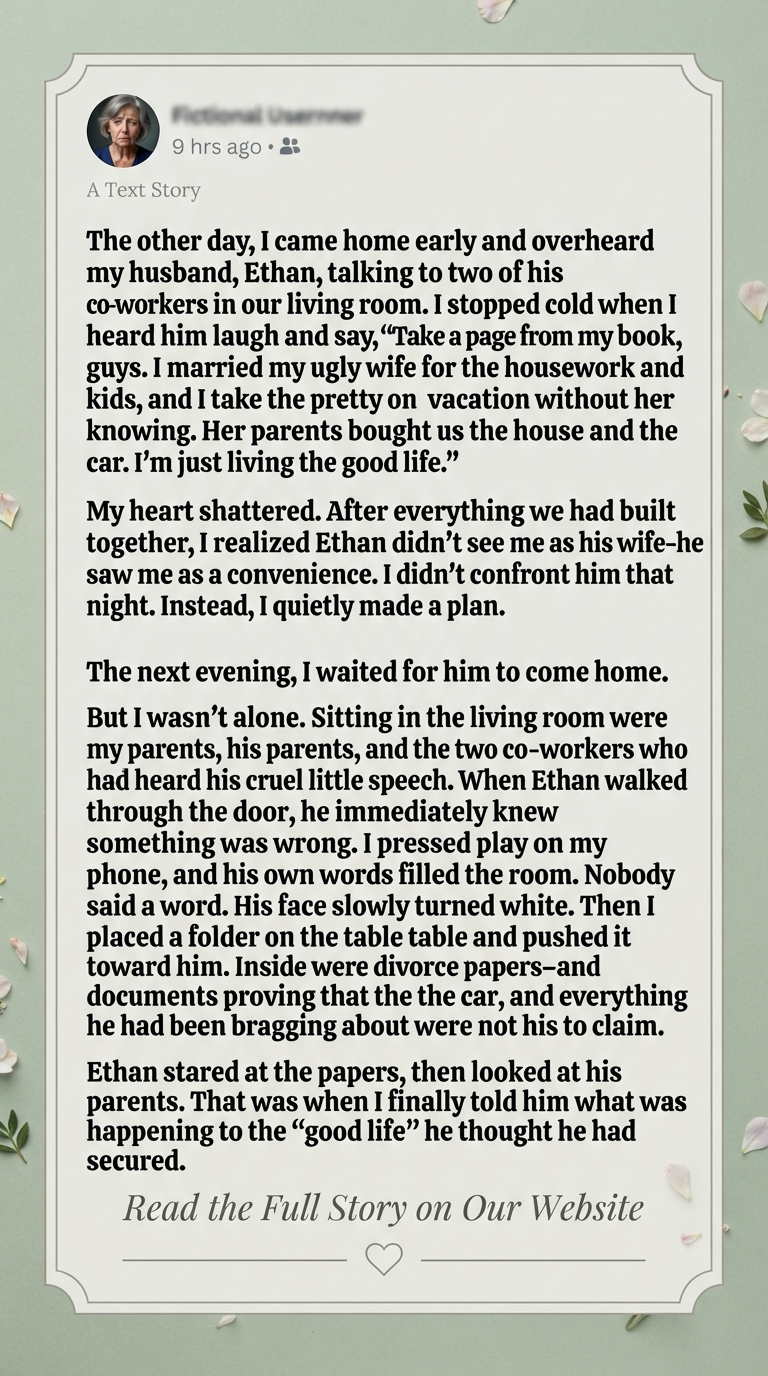
The other day, I came home early and overheard my husband, Ethan, talking to two of his co-workers in our living room.
I stopped cold when I heard him laugh.
“Take a page from my book, guys.”
One of the men laughed.
Ethan continued.
“I married my ugly wife for the housework and kids, and I take the pretty ones on vacation without her knowing.”
My heart stopped.
Then he said the words that hurt even more.
“Her parents bought us the house and the car. I’m just living the good life.”
I stood in the hallway, completely frozen.
The men laughed again.
I didn’t.
For eleven years, I had believed I was married to my best friend.
We had two children.
A beautiful house.
Two cars.
Family vacations.
Birthday dinners.
Christmas mornings.
I had cooked for him.
Supported his career.
Raised our children.
Moved cities twice because of his job.
When he came home exhausted, I listened.
When he was sick, I cared for him.
When he got promoted, I celebrated him.
I had never thought of those things as sacrifices.
That’s what marriage was supposed to be.
You took care of each other.
But standing there, listening to him describe me as “ugly” and “convenient,” I realized something.
Ethan didn’t think we had built a life together.
He thought he had acquired one.
And apparently, I was part of the package.
I quietly walked back outside.
I closed the door.
Then I sat in my car for almost an hour.
I didn’t cry.
Not yet.
I was too stunned.
Eventually, I drove to my parents’ house.
My mother opened the door.
One look at my face and she knew something was wrong.
“What happened?”
I sat down.
“Mom, I need you to tell me exactly what Dad gave Ethan and me when we got married.”
She looked confused.
“What do you mean?”
“The house.”
Her expression changed.
“The house your father bought?”
“Yes.”
She sat beside me.
“Why?”
“Is it in my name?”
She hesitated.
“Yes.”
My heart started beating faster.
“And the car?”
“That too.”
I looked at her.
“Did Ethan ever put money into either one?”
“No.”
“Did he contribute to the down payment?”
“No.”
“The mortgage?”
My mother shook her head.
“Your father paid it off before you moved in.”
I closed my eyes.
Suddenly, Ethan’s words made sense.
He had spent years telling people that my parents had “given us” a house and a car.
But he had quietly changed the story.
It wasn’t ours.
It was mine.
And he knew it.
My father joined us in the kitchen.
I played the recording.
His face hardened.
“How long has this been going on?”
“I don’t know.”
“Did he really say that?”
“Yes.”
Dad was quiet for a long time.
Then he asked:
“What do you want to do?”
I looked at him.
“I want to know exactly where I stand before I do anything.”
My father nodded.
“Then we’ll find out.”
The next morning, I called a family attorney.
I didn’t tell Ethan.
I didn’t confront him.
I didn’t post anything online.
I simply started gathering documents.
The deed.
The purchase agreement.
The title to the car.
Bank records.
Insurance documents.
Tax records.
The attorney reviewed everything.
Then she looked at me.
“Your parents purchased the house in your name before your marriage.”
“Yes.”
“And the vehicle?”
“Also mine.”
She nodded.
“Then based on these documents, Ethan has no ownership interest in either asset.”
I exhaled.
“What about our savings?”
“Those will need to be separated according to how the accounts were funded.”
I nodded.
Then she asked:
“Do you have evidence of his affair?”
I looked at my phone.
“Not yet.”
She raised an eyebrow.
“Not yet?”
I told her what I had heard.
She advised me not to confront him until we had reviewed the finances and understood our legal position.
So I waited.
The next evening, I asked Ethan to come home early.
He had no idea what was waiting for him.
When he walked through the front door, he stopped.
My parents were sitting in the living room.
His parents were sitting beside them.
And across the room were the two co-workers he had invited over the day before.
Ethan looked at everyone.
Then at me.
“What is this?”
I stood.
“Sit down.”
He didn’t move.
“What’s going on?”
I held up my phone.
“Yesterday, I came home early.”
His face changed.
Just slightly.
But I saw it.
I pressed play.
His own voice filled the room.
“I married my ugly wife for the housework and kids…”
Ethan’s face turned pale.
The recording continued.
“Her parents bought us the house and the car. I’m just living the good life.”
Silence.
Nobody moved.
Nobody defended him.
His two co-workers stared at the floor.
His father looked devastated.
His mother was crying.
Ethan looked at me.
“I was joking.”
I almost laughed.
“You weren’t.”
“I was drinking.”
“You weren’t drunk.”
“I didn’t mean it.”
“You said it.”
He looked toward his parents.
“Mom?”
His mother shook her head.
“Don’t look at me.”
His father stood.
“Is that really what you think of your wife?”
Ethan didn’t answer.
His father looked at me.
“I’m sorry.”
Then he looked at his son.
“Your mother and I raised you better than this.”
Ethan’s eyes narrowed.
“This is a family matter.”
“No,” I said.
“You made it a public matter when you bragged about it to your co-workers.”
I picked up the folder from the coffee table.
Then I placed it in front of him.
“Now this is the part you weren’t expecting.”
He stared at it.
“What is that?”
“Open it.”
He did.
The first page was a copy of the deed.
His eyes moved across the document.
Then stopped.
“This says…”
“That the house belongs to me.”
He looked at me.
“But your parents bought it for us.”
“My parents bought it for me.”
He flipped to the next document.
The vehicle title.
My name.
Then the purchase agreement.
My name.
Then the mortgage records.
Paid in full before our marriage.
He looked confused.
“Why didn’t you ever tell me?”
I stared at him.
“I did.”
He shook his head.
“You said your parents helped us.”
“They did.”
“I thought it was ours.”
“You thought it was yours.”
That silenced him.
I continued.
“You never asked.”
“Because I trusted you.”
“No, Ethan.”
I shook my head.
“You trusted the fact that I would never check.”
His father closed his eyes.
His mother whispered:
“Ethan, what have you done?”
He ignored her.
“What about the money?”
I handed him another document.
“Our attorney reviewed the accounts.”
He read it.
Over the years, Ethan had transferred thousands of dollars from our joint account into a separate investment account.
He had been building something quietly.
A safety net.
For himself.
But there was another problem.
Some of those funds had been used to pay for hotel rooms, flights, restaurants, and gifts.
I had suspected he was cheating.
Now I knew.
I slid printed receipts across the table.
Names.
Dates.
Hotels.
Airline tickets.
Weekend trips.
One woman.
Then another.
Then another.
His co-workers looked horrified.
One of them finally spoke.
“Ethan…”
He glared at him.
“Don’t.”
The man swallowed.
“I didn’t know.”
“You knew enough to laugh.”
The other co-worker nodded.
“We thought you were exaggerating.”
Ethan looked around the room.
For the first time, I think he realized there was nowhere left for him to hide.
His mother started crying.
“Is this true?”
He said nothing.
She stood up.
“Look at me.”
He wouldn’t.
“Is this true?”
Finally, he whispered:
“Some of it.”
His father slammed his hand against the arm of the chair.
“Some of it?”
Ethan looked at him.
“What do you want me to say?”
“The truth.”
Ethan laughed bitterly.
“The truth?”
He pointed at me.
“She stopped caring about herself years ago.”
I stared at him.
He continued.
“She doesn’t dress up anymore. She doesn’t want to go anywhere. She’s always tired. The house is always a mess.”
I looked around the room.
The house he had just insulted was the house I had maintained while raising our children.
The children were upstairs.
Doing homework.
Safe.
Fed.
Loved.
I looked back at him.
“I stopped dressing up because I was raising your children.”
He opened his mouth.
I didn’t let him speak.
“I was tired because I worked, cooked, cleaned, handled school, paid bills, took care of you when you were sick, and spent eleven years making sure everyone else had what they needed.”
I took a breath.
“And yes, the house got messy.”
I looked around.
“Because people actually live here.”
Nobody spoke.
Then I said:
“You didn’t marry an ugly woman.”
I paused.
“You married a woman who stopped performing for you.”
His mother covered her mouth.
My mother reached for my hand.
I continued.
“And now that I know what you really think of me, I don’t intend to spend another day trying to become beautiful enough for someone who doesn’t understand what beauty is.”
Ethan looked down.
Then he saw the final page in the folder.
Divorce papers.
He stared at them.
“You already filed?”
“I did.”
“When?”
“This morning.”
He looked stunned.
“You didn’t even talk to me.”
“I listened to you first.”
That sentence ended the argument.
The divorce took several months.
It wasn’t easy.
There were lawyers.
Financial disclosures.
Arguments over furniture.
Arguments over accounts.
Arguments over things I had once believed mattered.
But the house stayed with me.
The car stayed with me.
The financial accounts were divided according to what was legally ours.
The money he had transferred from our joint accounts was accounted for in the settlement.
His parents eventually apologized to me.
Not because they were responsible.
But because they admitted they had believed Ethan’s version of our marriage.
His father told me something I will never forget.
“I thought my son was lucky.”
I smiled sadly.
“He was.”
Ethan moved into a small apartment.
The vacations stopped.
The expensive dinners stopped.
The lifestyle he had bragged about disappeared almost immediately.
His co-workers stopped inviting him to parties.
One of them eventually apologized to me.
He said:
“I laughed because I thought you were just a joke to him.”
I looked at him.
“That’s exactly what made it cruel.”
Months later, I ran into Ethan at the grocery store.
He looked tired.
Older.
He stood beside me for several seconds without speaking.
Then he said:
“I lost everything.”
I looked at him.
“No.”
He seemed surprised.
“You lost what you thought belonged to you.”
He lowered his eyes.
“Was I really that terrible?”
I thought about the question.
“You weren’t terrible every day.”
He looked up.
“But you were dishonest when it mattered.”
I pushed my cart forward.
“And you made the mistake of thinking my kindness meant I didn’t know my worth.”
He didn’t follow me.
I finished my shopping.
I drove home.
My house.
My car.
My children.
My life.
For years, Ethan had called it his “good life.”
But he had misunderstood something.
The good life was never the house.
It wasn’t the car.
It wasn’t the vacations.
It wasn’t even the money.
It was the family dinners.
The children’s laughter.
The quiet mornings.
The people who showed up when things got hard.
And most importantly, it was the woman who had spent eleven years making all of it possible.
Me.
I had once believed losing my husband would destroy my life.
Instead, losing him gave me the chance to stop living in a marriage where I had to earn the right to be valued.
I kept the house.
Not because I wanted Ethan to suffer.
Because it was mine.
I kept the car.
Because it was mine.
And I kept my dignity.
Because that had never belonged to him in the first place.
A year after our divorce, I stood in the kitchen one Saturday morning.
My children were laughing upstairs.
My parents were coming over for dinner.
Sunlight was coming through the windows.
The same windows Ethan once bragged about owning.
I looked around the house.
And for the first time, it didn’t feel like a house I had to defend.
It felt like home.
My home.
The good life hadn’t disappeared when Ethan left.
It had finally become mine.