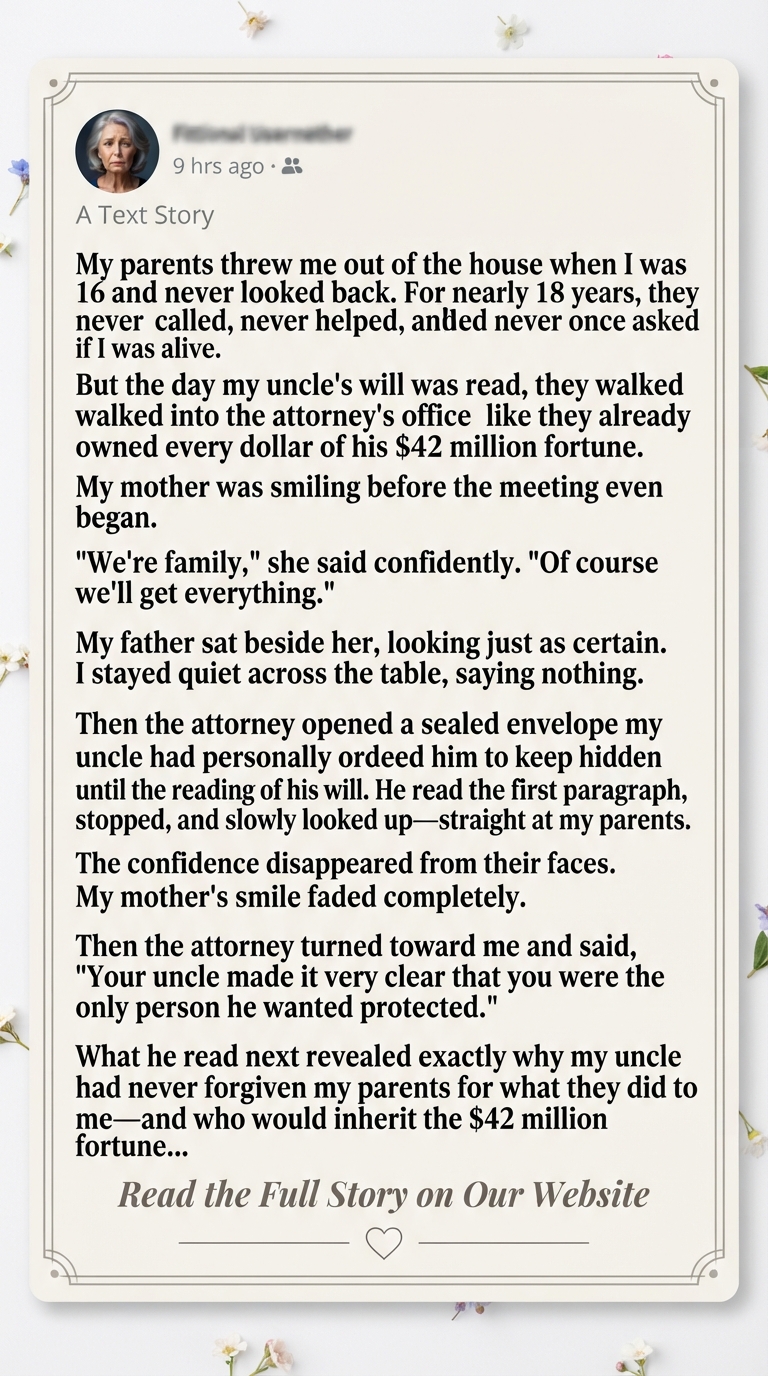
My parents threw me out of the house when I was sixteen.
They gave me two garbage bags.
One for my clothes.
One for everything else.
My mother stood in the doorway with her arms crossed while my father carried my suitcase outside.
“You’re old enough to figure things out,” he said.
I stared at him.
“I’m sixteen.”
He shrugged.
“You’ll manage.”
My mother didn’t say goodbye.
She didn’t even look sad.
She simply closed the door.
That was the last time I lived in my parents’ house.
For nearly eighteen years, they never called.
Not once.
They didn’t ask where I was.
They didn’t ask whether I finished school.
They didn’t ask whether I had enough to eat.
They didn’t come to my graduation.
They didn’t attend my wedding.
They didn’t meet my children.
As far as they were concerned, I had stopped being their daughter the night they put me outside.
The person who became my family was my uncle Arthur.
My father’s older brother.
He was the only adult who came looking for me.
He found me sleeping in the back room of a friend’s mother’s house.
He didn’t ask why my parents had abandoned me.
He simply asked,
“Are you hungry?”
I nodded.
He bought me dinner.
Then he helped me find a safe place to live.
He paid for my first semester of community college.
After that, I worked.
I paid my own bills.
I built my own life.
Arthur never treated me like charity.
He treated me like someone worth investing in.
“You don’t owe me anything,” he’d tell me.
“Just don’t let what they did convince you that you’re worthless.”
I never forgot those words.
Then, at seventy-two, Arthur died.
His estate was worth approximately $42 million.
I knew he was wealthy.
I didn’t know he was that wealthy.
The day his will was read, I arrived early and sat quietly at the end of the conference table.
Then my parents walked in.
I hadn’t seen them in years.
My mother looked older.
My father walked with a cane.
But neither looked ashamed.
My mother smiled when she saw me.
“Well,” she said.
“I suppose we’re all here for the same reason.”
I said nothing.
She sat down.
“We’re family,” she told the attorney confidently.
“Of course we’ll get everything.”
My father nodded.
I stared at the table.
I wasn’t expecting anything.
Arthur had never promised me his money.
He had only promised that I would never have to beg my parents for love again.
The attorney, Mr. Bennett, arranged the documents in front of him.
Then he looked at all of us.
“There is one matter before we begin.”
He reached into a locked drawer.
From it, he removed a sealed envelope.
Arthur’s name was written across the front.
The envelope had been sealed with red wax.
My father leaned forward.
“What is that?”
Mr. Bennett didn’t answer.
He opened it.
Then he began reading.
“Dear Thomas and Linda…”
My mother’s face changed.
Arthur was speaking directly to them.
“If you are hearing this letter, then I am dead, and you are sitting in a room expecting to receive the money I spent my life building.”
My father’s jaw tightened.
The attorney continued.
“You will receive nothing.”
My mother stared at him.
“What?”
Mr. Bennett kept reading.
“I have spent eighteen years watching what you did to your daughter.”
My mother’s face went pale.
Arthur knew.
He had known everything.
The attorney continued.
“You told yourselves that she was difficult. That she was rebellious. That throwing a sixteen-year-old girl out of her home was necessary.”
My father whispered,
“This is ridiculous.”
Mr. Bennett kept reading.
“You lied to yourselves because the truth was harder to live with.”
He paused.
Then looked directly at my parents.
“The truth is that you abandoned a child because she discovered what you were doing with my money.”
The room went silent.
I looked up.
My parents stared at each other.
I suddenly remembered.
I’d been sixteen.
I’d found bank statements in my father’s desk.
There were transfers from Arthur’s company.
Large ones.
My father had been taking money from a business account he managed for Arthur.
When I confronted him, he told me I didn’t understand business.
I told him I was going to tell Uncle Arthur.
My father became furious.
My mother told me to stay quiet.
The next morning, they threw me out.
At the time, I’d always wondered whether those events were connected.
Now I knew.
Arthur had found out.
The attorney continued.
“I discovered that Thomas had been taking money from the company without authorization.”
My father’s face turned gray.
“I also discovered that my own brother attempted to convince me that his daughter had misunderstood what she saw.”
Arthur had known.
He had investigated.
And he had found the evidence.
Mr. Bennett turned another page.
“Thomas repaid a portion of the money after I confronted him. He never apologized. He never admitted what he had done to his daughter.”
My father looked down.
My mother started crying.
But I wasn’t satisfied.
I wanted to know why Arthur had stayed in my life when my parents wouldn’t.
The attorney answered that too.
“Your daughter came to me because she believed telling the truth was more important than protecting her parents.”
My throat tightened.
Arthur remembered.
He remembered everything.
“I asked her whether she wanted revenge.”
The attorney paused.
“She said no.”
My eyes filled with tears.
I remembered that conversation.
Arthur had once asked me,
“If you could make them pay, would you?”
I’d told him no.
“I just want them to stop hurting me.”
The attorney continued.
“That was the day I decided she deserved protection.”
He turned to the final page.
Then he looked at me.
“Your uncle made it very clear that you were the only person he wanted protected.”
My mother’s voice broke.
“How much?”
The attorney looked at her.
“All of it.”
She stared at him.
“All forty-two million?”
“Yes.”
My father stood.
“You can’t do that.”
Mr. Bennett calmly replied,
“He already did.”
He began reading the will.
Arthur left me:
His controlling interest in his company.
His investment portfolio.
His commercial properties.
His primary residence.
His vacation property.
His liquid assets.
And the remainder of his estate.
The estimated total was approximately $42 million.
My mother started shaking her head.
“He was my brother.”
Mr. Bennett looked at her.
“And you were his sister.”
He turned toward me.
“But she was the child you abandoned.”
My father sat back down.
I couldn’t move.
Forty-two million dollars.
It was an amount so large that it didn’t feel real.
But Arthur had left something more important than money.
He had left a letter.
The attorney handed it to me.
I opened it.
The first line said:
“Don’t let this money become another chain around your life.”
I smiled through my tears.
Arthur continued:
“Your parents will tell you that I stole something from them. I didn’t. I simply refused to reward them for abandoning the person who told me the truth when it cost her everything.”
I kept reading.
“You were sixteen when they put you outside. You were a child. You should never have had to prove that you deserved a home.”
I couldn’t hold back my tears.
Then came the sentence that broke me.
“I couldn’t give you back the years they took, but I can make sure the rest of your life belongs entirely to you.”
I lowered the letter.
My mother was crying.
“Please,” she whispered.
“Don’t do this.”
I looked at her.
“Arthur did this.”
“He was angry.”
“He was.”
My father stood again.
“You’re really going to take all of it?”
I looked at him.
“I didn’t take anything.”
I pointed toward the will.
“He gave it to me.”
My father had no answer.
Then my mother said something I never expected.
“We’re still your parents.”
I stared at her.
“For eighteen years, you never called.”
She looked down.
“I know.”
“You didn’t know where I lived.”
“I know.”
“You didn’t know whether I was alive.”
Her face crumpled.
“I know.”
I took a breath.
“And now that Arthur left me money, suddenly we’re family?”
She cried harder.
“I was wrong.”
Maybe she meant it.
Maybe she didn’t.
I couldn’t know.
But I knew something else.
I didn’t owe her forgiveness just because she finally understood the consequences.
The estate took months to settle.
I became the majority owner of Arthur’s company.
At first, I considered selling everything.
But then I remembered his letter.
He hadn’t given me the money to escape my life.
He had given me the ability to build something better.
So I kept the company.
I created a scholarship program for teenagers who had been abandoned or forced out of their homes.
The first scholarship was named after Arthur.
Then I established a housing fund for young adults aging out of foster care.
I also set aside money for education.
Not because I wanted to become a symbol.
Because I remembered what it felt like to be sixteen with two garbage bags and nowhere to go.
Years later, one of the scholarship recipients asked me why I did it.
I told her the truth.
“Because someone once helped me when I had nothing.”
She asked,
“Was he your father?”
I smiled.
“No.”
I looked at the photograph of Arthur on my desk.
“He was my uncle.”
My parents eventually moved away.
I heard that my father had to sell several properties to cover his debts.
My mother sent letters occasionally.
I didn’t answer all of them.
But one Christmas, nearly two years after the will reading, I received one that was different.
There was no request for money.
No mention of the inheritance.
No guilt.
Only four words on the front:
“I’m sorry. Truly.”
I kept the letter.
I still didn’t know whether I would ever have a relationship with her.
Maybe someday.
Maybe never.
But I had stopped waiting for an apology to heal me.
Arthur had taught me something more important.
Sometimes closure isn’t getting the people who hurt you to admit they were wrong.
Sometimes closure is building a life so full that their absence stops feeling like a hole.
On the anniversary of Arthur’s death, I visited his grave.
I brought flowers.
And the original letter.
I sat beside his headstone and read the final paragraph again.
“You don’t need to spend your life proving that you deserved what I gave you.”
I smiled.
“I know,” I whispered.
Then I looked at the sky.
“For the first time, I really know.”
My parents thought they were walking into that attorney’s office to collect $42 million.
They walked out with nothing.
But I didn’t walk out with forty-two million dollars either.
I walked out with something Arthur had been giving me since I was sixteen.
A choice.
The choice to decide what my life would become.
And this time, nobody was taking it away from me.