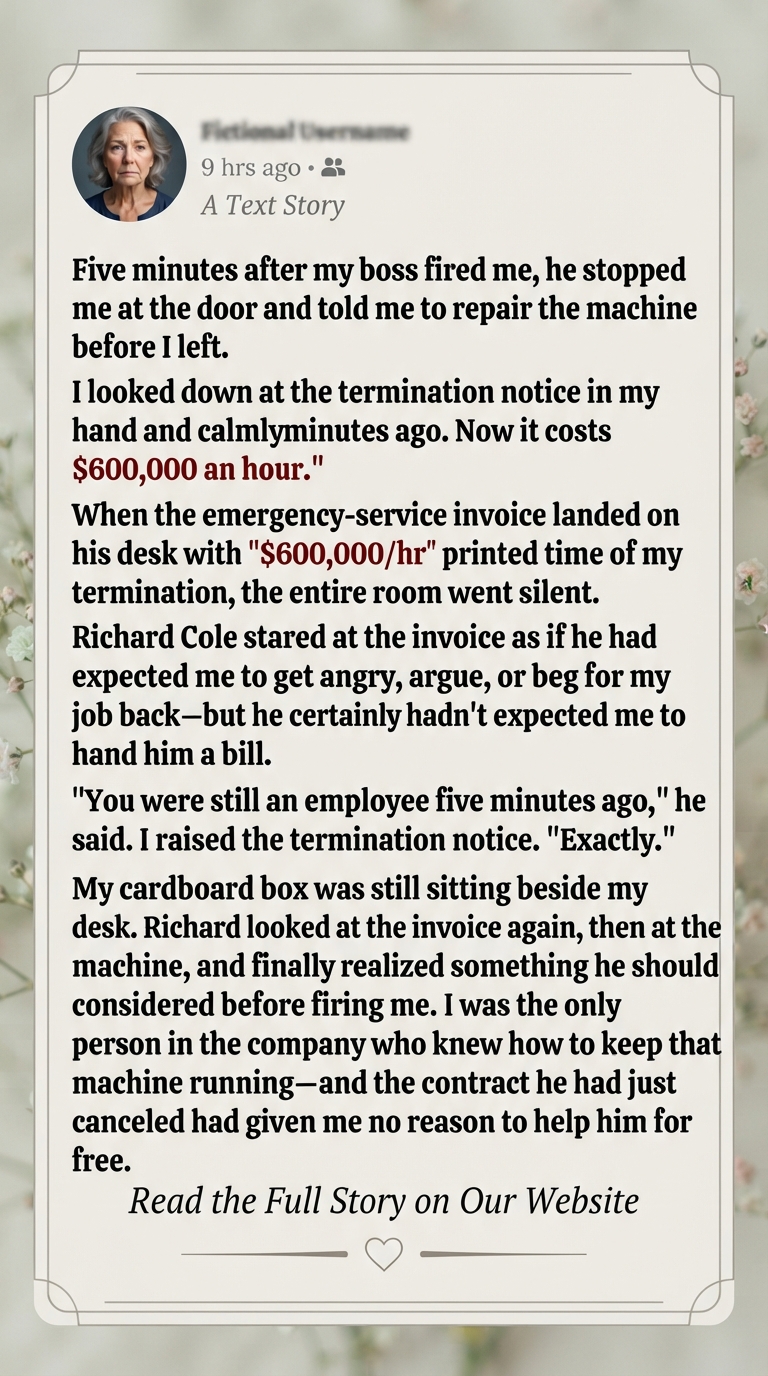
Five minutes after my boss fired me, he told me to repair the machine before I left.
I looked down at the termination notice in my hand.
Then I looked at the machine.
Then back at him.
“I’m sorry,” I said. “Did you just ask me to repair it?”
Richard Cole frowned.
“Yes. It’s already malfunctioning. You know how to fix it.”
I held up the termination notice.
“That service was free five minutes ago.”
He stared at me.
“What?”
“Now it costs $600,000 an hour.”
For the first time that morning, Richard didn’t have an answer.
My name is Daniel Mercer, and I’d spent fourteen years keeping one of the most important machines in Cole Industrial Systems running.
It wasn’t glamorous work.
I wasn’t an executive.
I didn’t have a corner office.
I didn’t wear a suit.
I wore steel-toed boots, carried a tool bag, and spent most of my days covered in grease.
But that machine was the reason the company had grown from a small manufacturer into a multimillion-dollar operation.
And I was the only person who understood it completely.
Not because I was a genius.
Because I’d been there when it was installed.
I’d watched it fail.
I’d rebuilt half of it.
I’d written the maintenance procedures.
I’d trained the original technicians.
And over fourteen years, I’d learned every sound, vibration, temperature change, and strange little hesitation it made before something went wrong.
Richard knew all of that.
He just didn’t think it mattered.
Until the morning he fired me.
It happened at 9:17 a.m.
Richard called me into his office.
There was an HR manager sitting beside him.
That’s never a good sign.
“Daniel, we’ve decided to eliminate your position.”
I stared at him.
“My position?”
“Yes.”
“After fourteen years?”
“Business decisions aren’t personal.”
That sentence is usually what people say when they know something is personal but don’t want to admit it.
He slid the termination papers toward me.
I read them.
Severance.
Benefits.
Final paycheck.
Everything looked official.
“Who’s taking over the machine?” I asked.
Richard leaned back.
“We’re outsourcing maintenance.”
“To who?”
“A service company.”
“Which one?”
He gave me the name.
I almost laughed.
They were competent.
But they had never maintained our machine.
They had never even worked on this model.
“How soon are they coming?”
“Tomorrow.”
I nodded.
“Then I suppose we’re done.”
Richard smiled.
“Exactly.”
I stood up.
I put the termination papers into my folder.
Then I started packing the few things from my desk.
A coffee mug.
A photograph of my daughter.
A small wrench my father had given me.
My toolbox.
I was halfway to the door when an alarm sounded from the production floor.
A sharp metallic screech.
Everyone in the hallway froze.
Richard turned toward the sound.
“What was that?”
I knew immediately.
“Main bearing temperature.”
He looked at me.
“What?”
“Your machine is overheating.”
An operator ran into the hallway.
“Mr. Cole! Machine three just shut down!”
Richard looked at me.
“Fix it.”
I almost thought I’d misheard him.
“Excuse me?”
“Fix the machine before you leave.”
I glanced at my termination notice.
“You just fired me.”
“I know.”
“So I’m no longer an employee.”
“This isn’t the time for semantics, Daniel.”
“No,” I said quietly. “It’s the time for contracts.”
He frowned.
“What contract?”
“The one you just terminated.”
I pointed to the termination notice.
“My employment agreement covers maintenance during working hours. I’m not working here anymore.”
Richard’s face hardened.
“You’re really going to walk out while the entire production line is down?”
I shrugged.
“You fired me.”
“I’m asking you as a professional.”
“Professionals get paid for their work.”
“How much?”
I thought for a moment.
Then I gave him the number.
“Six hundred thousand dollars an hour.”
The HR manager nearly choked.
Richard stared at me.
“You can’t be serious.”
“I am.”
“You’ve lost your mind.”
“No.”
I opened my toolbox.
“I’ve simply stopped being your employee.”
Then I walked out.
I expected him to call me back.
He didn’t.
At least, not immediately.
I drove home.
At 10:03 a.m., my phone rang.
Richard.
I let it ring.
At 10:07, another call.
At 10:11, another.
Then a text.
Call me.
I ignored it.
At 10:19, my lawyer called.
I answered.
“Everything okay?”
He laughed.
“I was about to ask you the same thing.”
Richard had contacted him.
Apparently, the company was panicking.
Machine three wasn’t simply down.
It was the central production unit.
Without it, the entire facility was losing approximately $80,000 every hour.
And worse, the outside service company couldn’t diagnose the failure.
They had arrived.
They had opened the access panel.
They had looked at the temperature readings.
And they had called their supervisor.
Then their supervisor called another engineer.
Nobody knew what was wrong.
My lawyer asked me a question.
“Did you actually quote them $600,000 an hour?”
“Yes.”
“Why?”
“Because Richard asked me to perform emergency work after terminating my employment.”
My lawyer was silent for a second.
“Do you have anything in writing?”
“I have the termination notice.”
“Good.”
Then he said something important.
“Don’t touch the machine unless you have a written agreement.”
I followed his advice.
At 11:42, Richard finally called from a different number.
I answered.
“Daniel.”
“Richard.”
“We need to talk.”
“We already did.”
“I need you back at the plant.”
“As an employee?”
“No.”
“Then as what?”
He hesitated.
“Consultant.”
“Consultant at what rate?”
He sighed.
“Your six hundred thousand dollars.”
“Per hour.”
“I know.”
“And minimum four hours.”
Silence.
“You’re serious?”
“Completely.”
“You expect us to pay $2.4 million?”
“No.”
I paused.
“I expect you to decide whether keeping your factory shut down is worth $2.4 million.”
Another silence.
Then:
“Come back.”
I did.
But I didn’t go back as Richard’s employee.
I went back as an emergency consultant.
My lawyer prepared the agreement.
The company signed it.
The clock started when I walked through the plant doors.
11:58 a.m.
At noon, I approached machine three.
I didn’t touch it.
I listened.
The other engineers watched.
I asked for the maintenance logs.
Then the temperature history.
Then the vibration readings.
Then I crouched beside the machine.
I placed my hand against the housing.
Richard stood behind me.
“Well?”
“Your bearing isn’t the problem.”
He blinked.
“What?”
“The bearing is reacting to something else.”
I walked around the machine.
Then I heard it.
A faint clicking sound.
Three clicks.
Pause.
Three clicks.
I knew it.
“Who changed the lubrication system?”
One of the outside engineers raised his hand.
“We did.”
“When?”
“Yesterday.”
I closed my eyes.
“Why?”
“The original system was obsolete.”
I looked at Richard.
“There’s your problem.”
“What?”
“The replacement system isn’t delivering oil at the correct pressure.”
The engineer shook his head.
“It meets manufacturer specifications.”
“Not for this machine.”
I opened my toolbox.
Then I pulled out an old binder.
My original maintenance notes.
I flipped to a page.
“This machine was modified eleven years ago. The pressure requirements changed when the secondary cooling loop was installed.”
The outside engineer looked stunned.
“You have documentation?”
“I wrote it.”
I showed him the page.
Then I pointed to the pressure specification.
“You’re running forty percent below the required pressure.”
He checked the gauge.
His face changed.
He looked at Richard.
“He’s right.”
Richard stared at me.
I spent the next two hours fixing the problem.
At 2:13 p.m., machine three started.
The production floor came alive.
Workers cheered.
Richard didn’t.
He was staring at the invoice.
Four hours.
$600,000 per hour.
Total:
$2,400,000.
He looked up.
“Daniel.”
“Yes?”
“This is insane.”
“No.”
I pointed at the machine.
“This is what fourteen years of specialized knowledge costs when you decide you don’t need the person who has it.”
He rubbed his forehead.
“You can’t just charge whatever you want.”
“You signed the contract.”
He knew I was right.
He paid.
But that wasn’t the end.
Three days later, Richard called another meeting.
This time, there was no HR representative.
No termination papers.
Just Richard.
He looked tired.
“I made a mistake.”
I said nothing.
“I thought we could replace you.”
“You can.”
He shook his head.
“No.”
He looked down.
“That’s the problem.”
He explained that the outside company had reviewed the system and admitted they had never seen the modifications I’d made over the years.
Not because the machine was unique.
Because the machine had evolved.
Every repair I’d made had created another layer of institutional knowledge.
And none of it had been documented properly.
Richard had assumed the company owned the machine.
He hadn’t realized that I carried fourteen years of knowledge about it in my head.
Then he surprised me.
“How much would you charge to train someone?”
I smiled.
“Now you’re asking the right question.”
I didn’t go back as an employee.
Instead, I created a small engineering consulting company.
Cole Industrial Systems became my first client.
I trained three technicians.
I documented every modification.
I created maintenance schedules.
I wrote emergency procedures.
And I made sure the company would never again depend entirely on one person’s memory.
Richard paid me well.
Very well.
But something changed between us.
He stopped calling me “the maintenance guy.”
He started calling me Mr. Mercer.
Six months later, I was invited to speak at an industry conference.
The topic was institutional knowledge.
During my presentation, I told the audience:
“Companies spend millions protecting machines and almost nothing protecting the knowledge of the people who maintain them.”
Then I told them what happened to me.
I didn’t mention Richard’s name.
I didn’t mention the $2.4 million invoice.
But everyone understood the lesson.
A year after my firing, Richard invited me to lunch.
He looked different.
Less confident.
More careful.
“I owe you an apology,” he said.
“You do.”
He smiled.
“I deserved that.”
I waited.
“I fired you because I thought your job was replaceable.”
I nodded.
“Most jobs are.”
“But your knowledge wasn’t.”
I looked out the window.
“No. It wasn’t.”
He took a breath.
“Would you ever consider coming back?”
“As an employee?”
He shook his head.
“No.”
“Then probably not.”
He laughed.
“Fair enough.”
We finished lunch.
When we stood up, Richard held out his hand.
I shook it.
Not because I’d forgotten what happened.
Because I’d finally gotten something better than revenge.
I had gotten freedom.
The old termination notice is still in my desk drawer.
So is the invoice.
Sometimes I look at them together.
The first piece of paper says:
EMPLOYMENT TERMINATED.
The second says:
$600,000 PER HOUR.
But the number isn’t what matters anymore.
The lesson is.
When Richard fired me, he thought he was taking away my job.
What he actually did was give me the courage to realize I didn’t need one.
And five minutes after losing my paycheck, I discovered something worth far more than money:
I had spent fourteen years building expertise that nobody could fire me from owning.