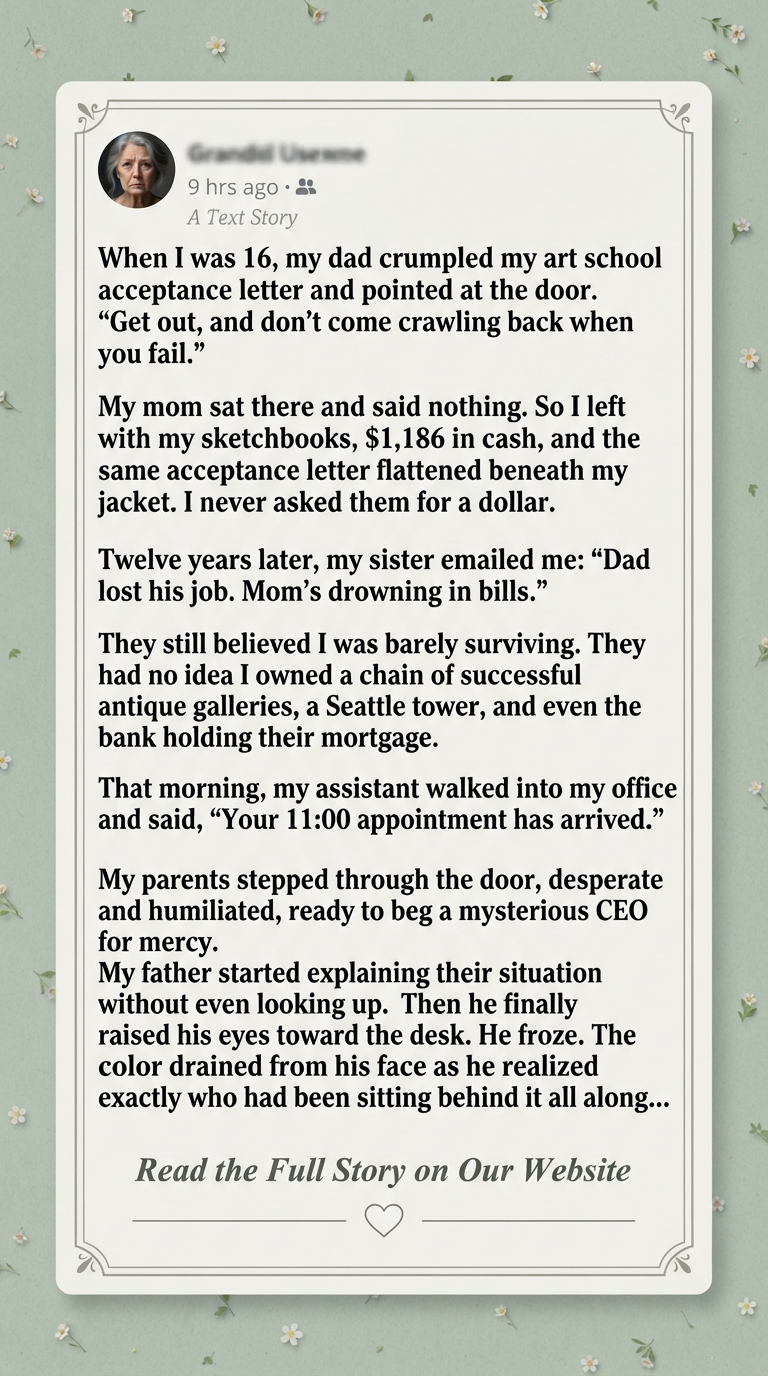
When I was sixteen, my father crumpled my art school acceptance letter in his fist.
“You’re not going.”
I stared at him.
“But I got accepted.”
“I know.”
He threw the crumpled paper onto the kitchen table.
“You’re wasting your life drawing pictures.”
My mother sat beside him.
She didn’t say anything.
That hurt almost more than his words.
I picked up the letter and carefully flattened it with my palms.
“I’ve worked for this.”
My father laughed.
“For what? To become some starving artist?”
“It isn’t like that.”
He stood.
“Enough.”
Then he pointed toward the front door.
“Get out.”
I froze.
My mother finally looked at me.
For one second, I thought she might stop him.
She didn’t.
My father folded his arms.
“And don’t come crawling back when you fail.”
I went upstairs.
I packed three sketchbooks.
Two pencils.
A change of clothes.
My wallet.
Inside it was $1,186—the money I’d saved from babysitting, selling drawings, and working weekends at a local antique shop.
And I took the acceptance letter.
It was still wrinkled.
I flattened it beneath my jacket.
Then I walked out.
I never went back.
Not because I didn’t miss them.
I did.
For years.
But I remembered my father’s words every time I was tempted.
Don’t come crawling back when you fail.
So I made a decision.
I would never crawl back.
I would build something.
Anything.
As long as I built it myself.
The first few years were difficult.
I attended art school on a scholarship and worked evenings at an antique store.
That job changed my life.
I discovered something I had never considered before.
Art wasn’t only something you created.
It was something people preserved.
Paintings.
Furniture.
Jewelry.
Sculptures.
Handmade objects.
Old books.
Every piece had a history.
And every piece had a story.
I became obsessed with learning.
I learned how to identify artists.
How to spot reproductions.
How to restore damaged frames.
How to negotiate with collectors.
How to research provenance.
And eventually, how to recognize value where other people saw only something old.
My first major opportunity came from a dusty painting sitting in the back of a shop.
The owner wanted $800 for it.
I noticed something unusual about the signature.
I researched it for three weeks.
The painting wasn’t worth $800.
It was worth nearly $90,000.
I bought it.
Restored it.
Found a collector.
And sold it.
The profit became the seed money for my first gallery.
It was tiny.
Two rooms.
A borrowed storefront.
One employee.
Me.
I named it Harlow & Finch, after my grandmother’s maiden name.
I didn’t tell my parents.
I didn’t call them when the first gallery succeeded.
I didn’t call when I opened the second.
Or the third.
Or the sixth.
I didn’t tell them when investors approached me.
I didn’t tell them when we began acquiring collections.
I didn’t tell them when our galleries expanded across the country.
And I certainly didn’t tell them when I bought the Seattle tower that became our headquarters.
The media eventually started calling me an “antique-industry visionary.”
I hated the phrase.
I was simply a girl who had once been told that her drawings were worthless.
Twelve years after I left home, Harlow & Finch had become a major national gallery chain.
And I had become its CEO.
But I still kept the acceptance letter.
The original.
Wrinkled.
Faded.
Folded exactly where my father’s fist had crushed it.
I kept it in the top drawer of my desk.
Not because I was angry.
Because I never wanted to forget where I started.
Then, one Tuesday morning, my sister Emily emailed me.
The subject line was simple:
Dad needs help.
I stared at it for several minutes.
I hadn’t spoken to Emily in years.
I opened the message.
“Dad lost his job.”
Another line.
“Mom’s drowning in medical and household bills.”
Then:
“They may lose the house.”
I leaned back.
The house.
The same house where my father had pointed toward the door.
The same house where I had packed my sketchbooks.
I continued reading.
Emily wrote that Dad had been unemployed for months.
Mom had accumulated debt.
Their mortgage was behind.
They had tried banks.
They had tried relatives.
Nobody would help.
Then came the sentence that surprised me.
“They keep saying you probably wouldn’t help anyway.”
I laughed quietly.
They still thought I was struggling.
Emily didn’t know about the galleries.
She didn’t know about the tower.
She didn’t know about the investments.
And she certainly didn’t know that three years earlier, Harlow & Finch Capital had acquired a controlling interest in Northstar Community Bank.
The bank holding my parents’ mortgage.
I could have ignored the email.
Part of me wanted to.
But another part remembered being sixteen.
Standing outside with a backpack.
And $1,186.
I called my assistant.
“Lena?”
“Yes?”
“I need you to do something.”
“Of course.”
“Schedule an eleven o’clock appointment for my parents.”
There was silence.
“Your parents?”
“Yes.”
“With you?”
“Yes.”
“Should I tell them who they’re meeting?”
“No.”
Lena paused.
“Understood.”
At eleven o’clock, my office door opened.
My parents walked in.
I almost didn’t recognize them.
My father looked older.
Much older.
His shoulders had lost their old confidence.
My mother looked exhausted.
They were carrying a folder.
Probably their mortgage documents.
They didn’t look at me.
Lena led them to the chairs across from my desk.
“Thank you for coming,” she said.
My father nodded.
“Thank you for seeing us.”
I remained behind my desk.
My father opened the folder.
“We’ve had some financial difficulties.”
I said nothing.
He continued.
“I lost my position several months ago.”
My mother stared at her hands.
“We’re behind on the mortgage.”
My father took a breath.
“We were told the bank may begin foreclosure proceedings.”
I folded my hands.
“And what are you asking for?”
He looked nervous.
“We were told the CEO might be willing to review our case.”
I nodded.
“She might.”
He finally looked up.
“I’m willing to work.”
I almost smiled.
That sounded like the man I remembered.
“I’ve worked my whole life,” he continued. “I made some mistakes, but I’ve always provided for my family.”
My mother finally looked at me.
“We’re not asking for charity.”
I glanced down at the folder.
“No?”
“No.”
My father shook his head.
“We just need time.”
I nodded.
“How much?”
“Six months.”
I opened the mortgage file.
Then I asked:
“Do you know who owns the bank holding your mortgage?”
My father frowned.
“No.”
I looked at him.
“You should.”
He shifted uncomfortably.
I turned toward the window.
“Your mortgage is held by Northstar Community Bank.”
“Yes.”
“Do you know who controls Northstar?”
“No.”
I turned back.
“I do.”
My father stared at me.
I reached into my desk drawer.
And placed something on the table.
A photograph.
It was a picture of me at sixteen.
Standing outside their house with my backpack.
My father’s face changed.
My mother gasped.
He slowly looked from the photograph to me.
Then back again.
“No.”
I said nothing.
His lips parted.
“Emma?”
My mother stood.
“Emma?”
I nodded.
The room went completely silent.
My father took one step backward.
“You?”
“Yes.”
He stared at me.
Then at the massive glass windows behind my desk.
Then at the company logo on the wall.
HARLOW & FINCH.
His eyes widened.
“I…”
He couldn’t finish.
My mother began crying.
“You’re the CEO?”
“Yes.”
My father sat down slowly.
I watched him.
The man who had once told me I would fail was now sitting in my office asking me for help.
But I wasn’t smiling.
I wasn’t celebrating.
I simply felt tired.
My father finally spoke.
“How?”
I shrugged.
“I went to art school.”
He looked down.
“I thought…”
“I know what you thought.”
He swallowed.
“You own all this?”
“Not all of it.”
I smiled faintly.
“Most of it.”
My mother looked around the office.
“How much?”
I didn’t answer.
She didn’t need the number.
She could see it.
The Seattle tower.
The company.
The staff.
The artwork hanging on the walls.
The city outside.
Everything I had built after walking out of their house.
My father looked at the photograph again.
“I didn’t know.”
“No.”
“You never told us.”
“You never asked.”
His face crumpled.
That sentence hurt him.
Good.
But I wasn’t finished.
I slid a document across the desk.
My father opened it.
It was a mortgage restructuring agreement.
He looked confused.
“What is this?”
“Your house won’t be foreclosed.”
My mother covered her mouth.
“You’re helping us?”
“I’m offering you a reasonable restructuring plan.”
My father looked at me.
“Why?”
I thought about it.
Because I wanted revenge?
No.
Because I wanted them to suffer?
Not anymore.
Because they were my parents?
That wasn’t enough.
Finally, I answered honestly.
“Because I know what it feels like to have nowhere to go.”
My mother started crying.
My father looked away.
“I was wrong,” he whispered.
I said nothing.
“I was wrong about you.”
Still nothing.
“I thought you were throwing your life away.”
I looked at the old acceptance letter sitting beside my computer.
“You thought art was worthless.”
He followed my eyes.
“What is that?”
I picked it up.
“My acceptance letter.”
He stared at it.
“You kept it?”
“For twelve years.”
He looked ashamed.
I handed it to him.
He unfolded it carefully.
His hands trembled.
“I destroyed this.”
“Yes.”
“And you kept it?”
“Yes.”
“Why?”
I looked at him.
“Because you were wrong.”
He lowered his head.
Not angry.
Not defensive.
Just defeated.
My mother finally spoke.
“I should have stopped him.”
I looked at her.
“Yes.”
She cried harder.
“I was afraid.”
“I was sixteen.”
“I know.”
“You were my mother.”
She nodded.
“I know.”
There was nothing else to say.
I didn’t forgive them that day.
But I didn’t punish them either.
I gave them a path forward.
The mortgage was restructured.
Their home was protected as long as they made the agreed payments.
My father found work six months later—not because I gave him a position, but because he applied for one and earned it.
My mother eventually started selling handmade crafts online.
I helped her set up a small business account.
Not because I owed her.
Because I wanted to.
Emily and I slowly rebuilt our relationship too.
She admitted she had been ashamed to contact me.
“I thought you’d hate us.”
“I did,” I told her.
She looked surprised.
I smiled.
“For a while.”
“And now?”
I thought about it.
“Now I just don’t want to waste my life carrying it.”
That became the difference between my past and my future.
I stopped trying to prove my parents wrong.
I had already done that.
I stopped trying to make them regret abandoning me.
They already regretted it.
And I stopped wondering whether I was finally successful enough to deserve their love.
I didn’t need their permission anymore.
Years later, I renovated the first little gallery I had opened.
I turned one room into a free art studio for teenagers who couldn’t afford supplies.
Above the entrance, I placed a simple sign:
Your talent does not need anyone’s permission to exist.
Sometimes young artists asked me why I started it.
I always told them the truth.
“Someone once told me I would fail.”
They would laugh.
“What happened?”
I would smile.
“I kept going.”
The acceptance letter remained in my office.
But it was no longer hidden in a drawer.
I had framed it.
The wrinkles were still visible.
The crease from my father’s fist was still there.
I could have replaced it with a perfect copy.
I never did.
Because perfection wasn’t the point.
The letter wasn’t proof that I had succeeded.
It was proof that, at sixteen, I had believed in myself before anyone else did.
My father had once pointed at the door and told me never to come crawling back.
Twelve years later, he walked through another door.
Mine.
And this time, I was the one sitting behind the desk.
But I didn’t make him crawl.
I simply showed him that the girl he had thrown away had never been the failure he expected her to become.
She had been the beginning.
And everything after that was hers.