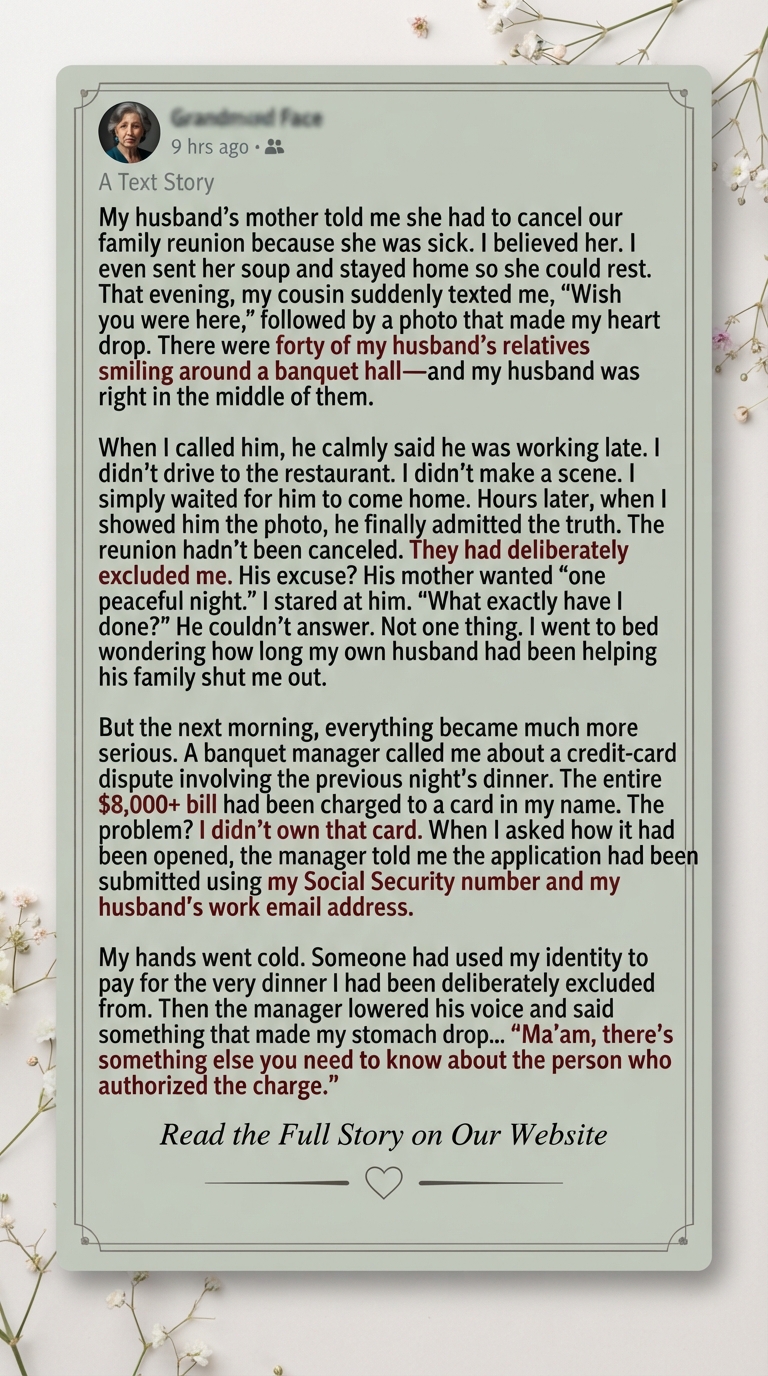
My husband’s mother told me she had to cancel our family reunion because she was sick.
I believed her.
I even sent her soup.
I told her to rest and stayed home so she wouldn’t feel guilty about everyone coming over.
That evening, my cousin suddenly texted me.
Wish you were here.
Then she attached a photo.
My heart dropped.
There were forty of my husband’s relatives smiling around a banquet hall.
And my husband was right in the middle of them.
I zoomed in.
There he was.
His mother was standing beside him, smiling.
She wasn’t sick.
She looked perfectly healthy.
I stared at the photograph for nearly a minute before calling my husband.
He answered on the third ring.
“Hey.”
“Where are you?”
There was a pause.
“I’m working late.”
I looked at the picture again.
“You’re at the family reunion.”
Silence.
Then he sighed.
“Who told you?”
“No one had to tell me. I have a picture.”
Another silence.
Finally, he said,
“It’s not what you think.”
I laughed bitterly.
“Then tell me what I’m looking at.”
He didn’t answer.
I didn’t drive to the restaurant.
I didn’t make a scene.
I simply waited.
Three hours later, he came home.
He walked through the door carrying the same jacket I’d seen in the photograph.
I held up my phone.
“Want to explain?”
He stared at the picture.
Then he sat down.
His shoulders dropped.
“The reunion wasn’t canceled.”
“I know.”
“My mom wanted one peaceful night.”
I stared at him.
“What exactly have I done?”
He looked at the floor.
Nothing.
Not one thing.
That was the part that hurt most.
I had spent years trying to be part of his family.
I remembered birthdays.
I brought gifts.
I helped his mother after surgery.
I hosted Thanksgiving twice.
I never asked them to choose between me and anyone else.
And apparently, none of that mattered.
His mother simply didn’t want me there.
I went to bed without speaking to him again.
But I barely slept.
Around 8:30 the next morning, my phone rang.
I didn’t recognize the number.
“Hello?”
“Is this Mrs. Carter?”
“Yes.”
“My name is David. I’m the banquet manager at the Grand Oak.”
My stomach tightened.
“Yes?”
“I’m calling about an issue with the payment from last night’s event.”
“What kind of issue?”
“There is a credit-card dispute.”
“I’m sorry?”
“The charge for the family dinner was over eight thousand dollars.”
I sat up.
“What does that have to do with me?”
“The card used for the reservation is in your name.”
I froze.
“My name?”
“Yes.”
“I don’t have that card.”
There was a pause.
“That’s what I wanted to clarify.”
I stood up.
“Who opened it?”
“The application was submitted using your Social Security number and your husband’s work email address.”
My hands went cold.
Someone had used my identity to pay for the very dinner I had been deliberately excluded from.
Then the manager lowered his voice.
“Ma’am, there’s something else you need to know about the person who authorized the charge.”
“What?”
“The signature on the authorization form isn’t yours.”
“I know.”
“It appears to be your husband’s.”
I couldn’t breathe.
“Are you sure?”
“Yes.”
“Can you send me copies?”
“I already sent them to the email address on the application.”
“Don’t send anything else there.”
He paused.
“Why?”
“Because I don’t know who has access to it.”
He understood immediately.
“I’ll send everything to this number instead.”
After we hung up, I sat on the edge of my bed.
I wasn’t thinking about the reunion anymore.
I wasn’t thinking about his mother.
I was thinking about my identity.
My credit.
My Social Security number.
And the fact that someone had apparently opened an account using my information without my permission.
I called the bank listed on the paperwork.
The representative pulled up the account.
“Ma’am, the card was opened three weeks ago.”
Three weeks.
I closed my eyes.
Three weeks ago, my husband had told me he was staying late at work.
Three weeks ago, he had also asked me to send him a copy of my Social Security card because he said his employer needed information for our insurance renewal.
I had trusted him.
I suddenly felt sick.
“How much has been charged?”
“There’s the $8,247 restaurant charge,” the representative said.
“Anything else?”
She paused.
“Yes.”
My heart sank.
“There are two hotel charges. One for $1,940 and another for $1,260.”
I stared at the wall.
“Where?”
She gave me the names.
Both were places my husband had recently traveled for “work.”
But his company had reimbursed him for those trips.
The expenses hadn’t been business expenses.
He had been using the fraudulent card.
I asked the bank to freeze the account immediately.
Then I called the credit bureaus.
Then I filed an identity-theft report.
Then I called the police.
Not because I wanted revenge.
Because I finally understood how serious this was.
When the detective arrived, I gave her everything.
The banquet paperwork.
The card application.
The signature.
The hotel charges.
The emails.
And the photograph of the family reunion.
She studied everything carefully.
Then she asked,
“Do you know who had access to your personal information?”
I looked at her.
“My husband.”
“Anyone else?”
“No.”
She wrote something down.
“Then don’t confront him yet.”
I swallowed.
“Why?”
“Because if he did this, you don’t want him destroying evidence.”
I nodded.
That afternoon, my husband came home early.
He knew immediately that something was wrong.
“What’s going on?”
I looked at him.
“I got a call from the bank.”
His face changed.
“What bank?”
“The one you used to pay for your mother’s dinner.”
He went completely still.
“You don’t have to explain,” I said.
“Actually, I do.”
“No.”
I placed a folder on the table.
“You need to listen.”
He opened it.
The first page was the credit-card application.
His work email address.
My Social Security number.
My name.
Then the restaurant receipt.
Then the hotel charges.
Then the signature.
His signature.
He stared at the pages.
“I can explain.”
“Then explain.”
He opened his mouth.
Nothing came out.
Finally, he said,
“My mom needed help.”
I almost laughed.
“Your mother needed $8,247?”
“She didn’t know about the card.”
“So who did?”
He looked away.
I knew the answer.
“Did your mother ask you to open it?”
He remained silent.
“Did she know you were using my identity?”
“She knew about the dinner.”
“That wasn’t my question.”
He rubbed his face.
“I didn’t think it was a big deal.”
I stared at him.
“You used my Social Security number.”
“I was going to pay it back.”
“You used my name.”
“I wasn’t stealing from you.”
“You opened a credit account in my name without my permission.”
He looked at me.
“I was trying to keep my family happy.”
I felt something inside me break.
“By making me the one who paid for the dinner you deliberately excluded me from?”
He had no answer.
Then he said something I’ll never forget.
“My mom said you didn’t deserve to be there.”
I looked at him.
“And you agreed?”
He didn’t answer.
That was enough.
I walked upstairs.
I packed a suitcase.
Not because I had decided what would happen to our marriage.
But because I needed to be somewhere I felt safe while I figured it out.
My husband followed me to the bedroom.
“Where are you going?”
“A hotel.”
“You’re overreacting.”
I stopped.
“Overreacting?”
“Yes.”
I turned around.
“You lied to me about where you were.”
He said nothing.
“You helped your family exclude me.”
Silence.
“You used my personal information without permission.”
Silence.
“And then you charged thousands of dollars to an account I didn’t even know existed.”
He looked down.
“You’re making it sound worse than it was.”
I stared at him.
“No.”
I picked up my suitcase.
“You’re making it sound smaller than it was.”
The investigation took several weeks.
The bank reversed the fraudulent charges after reviewing the evidence.
The hotels cooperated.
The banquet manager provided the original authorization documents.
The application records showed the email address and device used to submit the account.
And eventually, my husband admitted what he had done.
His mother hadn’t personally opened the account.
But she had asked him to “handle the dinner.”
He had used my information because he didn’t want his own credit affected by another large charge.
He had also hoped that I wouldn’t notice.
That hurt more than the money.
He hadn’t simply made one terrible decision.
He had made several.
And every decision required him to choose deception over honesty.
His mother eventually called me.
I answered.
“You ruined this family,” she said.
I almost laughed.
“No.”
She became angry.
“You’ve always tried to control him.”
“No.”
“You’ve turned him against us.”
“No.”
I took a breath.
“Your son made his choices.”
“He loves his family.”
“I know.”
“Then why are you doing this?”
I looked at the photograph of the reunion on my phone.
“Because I refuse to be part of a family where I’m expected to pay for events I’m not welcome at.”
She went silent.
“And I refuse to let anyone use my identity as the price of admission.”
She hung up.
My husband and I separated.
At first, he begged me to reconsider.
Then he blamed his mother.
Then he blamed himself.
Eventually, he stopped blaming anyone.
That was the first time I saw real remorse.
But remorse couldn’t erase what had happened.
We began marriage counseling months later—not because I had promised to stay, but because I wanted to understand whether anything could be rebuilt.
One evening, he said something that finally made me believe he understood.
“I thought keeping everyone happy meant avoiding conflict.”
I looked at him.
“And what did it cost?”
He lowered his eyes.
“You.”
I didn’t answer.
He continued.
“I should have defended you when my mother excluded you. I should have told her no. I should never have used your information. And I should have told you the truth before you found out from a banquet manager.”
I nodded.
“Yes.”
“I can’t undo it.”
“No.”
“But I can stop making excuses for it.”
That mattered.
Whether our marriage survived was no longer the only question.
The bigger question was whether trust could ever be rebuilt.
A year later, we were still working through it.
His relationship with his mother had changed dramatically.
He finally established boundaries with her.
And I had established my own.
My credit was clean again.
The fraudulent account was closed.
The charges were removed.
And every important financial document was now something I controlled myself.
I never attended another family reunion.
Not because I was afraid of them.
Because I finally understood that I didn’t need their invitation to know my worth.
One afternoon, my husband asked me,
“Do you ever wish you had gone to that dinner?”
I thought about it.
Forty relatives.
An expensive banquet hall.
An $8,000 bill.
A secret credit card.
And a room full of people who had decided I wasn’t welcome.
“No,” I said.
He looked surprised.
“Why not?”
“Because if I had been there, I might never have discovered what was happening.”
He nodded slowly.
The reunion I had been excluded from wasn’t the thing that destroyed my trust.
It was the evidence it uncovered.
And in the end, that may have been the one good thing that came from it.
I didn’t lose a family that night.
I discovered the truth about the one I had married into.
And once I knew the truth, I could finally decide what kind of life I was willing to live.