The Sister Who Gave Me Everything
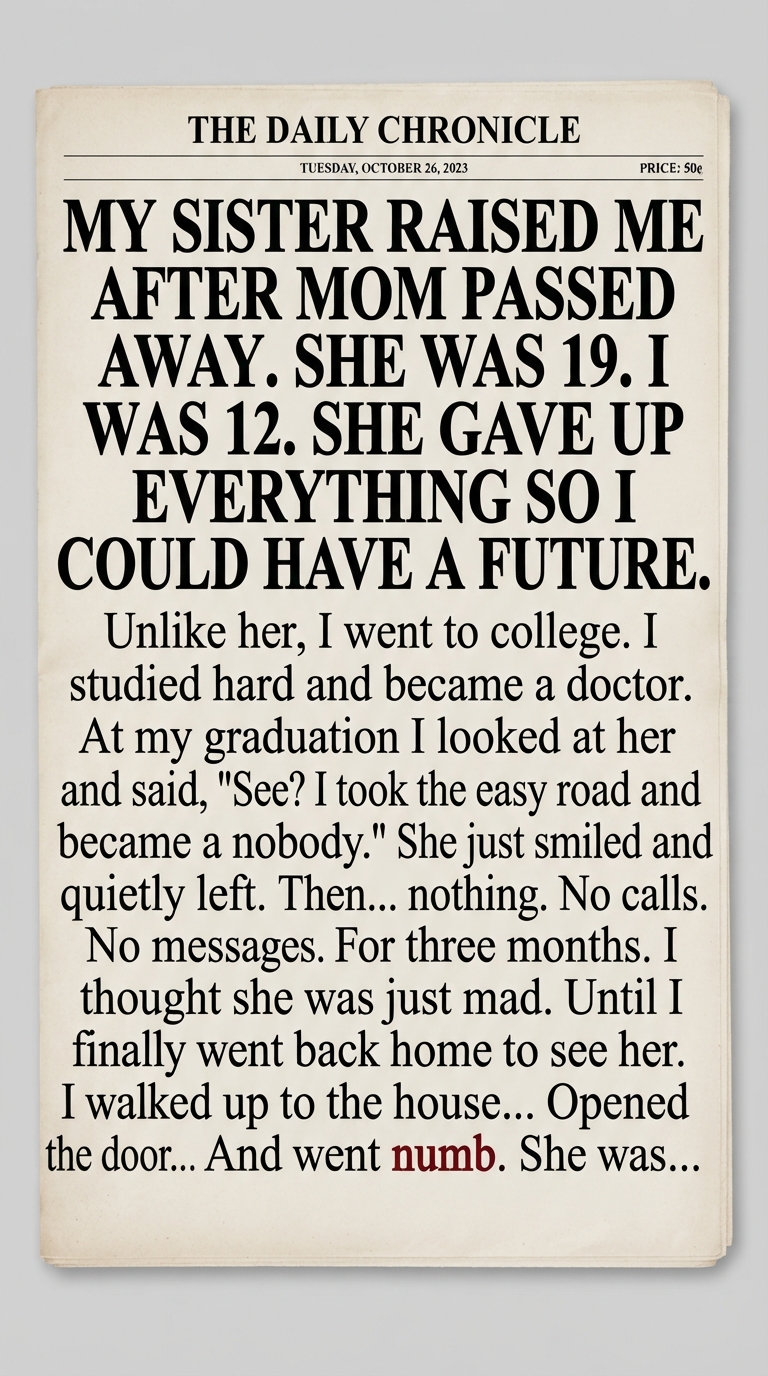
My sister raised me after our mother died.
She was nineteen.
I was twelve.
At that age, she should have been worrying about college, friends, first apartments, and the kind of future young people dream about.
Instead, she became responsible for me.
Her name was Emma.
After Mom passed away, everything changed overnight.
Our father had disappeared years earlier. We didn’t know where he was, and eventually, we stopped looking.
So when Mom died, it was just us.
I remember the night Emma sat beside me on the couch.
She was crying, but she kept wiping her tears away whenever I looked at her.
“What happens now?” I asked.
She forced a smile.
“We stay together.”
“But where?”
“Here.”
“What about you?”
She didn’t answer.
I didn’t understand what she meant at the time.
Years later, I did.
Emma gave up college.
She gave up the scholarship she had worked years to earn.
She took a job at a grocery store during the day and cleaned offices at night.
Sometimes she came home after midnight.
Then she woke up before sunrise to make sure I had breakfast and got to school on time.
She was nineteen years old.
And she became my mother.
I didn’t make it easy for her.
I was angry.
Angry at life.
Angry at Mom for dying.
Angry at Dad for disappearing.
And sometimes, I was angry at Emma simply because she was the only person left.
I slammed doors.
I skipped school.
I shouted things I knew would hurt her.
But she never left.
Not once.
When I got sick, she stayed awake beside my bed.
When I needed money for school, she worked extra shifts.
When I told her I wanted to become a doctor, she laughed.
Not because she didn’t believe in me.
Because she did.
“You’ll be a great one,” she said.
“I don’t know if I can afford college.”
She looked at me.
“You’ll go.”
“How?”
“I’ll figure it out.”
And she did.
She sold Mom’s jewelry.
She took another job.
She moved us into a smaller apartment.
She wore the same winter coat for five years.
Meanwhile, I studied.
I went to college.
Then medical school.
And while I was buried under textbooks and exams, Emma kept working.
Every time I called and asked if she was okay, she gave me the same answer.
“I’m fine.”
I believed her.
That was my mistake.
Years passed.
Eventually, I graduated.
I became a doctor.
On the day of my graduation, the auditorium was full.
Parents hugged their children.
Families took photographs.
People cried with pride.
I looked into the crowd and saw Emma sitting alone.
She wore a simple blue dress.
Her hair was pulled back.
She looked tired.
Older than she should have.
But when our eyes met, she smiled.
I walked over to her after the ceremony.
She hugged me so tightly I could barely breathe.
“You did it,” she whispered.
I laughed.
Then, trying to be funny, I said:
“See? I took the easy road and became a nobody.”
Emma looked at me.
Her smile changed.
It became smaller.
Sad somehow.
Then she said quietly:
“No. You became everything I hoped you would.”
I didn’t understand why her eyes filled with tears.
I thought she was simply emotional.
She hugged me one more time.
Then she left.
That was the last time I saw her for three months.
At first, I didn’t worry.
I assumed she was angry about something.
Maybe I hadn’t visited enough.
Maybe I hadn’t called.
I was busy starting my residency.
Long shifts.
New responsibilities.
A new life.
So I kept telling myself:
I’ll call her tomorrow.
Tomorrow became next week.
Next week became next month.
Then, one morning, I realized something.
Three months had passed.
No calls.
No messages.
Nothing.
I called her.
Straight to voicemail.
Again.
Voicemail.
I texted.
No response.
I became irritated.
Then worried.
Then afraid.
One Friday, I finally took a few days off and drove back to our old house.
The same house Emma had fought so hard to keep after Mom died.
As I turned onto the street, something felt wrong.
The curtains were closed.
The front yard was overgrown.
There were no lights on.
I parked in front of the house.
“Emma?”
No answer.
I knocked.
Nothing.
Then I tried the door.
Unlocked.
My stomach dropped.
“Emma?”
I stepped inside.
The house was silent.
Too silent.
I walked into the living room.
Everything was covered in dust.
Her coffee cup was still sitting on the table.
I walked toward her bedroom.
The door was slightly open.
I pushed it.
And went numb.
Emma was there.
She was lying in bed.
So thin I barely recognized her.
For one horrifying second, I thought she was dead.
“Emma!”
I ran to her.
Her eyes slowly opened.
She looked at me.
Then smiled.
“You came home.”
I couldn’t breathe.
“What happened?”
She tried to sit up.
I stopped her.
“Don’t move.”
She looked embarrassed.
“It’s nothing.”
I was a doctor.
I knew that was a lie.
Her skin was pale.
Her breathing was shallow.
There were medical papers scattered beside her bed.
I picked one up.
My hands began shaking.
I read the diagnosis once.
Then again.
I couldn’t make myself understand the words.
Advanced heart failure.
The date on the report was nearly four months earlier.
Four months.
“Why didn’t you tell me?”
Emma looked away.
“I didn’t want to bother you.”
I felt something break inside me.
“Bother me?”
“You were graduating.”
“Emma—”
“You worked so hard.”
I stared at her.
Tears filled my eyes.
“I could have helped you.”
She smiled faintly.
“You were helping people.”
“I could have helped you!”
Her eyes closed for a moment.
Then she whispered:
“I know.”
I called an ambulance.
She protested.
I ignored her.
At the hospital, I used every connection I had.
I called specialists.
I begged colleagues.
I refused to leave her side.
But as I read through her medical history, I discovered the truth.
Emma had known she was sick for almost a year.
She had hidden it.
She had continued working.
She had continued paying bills.
And she had refused treatment she couldn’t afford.
All while I was becoming a doctor.
The irony nearly destroyed me.
I had spent years learning how to save strangers.
And I hadn’t even noticed that the woman who had saved me was dying.
For days, I barely left her hospital room.
One night, I sat beside her bed holding her hand.
“Why didn’t you call me?”
She looked toward the window.
“Because I didn’t want you to give up your future.”
I started crying.
“My future?”
She turned toward me.
“Yes.”
“You were my family.”
“I still am.”
“No.”
My voice broke.
“You’re everything.”
Emma smiled.
The same smile she had given me when I was twelve.
The smile that said everything would be okay, even when she was terrified.
Then she whispered:
“You remember what you said at graduation?”
I closed my eyes.
I remembered.
Every word.
“See? I took the easy road and became a nobody.”
I began sobbing.
“I was joking.”
“I know.”
“I didn’t mean—”
“I know.”
She squeezed my hand weakly.
Then she said:
“You were never a nobody.”
I looked at her.
“And neither were you.”
Her eyes filled with tears.
I continued.
“You gave up your life so I could have one.”
Emma shook her head.
“No.”
“Yes.”
“You think I gave up everything.”
“You did.”
She smiled.
“Taking care of you wasn’t giving up my life.”
I couldn’t speak.
She looked at me and whispered:
“You were my life.”
Those words destroyed me.
For the next few weeks, I did everything I could.
But medicine has limits.
And sometimes, love does too.
Emma died forty-two days after I found her.
I was holding her hand.
She wasn’t alone.
And for that, I will be grateful for the rest of my life.
At her funeral, I stood in front of a room filled with people I barely knew.
Former coworkers.
Neighbors.
Friends from years ago.
One by one, they came to me.
And each of them told me something I had never known.
Emma had helped them too.
She had paid for groceries for an elderly neighbor.
She had covered a coworker’s rent.
She had spent weekends helping at a shelter.
She had quietly given money to children who couldn’t afford school supplies.
The woman I thought had sacrificed everything for me had somehow still found enough to give to everyone else.
Then an older woman handed me a small box.
“Emma asked me to give you this.”
Inside was a letter.
My hands shook as I opened it.
It said:
My dear little brother,
If you’re reading this, then you’re probably blaming yourself. Please don’t. You spent your whole life trying to become someone who could save people. Don’t let my story make you forget why you chose that path.
When Mom died, I was terrified. I didn’t know how I was going to raise you. But every time I thought about giving up, I remembered something Mom used to say: “Sometimes God gives us more strength than we know we have.”
You were never a burden to me.
You were the reason I kept going.
And when you became a doctor, I finally knew that everything was going to be okay.
So please don’t remember me as the sister who gave up her life.
Remember me as the sister who got to watch her little brother become the man he was always meant to be.
At the bottom, she had written one final sentence.
And please, take care of yourself now. It’s your turn.
I read that letter every year on the anniversary of her death.
I keep it in my office.
Whenever I feel exhausted, overwhelmed, or ready to give up, I take it out.
Then I remember a nineteen-year-old girl who should have been living for herself.
Instead, she chose to stay with a frightened twelve-year-old boy.
She worked until her feet hurt.
She went without so I could eat.
She gave up her dreams so I could chase mine.
And even in the end, when she was dying, she was still protecting me.
Today, above the entrance to the free clinic I built in her name, there is a simple plaque.
It reads:
EMMA’S HOUSE — Because every life deserves someone who refuses to give up on them.
Every time I walk through those doors, I think about her.
Not as someone who became a nobody.
Not as someone who gave up everything.
But as the woman who quietly became the reason I am everything I am.
Because I may have become a doctor.
But Emma?
Emma was the one who saved my life first.