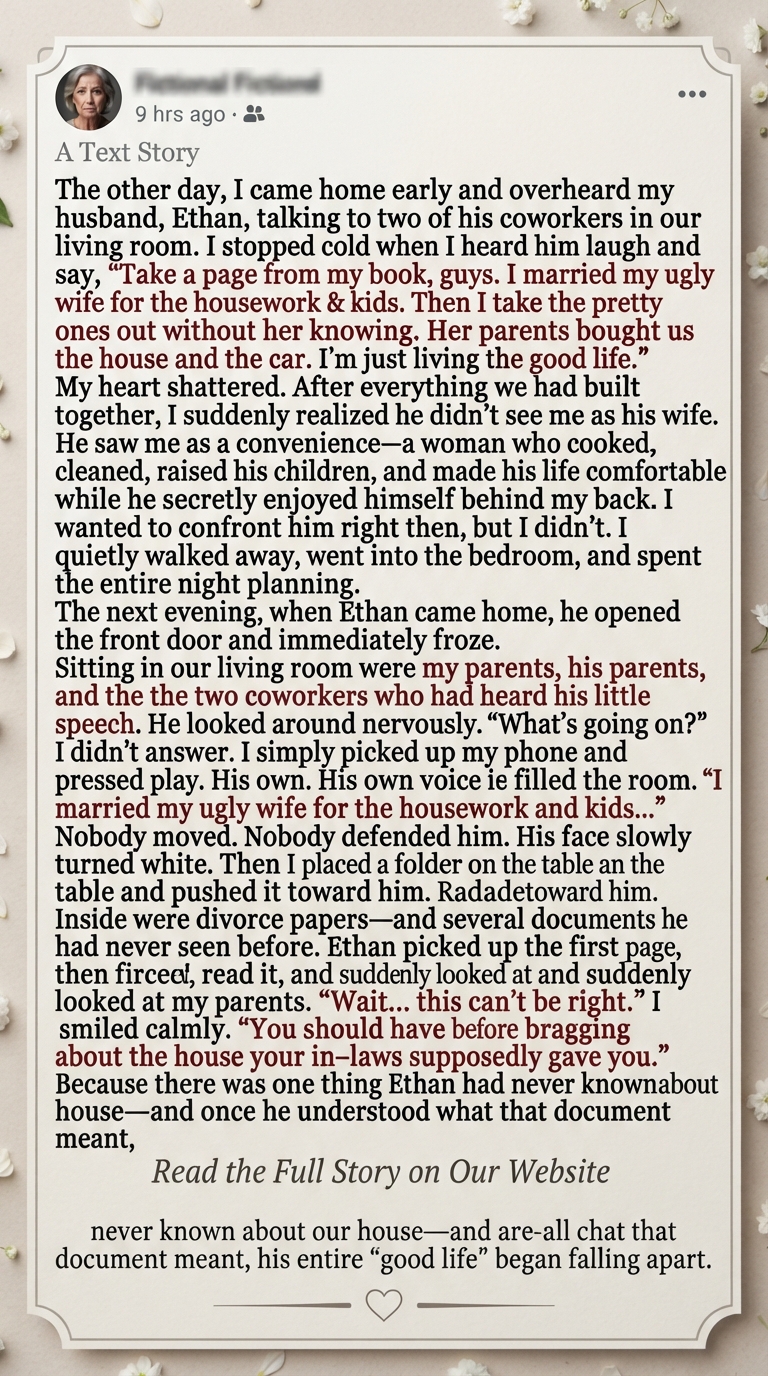
The other day, I came home early and overheard my husband, Ethan, talking to two of his coworkers in our living room.
I stopped in the hallway.
At first, I thought they were joking.
Then Ethan laughed.
“Take a page from my book, guys. I married my ugly wife for the housework and kids. Then I take the pretty ones out without her knowing. Her parents bought us the house and the car. I’m just living the good life.”
His coworkers laughed.
One of them said, “Man, you really figured it out.”
Ethan chuckled.
“I barely have to do anything. She cooks. She cleans. She handles the kids. I work, come home, and enjoy the benefits.”
I stood there in silence.
For twelve years, I had believed I was building a marriage.
Apparently, Ethan thought he had found a maid with a wedding ring.
I quietly backed away before they noticed me.
I went upstairs, closed the bedroom door, and sat on the edge of our bed.
I didn’t cry.
Not yet.
Instead, I opened the drawer of my nightstand and pulled out a folder I hadn’t looked at in years.
Inside was a copy of our marriage agreement.
Behind it was another document.
The original deed to our house.
I stared at it for a long time.
Then I smiled.
Ethan had spent twelve years believing the house belonged to both of us because my parents had helped me buy it before we were married.
But he had never actually read the deed.
And he certainly had never read the agreement we signed before our wedding.
That night, I made three phone calls.
The first was to my attorney.
The second was to my parents.
The third was to Ethan’s parents.
By the next evening, everyone knew the truth except Ethan.
And I intended to keep it that way until he walked through the front door.
At 6:17 p.m., Ethan came home.
He opened the door.
Then froze.
Sitting in our living room were my parents, his parents, and the two coworkers who had been with him the day before.
His smile disappeared.
“What’s going on?”
I stood beside the fireplace.
“Sit down, Ethan.”
He looked at his parents.
His mother frowned.
His father wouldn’t even meet his eyes.
Ethan slowly sat.
I picked up my phone.
“I think everyone deserves to hear what you said yesterday.”
His face changed.
“What?”
I pressed play.
His own voice filled the room.
“Take a page from my book, guys. I married my ugly wife for the housework and kids…”
The recording continued.
Nobody interrupted.
When it ended, the silence was unbearable.
Ethan stared at the floor.
One of his coworkers whispered, “Ethan…”
“Don’t,” Ethan snapped.
His mother looked at me.
“Is that really what he said?”
I nodded.
“Yes.”
Ethan finally looked up.
“Wait. You recorded me?”
“No.”
I smiled faintly.
“You said it loudly enough that your phone’s smart speaker recorded the conversation automatically. You left the recording synced to the family account.”
His coworker looked embarrassed.
“I told her where to find it.”
Ethan’s face turned red.
I walked to the coffee table and placed a folder in front of him.
“Now we’re going to talk about the house.”
He opened it.
The first document was the deed.
He scanned the page.
Then he frowned.
“I don’t understand.”
“Read the owner’s name.”
He looked again.
His eyes widened.
My name was the only name listed.
“But your parents bought this house.”
“My parents helped me buy it,” I corrected him.
“They gave me the down payment before our wedding. The deed was placed in my name because it was purchased before we were married.”
Ethan shook his head.
“But we’ve lived here together for twelve years.”
“Yes.”
“And I’ve paid bills.”
“Yes.”
“So I own part of it.”
I slid another document toward him.
“Our marital-property agreement says otherwise.”
He picked it up.
His hands started trembling.
Before we got married, my attorney had recommended that we sign an agreement clearly separating property acquired before the marriage from marital assets.
Ethan had signed it without reading it carefully.
At the time, he had laughed and said, “I don’t care about paperwork. We’re going to be together forever.”
I remembered that sentence now.
So did he.
His father finally spoke.
“You signed that?”
Ethan stared at him.
“I didn’t know…”
His mother interrupted.
“You didn’t know because you didn’t bother reading it.”
Ethan looked at me.
“But your parents bought the house for us.”
“No,” I said calmly.
“They helped me buy a house for myself. After we married, I allowed you to live there because I believed we were building a family together.”
I opened the folder again.
There was one final document.
A letter from my parents.
It explained that their financial contribution had always been intended as a gift to me—not to Ethan, and not to our marriage.
Ethan read it.
His expression collapsed.
Then he looked at my parents.
“You knew?”
My father nodded.
“We’ve always known.”
“Why didn’t you tell me?”
My mother looked at him sadly.
“Because you were supposed to be her husband. We never imagined you’d brag about using our daughter.”
That sentence hit harder than anything else.
Ethan lowered his head.
For the first time, he looked ashamed.
But I wasn’t finished.
I placed a second folder on the table.
“There’s also the car.”
He opened it.
The registration was in my name.
So was the loan.
So were the insurance records.
“The car isn’t yours either,” I said.
Ethan stared at me.
“But I drive it every day.”
“You did.”
His eyes snapped toward me.
“What do you mean?”
“I canceled your authorization this morning.”
His face went pale.
Then he laughed nervously.
“You can’t be serious.”
“I am.”
He stood.
“You’re throwing me out?”
“No.”
I shook my head.
“I’m not throwing you out.”
I looked directly into his eyes.
“You’ve been living in a house you don’t own, driving a car you don’t own, enjoying a life you didn’t appreciate, while secretly humiliating the woman who made that life possible.”
I took the divorce papers from the folder.
“So I’m ending the part of your life where you get to call that arrangement a marriage.”
I pushed the papers toward him.
Ethan didn’t touch them.
“Please.”
It was the first time I had ever heard fear in his voice.
“Please don’t do this.”
I almost laughed.
Not because it was funny.
Because twelve years earlier, he had promised to love me.
And now, faced with losing the comforts he’d mocked, he suddenly wanted to save our marriage.
“Do you love me?” I asked.
He stared at me.
“Yes.”
“Then why did you call me ugly?”
He said nothing.
“Why did you tell your coworkers you married me for housework?”
Nothing.
“Why were you taking other women out behind my back?”
His eyes dropped.
Still nothing.
I nodded.
“That silence is your answer.”
His mother began crying.
His father looked furious.
One of his coworkers stood.
“I think I owe you an apology,” he said.
I looked at him.
He swallowed.
“I laughed yesterday. I shouldn’t have. I thought Ethan was just joking. I didn’t realize…”
“You don’t owe me an apology for believing your friend,” I said.
He shook his head.
“No. I owe you one for laughing while he humiliated you.”
He left soon after.
The other coworker followed.
Ethan remained seated.
For a long moment, nobody spoke.
Finally, my father stood.
“Ethan, you need to leave.”
Ethan looked at me.
“Where am I supposed to go?”
I answered quietly.
“Somewhere that doesn’t belong to me.”
He packed a suitcase that night.
Before he walked out, he stopped at the doorway.
“I made a mistake.”
I looked at him.
“No, Ethan.”
He waited.
“You made a choice.”
He lowered his eyes.
“A mistake happens once.”
I continued.
“You made the choice every time you lied. Every time you went out with another woman. Every time you let me cook your meals while telling your friends you were smarter than me. Every time you looked at me and pretended to love me.”
His eyes filled with tears.
“I didn’t know what I had.”
I nodded.
“That’s the problem.”
He left.
The divorce was finalized several months later.
There was no dramatic courtroom battle over the house.
There didn’t need to be.
The documents were clear.
The house remained mine.
The car remained mine.
And, more importantly, my life became mine again.
I stopped measuring my worth by whether Ethan found me beautiful.
I started running again.
I went back to work.
I traveled with my children.
I hired someone to help with the house—not because I couldn’t do it, but because I no longer believed caring for everyone else was my responsibility.
Months later, I ran into one of Ethan’s former coworkers at a grocery store.
He smiled awkwardly.
“How are you?”
“Better than ever.”
He laughed.
Then he said something I never expected.
“Ethan still tells people that losing you was the biggest mistake of his life.”
I smiled.
“Tell him he’s wrong.”
He looked surprised.
“Wrong?”
“Yes.”
I picked up my groceries.
“Losing me wasn’t his biggest mistake.”
I paused.
“Thinking I was only useful because of what I did for him was.”
And I walked away.
Because Ethan had spent twelve years believing he was living the good life.
He never realized the good life was never his.
It was mine.
I had simply been generous enough to share it with him.
And the moment he mistook my kindness for weakness, I stopped sharing.