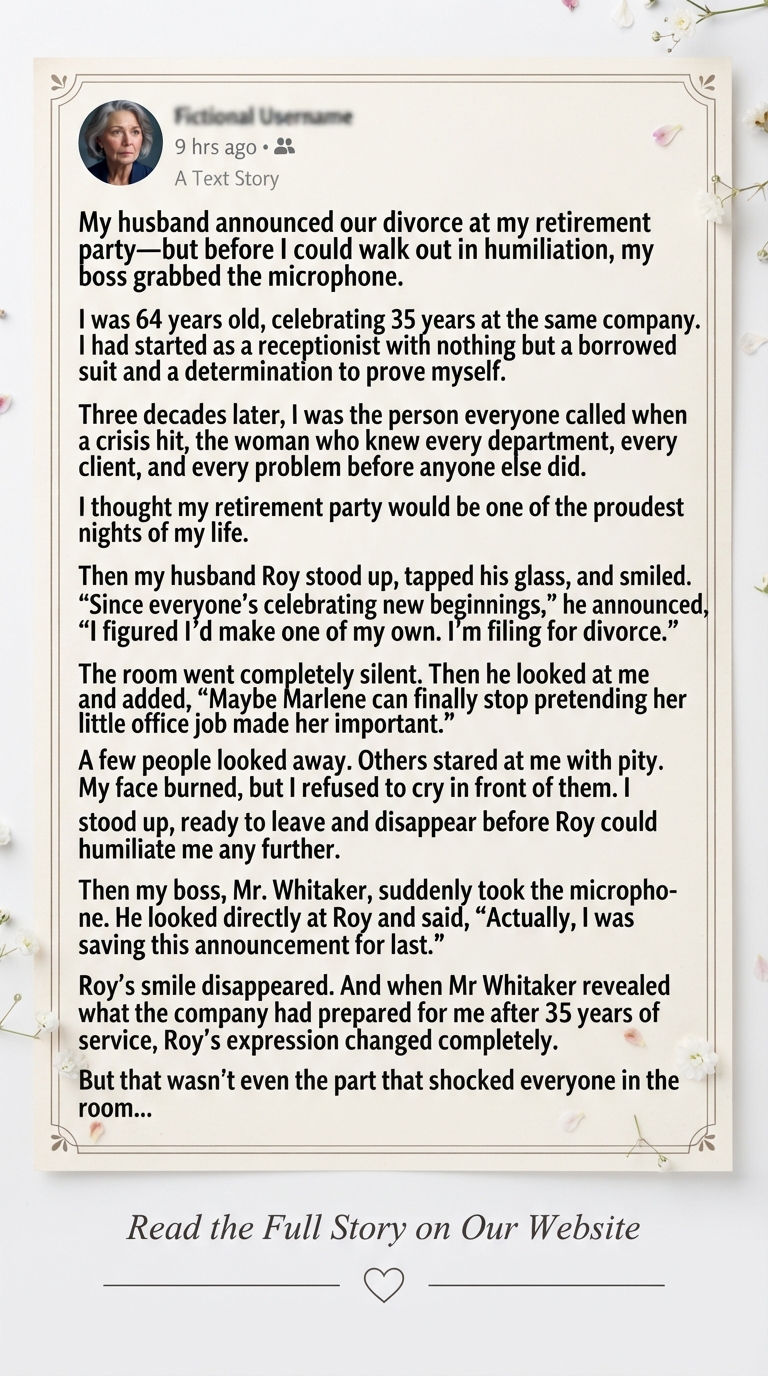
My husband announced our divorce at my retirement party.
He did it in front of 87 people.
My coworkers.
My closest friends.
Former clients.
And three generations of people who had watched me build a career from nothing.
I was 64 years old.
That night was supposed to be about celebrating 35 years at the same company.
Instead, my husband decided it would be the night he destroyed me.
I had started at Whitaker & Cole when I was 29.
Back then, I had a borrowed navy suit, a secondhand purse, and exactly $42 in my checking account.
I was hired as a receptionist.
I answered phones.
Made coffee.
Sorted mail.
Scheduled meetings.
Nobody knew my name.
For the first few months, I ate lunch at my desk because I was too embarrassed to sit with the executives in the cafeteria.
But I worked.
I learned.
I stayed late.
When the accounting department needed help, I volunteered.
When sales had a difficult client, I learned the account.
When the company changed computer systems, I took night classes and taught myself the software.
Eventually, I became an operations manager.
Then a regional director.
Then vice president of operations.
I became the person everyone called when something went wrong.
A client threatening to leave?
Call Marlene.
A major shipment stuck at customs?
Call Marlene.
A department falling apart?
Call Marlene.
A new executive who didn’t understand how the company actually worked?
Call Marlene.
After 35 years, I knew every department, every major client, every vendor, and nearly every employee.
My retirement party was supposed to be the final chapter of that story.
There were photographs on the walls.
Old company newsletters.
A slideshow of my career.
Someone had even found a picture of me from my first week.
I barely recognized that woman.
She looked terrified.
But she was smiling.
At 7:45 p.m., Mr. Whitaker, the company president, gave a beautiful speech.
He talked about loyalty.
Leadership.
Integrity.
Then everyone applauded.
I stood beside him, holding back tears.
I thought:
I made it.
For the first time in years, I allowed myself to imagine life without an alarm clock.
Travel.
Reading.
Gardening.
Maybe finally taking that trip to Italy I’d postponed for twenty years.
Then Roy stood up.
My husband of 31 years.
He tapped his wineglass with a fork.
The room quieted.
I smiled politely.
I thought he was going to say something kind.
Instead, he said:
“Since everyone is celebrating new beginnings, I figured I’d make one of my own.”
He looked directly at me.
“I’m filing for divorce.”
The room went completely silent.
I felt the blood drain from my face.
Someone near the back whispered, “Oh my God.”
Roy continued.
“Maybe Marlene can finally stop pretending her little office job made her important.”
A few people looked down.
Others stared at me with pity.
He smiled.
Actually smiled.
Like he’d just delivered the punchline of the evening.
My hands began to shake.
For months, I had known our marriage was falling apart.
Roy had complained that I worked too much.
He had mocked my career.
He had told friends that my company was “the only thing Marlene cared about.”
I had tried counseling.
He refused.
I had suggested we travel together.
He said he was bored.
Then, two weeks before my retirement party, he told me he wanted a divorce.
I asked him to wait.
Just until after the party.
I didn’t want my coworkers to know.
I didn’t want my final memory of 35 years to be surrounded by whispers about my marriage.
He agreed.
Apparently, he had only been waiting for a larger audience.
I looked around the room.
I could feel tears building.
I refused to let them fall.
I stood up.
“Excuse me.”
I was going to leave.
I was going to walk out with whatever dignity I had left.
Then Mr. Whitaker stood.
He reached for the microphone.
“Marlene.”
I stopped.
He looked at me.
Then at Roy.
“Actually, I was saving an announcement for last.”
Roy’s smile disappeared.
Mr. Whitaker turned toward the audience.
“For 35 years, Marlene has given this company more than we could ever put into a retirement speech.”
He paused.
“So tonight, we’re giving something back.”
The lights dimmed.
A screen behind him came alive.
The first slide showed a number.
$3.8 BILLION.
A murmur moved through the room.
Mr. Whitaker explained that over the previous decade, the company had undergone several major acquisitions.
During those transitions, I had been one of the people responsible for integrating operations.
My systems.
My procedures.
My negotiations.
My cost-saving programs.
My crisis management.
They had saved the company millions.
But the next slide made Roy sit forward.
It showed a document.
At the bottom was my name.
Mr. Whitaker said:
“Three years ago, our board created a long-term employee ownership program for several key executives and senior leaders.”
I stared at the screen.
I knew nothing about this.
“Because of Marlene’s contributions,” he continued, “she was granted a substantial equity position in the company.”
The room erupted.
Roy looked at me.
Then at the screen.
Then back at me.
Mr. Whitaker smiled.
“And tonight, that equity has fully vested.”
I couldn’t speak.
I thought I had misunderstood.
Then he said the number.
“Her current stake is valued at approximately $14.6 million.”
The room exploded in applause.
I stood completely frozen.
Fourteen point six million dollars.
I had spent my entire career thinking I was simply earning a paycheck.
Apparently, the company had been quietly rewarding me for years.
Roy’s face had gone white.
But Mr. Whitaker wasn’t finished.
He clicked to the next slide.
“This isn’t a retirement gift.”
The room quieted.
“It’s ownership.”
Then he looked directly at me.
“And there is one more thing.”
He explained that the board had unanimously voted to establish a new scholarship and professional development fund in my name.
The Marlene Hayes Leadership Fund.
It would provide scholarships for employees’ children and paid training opportunities for people starting at the company in entry-level positions.
Mr. Whitaker looked at me.
“Because Marlene never forgot where she started.”
I covered my mouth.
That was the moment I cried.
Not because of Roy.
Because I suddenly remembered the frightened 29-year-old woman in the borrowed suit.
The woman who had once eaten lunch alone because she didn’t believe she belonged.
She had made it.
But then Mr. Whitaker said something that changed the entire room.
“And Marlene has asked us to keep one final announcement secret until tonight.”
I looked at him.
“What?”
He smiled.
“You’ll see.”
The screen changed again.
This time, it showed a contract.
I recognized it immediately.
It was the acquisition agreement for a small business.
My heart stopped.
Mr. Whitaker explained that six months earlier, I had approached the board about creating a company-owned supplier network.
One of the small suppliers I had recommended was struggling.
The owner was a 68-year-old woman named Evelyn.
She had built the business herself but couldn’t find anyone willing to take it over.
I had spent months helping her prepare the company for sale.
I had forgotten about it.
Apparently, the board hadn’t.
Whitaker announced that our company had acquired the business.
And they had named me chair of the new subsidiary.
Not as an employee.
As a board member.
Even though I was retiring.
I stared at him.
“You’re offering me another job?”
The room laughed.
Mr. Whitaker shook his head.
“No.”
He smiled.
“We’re offering you a seat at the table.”
The applause was deafening.
I looked toward Roy.
He wasn’t clapping.
He was staring at me.
Then he walked toward me.
“Marlene…”
I raised my hand.
He stopped.
“Not tonight.”
His face tightened.
“I didn’t know.”
“No,” I said quietly.
“You didn’t.”
“I thought you were going to retire with nothing.”
I looked at him.
“That was your mistake.”
He lowered his voice.
“We can work this out.”
I almost laughed.
“Can we?”
He nodded quickly.
“I was angry.”
“You humiliated me.”
“I didn’t mean—”
“You planned it.”
He stopped.
Because he knew it was true.
He had waited until I was surrounded by the people who mattered most to me.
He had chosen the one night when I was most vulnerable.
And he had assumed I would leave with my head down.
Instead, I looked around the room.
My coworkers were standing.
My friends were crying.
People I had mentored were applauding.
Mr. Whitaker was smiling.
And for the first time all evening, I realized something.
Roy had thought he was the most important person in my life.
He had never understood that I had built a life much larger than my marriage.
I leaned toward him.
“You wanted everyone here to see how little you thought of me.”
He said nothing.
“Well,” I continued, “now they know.”
He looked at me.
“Know what?”
“That I don’t need your approval.”
I walked away.
The divorce took seven months.
There was no dramatic courtroom battle.
No screaming.
No revenge.
Just paperwork.
Assets were divided.
The house was sold.
Roy moved to Florida.
I stayed in Chicago.
And I accepted my seat on the board.
A year later, I traveled to Italy.
I spent three weeks there.
Alone.
It was wonderful.
I visited Rome.
Florence.
Venice.
I sat at tiny cafés and watched people walk by.
For the first time in decades, nobody needed me to solve anything.
And I discovered something I wish I had understood much earlier.
Retirement wasn’t the end of my life.
Divorce wasn’t the end of my life.
Being 64 wasn’t the end of my life.
It was simply the first time I was free to decide what came next.
Two years after that retirement party, I returned to Whitaker & Cole for the annual scholarship ceremony.
A young woman who had started as a receptionist was receiving the first full scholarship from my fund.
She approached the microphone nervously.
“I used to think people like me didn’t belong in rooms like this,” she said.
I smiled.
Because I knew exactly how she felt.
After the ceremony, she came up to me.
“Mrs. Hayes, can I ask you something?”
“Of course.”
“How did you become successful?”
I looked at her.
Then I thought about a borrowed suit.
A secondhand purse.
A lonely lunch table.
Thirty-five years of work.
And one humiliating retirement party that had unexpectedly become the beginning of something better.
I smiled.
“Don’t spend your life trying to prove your worth to people who have already decided not to see it.”
She nodded.
I looked around the room.
Then I added:
“Build something they can’t take away.”
And I meant every word.