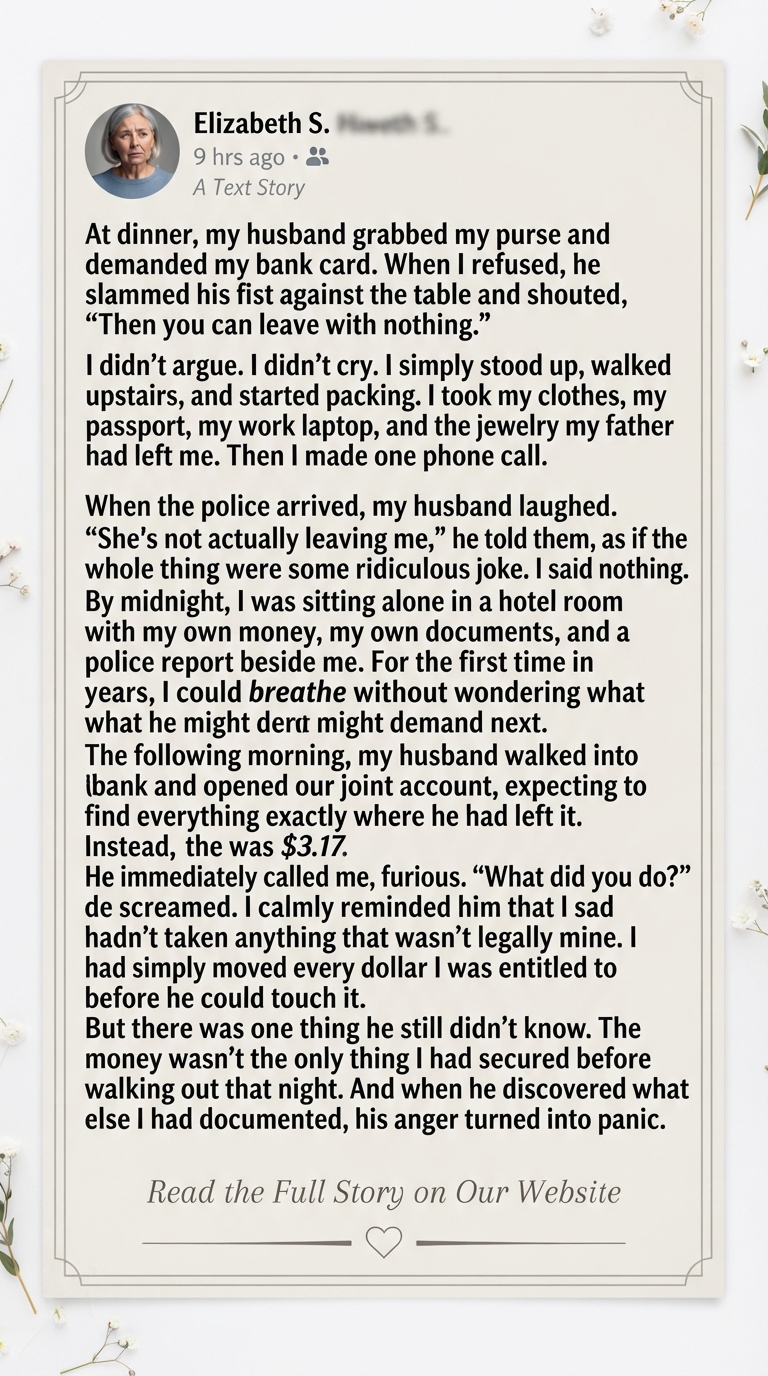
At dinner, my husband grabbed my purse and demanded my bank card.
“Give it to me.”
I stared at his hand.
“No.”
His jaw tightened.
“You heard me.”
“I did.”
He slammed his fist against the table so hard the plates jumped.
“Then you can leave with nothing!”
The room went silent.
For years, I had learned what happened after moments like this.
If I argued, he got louder.
If I cried, he called me dramatic.
If I tried to leave, he blocked the door.
So this time, I did something different.
I stood up.
I didn’t argue.
I didn’t cry.
I simply said, “Okay.”
Then I walked upstairs.
Behind me, he laughed.
“Where do you think you’re going?”
I didn’t answer.
I opened our bedroom closet and pulled down a suitcase.
I packed clothes.
My passport.
My work laptop.
My father’s watch.
The small diamond earrings he had given me before he died.
Every document that belonged to me.
My husband appeared in the doorway.
“You’re seriously packing?”
I kept folding clothes.
“You’re the one who told me to leave.”
“I didn’t mean literally.”
I stopped.
Then I looked at him.
“You should be careful with words you don’t mean.”
He scoffed.
“You’ll be back by morning.”
I zipped the suitcase.
“No.”
He laughed again.
“You don’t even have anywhere to go.”
“I do.”
I picked up my phone.
“And I’m about to call someone.”
His smile disappeared.
“Who?”
“The police.”
For the first time that night, he looked uncertain.
“Don’t be ridiculous.”
I made the call.
When the officers arrived, my husband was sitting on the couch as though nothing had happened.
One officer asked what happened.
My husband laughed.
“She’s not actually leaving me.”
He pointed at me.
“She gets emotional. That’s all.”
I said nothing.
Instead, I showed the officer the messages I had saved from previous arguments.
Threats.
Demands for my bank card.
Messages ordering me to transfer money.
Screenshots of him telling me that if I didn’t obey, he’d make sure I had nowhere to go.
Then I showed them the photograph I had taken after he punched the wall beside my head three weeks earlier.
The officer’s expression changed.
“Ma’am, do you feel safe staying here tonight?”
I looked at my husband.
“No.”
The officer nodded.
“You should leave tonight.”
My husband stopped laughing.
“This is ridiculous.”
Nobody answered him.
Before I left, I asked the officer whether I could document the incident formally.
He told me how to file a report.
I did.
Then I walked out with my suitcase.
My husband didn’t follow me.
He thought I would return.
He was wrong.
By midnight, I was sitting alone in a hotel room.
My own money.
My own documents.
My own laptop.
My father’s jewelry beside me.
And a police report on the table.
For the first time in years, I could breathe without wondering what my husband might demand next.
I barely slept.
The next morning, at 8:17 a.m., my phone rang.
It was him.
“What did you do?”
I didn’t answer immediately.
He was shouting.
“The joint account is empty!”
I looked at the balance on my banking app.
$3.17.
“What did you do?” he screamed again.
“I moved my money.”
“You stole from me!”
“No.”
“You took everything!”
“No.”
I spoke calmly.
“I transferred the money that came from my salary, my savings, and the accounts I funded before and during our marriage.”
“You had no right!”
“I checked.”
Silence.
Then he said something that made me almost laugh.
“You can’t just take all the money.”
“I didn’t take all the money.”
“You left three dollars!”
“I left exactly what I believed was yours.”
That wasn’t completely true.
But I knew what I had done was documented.
Before moving anything, I had spoken to my attorney.
I had provided bank statements.
Pay records.
Tax documents.
Investment statements.
Every transfer I had made into the joint account.
Every withdrawal he had made.
Every payment from the joint account that had gone toward his personal expenses.
We had separated our finances as much as possible without triggering unnecessary problems.
And I had not touched money that belonged solely to him.
But there was something else he didn’t know.
For the previous six months, I had been keeping records.
Not because I was planning to leave.
At first, I kept them because I was beginning to doubt myself.
I wanted proof that I wasn’t imagining things.
Every time he demanded money, I saved the message.
Every time he threatened to empty an account, I documented it.
Every time he transferred money without telling me, I downloaded the statement.
Every time he told me I would be left with nothing if I ever disobeyed him, I wrote down the date.
Eventually, I had an entire folder.
I called it “Receipts.”
My attorney called it evidence.
My husband didn’t know about the folder.
He found out two days later.
That was when his anger turned into panic.
My attorney had sent him a letter.
It wasn’t a divorce petition.
Not yet.
It was a preservation notice.
It instructed him not to sell, transfer, conceal, destroy, or dispose of marital property or financial records.
It also requested copies of several documents.
Including the records for a business account I had never been allowed to see.
My husband called me immediately.
“You went through my business?”
“No.”
“You knew about the account?”
“I knew you had one.”
“How?”
I didn’t answer.
Because the truth was, I had found it accidentally.
Three months earlier, I had been reviewing our tax documents.
A payment had appeared that didn’t make sense.
I traced it.
Then another.
Then another.
They led to a company registered in my husband’s name.
A company he had never mentioned.
The company had received nearly $280,000 over two years.
Money from contracts related to the business he had always told me was struggling.
And some of that money had been transferred into a separate investment account.
An account with only his name on it.
My husband had been telling me we were barely surviving while quietly building a financial cushion that I knew nothing about.
But the account wasn’t the biggest problem.
The biggest problem was where some of the money had come from.
My attorney found several transfers from our joint account into the company.
Transfers I had never authorized.
Transfers described as “business expenses.”
But the invoices didn’t match the actual work.
Some vendors didn’t exist.
Others were companies controlled by people my husband knew personally.
That changed everything.
The issue was no longer simply that my husband had tried to control my money.
There were questions about whether marital funds had been diverted.
Questions that would have to be answered properly.
A week later, we were sitting across from each other in a lawyer’s office.
My husband looked exhausted.
He wasn’t angry anymore.
He was afraid.
His attorney asked me to explain what I wanted.
I looked at my husband.
“I want a fair division of everything we legally own.”
He frowned.
“You’ve already taken the money.”
“No.”
I slid a binder across the table.
“I secured money I could document as mine. The rest is still being accounted for.”
He opened the binder.
Bank statements.
Tax returns.
Transfer histories.
Messages.
Photographs.
Copies of emails.
Dates.
Times.
Everything organized.
His face slowly changed.
Then he reached the final section.
His own messages.
One appeared on the page:
“If she ever leaves, make sure she has nothing.”
Another:
“Move the money before she figures out what we’re doing.”
Another:
“She’ll come back. She always does.”
My husband looked at me.
“You kept all of this?”
“Yes.”
“Why?”
I thought about all the years I had spent questioning my own memory.
Because he always told me I was exaggerating.
Because he always said I was too sensitive.
Because he always made me feel guilty for wanting control over my own life.
So I answered honestly.
“Because I finally realized that if I didn’t document reality, you would rewrite it.”
He lowered his eyes.
The divorce took several months.
The financial investigation took longer.
Some of the money he had moved was determined to be marital property.
Other amounts were his separate property.
There was no dramatic courtroom victory.
No judge screaming at him.
No overnight punishment.
Instead, there was something far more uncomfortable for him.
Accountability.
He had to disclose the accounts.
He had to explain the transfers.
He had to return funds that were improperly moved.
And he had to divide the assets according to the law.
The house was sold.
The investments were divided.
The business was valued.
And the financial control he had once used to frighten me became the very evidence that helped establish what had happened.
Months after our divorce was finalized, I received one final message from him.
“You destroyed everything.”
I stared at it for a long time.
Then I typed back:
“No. I stopped protecting the person who was destroying it.”
I never heard from him again.
I moved into a small apartment across town.
It wasn’t luxurious.
But every morning, I woke up knowing that every dollar in my account was there because I had earned it.
Every document was mine.
Every decision was mine.
And nobody could grab my purse and demand that I surrender the means to control my own life.
People sometimes ask why I didn’t leave sooner.
The truth is, leaving isn’t always one decision.
Sometimes it’s a thousand tiny decisions.
Saving a document.
Taking a photograph.
Making a phone call.
Talking to someone you trust.
Putting your passport somewhere safe.
Opening an account in your own name.
And finally believing that you deserve a life where “Give me your bank card” isn’t a command.
That night, my husband told me I could leave with nothing.
He was right about one thing.
I left.
But I didn’t leave with nothing.
I left with my documents.
My money.
My evidence.
My father’s jewelry.
My dignity.
And, most importantly, the certainty that I would never again confuse fear with love.