The Chessboard My Father Left Me
My father passed away on a cold Tuesday morning.
For the last three years of his life, I had been the one taking care of him.
My name is Kate.
I was the one who woke up before sunrise to make his breakfast.
I was the one who drove him to doctor’s appointments.
I was the one who helped him bathe when his hands became too weak to hold a towel.
I was the one who stayed awake beside his hospital bed when the doctors said there was nothing more they could do.
My sister, Lara?
She visited when it was convenient.
Birthdays.
Christmas.
Occasionally, Mother’s Day, even though our mother had been gone for years.
She always had an excuse.
Work.
Traffic.
The children.
Her husband’s schedule.
And Dad never complained.
That was the strange thing about him.
Even when she canceled at the last minute, he would simply smile and say:
“She has her own life, Kate.”
But I knew the truth.
Every time Lara failed to come, Dad waited.
He would sit near the window.
He would check his phone.
And eventually, he would whisper:
“Maybe next weekend.”
Then there would be no next weekend.
Until one day, there weren’t any weekends left at all.
After the funeral, my father’s lawyer contacted us.
He said the family needed to gather for the reading of the will.
I didn’t care about the money.
At least, I told myself I didn’t.
What I wanted was peace.
Maybe an old photograph.
One of Dad’s books.
Something small to remember him by.
Lara arrived twenty minutes late.
Of course she did.
She walked into the lawyer’s office wearing an expensive coat, sunglasses resting on top of her head.
Her husband came with her.
“So,” she whispered loudly as she sat down, “let’s see what Dad left us.”
I stared at her.
She smiled.
“What?”
I said nothing.
The lawyer, Mr. Bennett, opened a thick folder.
He adjusted his glasses.
Then he began.
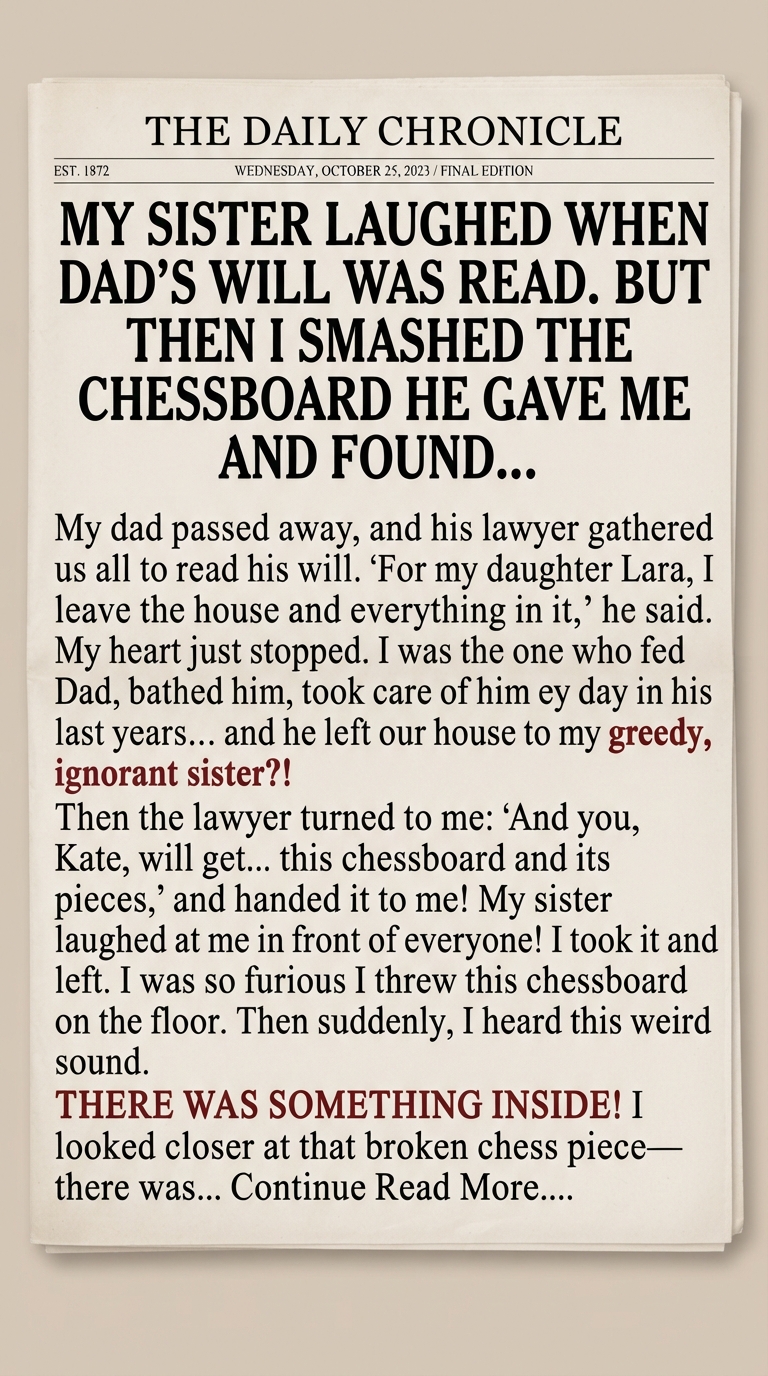
“For my daughter, Lara, I leave the house and everything contained within it.”
My heart stopped.
Everything?
The house I had grown up in.
The house where I had spent the last three years caring for Dad.
The house whose bills I had helped pay.
The house where I had sacrificed my own career opportunities because Dad needed someone close.
I looked at Lara.
Her mouth slowly opened.
Then she smiled.
A huge smile.
“Oh, Dad,” she whispered.
I felt sick.
I wanted to stand up.
I wanted to ask the lawyer if there had been a mistake.
Instead, I sat perfectly still.
The lawyer continued reading.
Then he looked at me.
“And to my daughter, Kate…”
My heart began beating again.
Maybe Dad had left me something else.
Savings.
The car.
A letter.
Anything.
Mr. Bennett reached beneath the table.
Then he placed a wooden box in front of me.
I frowned.
He opened it.
Inside was an old chessboard.
And a set of wooden chess pieces.
The same chessboard Dad had owned since I was a little girl.
The one he taught me to play on when I was seven.
Lara looked at it.
Then she laughed.
A sharp, ugly laugh.
“Seriously?”
Nobody answered.
She looked at me.
“Kate, you spent three years changing diapers, and I get the house.”
Her husband laughed quietly.
I felt my face burn.
Lara leaned back.
“Looks like Dad finally appreciated me.”
Something inside me broke.
Not because of the house.
Not really.
But because, for the first time, I wondered whether all those years had meant nothing to him.
Had I misunderstood everything?
Had Dad secretly loved Lara more?
Had he simply used me because he knew I would never say no?
The lawyer closed the folder.
“The will is clear.”
I picked up the chessboard.
It was heavier than I remembered.
I didn’t say goodbye.
I didn’t argue.
I walked out.
Behind me, I heard Lara laughing again.
That sound followed me all the way to my car.
I drove home.
The entire way, I was furious.
Furious at Lara.
Furious at the lawyer.
Furious at myself.
But most of all, I was furious at Dad.
“How could you?” I whispered.
When I got home, I carried the chessboard into my living room.
I set it on the table.
For a moment, I stared at it.
Then I remembered Lara’s voice.
You spent three years changing diapers, and I get the house.
I grabbed the board.
And threw it onto the floor.
The pieces scattered everywhere.
One rolled beneath the couch.
Another struck the wall.
Then—
Clink.
I froze.
That wasn’t the sound of wood.
I slowly walked toward the black bishop lying near my foot.
It had split open.
Inside was something metallic.
My hands began shaking.
I picked it up.
There was a tiny key hidden inside the hollow piece.
I stared at it.
Then I remembered something.
When I was little, Dad used to tell me:
“In chess, the most important piece isn’t always the biggest one.”
I had thought he was talking about pawns.
Maybe he hadn’t been.
I searched the rest of the chess pieces.
One by one, I shook them.
Some were solid.
Others weren’t.
The white knight contained a tiny folded piece of paper.
Inside the black rook was another key.
The queen contained a small brass number plate.
214.
And inside the white king, there was a message.
It simply said:
GO TO THE PLACE WHERE I TAUGHT YOU TO WIN.
I sat down.
For several minutes, I couldn’t move.
Then I knew exactly where he meant.
The old library.
When I was a child, Dad took me there every Saturday morning.
He taught me chess at a wooden table near the back window.
I hadn’t been there in years.
The next morning, I drove across town.
The library was still there.
The same brick building.
The same heavy wooden doors.
The same smell of books and dust.
I walked toward the back.
And there it was.
The old chess table.
I ran my hand beneath the edge.
Nothing.
I checked the drawers.
Nothing.
Then I noticed something carved beneath the tabletop.
A tiny arrow.
It pointed toward a small brass plaque on the side of the table.
Behind it was a keyhole.
My heart pounded.
I inserted the first key.
Nothing happened.
I tried the second.
Click.
The side of the table opened.
Inside was a small metal box.
And attached to it was a note.
Not yet. Go to 214.
I looked at the brass number plate in my hand.
Then it made sense.
A safety deposit box.
But which bank?
I turned the note over.
Dad had written the name of a bank branch.
I drove there immediately.
The manager checked the number.
Then she looked at me.
“I’m sorry,” she said. “You need identification and documentation showing you’re authorized to access the box.”
I called Mr. Bennett.
He told me to come to his office.
When I arrived, he was waiting with another envelope.
“I was instructed to give you this only if you found the first key,” he said.
I stared at him.
“You knew?”
“I knew there was something your father wanted you to discover.”
“Why didn’t you tell me?”
“Because he specifically asked me not to.”
I opened the envelope.
Inside was a letter.
My dear Kate,
If you are reading this, then you were angry enough to break the chessboard.
Despite everything, I laughed.
The lawyer smiled.
I continued reading.
Good. Sometimes anger helps us see what sadness hides.
I know what you are thinking. You believe I gave Lara everything and gave you nothing.
But you have always been my best chess player. And I wanted you to remember the first lesson I ever taught you.
Never judge the game by the first move.
My eyes filled with tears.
The letter continued.
Go to the bank. Open box 214. But before you do, promise me one thing: do not tell Lara until you understand why I did this.
My hands trembled as I signed the paperwork.
The bank manager led me into the vault.
She pulled out box 214 and placed it on a private table.
For a moment, I couldn’t breathe.
Then I opened it.
Inside were documents.
A passport.
A small velvet pouch.
Several sealed envelopes.
And a folder.
The first document I pulled out made no sense.
It was a deed.
Not for Dad’s house.
For a large piece of land outside the city.
Then I opened the next folder.
Investment statements.
Accounts.
Properties.
Shares.
My eyes moved down the pages.
Then I saw the total.
I stopped breathing.
The estate wasn’t worth a few hundred thousand dollars.
It was worth nearly $86 million.
And according to every document inside the box, almost all of it belonged to me.
I sat down.
There had to be a mistake.
I opened another envelope.
Inside was another letter from Dad.
Kate,
The house was never my greatest possession.
It was a house. Nothing more.
But I knew Lara wanted it. She told me so many times. She believed it would prove that she was the daughter I loved most.
I closed my eyes.
The letter continued.
I did not give her the house because she deserved more than you. I gave her the house because it was the only thing she wanted badly enough to mistake it for love.
Tears fell onto the paper.
You never asked me for anything.
Not once.
And because of that, I needed to make sure you would understand what I was giving you.
I kept reading.
Then I reached the paragraph that changed everything.
For the last three years, while you believed I depended entirely on you, I was watching you carefully.
I saw you cancel vacations. I saw you leave work early. I saw you spend your own money on me when I had more than enough to pay for myself.
You never knew because I was afraid that if you knew how wealthy I truly was, you would stop taking care of me out of love and start making decisions out of obligation.
I covered my mouth.
Dad had been wealthy.
All along.
But he had hidden it.
Then I read the final pages.
Dad had arranged something else.
A trust.
Not only for me.
For Lara too.
But her inheritance came with a condition.
She could keep the house.
However, all the taxes, repairs, and maintenance would be entirely her responsibility.
And there was no money attached.
She had received exactly what she had always wanted.
A house.
Nothing else.
I almost felt sorry for her.
Almost.
Three weeks later, Lara called me.
She sounded furious.
“Dad’s house needs repairs.”
“I’m sorry to hear that.”
“The roof is leaking.”
“You should call a contractor.”
“Do you know how much that costs?”
“Yes.”
She was silent.
Then she said:
“You’re enjoying this.”
“No.”
That was the truth.
I wasn’t enjoying her suffering.
I was finally understanding mine.
“Kate,” she said slowly, “the lawyer told me there was a trust.”
I said nothing.
“Dad left you everything else?”
I took a breath.
“Yes.”
Her voice changed.
“He left you all the money?”
“Yes.”
“For what?”
I looked out my window.
“For being his daughter.”
She started screaming.
I held the phone away from my ear.
Then she said the one thing I knew she had been thinking.
“You manipulated him.”
I almost laughed.
“For three years, I bathed him, fed him, and cared for him.”
“So you took advantage of him!”
I closed my eyes.
“Goodbye, Lara.”
“Wait!”
I hung up.
But Dad’s final lesson wasn’t about revenge.
I learned that when I opened the final envelope.
Inside was a single handwritten page.
Kate, if you have discovered everything, then the game is almost over.
I have one final move.
My hands shook as I read.
Dad had established a foundation using part of the inheritance.
Its purpose was to provide home care for elderly people who could not afford help.
There were instructions naming me as the director.
At the bottom, he had written:
You gave me dignity when I could no longer take care of myself. Now give that dignity to someone else.
I cried harder than I had at his funeral.
Because suddenly, I understood.
The chessboard wasn’t a consolation prize.
It was Dad’s way of speaking to me one last time.
Every hidden piece had been a move.
Every key had led to another answer.
And the entire time, he knew I would solve it.
Not because I was smarter than Lara.
But because he knew me.
He knew I would remember.
He knew I would search.
And most importantly, he knew I would never give up halfway through the game.
Months later, I visited Dad’s grave.
I brought the repaired chessboard with me.
I sat beside his headstone and placed the white king on the ground.
“You could have just left me a letter,” I said.
The wind moved softly through the trees.
For some reason, I could almost hear him laughing.
I looked down at the chess piece.
Then I smiled through my tears.
“No,” I whispered. “You had to make me work for it.”
The house stayed with Lara.
She eventually sold it.
The repairs and taxes were more than she could handle.
I didn’t stop her.
I didn’t buy it.
I didn’t want it.
I had finally learned that the things we fight hardest to inherit are not always the things that truly matter.
As for me, I kept the chessboard.
I had it repaired.
Not perfectly.
One of the pieces still has a thin crack running through it.
I asked the restorer not to hide it.
Because every time I see that crack, I remember the moment I thought my father had left me with nothing.
I remember how wrong I was.
And I remember his first lesson.
Never judge the game by the first move.