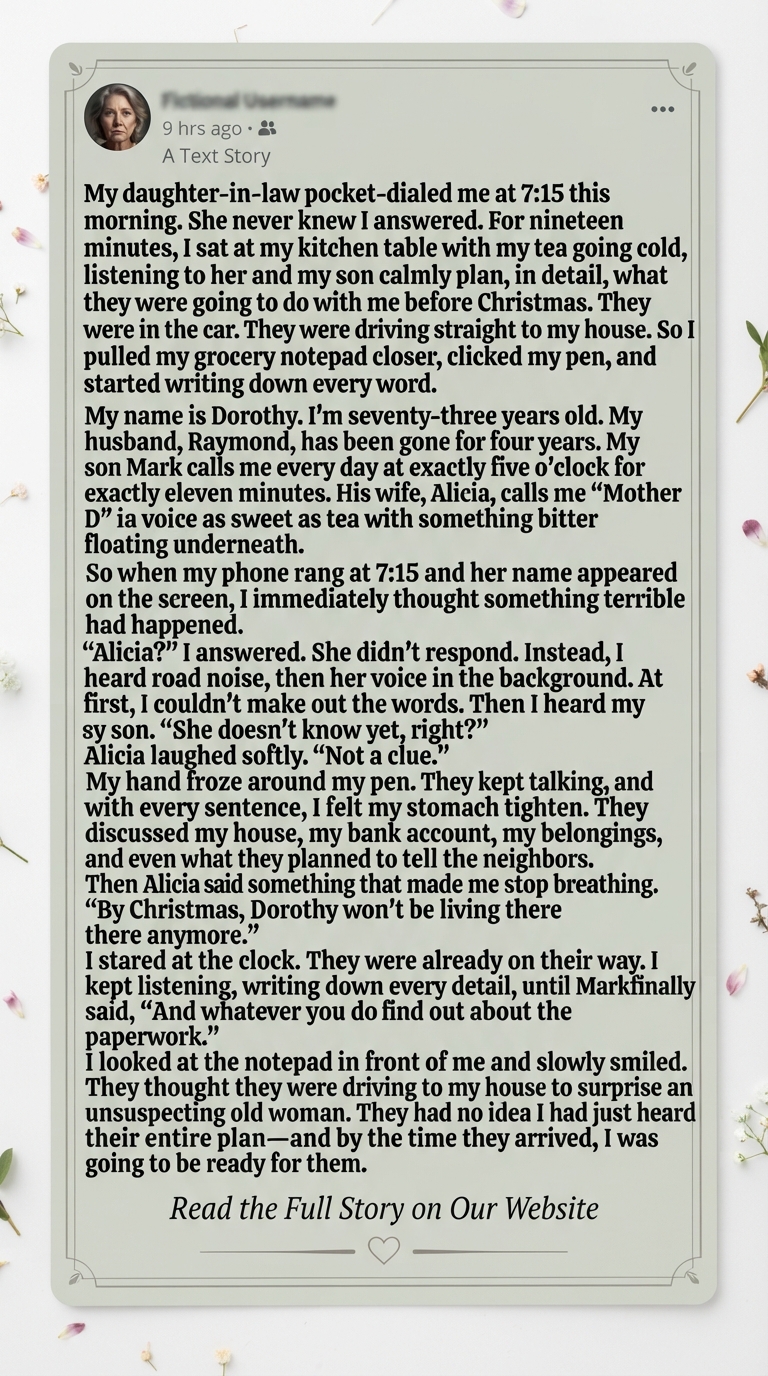
My daughter-in-law pocket-dialed me at 7:15 that morning.
She never knew I answered.
For nineteen minutes, I sat at my kitchen table with my tea going cold, listening to her and my son calmly plan, in detail, what they were going to do with me before Christmas.
They were in the car.
They were driving straight to my house.
So I pulled my grocery notepad closer, clicked my pen, and started writing down every word.
My name is Dorothy.
I’m seventy-three years old.
My husband, Raymond, has been gone for four years.
My son Mark calls me every day at exactly five o’clock for exactly eleven minutes.
His wife, Alicia, calls me “Mother D” in a voice as sweet as tea with something bitter floating underneath.
So when my phone rang at 7:15 and her name appeared on the screen, I immediately thought something terrible had happened.
“Alicia?” I answered.
She didn’t respond.
Instead, I heard road noise.
Then her voice in the background.
At first, I couldn’t make out the words.
Then I heard my son.
“She doesn’t know yet, right?”
Alicia laughed softly.
“Not a clue.”
My hand froze around my pen.
They kept talking.
And with every sentence, I felt my stomach tighten.
They discussed my house.
My bank account.
My belongings.
Even what they planned to tell the neighbors.
Then Alicia said something that made me stop breathing.
“By Christmas, Dorothy won’t be living there anymore.”
I stared at the clock.
They were already on their way.
I kept listening.
I wrote down every detail.
And eventually, Mark said something that changed everything.
“And whatever you do, don’t let Mom find out about the paperwork.”
I looked at the notepad in front of me.
Then I slowly smiled.
They thought they were driving to my house to surprise an unsuspecting old woman.
They had no idea I had just heard their entire plan.
And by the time they arrived, I was going to be ready for them.
The first thing I wrote down was the address of the attorney they mentioned.
The second was the name of the bank.
The third was the phrase Alicia repeated twice.
“Power of attorney.”
That was when I stopped writing for a moment.
My husband Raymond had always handled the legal paperwork in our family.
I had trusted him completely.
But after he died, I learned something he had apparently known for decades.
Our house had never simply been “our house.”
Raymond had purchased it before we married.
After we married, he added my name to the deed.
And six months before his death, he had changed something else.
He had placed the property into a revocable living trust.
I was the trustee.
I was also the sole beneficiary.
Mark knew we had a trust.
What he apparently didn’t know was what Raymond had put inside it.
I reached for my phone.
There was one person I needed to call.
My attorney.
Her name was Evelyn Carter.
She had helped Raymond set everything up.
I called her.
She answered on the fourth ring.
“Dorothy?”
“I need you to come over.”
There was a pause.
“Is everything okay?”
“No.”
I looked at my notepad.
“But I think I’m about to find out exactly how much my son knows about my finances.”
Evelyn arrived forty minutes later.
I handed her the notepad.
She read it silently.
When she finished, she looked at me.
“Did they really say they’re going to remove you from your house?”
“Before Christmas.”
“Did they say how?”
“Power of attorney. They also mentioned a conservatorship.”
Evelyn’s expression hardened.
“Do you have any reason to believe you are unable to manage your own affairs?”
I almost laughed.
“I’m seventy-three, Evelyn. I’m not dead.”
She smiled.
“That’s what I thought.”
I poured her coffee.
Then I told her something else.
Something I hadn’t told Mark.
After Raymond died, he left me a letter.
It contained instructions about the family trust.
And one warning.
Never give Mark access to the trust documents unless he comes to you himself and tells you what he wants.
I had never understood why Raymond wrote that.
Until that morning.
Evelyn looked at me carefully.
“Do you still have the letter?”
“Yes.”
“Then I think we should read it again.”
Raymond’s handwriting was unmistakable.
His letter was only two pages long.
I had read it so many times that I knew the first paragraph by heart.
But Evelyn pointed to the final section.
“Read that.”
I did.
Dorothy, if Mark ever tries to convince you that you’re no longer capable of managing your affairs, remember this: I established the trust specifically so no one could use your age, your loneliness, or your kindness to take control of your life.
My throat tightened.
Then I read the next line.
If someone tries to pressure you into signing anything, call Evelyn. Do not sign.
I looked at my attorney.
“He knew.”
Evelyn nodded.
“Your husband knew your son might eventually try.”
I sat very still.
“Why didn’t he tell me?”
“Because he knew you would defend Mark.”
I looked down.
That hurt because it was true.
Mark was my only child.
When Raymond died, Mark was the person I leaned on.
He brought groceries.
He fixed the porch light.
He called every evening.
And when Alicia came into his life, I welcomed her too.
I had spent four years believing my son was taking care of me.
Now I wondered if he’d simply been studying me.
At 9:41, my doorbell rang.
I looked through the window.
Mark’s SUV was in the driveway.
Alicia climbed out first.
She smiled.
That same sweet smile.
“Mother D!”
I opened the door.
“Good morning.”
She hugged me.
I allowed it.
Mark kissed my cheek.
“Mom.”
“You’re early.”
He laughed.
“We wanted to surprise you.”
I looked at Alicia.
“Apparently.”
She froze for half a second.
Then smiled again.
“Apparently?”
I stepped aside.
“Come in.”
They entered.
Neither noticed Evelyn sitting in the dining room.
Mark stopped.
His face changed immediately.
“Mom?”
I closed the door.
“You said you wanted to talk about some paperwork.”
Alicia looked at Mark.
Mark looked at me.
“I don’t know what you’re talking about.”
I walked to the kitchen.
Picked up my notepad.
And placed it on the table.
“I think you do.”
Mark’s face went white.
Alicia whispered,
“What is that?”
I opened the notepad.
“It’s everything you said on the phone this morning.”
Silence.
Mark stared at me.
“You answered?”
“Yes.”
Alicia’s mouth fell open.
“It was an accident.”
“I know.”
“You weren’t supposed to—”
She stopped.
Mark looked at her.
“Don’t.”
I turned the page.
“You said I didn’t know about the paperwork.”
Then another page.
“You said you planned to have me out of the house before Christmas.”
Another page.
“You said you would tell the neighbors I was moving into assisted living.”
Mark closed his eyes.
I looked at my son.
“Was that the plan?”
He didn’t answer.
“Mark.”
Finally he whispered,
“Yes.”
The word hurt more than I expected.
Not because I was surprised.
Because I wasn’t.
Alicia stepped forward.
“You’re misunderstanding everything.”
I looked at her.
“Then explain it.”
She swallowed.
“We’re worried about you.”
“No.”
She blinked.
“No?”
“You aren’t worried about me.”
I pointed to the notepad.
“You’re worried about what happens to my house.”
Mark shook his head.
“Mom, that’s not fair.”
“Then tell me why you discussed selling it.”
Silence.
“Tell me why you discussed my bank account.”
Nothing.
“Tell me why you talked about telling the neighbors I was moving.”
Mark finally sat down.
He looked exhausted.
“We thought you needed help.”
“I asked for help?”
“No.”
“Did a doctor say I couldn’t live alone?”
“No.”
“Did I miss a payment?”
“No.”
“Have I ever been unable to handle my own finances?”
“No.”
I looked at Alicia.
“Then what exactly did you think you were helping me with?”
Alicia finally lost her composure.
“You’re seventy-three!”
The room went silent.
She realized what she’d said.
I didn’t raise my voice.
I simply replied,
“And?”
She looked away.
Mark whispered,
“Mom…”
I held up my hand.
“No.”
I had spent too many years making excuses for him.
Not anymore.
Evelyn stood.
“I think we should discuss the trust.”
Mark looked at her.
“What trust?”
I smiled sadly.
“The one your father left me.”
His expression changed.
Alicia looked at him.
“You told me there wasn’t much.”
Mark didn’t answer.
I opened a folder.
Inside were bank statements.
Property records.
Investment accounts.
Trust documents.
And one page that made both of them stop breathing.
The total value of the assets held in the trust was just over $2.8 million.
Alicia stared at the number.
Mark looked at me.
“You never told me.”
“No.”
“Why?”
“Because it wasn’t your business.”
Alicia suddenly sat down.
“Mother D…”
I stopped her.
“Don’t call me that.”
She looked stunned.
“You’ve called me Mother D for four years.”
“I know.”
“And you never told us?”
“No.”
Mark stared at the documents.
Then he said quietly,
“That’s why Dad trusted you.”
I looked at him.
“Your father trusted me because I was his wife.”
Mark’s eyes filled with tears.
“Mom, we weren’t trying to hurt you.”
I looked at him for a long time.
“Then what were you trying to do?”
He had no answer.
The truth came out slowly.
Alicia had been struggling financially.
They had bought a larger house than they could afford.
Their business had accumulated debt.
Mark had borrowed money from his retirement account.
Then Alicia discovered how much my house was worth.
She convinced Mark that if I moved into assisted living, they could eventually sell the property.
They also believed I had substantial money in a bank account that they could access if Mark became my power of attorney.
The paperwork they mentioned wasn’t legitimate.
They had downloaded generic forms online.
They planned to take them to a notary and pressure me into signing.
And if I refused?
They had already spoken to a lawyer about pursuing guardianship.
I listened quietly.
Then I asked one question.
“How long have you been planning this?”
Mark looked at the floor.
“Six months.”
Six months.
While he called me every evening.
Every day at five.
Eleven minutes.
Exactly eleven minutes.
I suddenly understood why.
He wasn’t checking on me.
He was monitoring me.
Making sure I was still independent.
Still healthy.
Still living in the house.
Still useful to them.
I felt something inside me break.
Not loudly.
Quietly.
Like a thread finally snapping.
Mark stood.
“Mom, please.”
I looked at him.
“I loved you.”
His face crumpled.
“I love you.”
“No.”
I shook my head.
“You love what I can give you.”
He started crying.
And for the first time, I didn’t rush to comfort him.
I let him cry.
Because sometimes the consequences of betrayal are not supposed to be softened immediately.
Alicia stood too.
“We made a mistake.”
I looked at her.
“You made a plan.”
She had nothing to say.
Evelyn gathered the documents.
“I recommend you both leave.”
Mark looked at me one last time.
“Will you ever forgive me?”
I thought about Raymond.
About the letter.
About the years I had spent believing my son would protect me.
Then I answered honestly.
“Maybe.”
His eyes lifted.
“But forgiveness doesn’t mean access.”
He nodded.
And walked out.
Three weeks later, Mark called.
I almost didn’t answer.
But I did.
“Hello?”
“Mom.”
His voice sounded different.
Smaller.
“I wanted to tell you something.”
“What?”
“I’ve started counseling.”
I said nothing.
“I’m also selling the house.”
I frowned.
“Why?”
“Because we can’t afford it.”
I closed my eyes.
“I see.”
“I should have told you the truth.”
“Yes.”
There was a long pause.
Then he said,
“I don’t expect you to trust me.”
I looked out the window.
“No.”
“I just want you to know I’m sorry.”
This time, I believed him.
Not because his words were perfect.
Because he didn’t ask me for anything.
No money.
No paperwork.
No favor.
Just forgiveness.
And that was the first honest thing he’d given me in months.
Christmas arrived.
For years, Raymond and I had hosted Christmas dinner at our house.
This year, I almost canceled it.
Then I changed my mind.
I decorated the tree.
I baked Raymond’s favorite pecan pie.
I put his photograph on the mantel.
And I invited the people who had always respected my life.
My neighbors.
Evelyn.
A few old friends.
And eventually, I invited Mark.
Alone.
He arrived thirty minutes early.
No Alicia.
No paperwork.
No requests.
Just my son standing on my porch holding a small wrapped box.
“Merry Christmas, Mom.”
I opened the door.
“Merry Christmas, Mark.”
He handed me the box.
Inside was a framed photograph of Raymond.
Mark had restored it.
On the back, he had written:
I finally understand what Dad was protecting. It wasn’t the money. It was you.
I couldn’t speak for a moment.
Then I hugged my son.
Not because everything was fixed.
It wasn’t.
Trust doesn’t return because someone says sorry.
It returns one honest action at a time.
But as I held him, I realized something.
The nineteen minutes I spent listening to that accidental phone call had changed my life.
They had shown me exactly what my son and daughter-in-law were planning.
But they had also given me something more valuable.
The chance to protect myself before they could take anything from me.
My house was still mine.
My finances were still mine.
My independence was still mine.
And most importantly, my choices were still mine.
I was seventy-three years old.
I wasn’t helpless.
I wasn’t confused.
I wasn’t waiting for someone to decide what was best for me.
I was Dorothy.
Raymond’s wife.
Mark’s mother.
Wren’s grandmother.
And the owner of my own life.
As the Christmas lights reflected against the windows that evening, I looked around my home and smiled.
They had planned to have me gone before Christmas.
Instead, I was sitting exactly where I belonged.
At my own table.
In my own house.
Surrounded by people who loved me for who I was—not for what I owned.
And for the first time in a long time, I didn’t feel afraid of growing older.
I felt free.