My Family Celebrated Christmas Without Me—So I Gave Away the One Thing They Thought They’d Always Get
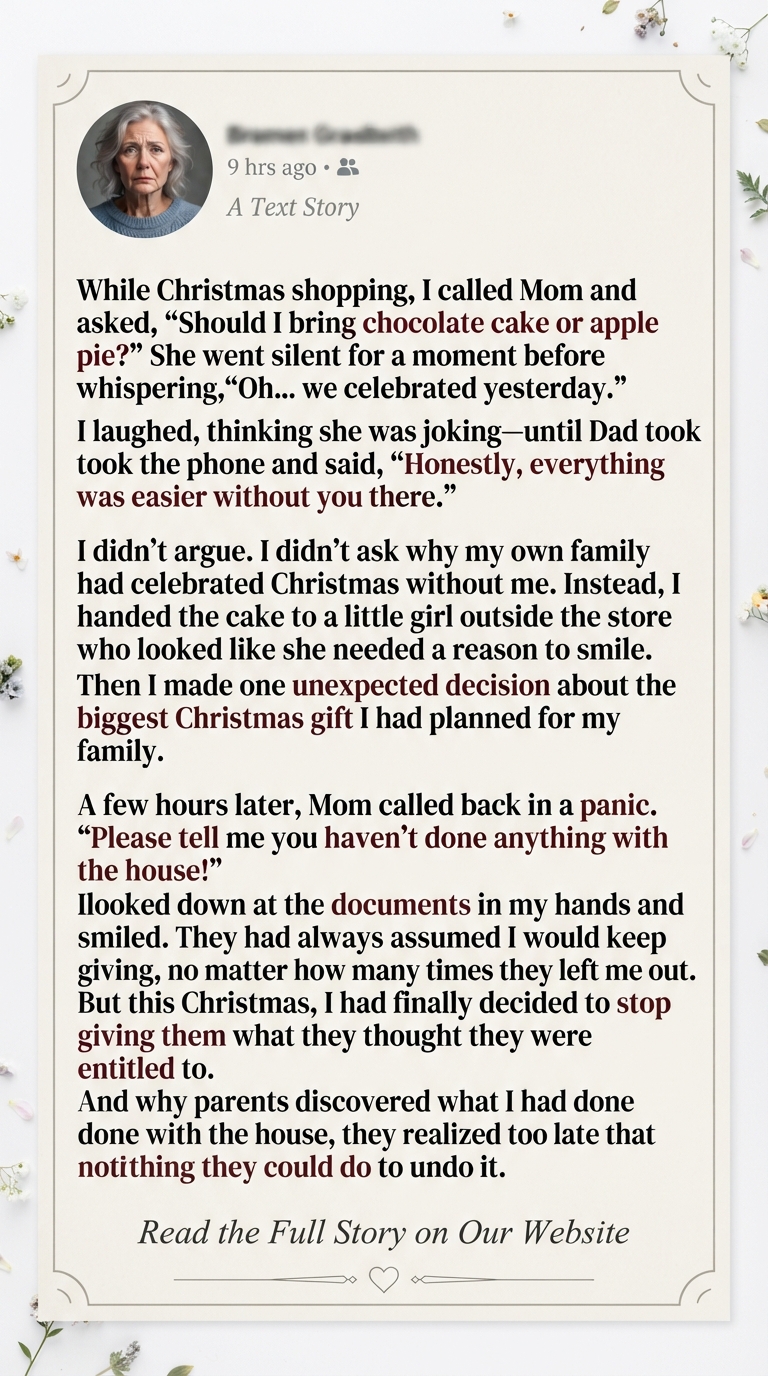
While Christmas shopping, I called Mom and asked, “Should I bring chocolate cake or apple pie?”
She went silent for a moment.
Then she whispered, “Oh… we celebrated yesterday.”
I laughed because I thought she was joking.
“Mom, Christmas is tomorrow.”
“I know.”
Her voice sounded uncomfortable.
I waited.
Then Dad took the phone.
“Honestly,” he said, “everything was easier without you there.”
I didn’t know what to say.
For a few seconds, I stood in the middle of the crowded department store with Christmas music playing overhead.
People were laughing.
Children were carrying toys.
Couples were choosing gifts.
And I was standing there realizing that my own parents had celebrated Christmas without me.
I forced a small laugh.
“Okay.”
Dad didn’t apologize.
Mom didn’t say anything.
I ended the call.
I looked down at the chocolate cake in my shopping cart.
I’d bought it because Mom loved chocolate cake.
I’d also spent the morning buying gifts for everyone.
Dad’s favorite whiskey.
Mom’s expensive perfume.
My brother’s new tablet.
My sister’s designer handbag.
And one enormous gift I had spent months preparing.
The house.
My parents’ house.
The house they had lived in for thirty-seven years.
The house I had quietly planned to give them.
They didn’t know yet.
I had purchased it two years earlier after they fell behind on their mortgage.
I had paid the remaining balance, transferred the title into my name, and allowed them to live there without paying rent.
They thought the house was still theirs.
I had never corrected them.
Because I never wanted anything from my parents.
I just wanted to make their lives easier.
But standing in that store, I suddenly realized something.
They had never asked themselves whether I was okay.
They had only asked themselves what I would give them next.
I pushed the cart toward the exit.
Outside the store, a little girl was sitting beside her mother.
The girl was staring at the Christmas displays through the glass.
She looked about seven.
I handed her the chocolate cake.
“Here.”
Her eyes widened.
“For me?”
I smiled.
“For you.”
Her mother looked surprised.
“You don’t have to—”
“I know.”
The little girl hugged the cake.
“Thank you.”
And somehow, that tiny smile felt more like Christmas than anything my family had planned.
I walked back to my car.
Then I made the decision.
The biggest decision I’d ever made.
I took out my phone and called my attorney.
“I’m ready to sign the transfer.”
Three hours later, Mom called.
Her voice was frantic.
“Please tell me you haven’t done anything with the house!”
I looked down at the documents in my hands.
“I have.”
Silence.
“What did you do?”
“I transferred ownership.”
“To Dad?”
“No.”
“Then who?”
I took a breath.
“To the family who lives in the neighborhood shelter.”
Mom gasped.
“You WHAT?”
“I donated the house.”
“You can’t do that!”
“Yes, I can.”
“But that’s our house!”
“No, Mom.”
I looked at the signed deed.
“It hasn’t been your house for two years.”
She became completely silent.
Then Dad grabbed the phone.
“You’ve lost your mind.”
“No.”
“You can’t just take our home away.”
“I didn’t take it away.”
“You bought it for us!”
“I bought it so you wouldn’t lose it.”
“Exactly!”
His voice became louder.
“So it’s ours!”
I closed my eyes.
That one sentence told me everything I needed to know.
Not once did he say thank you.
Not once did he ask why.
Not once did he say he was sorry.
He simply believed my generosity had created an obligation.
“You’re right about one thing,” I said.
“What?”
“I did buy it for you.”
Dad waited.
“And now I’ve decided where it should go.”
The house had become a symbol in our family long before I bought it.
My parents had raised three children there.
I had grown up in the small bedroom at the end of the hallway.
My brother, Jason, had the larger room.
My sister, Emily, had the room overlooking the backyard.
I had always been the quiet one.
The dependable one.
The one who didn’t complain.
When I moved away for college, I sent money home whenever I could.
When Dad’s business struggled, I paid several of his bills.
When Mom needed surgery, I covered the medical expenses their insurance didn’t pay.
When Jason lost his job, I helped him make his mortgage payments.
When Emily divorced her husband, I paid for her apartment for six months.
I never kept score.
That was my mistake.
Because while I thought I was helping my family through difficult seasons, they slowly began treating my help like a permanent family benefit.
Jason once joked, “You’re basically the emergency bank.”
Everyone laughed.
I laughed too.
But the truth was, they had stopped seeing my generosity as generosity.
They saw it as my responsibility.
Then came the house.
Two years earlier, my father called me late one night.
“We’re going to lose it.”
His voice was shaking.
The mortgage company had sent a final notice.
They were three months behind.
My parents were both retired.
They couldn’t refinance.
I had the money.
So I paid the entire remaining balance.
When Dad asked whose name should go on the new paperwork, I told him to put it in mine temporarily.
“It’ll make things easier,” I said.
He agreed.
I never mentioned that I could have sold the house immediately.
Instead, I let them stay there.
I paid the property taxes.
I paid for the new roof.
I repaired the plumbing.
I replaced the furnace.
I even renovated the kitchen.
And every Christmas, I brought gifts.
I thought I was taking care of my parents.
But I had confused love with obligation.
The next morning, Mom came to my apartment.
She was crying.
“How could you do this?”
I opened the door.
She walked inside.
“That’s the only home we’ve ever known.”
“I know.”
“Your father built that house.”
“I know.”
“You can’t just give it away.”
“I didn’t give it away.”
She looked at me.
“I donated it to a nonprofit that helps families who are transitioning out of homelessness.”
Her face changed.
“Why them?”
“Because they’ll appreciate it.”
Mom looked hurt.
“We’re your parents.”
“And they’re people who need a home.”
She sat down.
For the first time, she looked genuinely confused.
“Why are you doing this?”
I stared at her.
“Because you celebrated Christmas without me.”
She looked away.
“That wasn’t supposed to happen.”
“It happened.”
“We thought you were busy.”
“I called you.”
“I know.”
“You knew I was coming.”
Mom didn’t answer.
“Why didn’t you tell me?”
She wiped her eyes.
“Your father thought it would be easier.”
“Easier for whom?”
She didn’t respond.
I already knew.
Dad arrived an hour later.
He didn’t apologize.
He came with Jason and Emily.
All three stood in my living room like I was the one who had done something wrong.
Dad held a folder.
“We talked to an attorney.”
I almost smiled.
“About what?”
“The house.”
“It’s legally mine.”
“We know.”
“Then what’s the problem?”
Dad looked at Jason.
Jason stepped forward.
“You promised Mom and Dad they could live there forever.”
“I never promised that.”
“You implied it.”
“No.”
Emily crossed her arms.
“You know how much that house means to us.”
I nodded.
“I do.”
“Then why would you give it away?”
I looked at all three of them.
“Because I finally realized something.”
Nobody spoke.
“I spent years giving because I thought my family needed me.”
I paused.
“But you didn’t need me.”
Dad frowned.
“You expected me.”
That sentence silenced the room.
Jason looked down.
Emily’s expression softened.
Dad said nothing.
I continued.
“There’s a difference.”
Then I gave them the final documents.
The nonprofit had agreed to let my parents remain in the house for ninety days while they found another place.
They wouldn’t be thrown out.
They wouldn’t become homeless.
They simply wouldn’t own the property.
Mom looked at the paperwork.
“You’re giving us ninety days?”
“Yes.”
“That’s all?”
“No.”
I reached into the folder.
“I also opened a retirement account for you three years ago.”
Dad looked up.
“What?”
“I deposited money into it every month.”
Mom stared at me.
“Why?”
“Because I wanted you to be secure.”
She started crying.
“How much?”
“Enough for you to live comfortably if you stop spending like I’m going to rescue you every time something goes wrong.”
Dad sat down.
For the first time, he looked ashamed.
“You did all that?”
“Yes.”
“And you never told us?”
“I didn’t want praise.”
I looked at him.
“I wanted you to be okay.”
He covered his face with his hands.
The room became quiet.
Then Dad finally said something I had been waiting years to hear.
“I was wrong.”
I didn’t answer.
He looked at me.
“We were wrong.”
Mom nodded through her tears.
“We took you for granted.”
“Yes,” I said quietly.
“You should have told us.”
“I tried.”
She looked confused.
“How?”
“Every time I stopped helping, you got angry.”
She lowered her eyes.
That was the truth.
Christmas morning came.
I woke up alone.
For the first time in years, I didn’t have a pile of presents waiting to be delivered.
I didn’t have to drive across town.
I didn’t have to pretend everything was fine.
I made coffee.
Then my phone buzzed.
It was a text from the nonprofit.
“The family has moved in.”
Attached was a photograph.
A mother standing in the kitchen with two children.
The little girl was holding a Christmas stocking.
On the refrigerator was a child’s drawing of a house.
Underneath it were the words:
OUR FIRST CHRISTMAS HOME.
I stared at the picture for a long time.
Then I cried.
Not because I regretted what I had done.
Because for the first time, I knew exactly where my money had gone.
It had become a home for people who had nowhere else to go.
Later that afternoon, Mom called.
“Your father wants to speak with you.”
I hesitated.
Then I answered.
Dad’s voice sounded different.
Softer.
“I owe you an apology.”
“You do.”
“I thought because you were our daughter, you would always take care of us.”
“I know.”
“I was wrong.”
I didn’t say anything.
He continued.
“You gave us everything.”
“No, Dad.”
I looked out the window.
“I gave you too much.”
He was silent.
Then he said, “Are you coming for Christmas dinner?”
I smiled.
“No.”
He sounded disappointed.
“I understand.”
“But I might come next year.”
There was a pause.
“Really?”
“Yes.”
“Why?”
“Because if I come, I want to be there because I’m your daughter.”
I took a breath.
“Not because I’m paying for anything.”
Dad’s voice cracked.
“I understand.”
And for the first time in my life, I believed him.
A few weeks later, my parents moved into a smaller home.
It wasn’t the house they had lived in for thirty-seven years.
But it was warm.
Affordable.
And theirs.
Jason got a job and stopped asking me for money.
Emily began supporting herself.
And slowly, my family learned something they should have learned years earlier.
Love doesn’t mean unlimited access to another person’s money, time, or forgiveness.
And generosity is a gift.
Not a contract.
I still talk to my parents.
I still love them.
But I no longer rescue everyone.
I no longer say yes when I mean no.
And I no longer give just because someone expects me to.
That Christmas, my family thought I had taken something away from them.
But the truth was, I had finally given myself something I’d never given before.
A boundary.
And strangely enough, that was the first gift they ever truly appreciated.