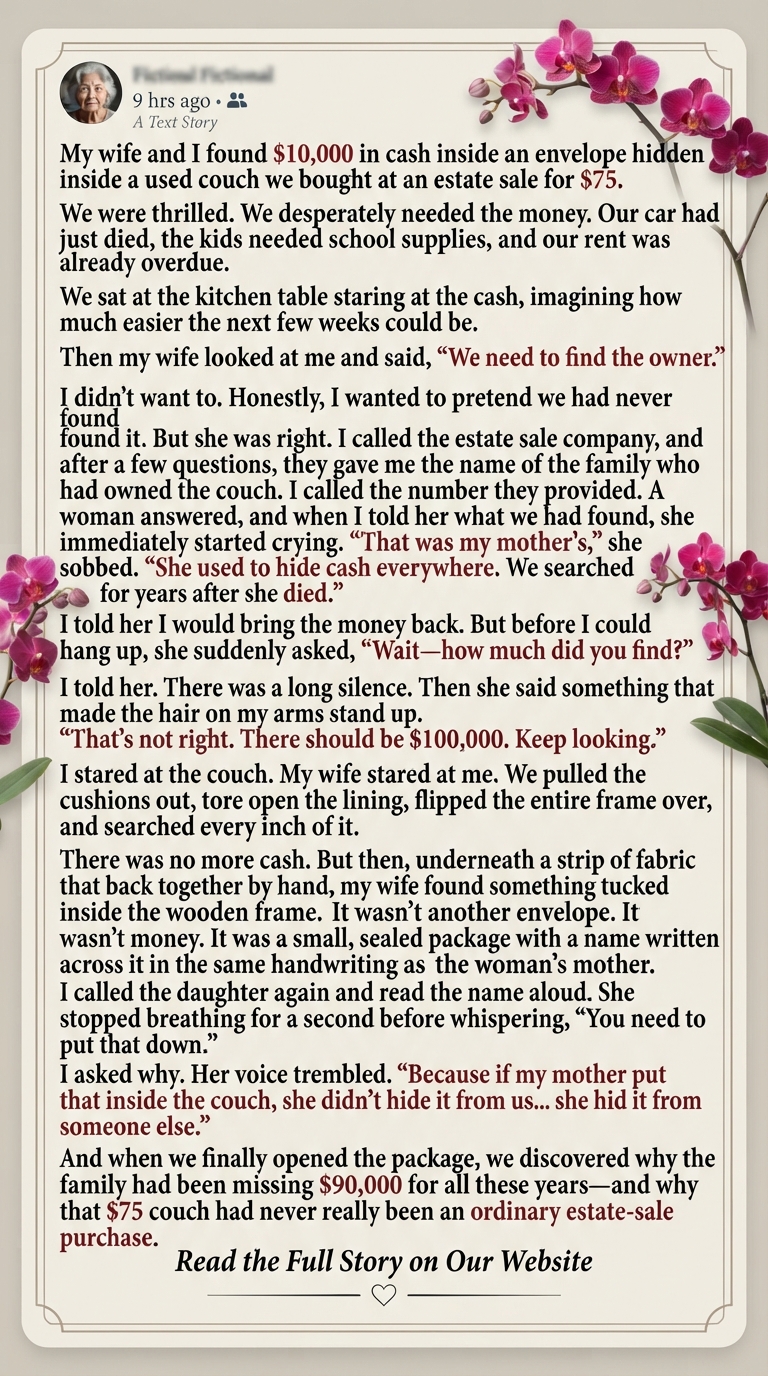
My wife and I found $10,000 in cash inside an envelope hidden inside a used couch we bought at an estate sale for $75.
We were thrilled.
We desperately needed the money.
Our car had just died. The kids needed school supplies. Our rent was already overdue, and I had spent the previous night calculating which bills we could postpone without getting another late notice.
We sat at the kitchen table staring at the cash.
Ten thousand dollars.
It felt unreal.
My wife, Rachel, picked up one stack and ran her thumb across the edges.
“We could catch up on rent,” she said quietly.
“And fix the car.”
“And buy the kids what they need for school.”
For a few seconds, neither of us spoke.
Then Rachel looked at me.
“We need to find the owner.”
I sighed.
Honestly, I didn’t want to.
The estate sale had been legitimate. We had paid $75 for the couch. Nobody had told us there was money inside it. I could already hear the argument in my head.
“Finders keepers.”
“They sold the couch.”
“We didn’t steal anything.”
But Rachel shook her head.
“Imagine if it were your mother.”
That ended the argument.
I called the estate sale company.
After several questions, they found the transaction record and gave me the name of the family who had owned the couch.
I called the number they provided.
A woman answered.
“Hello?”
“Hi. My name is Daniel. I bought a couch from your mother’s estate sale.”
There was a pause.
“Okay.”
“I think we found something inside it.”
“What?”
“Cash.”
Her breathing changed.
“How much?”
“Ten thousand dollars.”
She suddenly started crying.
“That was my mother’s.”
I sat up straighter.
“She used to hide cash everywhere,” the woman said through tears. “We searched for years after she died. We knew she had money somewhere, but we could never find it.”
I looked at Rachel.
“I’ll bring it back,” I told her.
“Thank you.”
I was about to hang up when she suddenly said, “Wait.”
“What?”
“How much did you say?”
“Ten thousand.”
There was a long silence.
Then she whispered:
“That’s not right.”
“What do you mean?”
“There should be one hundred thousand dollars.”
Rachel slowly lowered the cash onto the table.
I stared at her.
The woman continued.
“My mother kept exactly $100,000 in cash. She told my brother and me about it years ago. We searched every drawer, every closet, every box. We even hired someone to look through the house.”
“So maybe she spent some of it?”
“No.”
Her voice became strangely firm.
“She never spent it.”
“Then where is the rest?”
“I don’t know.”
Another silence.
Then she said something that made the hair rise on my arms.
“Keep looking.”
We pulled the cushions off the couch.
Nothing.
We removed the fabric underneath.
Nothing.
We turned the couch upside down.
Rachel ran her fingers along every wooden beam.
I checked the seams with a flashlight.
Still nothing.
Then Rachel noticed something.
“Wait.”
She pointed toward a narrow strip of fabric underneath the frame.
It had been sewn back together by hand.
The stitching looked old.
Careful.
Deliberate.
I cut the thread.
Something slid out.
It wasn’t another envelope.
It wasn’t money.
It was a small sealed package wrapped in brown paper.
On the front was a name.
Thomas Reed.
Rachel looked at me.
I called the daughter again.
When she answered, I read the name aloud.
She stopped breathing for a second.
Then she whispered:
“You need to put that down.”
“Why?”
“Because if my mother put that inside the couch, she didn’t hide it from us.”
She swallowed.
“She hid it from someone else.”
I looked at Rachel.
“Who was Thomas Reed?”
The woman didn’t answer immediately.
Finally she said:
“My mother’s accountant.”
My stomach tightened.
“Was he involved with the estate?”
“No.”
“Then why would she hide something from him?”
“Because he wasn’t just her accountant.”
Her voice cracked.
“He was stealing from her.”
Rachel sat down.
“How much?”
“Ninety thousand dollars.”
Everything suddenly made sense.
The missing $90,000.
The strange amount.
The hidden package.
The $100,000 my mother had supposedly kept.
I carefully opened the brown paper.
Inside was a small notebook, three bank deposit slips, and a handwritten letter.
The handwriting matched the writing on the package.
Rachel unfolded the letter.
I read it aloud.
“My children,
If you are reading this, then I am gone, and Thomas believes he got away with everything.
He did not.
For the past three years, Thomas has been taking money from my accounts in small amounts. He thinks I don’t notice because I am old.
I notice everything.
The total is $90,000.
I confronted him once.
He threatened me.
He told me nobody would believe an old woman over a respected financial adviser.
So I stopped confronting him.
Instead, I started collecting proof.”
Rachel looked at the bank slips.
There were dates and amounts written beside each one.
$4,500.
$7,000.
$2,300.
$9,000.
The total came to exactly $90,000.
Then the letter continued.
“I put the evidence inside the couch because Thomas has access to my house and knows where I keep important papers.
He will look for my safe.
He will look through my desk.
He will search my bedroom.
He will never think to look inside a couch he believes is worthless.
If my children find this, do not confront Thomas yourselves.
Take this to the police.
And remember this:
The $100,000 was never lost.
I divided it.
$10,000 is in the envelope.
The remaining $90,000 was stolen by Thomas.
I have spent years waiting for someone to believe me.”
The letter ended with one final sentence.
“Now you have proof.”
Rachel stared at me.
“Daniel…”
“I know.”
We didn’t take another dollar.
The next morning, we brought everything to the police.
The investigators contacted the bank.
The deposits matched.
The handwriting matched.
The account records matched.
And then they discovered something even worse.
Thomas Reed had been accused of financial misconduct before.
But every time someone complained, there wasn’t enough evidence to prosecute him.
Until now.
The notebook gave investigators the dates.
The bank records gave them the transactions.
And the letter explained exactly what had happened.
Within weeks, Thomas was charged with multiple counts of financial fraud and theft from an elderly client.
The family’s missing $90,000 became part of the case.
But there was another surprise.
The estate attorney contacted us.
He told us that the $10,000 envelope had never been included in the estate inventory because nobody knew it existed.
Legally, the family could have pursued us for it.
Instead, the daughter called us.
“I want you to keep it,” she said.
I immediately refused.
“No. It belongs to your family.”
She laughed softly.
“My mother would disagree.”
“What?”
“She wrote one more thing on the back of the letter.”
I hadn’t noticed.
The daughter read it to me.
“She said, ‘If strangers are the ones who find this money and return it, give them the $10,000. Good people deserve to be helped sometimes.’”
I looked at Rachel.
Neither of us knew what to say.
The $10,000 paid our overdue rent.
It repaired our car.
It bought backpacks, shoes, notebooks, and school supplies for our kids.
And we put the last few hundred dollars into savings.
But the couch?
We never kept it.
The estate attorney eventually arranged for it to be donated to a local charity.
Before it left our house, Rachel stood beside it for a moment.
“You know,” she said, “we almost kept the money.”
“I know.”
“And if we had…”
I shook my head.
“We wouldn’t have found the package.”
She nodded.
That $75 couch had looked like nothing.
A worn-out piece of furniture someone was willing to get rid of.
But hidden inside it was a story about an old woman who had been robbed, an accountant who thought he could bury the truth, and a family that had spent years wondering where $100,000 had disappeared.
The money wasn’t the real treasure.
The proof was.
Because sometimes the thing people hide isn’t valuable because of what it can buy.
It’s valuable because it can finally make someone believe what happened.
And to this day, whenever I see an old couch at an estate sale, Rachel gives me the same look.
I always laugh.
“Don’t worry,” I tell her.
“We’re not buying another one.”
She smiles.
“Good.”
“Why?”
“Because,” she says, “we already got our miracle.”