The Promise in the Yearbook
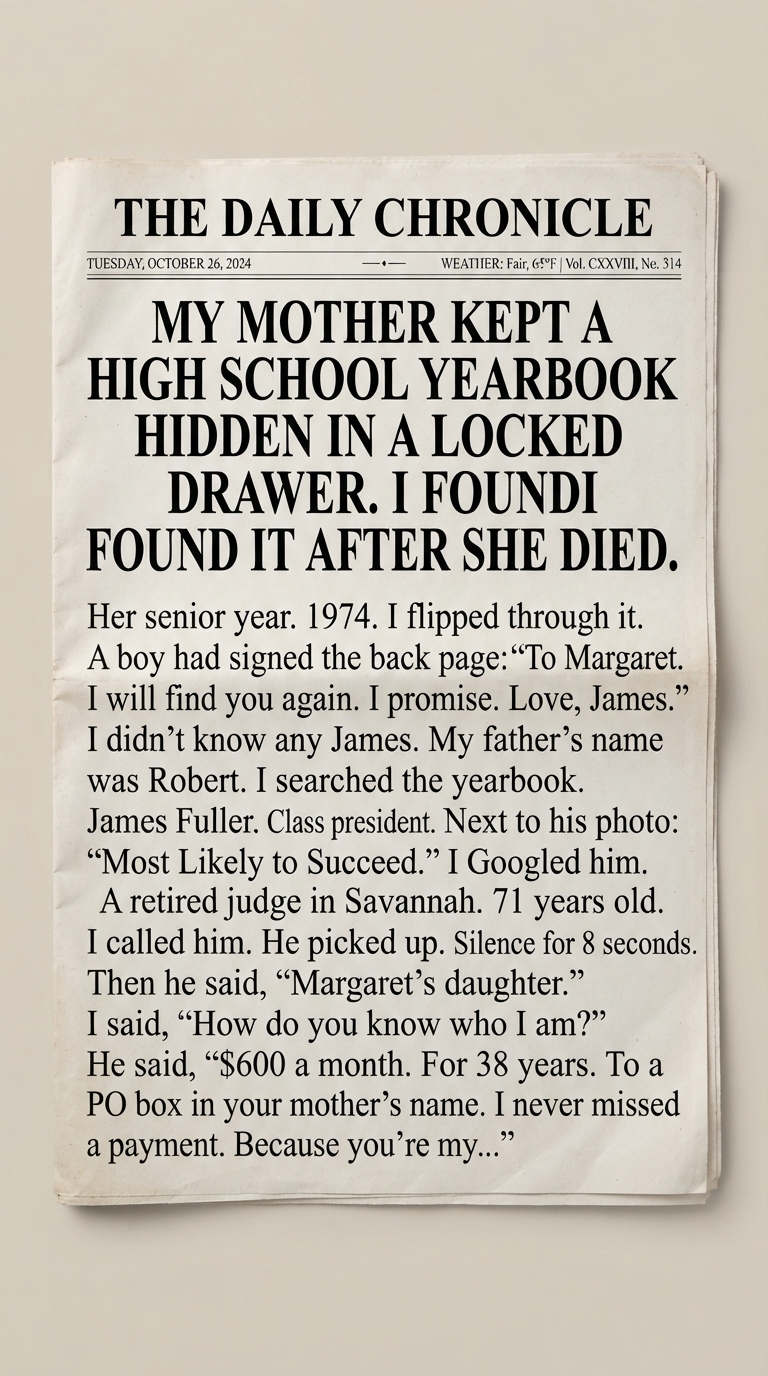
My mother kept a high school yearbook hidden in a locked drawer.
I found it three days after she died.
For most of my life, my mother, Margaret, had been a private person. She wasn’t secretive exactly. She simply had parts of herself she never discussed.
She rarely talked about high school.
She never mentioned old boyfriends.
And whenever I asked about the years before she married my father, Robert, she would smile and say:
“That was a long time ago, sweetheart.”
Then she would change the subject.
After the funeral, I returned to her house to sort through her things.
My father had died six years earlier, and now the house felt unbearably quiet.
I opened closets.
Sorted photographs.
Folded clothes.
And tried not to cry every time I found something that still smelled like her.
Then I came to the old desk in her bedroom.
The bottom drawer was locked.
I almost left it alone.
But taped beneath the desk was a tiny key.
I remember staring at it.
Mom had hidden the key in the most obvious place imaginable.
Like she had wanted someone to find it.
Eventually.
My hands shook as I unlocked the drawer.
Inside were old letters tied with ribbon.
A faded photograph.
A small velvet box.
And a high school yearbook.
My mother’s senior year.
I sat on the floor and opened it.
There she was.
Margaret Ellis.
Young.
Beautiful.
Smiling in a way I had rarely seen her smile as an adult.
I turned the pages slowly.
Messages from classmates.
Teachers.
Friends.
Then I reached the back page.
And stopped.
Someone had written:
To Margaret.
I will find you again. I promise.
Love, James.
I read it three times.
James?
I didn’t know any James.
My father’s name had been Robert.
I searched through the yearbook until I found him.
James Fuller.
Class president.
Most Likely to Succeed.
There was something familiar about his face.
Not enough that I could explain.
But enough to make my heart beat faster.
That night, I searched for him.
It didn’t take long.
James Fuller.
Retired judge.
Savannah, Georgia.
Seventy-one years old.
I stared at the phone number for almost an hour.
Then I called.
It rang twice.
“Hello?”
His voice was older than I expected.
Deep.
Careful.
I swallowed.
“Is this Judge Fuller?”
“Yes.”
“My name is—”
Then there was silence.
Eight seconds.
I counted them.
One.
Two.
Three.
Four.
Five.
Six.
Seven.
Eight.
Then he said:
“Margaret’s daughter.”
Every hair on my arms stood up.
I sat straight up in my chair.
“How do you know who I am?”
Another pause.
Then he exhaled.
Slowly.
And said:
“Six hundred dollars a month. For thirty-eight years. To a post office box in your mother’s name. I never missed a payment.”
I couldn’t speak.
The room seemed to tilt.
“What?”
His voice cracked.
“Because you’re my daughter.”
The phone nearly fell from my hand.
For several seconds, neither of us spoke.
Then I whispered:
“My father was Robert.”
“No,” James said quietly.
“Robert raised you.”
I stood up.
“No.”
“Yes.”
“My mother never told me.”
“I know.”
“You knew about me?”
“Yes.”
“For thirty-eight years?”
“Yes.”
I began pacing across the room.
My entire life suddenly felt unstable.
Every memory.
Every family photograph.
Every story my mother had told me.
I looked at the yearbook lying open on the table.
“I don’t understand.”
“I didn’t expect you to.”
“Then explain it.”
James went quiet.
Finally, he said:
“Your mother and I were together in high school. We planned to marry.”
I closed my eyes.
“But?”
“But life happened.”
I laughed bitterly.
“That isn’t an explanation.”
He sighed.
“No. It isn’t.”
Then he told me.
After graduation, James left for college.
Margaret stayed behind.
They promised to write.
They promised to visit.
And according to him, for a while, they did.
Then one day, her letters stopped.
James called.
Her mother answered.
She told him Margaret had moved on.
That she was seeing someone else.
Robert.
My father.
James believed it.
Until almost two years later.
He received one final letter.
Not from Margaret.
From a lawyer.
It informed him that Margaret had given birth to a daughter.
Me.
My hands began shaking.
“What did you do?”
“I drove to her house.”
“And?”
“Her parents wouldn’t let me see her.”
I sat down.
James continued.
“Her father told me that Margaret had married Robert.”
My chest tightened.
“And you just accepted that?”
“I was twenty-one.”
His voice broke.
“I was angry. I was confused. I thought she’d chosen him.”
I looked toward my mother’s empty bedroom.
“She did choose him.”
“I know.”
The words were almost too quiet to hear.
“What do you mean?”
James took a deep breath.
“Your mother called me.”
“When?”
“The day before her wedding.”
My heart stopped.
“She called me and said she was sorry.”
“For what?”
“She said she loved me.”
I covered my mouth.
James continued.
“But she said Robert had agreed to marry her. To give you his name. To raise you as his own.”
I couldn’t breathe.
“Why?”
“Because she was pregnant.”
I closed my eyes.
The truth was beginning to form.
My mother had been pregnant with me.
James had been away.
Robert had stepped into the picture.
But there was still something I didn’t understand.
“If you knew I was your daughter, why didn’t you come?”
His answer came immediately.
“Because your mother asked me not to.”
Silence.
Then I heard him say:
“She said she couldn’t give you a stable life if we kept fighting.”
I felt tears running down my face.
“So she chose Robert?”
“She chose peace.”
I looked at the yearbook.
At his promise.
I will find you again.
“And the money?”
I asked.
James became quiet.
“Your mother never wanted money from me.”
“Then why did you send it?”
“Because I was your father.”
I couldn’t speak.
“Every month?”
“Yes.”
“For thirty-eight years?”
“Yes.”
“Why didn’t I know?”
“Because the agreement was that you wouldn’t.”
I felt anger rising inside me.
“At Mom?”
“No,” he said softly. “At me, if you need to.”
I sat down again.
For thirty-eight years, this man had quietly sent money to a post office box.
Money I had never seen.
Money my mother had kept separate from our lives.
Or so I thought.
I looked around the room.
Then something caught my attention.
The old velvet box.
I opened it.
Inside was a tiny silver key.
Engraved on it were three numbers.
317.
My heart started racing.
“James.”
“Yes?”
“Did my mother leave anything else?”
He went silent.
Then he said:
“Look for a letter.”
I froze.
“How do you know?”
“Because she told me she would.”
I searched the drawer.
Underneath the stack of letters was an envelope.
My name was written on the front.
The handwriting was unmistakably hers.
I stared at it.
“Mom?”
I whispered.
Then I opened it.
My darling,
If you are reading this, then I am gone, and I am sorry that I was not brave enough to tell you the truth myself.
I stopped.
My tears blurred the words.
James Fuller is your biological father. Robert was the man who chose to become your father.
My chest tightened.
You were not an accident. You were not a mistake. You were loved before you were even born.
I kept reading.
Then I reached the part that changed everything.
Robert knew from the beginning that James was your biological father.
I stared at the page.
My father knew.
All my life.
And he had never told me.
Mom’s letter explained why.
James had offered to return.
He had offered to marry her.
But Margaret had discovered something that terrified her.
James had accepted a prestigious scholarship overseas.
His future was uncertain.
Robert had a steady job.
A home.
A family who welcomed her.
And Robert knew Margaret was pregnant.
He told her:
“I can’t give you the past you wanted. But I can give your child a future.”
Mom married him.
And Robert became my father.
Not because he had to.
Because he chose to.
I began sobbing.
All those years, I had assumed my father was simply my father because biology had decided it.
But the truth was more powerful.
Robert had looked at a frightened young woman carrying another man’s child and said:
I’ll stay.
Mom’s letter continued.
James was heartbroken, but he agreed to let Robert raise you. He asked only that he be allowed to help provide for you.
That was the beginning of the $600 payments.
Mom wrote that she had used some of the money for my education.
My school clothes.
My piano lessons.
My college fund.
But she had hidden the source.
Because she never wanted me to grow up feeling divided between two fathers.
Then came the final paragraph.
You may be angry with me. You have every right to be. But please understand this: I did not hide the truth because I was ashamed of you. I hid it because I was afraid that telling you would make you question the love you already had.
Robert was your father in every way that mattered.
James was your father too, even from far away.
I lowered the letter.
For a long time, I couldn’t move.
Then I looked at the silver key.
I called James again.
“It’s a safe-deposit box,” he said.
“How did you know?”
“Your mother and I arranged it years ago.”
“You arranged this?”
“Yes.”
“When?”
“Thirty-eight years ago.”
I drove to the bank the next morning.
The box had been in my mother’s name.
But the documents inside listed me as the beneficiary.
I placed the key in the lock.
My hands trembled as I opened it.
Inside were dozens of envelopes.
One for every year of my life.
And beneath them, a photograph.
It showed my mother.
Young.
Pregnant.
Standing beside two men.
Robert was on one side.
James was on the other.
Both had their hands resting gently on her shoulders.
I sat down.
There was no hatred in the photograph.
No rivalry.
Only sadness.
And something else.
Love.
I opened the first envelope.
It was dated the year I was born.
Inside was a short letter from James.
Today, you came into the world. I have not met you. I don’t know if I ever will. But I want you to know that there will never be a day when I don’t wonder who you are becoming.
I opened another.
My sixth birthday.
Your mother says you like drawing horses. I hope one day you draw one for me.
Another.
My thirteenth birthday.
Today you became a teenager. I imagine Robert is having a difficult time. Tell him I said good luck.
Despite everything, I laughed through my tears.
Every year of my life, James had written to me.
Letters I had never known existed.
He knew when I started school.
When I won a science award.
When I broke my arm.
When I went to college.
Mom had told him.
Quietly.
From a distance.
They had never truly forgotten each other.
They had simply kept their promise in a different way.
At the bottom of the box was one final letter.
It was from James.
Dated three months before my mother’s death.
It said:
Margaret, I know we are old now. I know the past cannot be changed. But I kept my promise. I found you again.
Underneath it, in my mother’s handwriting, was her reply.
You never stopped finding me. You just learned to do it from far away.
I cried until I couldn’t read anymore.
Three weeks later, I drove to Savannah.
I called James when I arrived.
He told me to meet him at a small park near the courthouse where he had spent most of his career.
I saw him sitting alone on a bench.
He was holding something in his hands.
My high school graduation photograph.
I recognized it immediately.
Mom had taken the picture.
“How did you get that?”
He smiled nervously.
“Your mother sent me a copy.”
I stood there.
For thirty-eight years, I had imagined my family was simple.
A mother.
A father.
A daughter.
But life had been far more complicated.
And somehow, far more loving than I had ever known.
James stood slowly.
Neither of us knew what to say.
Finally, he whispered:
“You look like her.”
I started crying.
Then I walked toward him.
He opened his arms.
And for the first time in my life, I hugged my biological father.
He held me carefully.
Like he was afraid I might disappear.
“I’m sorry,” he whispered.
“For what?”
“For missing your whole life.”
I pulled back.
“You didn’t miss all of it.”
He looked at me.
I handed him one of the letters from the safe-deposit box.
“You were there.”
James began crying.
We sat on that bench for hours.
He told me stories about my mother.
Not the mother I knew.
The teenage girl who once skipped class to watch the sunrise.
The girl who loved old jazz records.
The girl who dreamed of becoming a writer.
For the first time since she died, I felt like I was meeting her again.
Months later, I visited my father’s grave.
Robert’s.
I brought flowers.
And I brought a copy of the old photograph from the bank.
I placed it beside his headstone.
For a long time, I stood silently.
Then I whispered:
“I know.”
The wind moved through the trees.
I smiled through my tears.
“You didn’t have to be my father.”
But he was.
He taught me to ride a bicycle.
He waited outside my bedroom when I was sick.
He cried when I left for college.
He walked me down the aisle.
And apparently, for my entire life, he had carried a secret that could have changed everything.
But he never used it to make me feel less like his daughter.
Because being a father had never been about sharing my blood.
It had been about choosing me.
And James?
James had chosen me too.
In his own quiet way.
Every month.
Every letter.
Every year.
I grew up believing I had one father.
After my mother died, I discovered I had two.
One gave me his name.
The other gave me half his blood.
But both, in their own way, gave me something even more important.
They gave me love.
And in the end, I finally understood the promise James had written in that yearbook more than fifty years earlier.
I will find you again.
He had.
He just waited thirty-eight years for me to find him too.