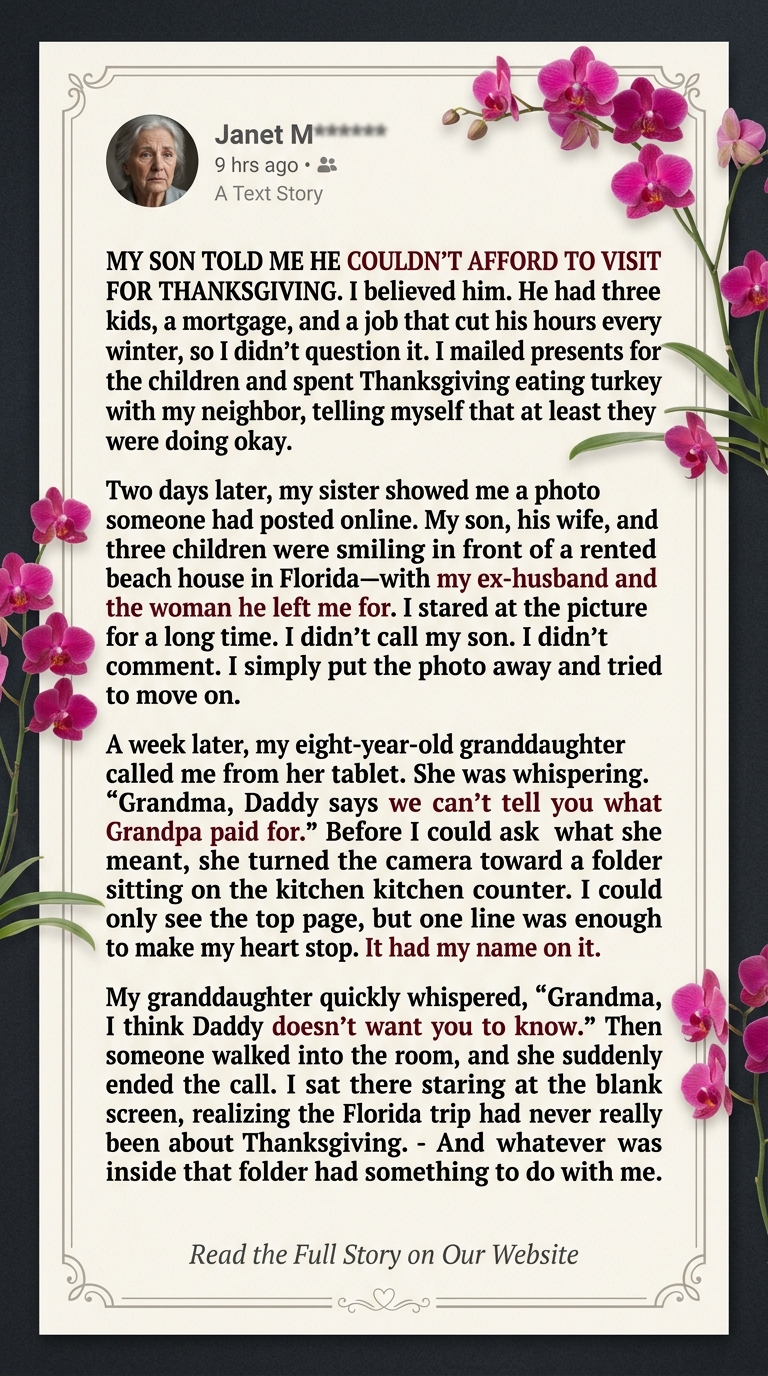
My son told me he couldn’t afford to visit for Thanksgiving.
I believed him.
He had three kids, a mortgage, and a job that cut his hours every winter, so I didn’t question it.
I mailed presents for the children and spent Thanksgiving eating turkey with my neighbor, telling myself that at least they were doing okay.
Two days later, my sister showed me a photo someone had posted online.
My son, his wife, and all three children were smiling in front of a rented beach house in Florida.
With my ex-husband.
And the woman he left me for.
I stared at the picture for a long time.
I didn’t call my son.
I didn’t comment.
I simply put the photo away and tried to move on.
A week later, my eight-year-old granddaughter called me from her tablet.
She was whispering.
“Grandma, Daddy says we can’t tell you what Grandpa paid for.”
Before I could ask what she meant, she turned the camera toward a folder sitting on the kitchen counter.
I could only see the top page.
But one line was enough to make my heart stop.
It had my name on it.
My granddaughter quickly whispered,
“Grandma, I think Daddy doesn’t want you to know.”
Then someone walked into the room.
She suddenly ended the call.
I sat there staring at the blank screen.
The Florida trip had never really been about Thanksgiving.
And whatever was inside that folder had something to do with me.
I didn’t sleep that night.
Not because I was angry.
Because I was afraid.
My son, Daniel, had never been good with money.
But he had always been honest with me.
At least, I thought he had.
The next morning, I called my sister.
“Do you know anything about a folder at Daniel’s house with my name on it?”
She was quiet.
“Why?”
“Because Emma showed it to me.”
My sister sighed.
“Then you should probably talk to Daniel.”
“That’s not an answer.”
“No.”
Another pause.
“It’s not.”
I knew my sister well enough to recognize fear in her voice.
“What aren’t you telling me?”
She finally said,
“Your ex-husband has been contacting Daniel for months.”
My stomach tightened.
“Why?”
“I don’t know everything.”
“Then tell me what you do know.”
She told me that three months earlier, my ex-husband, Richard, had contacted Daniel and offered to pay for a family vacation.
Daniel had refused at first.
Then Richard offered to cover the children’s expenses.
Daniel’s youngest had needed braces.
Their mortgage had fallen behind.
His work hours had been reduced.
Richard offered to pay for all of it.
In exchange, he wanted Daniel to sign some paperwork.
“What paperwork?”
“I don’t know.”
I hung up.
Then I called Daniel.
He didn’t answer.
I called again.
Nothing.
I texted him.
We need to talk.
Five minutes later, he replied.
About what?
I stared at the screen.
Then I wrote:
Emma showed me the folder.
He didn’t respond.
Not for ten minutes.
Not for an hour.
Finally:
Mom, please don’t make this worse.
I felt something inside me sink.
I wrote back:
Then tell me what it is.
He called.
“Mom.”
His voice sounded exhausted.
“What’s in the folder?”
Silence.
“Daniel.”
“I was going to tell you.”
“When?”
“I don’t know.”
“Before or after Dad got what he wanted?”
He didn’t answer.
I closed my eyes.
“What did you sign?”
“Nothing that hurts you.”
“That isn’t what I asked.”
Another silence.
Then he said,
“Dad wanted to settle something from the divorce.”
My heart started pounding.
“What does that mean?”
“It means he said there were assets you never received.”
I laughed bitterly.
“After thirty-two years, your father suddenly found his conscience?”
“Mom—”
“He left me with two children and $8,000 in debt.”
“I know.”
“He took the house.”
“I know.”
“He emptied our joint savings account.”
“I know.”
“And now he’s suddenly claiming he owes me money?”
Daniel’s voice became quieter.
“He says you signed something back then.”
My stomach dropped.
“What?”
“A property agreement.”
I remembered it.
Thirty-two years earlier, during the divorce, Richard had pressured me to sign several documents.
He said they were temporary.
I was exhausted.
I had two young children.
I trusted the attorney who had told me the divorce would be finalized quickly.
I never saw some of those documents again.
“What property agreement?”
Daniel said,
“Dad claims you agreed to let him keep a rental property in exchange for a larger share of your retirement account.”
I almost laughed.
“I didn’t have a retirement account.”
“I know.”
“Then why would I sign that?”
“I don’t know.”
I heard something in his voice.
Fear.
Not guilt.
Fear.
“Daniel,” I said slowly.
“What?”
“What did Dad pay you to sign?”
He didn’t answer.
That was enough.
I drove to his house the next morning.
When he opened the door, he looked like he hadn’t slept.
His wife, Megan, stood behind him.
Neither said hello.
I walked inside.
“Where’s the folder?”
Daniel looked at Megan.
She nodded.
He went into the kitchen.
A moment later, he returned with it.
He placed it on the table.
My name was typed across the front.
I opened it.
The first page was a copy of a document dated thirty-two years earlier.
My signature appeared at the bottom.
I stared at it.
I didn’t remember signing it.
But the signature looked like mine.
Daniel sat across from me.
“Dad said this proves you gave up your claim to a property in Florida.”
I looked up.
“What property?”
“The beach house.”
I stared at him.
“The house you rented for Thanksgiving?”
He nodded.
“Dad says he bought it years ago using money that was supposed to be yours.”
I flipped through the papers.
There were bank statements.
Old property records.
Divorce documents.
Tax records.
And then I saw something that made my hands shake.
A page from my old divorce file.
A settlement agreement.
But it wasn’t the agreement I remembered.
This one said I had voluntarily surrendered all rights to a small investment property in Florida.
I had never owned property in Florida.
Or at least, I didn’t think I had.
I looked at Daniel.
“Where did your father get this?”
“I don’t know.”
“Who gave you the folder?”
“His attorney.”
“And what did Dad want from you?”
Daniel lowered his head.
“He wanted me to sign a statement saying you knew about the property.”
My chest tightened.
“So the vacation was payment.”
He nodded.
“I didn’t think it was like that.”
“But it was.”
“Yes.”
I stood up.
“I need to leave.”
“Mom, please.”
I turned toward him.
“You lied to me.”
“I was scared.”
“So was I.”
He started crying.
“I thought Dad was finally going to help us.”
I looked at my son.
For the first time, I realized he hadn’t gone to Florida because he didn’t love me.
He had gone because he was desperate.
That didn’t make the lie okay.
But it explained it.
I took the folder with me.
Then I called an attorney.
Her name was Rachel Morgan.
She had handled my estate planning for years.
When she saw the documents, she immediately noticed something.
“Where did this signature come from?”
“I don’t know.”
She placed it beside my actual signature.
“It’s very close.”
“Is it mine?”
“No.”
I looked at her.
“How can you tell?”
“The pressure points are wrong.”
She explained that the signature had been traced or digitally reproduced from an older document.
Then she checked the notary information.
The notary had retired twenty-five years earlier.
The document claimed she had notarized my signature in 2001.
She died in 1998.
I stared at the page.
My stomach dropped.
“This is fake.”
Rachel nodded.
“Very likely.”
Then she searched the property records.
The Florida property did exist.
It had originally been purchased by Richard in 1991.
But there was something strange.
The original deed listed both of us as owners.
I had never known that.
Rachel found the original mortgage.
My name was on it.
Then she found the transfer.
A document filed three years after our divorce supposedly transferred my interest to Richard.
My signature was there.
Again.
Forged.
I sat back.
For thirty-two years, I had believed Richard had taken everything legally.
He hadn’t.
He had forged the paperwork after our divorce.
He had taken a property that was legally half mine.
And now, decades later, he had discovered that the mistake could cost him millions.
Because the property had been sold several times.
The small beach house was now part of a valuable parcel.
Its current value was nearly $2.4 million.
Richard wasn’t trying to prove that I owed him something.
He was trying to protect himself from losing something that had never legally belonged entirely to him.
Rachel found one more document.
A recent agreement between Richard and Daniel.
It said Daniel would testify that I had known about the Florida property and had willingly surrendered my ownership.
In exchange, Richard would pay Daniel $65,000.
My son had been paid to lie about me.
I felt like I couldn’t breathe.
But then Rachel noticed something.
The agreement had been signed after the Florida vacation.
Not before.
That meant Daniel hadn’t been paid for the trip.
He had been paid afterward.
The vacation had been the bait.
The agreement was the trap.
Rachel immediately contacted the attorney representing the current property owner.
Within weeks, a lawsuit was filed.
The original divorce records were subpoenaed.
The forensic handwriting expert confirmed that the signatures on the transfer documents were not mine.
The notary records proved the documents had been fabricated.
And then investigators found the person who had helped Richard.
His former accountant.
The accountant admitted that Richard had asked him to recreate old financial records to make it appear that I had received money in exchange for the Florida property.
The entire story collapsed.
Richard was facing charges for fraud and forgery.
The property dispute was settled.
Because I had never legally transferred my interest, I was entitled to a substantial share of the property’s value.
But there was something else I needed to deal with.
My son.
Daniel came to my house one rainy evening.
He stood on my porch for almost a minute before knocking.
When I opened the door, he looked broken.
“I know you don’t want to see me.”
“I didn’t say that.”
He looked down.
“I was wrong.”
“Yes.”
“I should have told you.”
“Yes.”
“I should never have signed anything.”
“No.”
He nodded.
“I know.”
I stepped aside.
He came in.
We sat at the kitchen table.
The same table where I had opened the folder.
“I was desperate,” he said.
“I know.”
“I thought Dad was helping me.”
“He wasn’t.”
“I know that now.”
He started crying.
“I was so ashamed that I couldn’t provide for my family.”
I looked at him.
“Daniel, being poor doesn’t make you a bad father.”
He wiped his face.
“But lying to your mother because someone offered you money does make you responsible for your choices.”
He nodded.
“I know.”
I wasn’t ready to forgive him.
Not yet.
But I wasn’t ready to lose him either.
So I told him something my own mother had once told me.
“Love doesn’t mean pretending someone didn’t hurt you.”
He looked at me.
“It means deciding what you want to do with the hurt.”
It took time.
Daniel eventually repaid the money he had received from his father.
He and Megan sold their second car and moved into a smaller house.
I helped with the children.
Not because I had forgotten what happened.
Because they weren’t responsible for their father’s choices.
And slowly, Daniel and I rebuilt our relationship.
Not the way it had been.
Better.
More honest.
There were no secrets anymore.
No pretending.
No convenient lies.
As for Richard, the legal case continued.
The Florida property was eventually sold.
My share was placed into an account under my control.
I didn’t buy another house.
I didn’t take an expensive vacation.
I did something much simpler.
I established college funds for my grandchildren.
All three of them.
Then I put the remaining money into a trust that my children couldn’t touch.
My son asked me why.
I told him,
“Because I want the next generation to inherit something better than our secrets.”
He understood.
Years later, I still have the photograph from Florida.
My son.
His wife.
My three grandchildren.
My ex-husband.
And the woman he left me for.
I used to hate that photograph.
Now I keep it.
Not because it reminds me of betrayal.
Because it reminds me how easily a lie can look like happiness.
They were smiling in that picture.
They looked like a perfect family.
But behind that smile was a forged signature, a hidden property, a desperate son, and a man who had spent thirty-two years believing he could rewrite history.
He couldn’t.
The truth was still there.
Buried in old county records.
Hidden in a forgotten divorce file.
Waiting for someone to look closely enough.
And eventually, someone did.
Me.
The Thanksgiving I spent alone wasn’t the holiday I thought I had lost.
It was the beginning of finding out what had really happened to my life.
And the folder with my name on it?
It didn’t just contain proof of what my son had done.
It contained proof that, thirty-two years after my divorce, I finally got back something my ex-husband had stolen from me.
Not just money.
Not just property.
The truth.