MY HUSBAND MOCKED A MOTHER WHO NEEDED BABY FORMULA—SIX WEEKS LATER, SHE RETURNED WITH AN ENVELOPE THAT EXPOSED HIS DARKEST SECRET
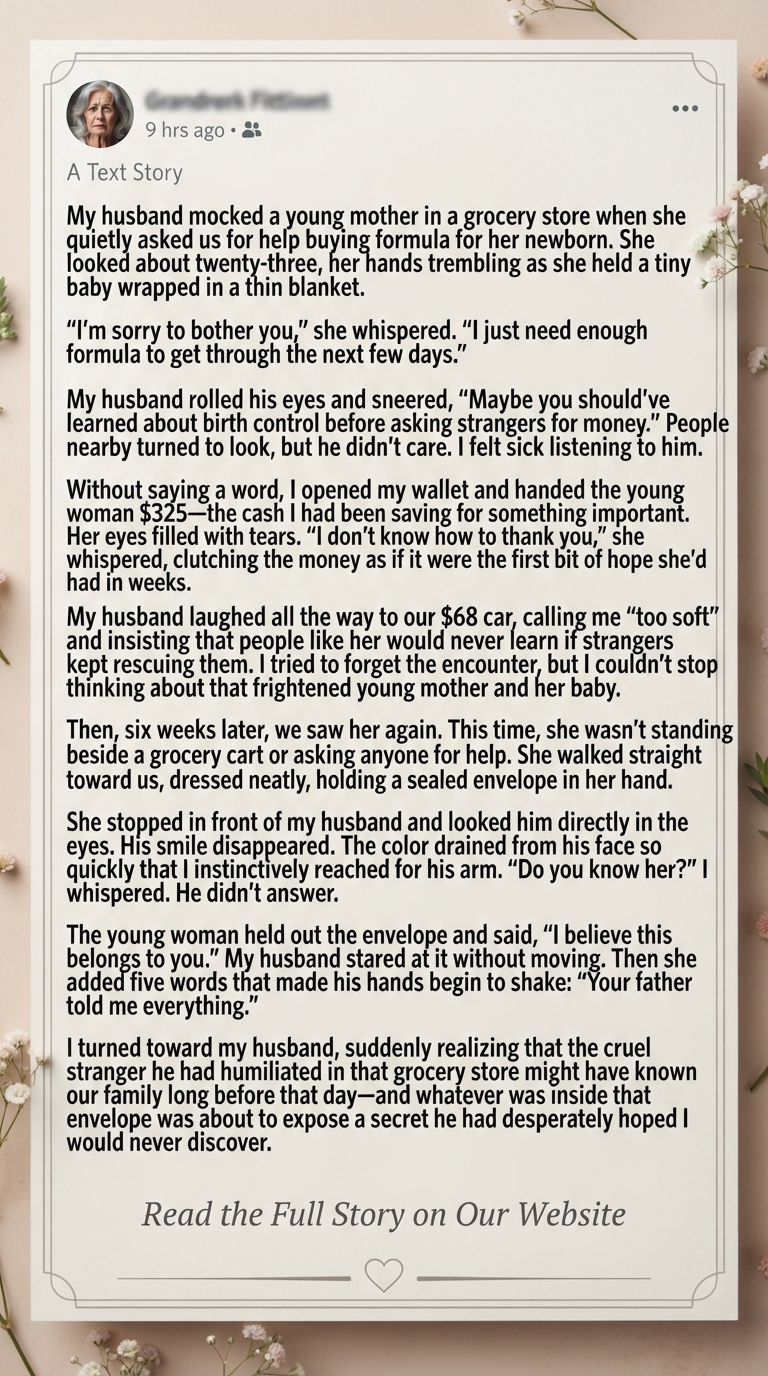
My husband humiliated a young mother in a grocery store when she quietly asked us for help buying formula for her newborn.
She looked about twenty-three. Her hands trembled as she held a tiny baby wrapped in a thin blanket, and exhaustion had settled beneath her eyes.
“I’m sorry to bother you,” she whispered. “I just need enough formula to get through the next few days.”
Before I could answer, my husband, Grant, rolled his eyes.
“Maybe you should’ve learned about birth control before asking strangers for money.”
The woman lowered her head. Several shoppers turned to look, but Grant seemed proud of himself.
I felt sick.
Without arguing with him, I opened my wallet and handed her $325—the money I’d been saving for something important.
Her eyes filled with tears.
“I don’t know how to thank you,” she whispered, clutching the cash as if it were the first bit of hope she’d had in weeks.
“You don’t have to thank me,” I told her. “Just take care of yourself and that little baby.”
Grant laughed all the way to our car, calling me too soft.
“People like her will never learn if strangers keep rescuing them,” he said.
I stared out the window, thinking about the young mother and her child.
I didn’t know her name. I didn’t know her story. But I knew that a hungry baby shouldn’t have to pay for an adult’s mistakes.
Six weeks later, I saw her again.
This time, she wasn’t standing beside a grocery cart asking for help. She walked straight toward us, dressed neatly in a navy coat, with her baby resting in a carrier. In one hand, she held a sealed envelope.
She stopped in front of Grant.
“I believe this belongs to you.”
His smile vanished.
The color drained from his face so quickly that I instinctively reached for his arm.
“Do you know her?” I whispered.
He didn’t answer.
The young woman held the envelope toward him.
“Your father told me everything.”
Grant’s hands began to shake.
“Where did you get that?” he demanded.
“From the man who came to see me last week,” she replied. “The man who said he was tired of watching you pretend to be someone you’re not.”
Grant looked around nervously, as if he expected the shoppers to disappear and leave us alone.
I stepped between them.
“Someone needs to explain what’s happening.”
The woman looked at me with an expression that was neither angry nor triumphant. It was simply tired.
“My name is Hannah Brooks,” she said. “Your husband knows my mother. And he knows why I was desperate enough to ask strangers for baby formula.”
Grant snatched the envelope.
“Don’t listen to her, Claire. She’s trying to get money out of us.”
Hannah shook her head.
“I’m not asking you for anything. Your father already helped me. I’m here because he asked me to deliver this to you personally.”
Grant ripped open the envelope.
Inside was a letter, a photograph, and a copy of a legal document.
I watched his face change as he read the first paragraph.
“What is it?” I asked.
He folded the letter and tried to put it in his pocket.
I held out my hand.
“Grant. Let me see it.”
For a moment, I thought he might refuse. Then Hannah spoke.
“If you hide it from her, I’ll tell her myself.”
Grant finally handed me the pages.
The letter was from his father, Richard.
It began with a confession.
Twenty-four years earlier, before Grant’s parents had finalized their divorce, Richard had been involved with Hannah’s mother, Melissa. Their relationship had ended before Melissa discovered she was pregnant. Richard had believed she moved away and built a life without him.
But Melissa had kept the truth from him because she feared the damage it would cause both families. She raised Hannah largely on her own and rarely spoke about her biological father.
Years later, after Melissa became seriously ill, she finally told Hannah the truth and gave her Richard’s name.
Hannah had contacted him—not to demand an inheritance, but to learn about the father she had never known.
Richard arranged a DNA test.
The result was included in the envelope.
Hannah was Grant’s half-sister.
I looked from the document to the young woman standing in front of us.
“You’re his sister?”
“Half-sister,” Hannah said quietly. “I know it’s a lot to take in.”
Grant shook his head.
“No. This is ridiculous. My father would’ve told me.”
“He tried,” Hannah replied. “He said he wrote you a letter after the test came back. You never answered.”
Grant’s jaw tightened.
I turned to him. “You knew about this?”
“No.”
“Then why are you acting as if you’ve seen a ghost?”
He looked away.
Hannah took a slow breath.
“There’s something else. Your father told me that when I approached you in the grocery store, he was already trying to reach you. He wanted you to know about me before I met you by accident.”
I remembered Grant’s expression when she first walked toward us. His shock had seemed too immediate, too personal.
“You recognized her,” I said.
Grant said nothing.
Hannah nodded toward the photograph in my hand. It showed Richard standing beside Melissa at a hospital, holding a newborn baby.
“My mother kept that picture for years,” she said. “She never wanted to destroy anyone’s family. She just wanted me to know where I came from.”
I felt a knot form in my chest.
“Then why did Grant look so frightened when you gave him this?”
Hannah hesitated.
“Because I don’t think he was afraid of me. I think he was afraid of what his father had written about him.”
I looked down at the letter again.
Near the bottom, Richard had written a paragraph addressed specifically to his son.
He explained that he had recently reviewed the records of a family investment account he had established for Grant years earlier. Several withdrawals had been made without his authorization. Richard had initially suspected a bank error, but the transaction records indicated that the money had been transferred to an account Grant controlled.
The total was $48,000.
Richard had asked Grant about the missing money. According to the letter, Grant had insisted it was a misunderstanding and promised to provide records proving the transfers were legitimate.
He never did.
The final paragraph was painfully direct.
“Grant, I am telling you this because I will not allow another person in this family to be treated as though their hardship makes them less deserving of dignity. Hannah came to me with questions, not demands. She deserves honesty. So does your wife. If you used money that was not yours, return it and tell the truth. I will not cover it up for you.”
I lowered the letter.
Grant’s face had gone pale again.
“Is that true?” I asked.
He rubbed his forehead.
“It wasn’t what you think.”
“Then explain it.”
He glanced at Hannah, then back at me.
“I borrowed the money. I was going through a difficult time, and I intended to pay it back.”
“You told me your father had given you that money,” I said.
“I knew you’d make a big deal out of it.”
“Forty-eight thousand dollars is not a small misunderstanding, Grant.”
He raised his voice. “I said I was going to pay it back!”
Hannah stepped back, shielding her baby carrier with one hand.
“I didn’t come here to fight with you,” she said. “I came because your father asked me to deliver the letter. He also told me something else.”
She reached into her bag and removed a second envelope.
“This contains a cashier’s check for the money your father gave me to help with my baby’s needs. I didn’t ask him for it, and I don’t want anyone thinking I approached you for money. I accepted his help because he insisted, but I’m keeping records of everything.”
She handed the envelope to me.
Inside was a note from Richard and a check for $2,000 made out to Hannah. His note explained that he wanted to help his granddaughter get through the difficult months ahead. It was a gift, not payment for her silence.
I felt tears sting my eyes.
Grant, who had mocked a struggling mother for asking for enough formula to feed her baby, was now standing in front of his own sister—the sister he had never bothered to know—while she tried to prove she wasn’t exploiting anyone.
“Why didn’t you tell me who you were?” I asked Hannah.
“Because I didn’t know you were my sister-in-law when I first saw you,” she said. “And after Grant spoke to me that way, I wasn’t sure I wanted him to know. I was embarrassed, and I didn’t want my baby caught in the middle of a family argument.”
I couldn’t blame her.
The $325 I’d given her in the grocery store had helped her buy formula, diapers, and groceries while she waited for a delayed paycheck and tried to arrange more stable housing. She had kept the receipts. She wasn’t living extravagantly or searching for a shortcut. She was trying to keep her baby fed.
And Grant had judged her without knowing a single thing about her life.
I turned to him.
“You humiliated a woman who needed help. You called her irresponsible. And all this time, she was your sister.”
“I didn’t know that in the store,” he snapped.
“No,” I said. “But you didn’t need to know she was your sister to treat her like a human being.”
For the first time, he had no immediate comeback.
Hannah adjusted the blanket around her baby.
“I don’t expect us to become a family overnight,” she said. “I don’t even know if I want a relationship with Grant yet. I just wanted the truth out in the open.”
Then she looked at me.
“Thank you for helping me that day. You didn’t ask me to prove I deserved it.”
I reached for her hand.
“You and your baby deserve kindness whether we’re related or not.”
She smiled faintly, and I saw the fear in her expression begin to ease.
Before she left, she gave me her phone number. I promised to check in, and I meant it.
Grant drove home in silence.
That evening, I asked him to sit at the kitchen table and tell me everything about the money. After several hours, he admitted that he had transferred funds from his father’s account without permission to cover debts from a failed business investment. He had convinced himself he could replace the money before anyone noticed.
He had also ignored his father’s letters because he feared the consequences of admitting what he had done.
I told him I wouldn’t help him hide it.
He needed to speak honestly with his father, provide the financial records, and make a repayment plan. If he had broken the law, he would have to face the appropriate consequences. I wasn’t going to invent excuses for him simply because he was my husband.
For weeks, our marriage felt like a house with a cracked foundation. We spoke mostly about practical matters, and I insisted that we separate our finances while the missing money was investigated.
Grant eventually confessed everything to Richard and agreed to a formal repayment arrangement. Richard consulted an attorney, and the family handled the financial dispute through proper legal channels. Grant repaid the money over time, sold some investments, and accepted that trust would take much longer to rebuild than his bank balance.
He also apologized to Hannah.
She accepted the apology without pretending the humiliation hadn’t happened. She told him she was willing to consider a relationship, but only if he treated her with respect and stopped making assumptions about people whose struggles he couldn’t see.
It was a boundary he needed to learn.
I began visiting Hannah occasionally. We took walks with her baby, shared simple dinners, and talked about our lives. She never asked me for money again. When she needed practical help, she was honest about it, and I learned to offer support without making promises I couldn’t keep.
Over time, she found steadier work and moved into a small apartment where she and her child could feel safe. Richard became part of her life, too, slowly and carefully, without demanding that she instantly forgive the years he had been absent.
Grant and I worked with a marriage counselor to address the dishonesty and contempt that had surfaced. I didn’t pretend one apology could erase everything. Whether our marriage could survive depended on the choices he made after the crisis, not the promises he made during it.
Months later, I thought back to that grocery store.
I’d handed Hannah $325 because a baby needed formula. I hadn’t expected a secret family connection, a letter exposing financial wrongdoing, or a confrontation that would force me to reconsider my marriage.
But the most important lesson wasn’t that the woman I’d helped turned out to be related to my husband.
It was that she had deserved help before either of us knew her name.
Grant had believed kindness made people weak and cruelty made him look strong. The truth was the opposite. It took almost nothing for him to humiliate a frightened young mother. It took far more courage for him to admit what he’d done, face the consequences, and begin changing.
I never regretted giving Hannah that $325.
The money had bought formula, diapers, and a few days of relief. But it had also opened a door to a truth our family could no longer avoid.
And every time I saw Hannah holding her little boy, I remembered what I’d told her that first day.
“You don’t have to thank me. Just take care of yourself and that baby.”
She had done exactly that.
In the end, the envelope didn’t teach me that kindness always earns a reward. It taught me something more important: **someone doesn’t have to prove they’re family—or prove they’re worthy—to deserve compassion.**