FULL STORY
My Son Watched His Wife Cut Off My Hair and Said I Deserved It—Three Days Later, One Envelope Changed Everything
The scissors were still lying on the hardwood floor when I finally found my voice.
My name is Eleanor Hayes, and for thirty years, I had worn my hair almost to my waist.
My late husband, Richard, used to brush it for me when his hands were strong enough. During the final months of his battle with cancer, when he could barely lift his arms, he would reach for a strand and smile.
“Promise me you’ll keep it long,” he once whispered. “There’s something I need you to understand about it.”
I had laughed softly and told him he was being sentimental.
He shook his head.
“One day, Eleanor. You’ll understand one day.”
He died six months later.
I never cut my hair.
Until that morning.
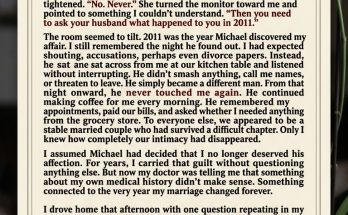
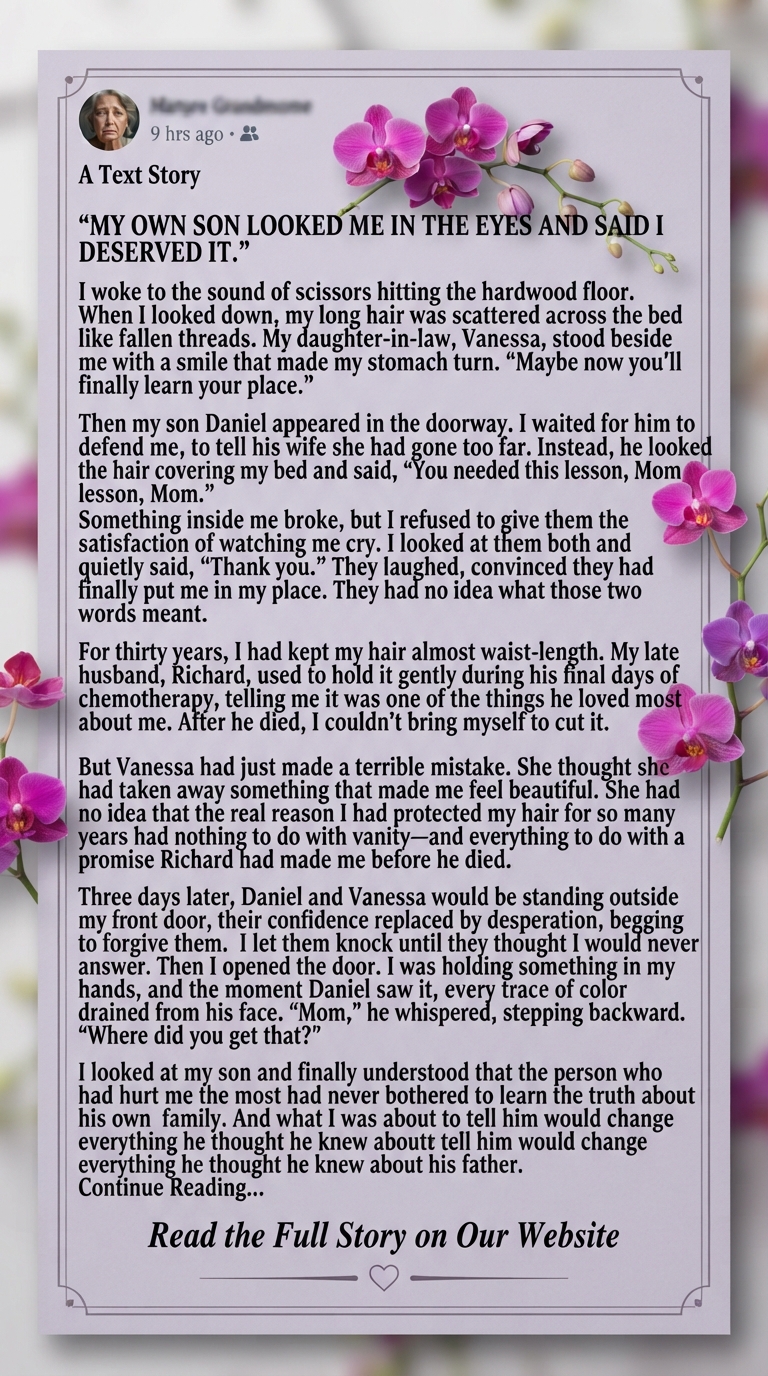
I woke to the sharp sound of scissors hitting the floor. When I opened my eyes, Vanessa, my daughter-in-law, stood beside my bed holding a thick section of my hair.
She smiled as though she had accomplished something wonderful.
“Maybe now you’ll finally learn your place.”
For a moment, I couldn’t understand what I was seeing. My hair was scattered across the sheets, and the woman standing over me looked almost pleased with herself.
“Vanessa,” I whispered. “What have you done?”
She shrugged.
“You’ve been making this family miserable for months. Someone needed to teach you that you don’t control everything.”
Then Daniel appeared in the doorway.
My only son.
The little boy who used to run into my bedroom after nightmares. The teenager whose graduation photograph I still kept beside my bed. The man whose wedding I had paid for because I wanted him to begin his marriage without debt.
I looked at him, waiting.
I expected outrage. Disbelief. Anything that would tell me the son I had raised still existed somewhere inside the man standing before me.
Instead, he glanced at the hair on the bed and sighed.
“You needed this lesson, Mom.”
Those words hurt more than the scissors.
I swallowed the tears rising in my throat.
Then I looked at both of them and said quietly, “Thank you.”
Vanessa laughed.
Daniel shook his head as if I had finally admitted defeat.
Neither understood what I meant.
For years, I had protected my hair for a reason neither of them had bothered to ask about.
And now, after everything they had done, I finally knew it was time to tell the truth.
Three days later, they would return to my front door, desperate to speak to me.
But by then, everything would be different.
After Vanessa and Daniel left that morning, I sat in front of my bedroom mirror.
My reflection barely looked like me.
Uneven strands framed my face. One side was shorter than the other, and the scissors had left several jagged patches near the back of my head.
I touched the remaining hair gently.
Then I remembered Richard’s final birthday.
He had been too weak to sit at the dinner table, so I had brought his cake into the bedroom. After he blew out the candle, he asked me to sit beside him.
“Do you remember the summer we bought our first house?” he asked.
“Of course.”
“We had almost nothing. One couch, two plates, and a mattress on the floor.”
“And your terrible cooking,” I teased.
He smiled.
“Especially my terrible cooking.”
Then his expression grew serious.
“Eleanor, if anything ever happens to me, I need you to remember something. Our family has a history that Daniel doesn’t know about. I wanted to tell him when he was older, but I never found the right moment.”
I had assumed the medication was making him emotional.
“What history?”
He looked toward the bedside table, where a small wooden box rested beneath a stack of books.
“Everything you need is in there. But don’t open it until you understand why I kept it.”
I promised I would.
After his funeral, I placed the box in the bottom drawer of my dresser and left it untouched.
For years, I couldn’t bear to open it. Every time I saw it, I heard Richard’s voice and remembered how frightened he had looked during that final conversation.
Then Daniel married Vanessa.
At first, she seemed charming. She brought flowers when she visited and called me Mom before I had even learned what kind of coffee she liked.
But gradually, her behavior changed.
She criticized the way I decorated my home. She complained that Daniel spent too much time checking on me. She made little remarks about my age, my clothes, and the fact that I still lived in the house Richard and I had purchased together.
When Daniel lost his job two years later, I helped them financially.
I paid several months of their mortgage, covered an unexpected medical bill, and even gave them money toward a new car.
I never asked for repayment.
I believed family helped family.
Vanessa, however, began treating my generosity as an obligation.
Whenever I refused a request, she accused me of trying to control Daniel.
Whenever I offered advice, she called me manipulative.
And Daniel, desperate to keep peace in his marriage, began agreeing with her.
The morning she cut my hair was not the first time they had humiliated me.
It was simply the first time they had crossed a line I could never allow them to cross again.
That afternoon, I called my hairdresser, Susan.
When she arrived, she took one look at me and covered her mouth.
“Oh, Eleanor. What happened?”
“My family made a mistake,” I replied.
She didn’t ask another question.
She gently shaped the remaining hair into a short, elegant bob. When she finished, I studied my reflection.
I looked different.
But I was still me.
And for the first time in years, I didn’t feel the need to make excuses for anyone.
That evening, I retrieved Richard’s wooden box.
Inside were three envelopes, a small brass key, and a photograph of Richard standing beside an older man I had never seen before.
On the back, Richard had written:
For Eleanor and Daniel. The truth belongs to both of you.
My hands trembled as I opened the first envelope.
It contained a letter from Richard’s father, Thomas Hayes, dated 1968.
The letter explained that Thomas had inherited a family business from his own father. It was a small manufacturing company that had grown steadily over the decades.
But the business had nearly collapsed during a financial crisis.
Thomas had been forced to sell most of his personal assets to keep it alive. Before doing so, he established a trust for his descendants, hoping that one day it would protect the family from the kind of financial hardship he had experienced.
The trust included shares in the business, property, and investments.
I kept reading.
According to the letter, Richard had become the sole beneficiary of the remaining trust assets after his older brother died without children.
And Richard had eventually transferred the assets into a family trust designed to benefit me and Daniel.
I stared at the pages.
Richard had never mentioned any inheritance.
We had lived comfortably but modestly. He had worked as an accountant for a regional company, and I had spent most of my adult life teaching elementary school.
We had saved carefully, but we had never been wealthy.
Why would he keep something like this from me?
The answer was in the second envelope.
It contained a letter from Richard’s attorney, dated shortly before Richard’s death.
The attorney explained that the family trust had been structured to protect its assets from creditors and to ensure that the beneficiaries would receive financial support according to specific conditions.
The documents also explained that Richard had deliberately kept the trust separate from our everyday finances.
He wanted Daniel to grow up believing that hard work mattered more than inherited money.
I could understand that.
But there was something else.
The final pages contained a list of conditions Richard had written into his estate plan.
One clause caught my attention.
No beneficiary could demand control of the trust simply because of family relationships. Any distribution would be subject to the trustee’s independent review and the terms of the trust.
Richard had anticipated that someone might eventually try to use family loyalty as leverage.
I remembered Vanessa’s increasingly demanding requests.
The expensive renovations she wanted. The luxury vacations she expected Daniel to provide. The way she repeatedly asked whether Richard had left us anything substantial.
Had she suspected something?
I opened the third envelope.
Inside was a letter addressed directly to me.
My dearest Eleanor,
If you are reading this, I am no longer there to explain everything myself.
I kept the trust private because I wanted you and Daniel to have a normal life. I didn’t want money to become the center of our family.
Our son has a good heart, but he has always been afraid of disappointing people. I worry that someday someone will take advantage of that fear.
If that happens, please remember that love does not require you to accept cruelty.
You have spent your life giving people second chances. I admire that about you. But there is a difference between forgiveness and allowing someone to keep hurting you.
The key in this box belongs to a safe-deposit box at First Harbor Bank. Inside, you’ll find the original trust documents and a letter explaining my final wishes.
Don’t open it because you want revenge. Open it when you’re ready to protect yourself.
All my love,
Richard.
I sat motionless for a long time.
Then I called the attorney whose name appeared on the letter.
His office confirmed that the trust was still active. He scheduled an appointment for the following morning and asked me to bring the key and every document I had found.
I barely slept that night.
Not because I was planning revenge.
Because I finally understood that Richard had left me more than money.
He had left me a way to protect the life we had built.
The next morning, I met Richard’s attorney, Mr. Bennett, at his office.
He reviewed the letters carefully before opening the trust file.
“Your husband was meticulous,” he said. “He wanted to make sure you would always have financial security, regardless of what happened to the family business.”
“How much is in the trust?”
He gave me a cautious look.
“The current value fluctuates with the investments, but the assets are substantial. The trust includes commercial property, investments, and shares in a privately held company.”
He showed me the current statements.
I stared at the figures.
I had spent decades clipping coupons, comparing grocery prices, and delaying home repairs until we could afford them.
Meanwhile, Richard had quietly arranged for me to be secure.
But I wasn’t interested in suddenly living like a wealthy woman.
I wanted to understand the conditions.
Mr. Bennett explained that I had certain rights as a beneficiary, while Daniel’s access was governed by separate provisions. Neither of us could simply withdraw everything at will.
The trustee had to follow the trust’s terms and protect its assets.
Then he showed me a second document.
It was a letter Richard had written to the trustee shortly before his death.
If my son ever comes to believe that being my child entitles him to control assets he has not earned, do not reward that belief.
Support his reasonable needs when the trust permits. Help him become independent. But never allow family pressure, threats, or emotional manipulation to override the trust’s purpose.
I closed my eyes.
Richard hadn’t known Vanessa would cut my hair.
He hadn’t predicted this exact cruelty.
But he had understood the danger of allowing money to become a substitute for character.
“Does Daniel know about the trust?” I asked.
“Not the full details,” Mr. Bennett replied. “Your husband instructed us to explain the arrangement when Daniel reached a certain age, but he also wanted the information presented responsibly. We have not disclosed any confidential details to your daughter-in-law.”
“Could Daniel demand the money?”
“Not simply because he is your son. The trustee must follow the document. And your own assets and residence are separate matters that we should review carefully.”
I nodded.
Then I asked Mr. Bennett to help me do three things.
First, I wanted to make sure my home and personal finances were secure.
Second, I wanted all future financial assistance to Daniel and Vanessa to stop until I had time to reconsider what was appropriate.
Third, I wanted to understand exactly what Richard had intended for his son’s future.
Mr. Bennett agreed to help me review the relevant documents and make any changes that were legally available to me.
When I left his office, I felt lighter.
For the first time in years, I had made a decision without worrying about whether Daniel would be upset.
That afternoon, Daniel called.
“Mom, we need to talk.”
“About what?”
“Vanessa says you haven’t answered any of her messages.”
“I’ve been busy.”
“She’s worried about you.”
I almost laughed.
“Is that what she told you?”
He sighed.
“Mom, we know what happened was wrong, but you have to understand that Vanessa was frustrated. You haven’t exactly made things easy for us lately.”
I stood beside the window and looked at the garden Richard and I had planted together.
“Daniel, your wife cut my hair while I was asleep.”
“I know.”
“She did it to humiliate me.”
“I know, Mom.”
“And you told me I deserved it.”
There was a long silence.
Then he said, “I shouldn’t have said that.”
It was the closest thing to an apology I had heard from him.
But it wasn’t enough.
“No,” I replied. “You shouldn’t have.”
“Can we come over tonight? We want to talk.”
“Not tonight.”
“Mom, please. We need to work this out.”
I thought about Richard’s letter.
There is a difference between forgiveness and allowing someone to keep hurting you.
“We’ll talk when I’m ready,” I said, and ended the call.
For the next two days, I ignored their messages.
I didn’t block them. I didn’t insult them. I simply stopped making myself available whenever they wanted something.
On the third day, someone began pounding on my front door.
I looked through the window.
Daniel and Vanessa stood on the porch.
Vanessa was crying. Daniel looked pale and exhausted.
I waited several minutes before opening the door.
“What do you want?”
Daniel glanced at the small wooden box in my hands.
His face changed instantly.
“Mom,” he whispered. “Where did you get that?”
I looked at him carefully.
“You recognize it?”
He nodded.
“Grandpa Thomas’s box. Dad showed it to me once when I was a teenager. He told me it contained family history, but he said I wasn’t ready to understand it.”
“Your father left it to me.”
Daniel’s eyes moved to the letters tucked beneath my arm.
“Did you open them?”
“Yes.”
Vanessa stepped forward.
“What does that mean? What’s in there?”
I didn’t answer her.
I looked only at my son.
“Your father left us a trust, Daniel. One that he spent years building to protect this family.”
Daniel went completely still.
“What trust?”
I handed him a copy of the letter from Richard’s attorney.
He read the first page, then the second. His mouth fell open.
“Is this real?”
“Your father’s attorney has confirmed it.”
“How much money are we talking about?”
There it was.
Not Are you okay, Mom?
Not I’m sorry for what I said.
Not even Why did Dad keep this from me?
The first question that came to his mind was how much money existed.
I felt a sadness deeper than anger.
“The exact value is being reviewed by the trustee,” I said. “But this was never intended to be a blank check.”
Vanessa grabbed the letter from his hand.
“Daniel, do you understand what this means? We could finally pay off our debts. We could sell our house and buy something better. We could—”
“Stop,” I said.
She turned toward me.
“Excuse me?”
“This trust is not a reward for mistreating me. And it is not money either of you can demand.”
Her face hardened.
“We’re family!”
“Then you should have treated me like family when I was lying in bed.”
She looked away.
Daniel rubbed his forehead.
“Mom, we didn’t know about the trust. If we had known, none of this would have happened.”
The words settled between us like a stone.
I studied my son.
“So you’re saying you would have treated me better if you had known I might be wealthy?”
He opened his mouth.
Nothing came out.
Vanessa tried to recover.
“That’s not what he meant. We were under a lot of stress, and I admit I went too far with the scissors. But this is a chance for us to move forward.”
“Move forward to what?”
She stared at me.
“To be a family again.”
I looked at the woman who had stood beside my bed and cut away something precious to me.
Then I looked at the boy I had once carried on my hip, the child who had grown into a man who could watch his wife humiliate his mother and call it a lesson.
“You don’t get to decide that everything is forgiven just because you discovered an inheritance.”
Daniel’s eyes filled with tears.
“Mom, please. I made a mistake.”
“You made a choice.”
“I know.”
“Do you? Because when you walked into my bedroom, you had a chance to make another choice. You could have defended me. You could have helped me. You could have told Vanessa to stop.”
He lowered his head.
“But you looked at me and said I deserved it.”
For the first time, Vanessa had nothing to say.
I stepped back from the doorway.
“I’m willing to consider rebuilding a relationship with you, Daniel. But that will take time, honesty, and changed behavior. It will not happen because of money.”
He wiped his face.
“What do you want us to do?”
“Start by apologizing without excuses. Then give me the space to decide what I want.”
Vanessa’s expression tightened.
“And the trust?”
“The trustee will administer it according to the legal documents. You will not pressure me to change anything, and you will not receive financial assistance from me simply because you ask.”
She looked as though I had slapped her.
Daniel stared at the floor.
I continued.
“Your father worked hard to make sure money wouldn’t control our family. I’m not going to let it become the only reason you come to my door.”
Then I closed it.
Not to punish them.
But because, for the first time in my life, I understood that I was allowed to close a door without feeling guilty.
The following months were difficult.
Daniel sent me a letter apologizing for his behavior. It was the first apology he had written without blaming stress, Vanessa, or me.
He admitted that he had been so afraid of conflict in his marriage that he had allowed his wife to mistreat the person who had always supported him.
He also admitted that the possibility of an inheritance had made him realize how little he had understood about his father’s plans.
I appreciated the honesty.
But I did not immediately invite him back into my life.
Vanessa sent a message asking me to reconsider my position. When I refused to discuss the trust with her, she stopped contacting me.
That silence told me something important.
Daniel and I eventually began meeting for coffee once a month.
At first, our conversations were awkward. We talked about the weather, work, and ordinary family memories. He never asked about the trust again.
One afternoon, he noticed my short hair.
“I’m sorry,” he said quietly. “I should have protected you.”
I looked at him.
“Yes, you should have.”
He nodded, accepting the answer without trying to defend himself.
“I don’t expect you to forgive me quickly.”
“Good,” I replied. “Because trust takes longer to grow than hair.”
For the first time in months, he gave a small, genuine smile.
We weren’t healed. Not yet.
But we were finally being honest.
I eventually donated part of my own savings to a local organization that helped older women who had experienced abuse or financial exploitation. The trust continued to be managed according to its terms, and I made sure my estate documents reflected my wishes clearly.
I didn’t use the money to humiliate Daniel or punish Vanessa.
I used my choices to protect my future.
And I learned that the promise Richard had made about my hair had never really been about its length.
Before he died, he had wanted me to understand that I deserved to be treated with dignity, even when the people hurting me shared my name.
For thirty years, I had believed keeping my hair long was a way of honoring him.
Now I understood that honoring him also meant refusing to let anyone make me feel small.
My hair grew back slowly.
Some days, I missed its familiar weight against my shoulders. Other days, I liked the freedom of its shorter shape.
But whenever I looked in the mirror, I remembered the morning Vanessa dropped those scissors.
I remembered Daniel saying I deserved it.
And I remembered the words I had spoken in response.
“Thank you.”
They had thought I was surrendering.
In truth, I was thanking them for showing me what I could no longer ignore.
Love does not mean accepting cruelty. Forgiveness does not mean surrendering your boundaries. And being someone’s mother does not mean you must allow them to destroy your peace.
Richard had left me financial security, but his greatest gift was the reminder that I could stand on my own.
My son might someday earn back my trust.
His wife might someday understand the harm she caused.
But neither of them would ever again be allowed to confuse my kindness with weakness.
Because the most important inheritance Richard left me wasn’t the trust, the property, or the money.
It was the courage to finally choose myself.