The Morning My Husband’s Daughter Learned Who Really Ran My House
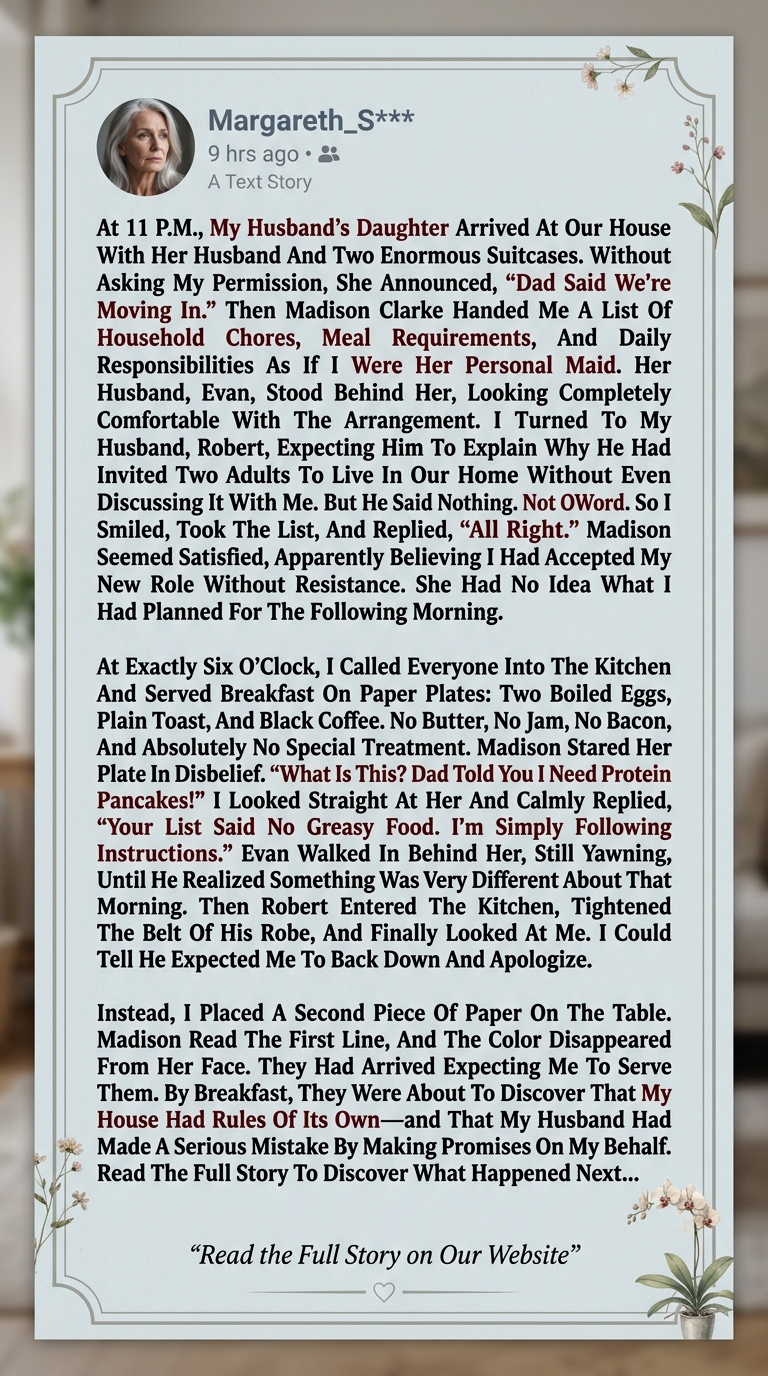
At eleven o’clock on a Tuesday night, my husband’s daughter arrived at our front door with her husband, two enormous suitcases, and the kind of confidence usually reserved for people who own the building they’re walking into.
Madison Clarke didn’t ask whether she could stay.
She stepped into my living room, placed her designer handbag on my favorite chair, and announced, “Dad said we’re moving in.”
Her husband, Evan, wheeled the suitcases inside without even looking at me.
I stood beside the staircase in my pajamas, trying to understand what I was hearing.
“Moving in?” I repeated.
Madison sighed as though I were being deliberately difficult.
“Yes. Just temporarily, obviously. Our apartment situation has become complicated, and Dad said we could stay here until we figure everything out.”
I turned toward my husband, Robert.
We had been married for eleven years. During that time, I had learned that Robert hated confrontation, especially when it involved his only daughter. Madison was thirty-one, perfectly capable of supporting herself, and accustomed to getting her way by making everyone around her feel guilty.
But even Robert had never invited someone to live in our house without discussing it with me.
At least, I thought he hadn’t.
“Robert?” I asked.
He cleared his throat.
“It’s just for a little while, honey.”
“How long is a little while?”
“Let’s not make this difficult.”
That sentence told me everything.
Madison smiled triumphantly and reached into her handbag.
“Oh, and I made a list so there won’t be any confusion.”
She handed me two pages of neatly typed instructions.
Breakfast at seven. Protein pancakes on weekdays. Fresh fruit cut before serving. Lunch prepared by noon. Dinner no later than six-thirty. No greasy food. No excessive noise in the morning. Laundry separated by color. Bathroom cleaned daily. Fresh towels every other day.
At the bottom, she’d added a note.
Please make sure our room is kept tidy. Evan works hard and needs a peaceful environment.
I stared at the page.
Then I looked at Madison.
“Is there anything else?”
She considered the question.
“Actually, yes. I have a sensitive stomach, so I can’t eat anything too acidic. And Evan doesn’t like reheated food.”
Her husband nodded as if this were a perfectly reasonable conversation.
Robert stood behind them, studying the carpet.
I could have shouted.
I could have reminded Madison that this was my house, too, and that I wasn’t her employee.
Instead, I smiled, folded the list carefully, and said, “All right.”
Madison relaxed immediately.
“Great. I knew we’d get along.”
She kissed her father on the cheek, instructed Evan to bring their remaining bags upstairs, and disappeared into the guest bedroom.
Robert followed her.
I remained in the living room, holding the list.
For eleven years, I had worked hard to make our home a peaceful place. I paid half the mortgage, maintained the garden, handled most of the household planning, and respected Robert’s relationship with his daughter.
I had never demanded that Madison love me.
I had only expected her to treat me with basic courtesy.
Apparently, that had been too much to ask.
I went into the kitchen, placed her list beside the coffee maker, and took out a clean sheet of paper.
If Madison wanted rules, she was about to discover that rules worked both ways.
At six o’clock the following morning, I was already dressed and standing beside the kitchen island.
Breakfast was ready.
Two boiled eggs per person. Plain toast. Black coffee.
Everything was served on paper plates.
There was no bacon, no butter, no jam, and certainly no protein pancakes.
At precisely six fifteen, Madison appeared at the top of the stairs wearing silk pajamas and an expression of deep irritation.
“Why is everyone awake so early?”
“Good morning,” I replied.
She walked into the kitchen, looked at her plate, and stopped.
“What is this?”
“Breakfast.”
“I can see that. Where are my protein pancakes?”
I took a sip of coffee.
“Your list said no greasy food. I thought I’d keep everything simple.”
“Protein pancakes aren’t greasy!”
“I’ll make a note of that for tomorrow.”
Her mouth opened.
Then closed.
Evan shuffled into the room, scratching his head.
“What’s going on?”
“She’s serving us prison food,” Madison snapped.
Evan looked at the eggs, the toast, and the coffee.
Then he looked at me.
“Do you have any cereal?”
“Of course. There’s a grocery store three blocks away.”
His expression changed.
Before either of them could respond, Robert entered the kitchen wearing his robe.
He glanced at the table.
Then at Madison.
Then at me.
“What is all this?”
“Breakfast,” I said.
Robert pulled me aside.
“Can you please just make them something proper? Madison has a sensitive stomach.”
“So do I, occasionally.”
He lowered his voice.
“Don’t start this. She’s my daughter.”
“And I’m your wife.”
He stared at me as if he hadn’t expected that answer.
I reached into my pocket and placed a second sheet of paper on the table.
“Before anyone eats, I think we should discuss the arrangements.”
Madison grabbed the paper.
The first line read:
TEMPORARY HOUSEHOLD OCCUPANCY AGREEMENT
Her expression shifted.
“What is this?”
“Something I prepared last night.”
She read the next paragraph aloud.
“Guests are responsible for their own meals, laundry, cleaning, personal expenses, and transportation unless otherwise agreed upon in writing.”
She looked up.
“Guests?”
“Yes.”
“We’re family!”
“Then I’m sure you understand why we should be able to discuss expectations respectfully.”
She continued reading.
“No access to private offices, personal documents, or locked storage areas. No guests without prior approval. No changes to the household schedule without mutual agreement. Temporary occupancy is limited to fourteen days unless both homeowners agree otherwise.”
She stopped.
“Fourteen days?”
“Correct.”
Madison turned toward her father.
“Dad!”
Robert rubbed his forehead.
“Let’s talk about this calmly.”
“I am calm,” I replied. “I simply want everyone to understand the arrangement before we continue.”
Evan leaned over to read the page.
Then he reached the final section.
It was titled FINANCIAL RESPONSIBILITIES.
Madison read it twice.
“You expect us to pay rent?”
“I expect adults who live here to contribute to household expenses if the arrangement extends beyond an emergency stay. We can discuss a reasonable amount if we reach that point.”
“You can’t charge us rent! Dad said we could move in!”
I turned toward Robert.
“Did you tell them they could move in without asking me?”
He looked uncomfortable.
“I told Madison she could stay here temporarily.”
“Did you tell her I would prepare her meals, do her laundry, and follow a list of household demands?”
“No.”
Madison’s face reddened.
“Well, Dad said you’d help us get settled!”
“Helping someone get settled is not the same as becoming their personal housekeeper.”
Robert opened his mouth, but no words came out.
For the first time that morning, Madison looked uncertain.
She had arrived expecting me to obey her instructions. She had not considered that I might have expectations of my own.
Then she pointed at the agreement.
“This is ridiculous. You can’t just make up rules because you’re upset.”
“Actually, I can establish reasonable household rules in my own home. And you can decide whether you want to stay under those conditions.”
She stared at me.
I smiled politely.
“Now, would anyone like another piece of toast?”
Nobody answered.
The silence lasted until Robert finally pulled out a chair.
“Madison, sit down.”
She looked at him.
“Dad, tell her this is unacceptable.”
Robert took a long breath.
Then he said something I hadn’t expected.
“Your stepmother is right about one thing. I should have discussed this with her first.”
Madison looked as though he had slapped her.
“What?”
“I shouldn’t have promised you could move in without talking to my wife. That was my mistake.”
I watched him carefully.
For eleven years, I had hoped Robert would recognize that being a good father did not mean agreeing with his daughter about everything.
Now, finally, he had acknowledged it.
But Madison wasn’t finished.
“You’re choosing her over me?”
“No,” Robert said. “I’m asking you to respect the fact that we share this house.”
She pushed her chair back so hard it scraped across the floor.
“Unbelievable.”
Evan, who had been quiet throughout the conversation, suddenly cleared his throat.
“Madison, maybe we should calm down.”
She turned on him.
“Whose side are you on?”
“I’m on the side of not making ourselves homeless over breakfast.”
I almost laughed.
Madison glared at him, then stormed upstairs.
Evan remained seated, staring at his untouched eggs.
After a moment, he looked at me.
“I’m sorry. I should have asked what the arrangement was before we arrived.”
It was the first sincere apology I’d heard since the front door opened the previous night.
“Thank you,” I said.
He nodded.
“I can handle my own laundry. And breakfast.”
“I appreciate that.”
He picked up his plate.
“Where do you keep the dish soap?”
For the first time that morning, I smiled without forcing it.
“Under the sink.”
While Evan cleaned up, Robert followed me into the pantry.
He closed the door behind us.
“Are you really going to make them leave in fourteen days?”
“I’m going to give them fourteen days to decide whether they can respect our home.”
“They’re having a hard time.”
“I understand that.”
“Madison lost her apartment.”
“Then she needs help finding another one. She doesn’t need to assign me chores.”
Robert looked down.
“I know.”
I crossed my arms.
“Robert, I need you to understand something. I am not angry because your daughter needs help. I am angry because you made promises on my behalf and expected me to accept them without question.”
He nodded slowly.
“You’re right.”
“And if she stays here, I need you to stand beside me when we establish boundaries. I will not be the only person enforcing them while you quietly apologize to her behind my back.”
He looked at me for a long moment.
Then he said, “I promise.”
I wanted to believe him.
But promises were easy.
What mattered was what happened next.
That afternoon, I found Madison sitting on the guest bed, scrolling through her phone.
A suitcase lay open on the floor. Clothes covered the chair, and several makeup bags had been arranged across the dresser.
She didn’t look up when I entered.
“Have you come to tell me I have to leave?”
“No. I’ve come to talk.”
She gave a short laugh.
“About your little contract?”
“About what happened last night.”
She finally looked at me.
“Dad said I could stay. I didn’t force him to invite us.”
“I know.”
“So why are you treating me like a criminal?”
“I’m not. I’m asking you to recognize that this is my home, too.”
She folded her arms.
“You’ve always had a problem with me.”
The accusation caught me off guard.
“Why do you think that?”
“Because you never wanted me around.”
I sat down in the chair beside the dresser.
“Madison, when your father and I got married, I made a conscious decision not to compete with you for his attention. I never wanted you to feel that you were losing your father.”
“Then why do you act like everything has to be your way?”
“Because I live here. I contribute to this household. I have routines, responsibilities, and a life of my own. That doesn’t mean I don’t care about you.”
She looked away.
For a moment, I thought she might say something honest.
Instead, she replied, “Well, you could at least try to make us comfortable.”
“I can. But comfort is something we create together, not something one person demands from another.”
She didn’t answer.
I stood up.
“Your father and I will help you look for an apartment tomorrow. If you need assistance with applications or deposits, we’ll discuss what we can reasonably do. But while you’re here, you and Evan are responsible for your own meals, laundry, and personal space.”
She stared at me.
Then she said quietly, “I don’t know how to do laundry properly.”
I turned back toward her.
It was such a small admission, but it revealed something I hadn’t expected.
Madison had spent years acting as though she knew exactly what she was entitled to. Yet beneath that confidence was a woman who had relied on other people to solve problems she had never learned to handle herself.
“Then I’ll show you,” I said.
She looked surprised.
“Really?”
“Really. Once. After that, you’ll do your own.”
For the first time since she arrived, she almost smiled.
The next two weeks weren’t perfect.
Madison complained about the coffee, the shower pressure, and the fact that we didn’t keep her preferred brand of yogurt in the refrigerator.
But she began doing her laundry.
Evan started cooking dinner twice a week. He turned out to be an excellent cook, and his homemade chicken soup became something we all looked forward to.
Robert stopped making promises without consulting me.
More importantly, Madison began asking before making demands.
One evening, she came into the kitchen while I was preparing dinner.
“Can I ask you something?”
“Of course.”
She hesitated.
“Did you really mean it when you said we could stay fourteen days?”
“Yes.”
She looked down.
“I found an apartment. It’s smaller than the one we had, but it’s affordable. We can move in next weekend.”
I set down the knife.
“That’s good news.”
She nodded.
“Evan and I talked. We realized we were treating your house like a hotel.”
I didn’t interrupt.
She took a breath.
“I’m sorry I gave you that list. It was rude.”
I looked at her.
“Thank you for saying that.”
She shifted her weight.
“I thought if I acted confident, nobody would notice how scared I was about losing our apartment.”
Her honesty surprised me.
“Being scared is understandable, Madison. Treating people badly because you’re scared isn’t fair to them.”
“I know.”
She glanced toward the dining room, where Robert was reading.
“Dad always tries to fix things for me. I think I’ve gotten used to assuming he can make everything work out.”
“Your father loves you. But loving someone doesn’t mean making every difficult consequence disappear.”
She nodded slowly.
Then she asked, “Would you teach me how to make your chicken casserole before we leave?”
I smiled.
“Absolutely.”
On their final evening, Madison and Evan packed their suitcases and carried them downstairs.
The same two enormous bags that had rolled through my front door at eleven o’clock two weeks earlier now stood beside the entrance.
But something was different.
Madison approached me with a small box.
“I bought you something,” she said.
Inside was a ceramic mug with a simple message printed across it:
Thank you for making room for us.
I felt my eyes sting.
“You didn’t have to do that.”
“I know. I wanted to.”
She hesitated, then added, “And I wanted to tell you something else.”
I waited.
“You weren’t wrong about the rules. I just didn’t like being told I couldn’t do whatever I wanted.”
I laughed softly.
“That happens to all of us sometimes.”
She smiled.
Then she hugged me.
It wasn’t a perfect reconciliation, and I didn’t expect it to be. Two weeks couldn’t erase years of tension or instantly transform our relationship.
But it was a start.
After Madison and Evan left, Robert and I sat together in the living room.
He took my hand.
“I owe you an apology, too.”
I looked at him.
“For what?”
“For assuming that because you love me, you’d automatically agree with whatever I wanted to do for my daughter.”
I squeezed his hand.
“I love you, Robert. But I need to be your partner, not the person who quietly absorbs the consequences of your decisions.”
He nodded.
“I understand that now.”
And this time, his actions proved it.
From then on, whenever a family member needed help, we discussed the situation together. We learned to distinguish between offering support and taking responsibility for someone else’s life.
Madison eventually settled into her new apartment. She and Evan began managing their finances more carefully, and she occasionally called me to ask for a recipe or advice.
Sometimes, she even invited us over for dinner.
One Sunday, she served the chicken casserole I had taught her to make.
She had added too much salt, and the potatoes were slightly undercooked.
But she had made it herself.
When I told her it was delicious, she grinned.
“I’m getting better.”
“You are,” I said.
And I meant it.
Looking back, I realize the most important moment in that entire experience wasn’t the breakfast I served on paper plates or the agreement I placed on the table.
It was the moment I refused to confuse kindness with surrender.
I could help Madison without becoming her servant.
Robert could love his daughter without ignoring his wife’s voice.
And Madison could receive support without expecting everyone else to carry her responsibilities.
That morning, they arrived believing I would accept whatever arrangement they demanded.
By the time they left, we had all learned something more valuable than how to make protein pancakes.
A family home isn’t a place where one person gets everything they want.
It’s a place where everyone learns to respect the people who share it.
And sometimes, the kindest thing you can do for someone you love is to help them stand on their own feet—even when that means saying no first.