The Day I Left Them Outside
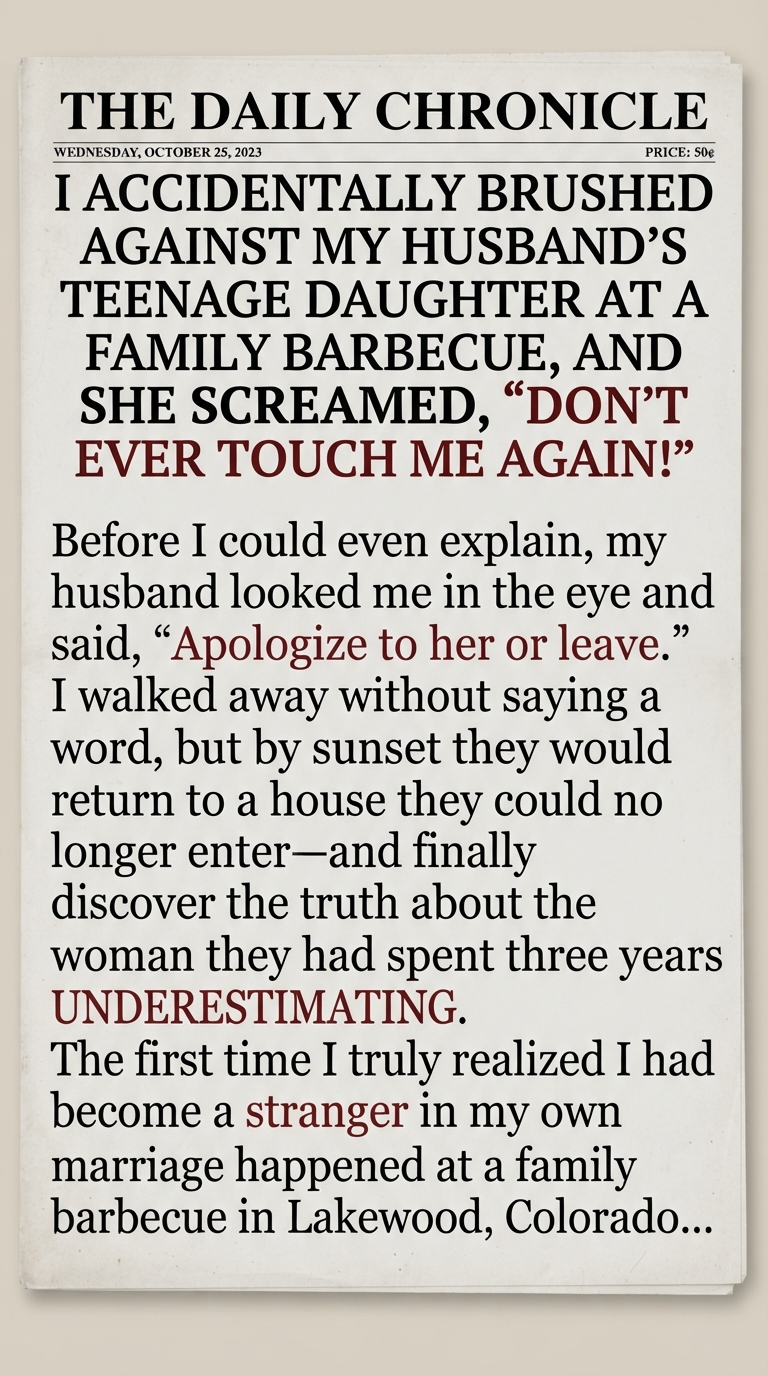
The first time I truly realized I had become a stranger in my own marriage happened at a family barbecue in Lakewood, Colorado.
It was a warm Saturday afternoon, the kind where children ran through sprinklers and adults stood around pretending not to notice old family grudges.
My husband, Mark, was at the grill.
His teenage daughter, Ava, sat with her cousins near the patio, scrolling through her phone.
And I was carrying a tray of drinks.
I had been married to Mark for three years.
Three years of trying.
Three years of remembering birthdays, buying thoughtful gifts, attending school events, and telling myself that Ava’s coldness toward me was understandable.
Her mother had died when she was nine.
Mark and I met two years later.
Ava was eleven.
And from the beginning, she made one thing very clear:
I was not her mother.
I never tried to be.
But apparently, that wasn’t enough.
I was walking past her chair when my arm accidentally brushed against her shoulder.
It was barely a touch.
But Ava suddenly jumped up.
“DON’T EVER TOUCH ME AGAIN!”
The entire backyard went silent.
I froze.
“What?”
“Don’t touch me!”
“Ava, I accidentally—”
She stepped backward.
“Just stay away from me!”
People stared.
Mark turned from the grill.
He looked at Ava.
Then he looked at me.
And without asking what happened, without asking whether it had been an accident, he said:
“Apologize to her.”
I stared at him.
“What?”
“You heard me.”
“Mark, I barely touched her.”
“She said don’t touch her.”
“It was an accident.”
His face hardened.
“Apologize to her or leave.”
I looked around.
His parents.
His sister.
Ava.
Everyone was watching.
Waiting to see what I would do.
For three years, I had tried to keep the peace.
I had apologized when I wasn’t wrong.
Stayed quiet when I was insulted.
Paid bills without asking for credit.
Made sacrifices nobody seemed to notice.
I had spent three years proving that I deserved a place in their family.
And suddenly, I was exhausted.
So I put the tray down.
I looked directly at Mark.
Then I said:
“Okay.”
And I walked away.
Nobody stopped me.
Not Mark.
Not Ava.
Not a single person.
I got into my car and drove home.
The entire way, I didn’t cry.
I expected to.
Instead, I felt strangely calm.
When I arrived, I stood outside the house for several minutes.
Then I took out my phone.
I made three calls.
The first was to my attorney.
The second was to the security company.
The third was to the locksmith.
Then I walked inside.
The house was beautiful.
Three stories.
Large windows.
A stone fireplace.
A backyard that Mark loved to brag about.
But there was something Mark never mentioned when he talked about it.
The house belonged to me.
Not Mark.
Me.
I had purchased it five years before we married.
My name was the only one on the deed.
When Mark moved in, I never made him sign a lease.
I never asked him for rent.
When Ava moved in full-time after her mother died, I made space for her.
I gave her the largest upstairs bedroom.
I paid for renovations.
Furniture.
A new laptop.
Driving lessons.
A private summer program in California.
Every time Mark struggled financially, I covered the gap.
And I never complained.
Not once.
Because I believed marriage meant building a life together.
But building a life together should never mean allowing people to erase you inside your own home.
By five o’clock, the locksmith had changed every exterior lock.
By five-thirty, the security company had removed Mark and Ava from the approved access list.
By six, I had packed their personal belongings into labeled boxes.
I wasn’t cruel.
I didn’t throw anything away.
I didn’t damage anything.
I simply placed everything carefully in the garage.
Then I sat in the living room.
And waited.
At 7:18 p.m., my phone rang.
Mark.
I ignored it.
Then again.
Then Ava called.
Then Mark’s sister.
Then his mother.
By 7:43, I had seventeen missed calls.
At 8:02, I heard a car pull into the driveway.
A minute later, someone knocked.
Then knocked again.
Then the doorbell rang.
I didn’t move.
My phone buzzed.
MARK: Open the door.
I stared at the message.
Another one arrived.
MARK: This isn’t funny.
I replied:
Neither was what happened at the barbecue.
Three dots appeared.
Then:
MARK: Stop being dramatic. Ava is upset.
I laughed.
Actually laughed.
Three years of swallowing my feelings.
And somehow, I was being dramatic.
Ava started pounding on the door.
“Dad! She changed the locks!”
Then Mark shouted:
“Open this door right now!”
I walked calmly to the front entrance.
I didn’t open it.
Instead, I stood behind the door.
“Mark.”
“Open the door.”
“No.”
“What is wrong with you?”
I almost smiled.
“That’s an interesting question.”
“Emily, this is my home too.”
“No.”
Silence.
Then:
“What?”
“This is my house. You live here because I allowed you to.”
“You can’t just throw us out!”
“I didn’t throw you out.”
I looked toward the boxes in the garage.
“I ended an arrangement.”
His voice became angry.
“You’re punishing Ava because she was uncomfortable!”
“No.”
I said quietly.
“I’m responding to the fact that you gave me an ultimatum.”
Silence.
I continued.
“You said apologize or leave.”
“You took that seriously?”
That was the moment.
The moment everything became perfectly clear.
“You didn’t?”
I asked.
“You know I didn’t mean it like that.”
“How did you mean it?”
He couldn’t answer.
“You wanted me to apologize,” I said. “You wanted me to stand there in front of your family and accept blame for something I didn’t do.”
“She’s my daughter!”
“And I’m your wife.”
Silence.
I walked away from the door.
But Mark wasn’t finished.
His family began calling.
His mother left a voicemail.
Family doesn’t treat family this way.
I listened to it twice.
Then I deleted it.
Because suddenly, I understood something.
They had never treated me like family.
They treated me like a convenience.
A house.
A bank account.
A cook.
A driver.
Someone who would always forgive them.
By midnight, the house was quiet.
For the first time in three years, I slept peacefully.
The next morning, I opened the door.
The boxes were gone.
But Mark’s car was still parked across the street.
And sitting inside it was Ava.
Alone.
I hesitated.
Then I walked outside.
Ava rolled down the window.
Her eyes were red.
“Can we talk?”
I nodded.
We sat on the front steps.
For several minutes, neither of us spoke.
Finally, she said:
“I didn’t mean what I said yesterday.”
I looked at her.
“I know.”
She started crying.
“I just… I was mad.”
“At me?”
She nodded.
“Why?”
“Because you make Dad happy.”
That wasn’t what I expected.
She wiped her eyes.
“Mom died. Then Dad was sad all the time. And then you came.”
I listened.
“I thought if I hated you enough, maybe Dad would stop loving you.”
My heart broke.
Ava was seventeen.
She wasn’t really cruel.
She was grieving.
And I had been the easiest target.
“But yesterday,” she whispered, “I wasn’t scared because you touched me.”
I already knew.
“I wanted Dad to choose me.”
I looked toward the road.
Mark was still sitting in his car.
“I see.”
“I didn’t think he’d tell you to leave.”
I smiled sadly.
“Neither did I.”
Ava lowered her head.
“I’m sorry.”
For the first time in three years, I believed her.
“Thank you.”
She looked up.
“Can we come back?”
I thought about everything.
Then I shook my head.
“Not today.”
Her face fell.
“Maybe someday. But things have to change first.”
She nodded.
Then she whispered:
“Dad says you’re overreacting.”
I looked directly at her.
“And what do you think?”
Ava looked back at the house.
Then at her father sitting across the street.
“I think I’ve been taking things from you without saying thank you.”
I didn’t answer.
Because I didn’t know how.
Later that afternoon, my attorney called.
There was something I needed to know.
Mark had contacted a lawyer.
He was claiming that because he had lived in the house for three years and contributed to some expenses, he had rights to part of the property.
I laughed.
Not because it was funny.
Because I had been waiting for it.
I had every financial record.
Every mortgage payment.
Every renovation invoice.
Every property tax statement.
All under my name.
And there was one more thing.
Three months before our wedding, Mark had signed a prenuptial agreement.
I had almost forgotten about it.
But my attorney hadn’t.
Mark had agreed that the house was mine.
Completely mine.
By the end of the week, his lawyer withdrew the claim.
Then Mark called.
“Can we talk?”
We met at a coffee shop.
He looked exhausted.
Older somehow.
“I messed up,” he said.
I waited.
“I shouldn’t have said what I said.”
“No.”
“I was trying to protect Ava.”
“And who was protecting me?”
His eyes filled with tears.
“I thought you’d never leave.”
There it was.
The truth.
He had believed I would always stay.
No matter how I was treated.
No matter what he said.
He thought my patience had no limit.
I looked at him.
“That’s the problem, Mark.”
He swallowed.
“I love you.”
“I loved you too.”
The word too destroyed him.
He stared at the table.
“Is there someone else?”
I almost laughed.
“No.”
“Then why?”
“Because sometimes love isn’t the reason a marriage ends.”
He looked up.
“What is?”
I took a breath.
“Being alone inside it.”
I filed for divorce two months later.
Ava came to see me before the papers were finalized.
She brought me a small gift.
Inside was a framed photograph.
All three of us.
Taken during our first Christmas together.
On the back, she had written:
I’m sorry it took me so long to see you.
I cried when I read it.
I hugged her.
And for the first time, she hugged me back.
Mark and I eventually sold some shared possessions.
But not the house.
The house remained mine.
I changed Ava’s old bedroom into an office.
But I kept one thing exactly where it was.
A small photograph on the shelf.
Ava and me.
Because even though our family had fallen apart, I didn’t want to rewrite the good moments out of existence.
A year later, I received a text from Ava.
I’m starting college next month.
I smiled.
Then another message appeared.
Thank you for teaching me that saying sorry doesn’t make you weak.
I stared at the screen for a long time.
Then I replied:
And thank you for finally saying it.
People often ask me if I regret changing the locks.
The answer is no.
Because I didn’t change them to punish anyone.
I changed them because, for the first time, I understood that a home isn’t defined by who has a key.
It’s defined by who makes you feel safe enough to stay.
That night, Mark told me to apologize or leave.
So I left.
And by sunset, they discovered something they had spent three years underestimating.
I wasn’t helpless.
I wasn’t dependent on them.
And I wasn’t someone who would stay where she wasn’t respected.
I was the woman whose name was on the deed.
But more importantly…
I was finally the woman who knew her own worth.