The Flight Attendant Asked Me to Follow Her After My 12-Year-Old Daughter Went to the Bathroom—Then I Heard the Secret She Had Been Hiding From Me
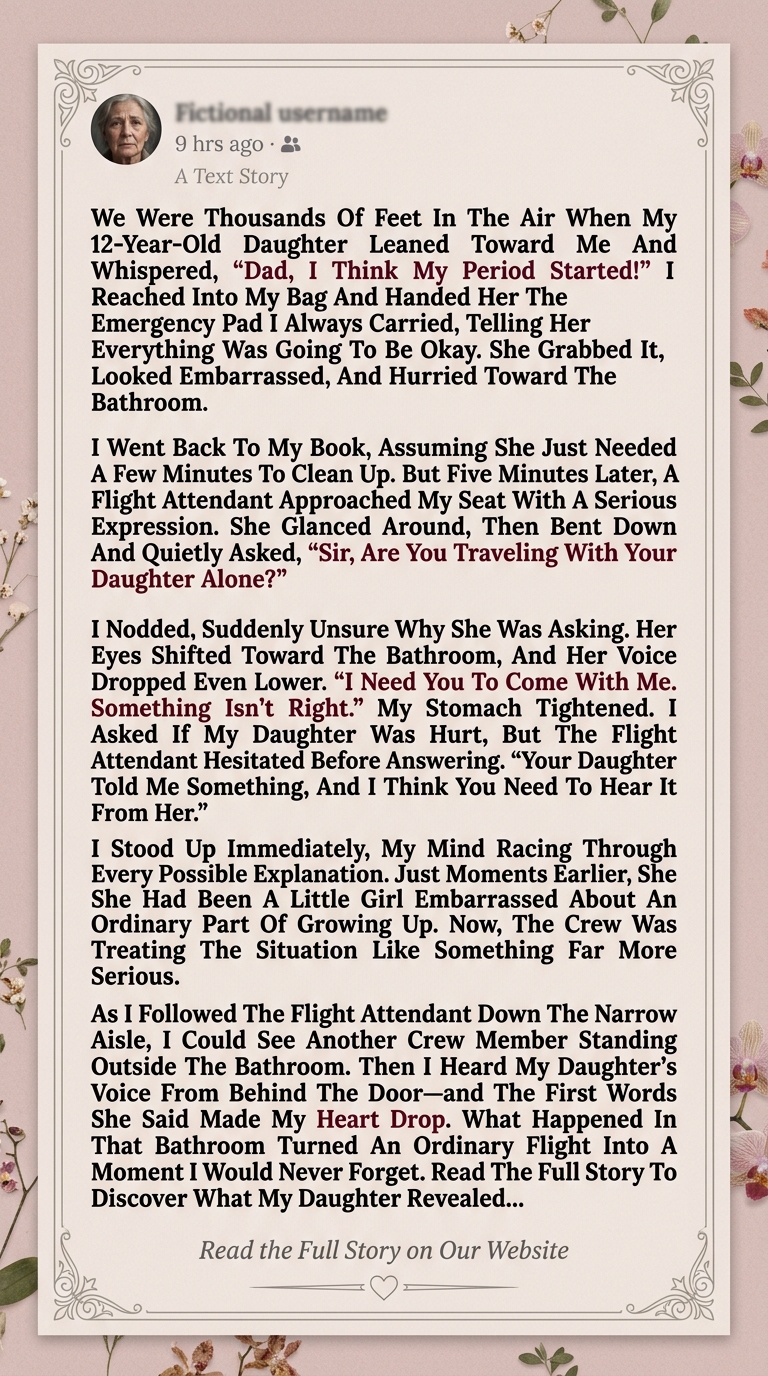
“Dad, I think my period started.”
My twelve-year-old daughter, Lily, whispered the words so quietly that I almost missed them over the roar of the airplane engines.
We were three hours into a flight from Chicago to Seattle. Lily had spent most of the journey looking out the window, occasionally asking how much longer we had before landing.
I closed my book and reached into my backpack.
“It’s okay, sweetheart. Don’t worry. I’ve got you covered.”
I handed her the emergency pad I always carried for her. Her mother, Rachel, had died two years earlier, and since then, I’d learned to prepare for things I never imagined I’d have to handle alone.
I kept spare hair ties, tissues, pain relievers approved for her age, and period supplies in my bag. I didn’t always know exactly what to say, but I wanted Lily to know she could come to me with anything.
She took the pad, gave me a small embarrassed smile, and hurried toward the bathroom.
I returned to my book.
Five minutes later, a flight attendant stopped beside my seat.
“Sir, may I speak with you privately?”
Her expression made my stomach tighten.
“Is something wrong with my daughter?”
She glanced toward the bathroom at the back of the cabin.
“Are you traveling with Lily alone?”
“Yes. Why?”
She hesitated before answering.
“Your daughter told me something, and I think you need to hear it from her. Could you please come with me?”
I stood so quickly that my book slid onto the floor.
My mind raced through every possibility. Had Lily fainted? Was she bleeding heavily? Had she gotten hurt?
The flight attendant led me down the aisle. Another crew member stood outside the bathroom, speaking gently to someone inside.
Then I heard Lily’s voice.
“Please don’t tell him yet. I don’t know how to explain it.”
I stopped walking.
The flight attendant turned toward me.
“She’s frightened, sir. But she isn’t in trouble. We just want to make sure she feels safe.”
I knocked softly on the bathroom door.
“Lily? Sweetheart, it’s Dad. I’m right here.”
There was a long silence.
Then came a quiet, trembling answer.
“Dad, I need to tell you something. But you have to promise you won’t be mad at me.”
My heart broke a little at those words.
“I’m not mad, sweetheart. Whatever it is, you can tell me.”
The door opened a few inches.
Lily’s face appeared in the gap. Her eyes were red, and she was clutching something tightly in her hand.
It wasn’t the emergency pad I’d given her.
It was a folded piece of paper.
“Dad,” she whispered, “I found this in Mom’s old suitcase before we left home.”
I stared at her.
Rachel’s old suitcase had been stored in the back of my closet since her death. Lily had asked about it several times, but I’d always told her we would go through her mother’s belongings together when she felt ready.
Apparently, she had decided to look on her own.
“What is it?” I asked gently.
Lily unfolded the paper.
It was a handwritten letter, creased several times and marked with my wife’s familiar handwriting.
At the top was a date from three years earlier, several months before Rachel had died.
And beneath it were six words that made the cabin seem to tilt around me.
If anything happens to me, tell Lily.
I recognized Rachel’s handwriting immediately.
But I had never seen the letter before.
“Where did you find this?” I asked.
“In the inside pocket of Mom’s suitcase,” Lily replied. “I wasn’t trying to snoop. I just wanted something that smelled like her.”
She lowered her eyes.
“Then I found the letter. I read the first part, but I got scared. I didn’t know whether I should tell you.”
I wanted to take the paper and read it immediately, but I stopped myself.
“Lily, you haven’t done anything wrong. You don’t have to hide things from me because you’re afraid I’ll be angry.”
She looked at me with an expression I hadn’t seen since Rachel’s funeral.
The expression of a child who had been carrying something too heavy for too long.
“I think Mom knew something was going to happen to her,” she whispered.
I felt a chill run through me.
Rachel had been diagnosed with an aggressive illness after months of unexplained fatigue. The doctors had told us that the disease had probably been developing for some time before we discovered it.
But she had never told me she suspected anything before her diagnosis.
At least, I had always believed she hadn’t.
I gently asked Lily if she wanted to come sit with me while we read the letter.
She nodded.
The flight attendant helped us find a little privacy near the rear of the cabin. Lily sat beside me, holding my hand as I unfolded the paper.
The first few lines were ordinary.
Rachel had written about Lily’s school, her favorite books, and the funny things she said when she thought nobody was listening.
Then the letter changed.
My sweet Lily,
If you’re reading this, something has happened that I hoped you would never have to face while you were still young.
There is something I want you to understand about your father.
I stopped reading.
Lily squeezed my hand.
“What does it say?”
I continued.
Your dad has always tried to protect you. Sometimes he thinks that means carrying every difficult thing by himself. If I am no longer here, please don’t mistake his silence for a lack of love.
I swallowed hard.
Rachel had known me better than anyone.
After she died, I had thrown myself into work, school pickups, grocery shopping, and every practical task I could manage. I thought keeping Lily’s life organized would protect her from grief.
I rarely spoke about my own sadness.
Whenever Lily asked whether I missed her mother, I’d tell her that, of course, I did, then quickly change the subject.
I had thought I was being strong.
Perhaps I had simply taught my daughter that certain feelings were too painful to discuss.
I continued reading.
There is one more thing I need you to know. Before we learned how sick I was, I had started putting together a little box of letters for you. I wanted you to have something from me for the moments when you needed advice and I couldn’t be there.
The box is hidden in the blue storage trunk in your father’s office.
I looked at Lily.
“The blue trunk?”
She nodded.
“I’ve seen it.”
Neither of us had known there was anything inside it for her.
The letter continued.
I wrote letters for your first day of middle school, your first heartbreak, your sixteenth birthday, and the day you begin to understand what kind of person you want to become.
I didn’t finish all of them. I thought I had more time.
My vision blurred.
Rachel had died before Lily’s tenth birthday.
For three years, a box of unfinished letters had sat in my office while I convinced myself that the best way to protect my daughter was to keep the past packed away.
The final paragraph was short.
Lily, you were never responsible for making me happy, and you will never be responsible for keeping your father from being sad. You are allowed to grow up, make mistakes, ask questions, and tell us when something frightens you.
You are loved on your best days and your worst days. Nothing you experience as you grow older will make you less worthy of that love.
Love, Mom.
I couldn’t speak.
Lily leaned against my shoulder.
“Dad, I didn’t want to upset you,” she said. “You already miss Mom so much. I thought if the letter made you sad, I should keep it to myself.”
I put my arm around her.
“Oh, sweetheart.”
She began to cry.
“I didn’t know who else to ask. I thought maybe Mom was trying to tell me something important, and I was scared I would never find out.”
I held her close while the airplane hummed around us.
Then I realized something that hurt more than the letter itself.
My daughter had reached a frightening moment in her life, discovered a message from her dead mother, and felt she had to manage her father’s emotions before she could ask for help.
She had been trying to protect me.
The child I was supposed to protect.
“Listen to me,” I said softly. “You never have to take care of my feelings before you tell me yours. I’m your dad. It’s my job to help you, even when something makes me sad.”
She wiped her cheeks.
“Even if I find something about Mom?”
“Especially then.”
“And even if I have questions you don’t know how to answer?”
I kissed the top of her head.
“Then we’ll figure them out together.”
The flight attendant quietly checked whether Lily needed anything. I thanked her for taking my daughter seriously and helping her feel safe.
Before returning to our seats, Lily asked me one more question.
“Dad, do you think Mom would be proud of me?”
I looked at the little girl who had been so afraid of upsetting me that she’d nearly kept her mother’s letter a secret.
“Your mom would be proud of you for being brave enough to tell me,” I said. “But you don’t have to be brave every minute. You can be scared. You can cry. You can ask for help. You can be twelve.”
For the first time since we’d boarded the plane, Lily smiled.
When we returned to our seats, she rested her head against my shoulder. I tucked a blanket around her and watched the clouds drift beneath us.
The ordinary flight continued.
People ate their snacks, watched movies, and checked the time until landing. Nobody else knew what had happened in the back of the cabin.
But something had changed between my daughter and me.
I had spent two years trying to be both parents by making sure nothing went wrong.
Now I understood that being a good father wasn’t about having an answer for every problem.
Sometimes it meant making room for a question.
Sometimes it meant letting my daughter see me cry.
And sometimes it meant listening to what she was afraid to say without rushing to make the fear disappear.
When we arrived in Seattle, I took Lily to a quiet café near the airport before we continued to our hotel.
We talked about her first period, the changes she could expect as she grew up, and how she could always come to me if she felt uncomfortable or confused. I answered what I could and admitted when I didn’t know something.
Then I called a trusted pediatrician’s office to arrange an appointment so Lily could ask any health questions she preferred to discuss with a professional.
She seemed relieved.
Later that evening, we unpacked the blue storage trunk together.
Inside was a small wooden box tied with a faded blue ribbon.
There were envelopes labeled in Rachel’s handwriting.
For your first day of middle school.
For the day you feel different from everyone else.
For your sixteenth birthday.
For when you fall in love.
For when you need to remember how deeply you are loved.
Some letters were finished. Others contained only a few sentences. One envelope was empty except for a small note that read, I’ll finish this when I know what else I want you to remember.
Lily sat on the floor and carefully arranged the envelopes.
She didn’t open them all that night.
Instead, she chose the one marked For the day you feel different from everyone else.
I sat beside her while she read it silently.
When she finished, she folded the letter and held it against her chest.
Then she handed me a separate envelope.
On the front, Rachel had written my name.
I stared at it for a long time before opening it.
Inside was a short note.
Daniel,
If you’re reading this, you may be trying very hard to be strong for Lily.
Please remember that she doesn’t need a perfect father. She needs a present one.
Let her see you miss me. Tell her stories about our life together. Let her ask questions, even when you don’t know the answers.
And when she grows up, don’t hold on so tightly that she becomes afraid to leave your side.
Your job isn’t to keep her little forever. Your job is to help her feel safe enough to become herself.
I love you both.
I lowered the letter and cried.
Not quietly. Not with my face turned away.
I cried in front of my twelve-year-old daughter, and she wrapped her arms around me.
Neither of us tried to stop the other from grieving.
For the first time in a long time, we talked about Rachel without treating every memory as something that might break us.
We remembered the way she sang off-key while cooking, how she always bought too many books, and how she once drove twenty minutes back to a grocery store because she’d forgotten Lily’s favorite cereal.
We laughed.
We cried.
And we began to understand that remembering someone wasn’t the same as being trapped in the past.
Over the months that followed, we kept the wooden box in Lily’s bedroom. Whenever she reached a new milestone or faced something she found difficult, she sometimes chose a letter to read.
Other times, she simply came to me.
I learned to listen without immediately offering solutions. She learned that my sadness wasn’t her responsibility and that asking for help didn’t make her a burden.
On her thirteenth birthday, we celebrated with a small dinner at home.
There was a cake, a few friends, and a photograph of Rachel on the table.
Before blowing out the candles, Lily looked at me.
“Dad, can I make a wish?”
“Of course.”
She closed her eyes.
Afterward, she told me what she’d wished for.
“I wished that when I’m older, I’ll remember that I can tell you anything.”
I reached across the table and took her hand.
“You won’t have to remember it by yourself,” I told her. “I’ll keep showing you.”
That flight had begun with an ordinary moment between a father and his daughter.
It had become one of the most important days of our lives because a frightened twelve-year-old had finally said what she needed to say—and because, this time, her father had listened.
I had always thought protecting Lily meant shielding her from the pain of losing her mother.
Now I understood that I couldn’t remove every painful thing from her life.
I could only make sure she never had to face those things believing she was alone.
And that was the promise I intended to keep.