The Paramedic Pulled Me Aside After My Husband Delivered Our Baby—What He Noticed About His Hands Revealed a Secret From His Past
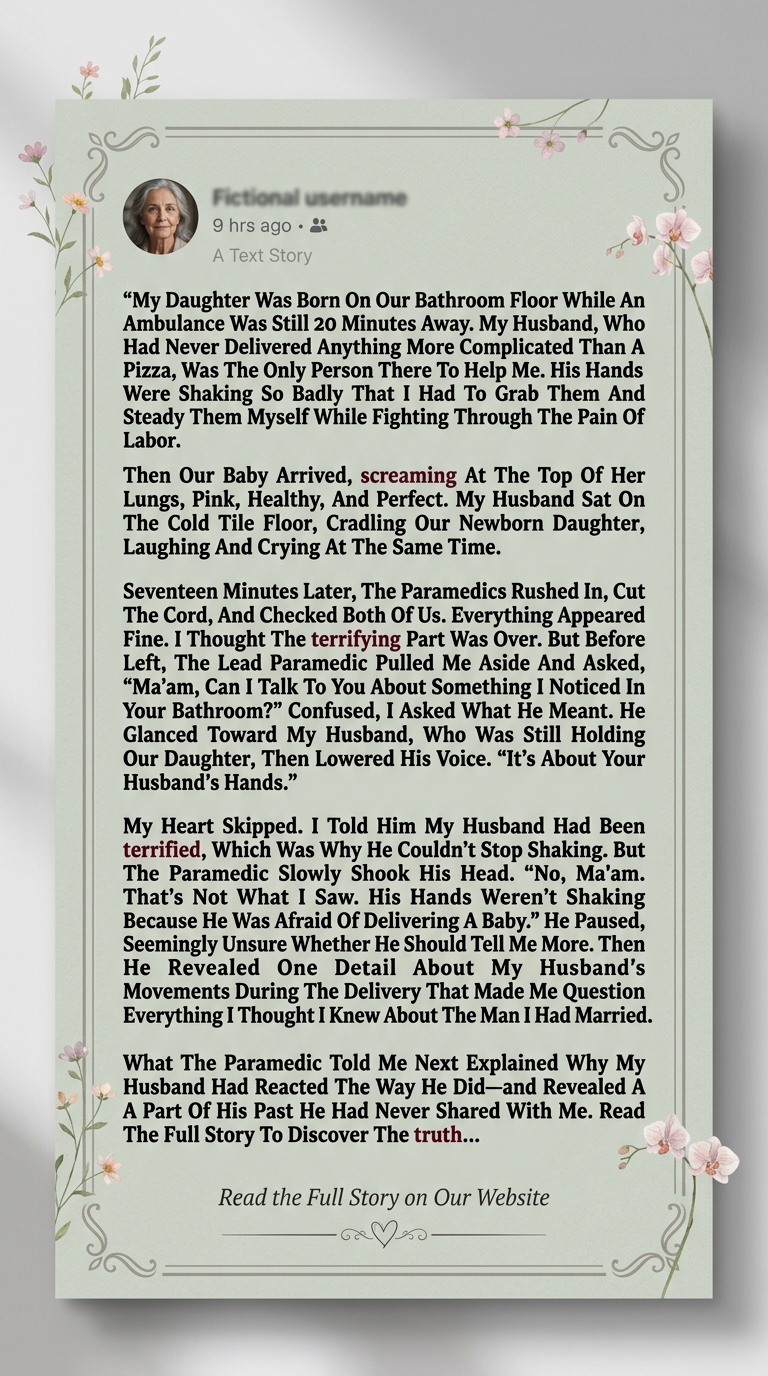
My daughter was born on our bathroom floor while an ambulance was still twenty minutes away.
My husband, Daniel, had never delivered anything more complicated than a pizza. He had never taken a first-aid class beyond the basic training required at his old job, and the sight of blood usually made him turn pale.
Yet that morning, with me screaming through contractions and our baby arriving far faster than either of us expected, he became the only person I could depend on.
His hands were trembling so badly that I grabbed his wrists and forced him to look at me.
“Daniel, look at me! I need you to stay with me!”
He swallowed hard and nodded.
“I’m here, sweetheart. I’m right here.”
Outside, rain hammered the windows. My phone lay on the bathroom counter with the emergency dispatcher speaking through the speaker. Towels covered the floor, and Daniel kept repeating the instructions he was given, trying desperately to remember every word.
Then our daughter arrived.
She let out a powerful cry that seemed to fill the entire house.
For a moment, neither of us moved.
Then Daniel began laughing and crying at the same time.
“She’s here,” he whispered. “Oh, my God, she’s actually here.”
He held our newborn close while I collapsed against the bathtub, exhausted and overwhelmed. Our daughter was pink, breathing, and crying loudly. Daniel kept looking at her face as if he couldn’t believe something so perfect had just entered our lives.
Seventeen minutes later, the paramedics rushed through the front door.
They assessed both of us, checked the baby, and took over the medical care. Thankfully, everything appeared stable enough for them to transport us for further evaluation without an immediate crisis.
I thought the terrifying part was finally over.
Then the lead paramedic, a middle-aged man named Harris, asked to speak with me privately.
“Ma’am, can I ask you something about what happened in the bathroom?”
I nodded, still trembling from the delivery.
He glanced toward Daniel, who was sitting nearby with our daughter wrapped securely in a blanket.
“It’s about your husband’s hands.”
I frowned.
“He was terrified. He told me he’d never seen a baby born before.”
Paramedic Harris shook his head slowly.
“No, ma’am. His hands weren’t shaking because he was afraid of delivering a baby.”
My stomach tightened.
“What are you saying?”
He hesitated, as though deciding how much he should reveal.
“During the delivery, I noticed something unusual when I reviewed the situation with him. He followed the dispatcher’s instructions remarkably well. But that wasn’t the part that caught my attention.”
He lowered his voice.
“When we arrived, your husband had positioned himself beside you in a way that kept the space clear for emergency treatment. He had gathered the clean towels, moved obstacles out of the way, and remembered the exact time the baby was born. He was frightened, yes, but his actions were unusually organized for someone who claimed to have no experience.”
I stared at him.
“Maybe he was just trying to help.”
“That’s possible,” he replied. “But when I asked him whether he had any medical training, he went completely silent. Then his hands started shaking even harder.”
My heart began pounding.
Daniel had never told me he had medical training.
In fact, during our six years of marriage, he had always described himself as an ordinary office manager who preferred spreadsheets to anything involving hospitals.
“Are you saying my husband lied to me?”
“I don’t know what happened in his past,” Harris said carefully. “I’m not here to accuse him of anything. But I recognized the way he was watching your daughter after she was born. He wasn’t only looking at her as a father. He was checking her breathing, her color, and her response.”
He paused.
“I’ve worked emergency calls for eighteen years. Sometimes people remember training they thought they had forgotten. Sometimes they have experience they never talk about.”
I looked across the room at Daniel.
He was gently touching our daughter’s tiny fingers, whispering something I couldn’t hear.
For the first time since I had met him, I wondered whether there was an entire chapter of his life I had never seen.
And I realized that I needed to ask him about it.
Not because I suspected he had done something terrible.
Because I loved him, and I suddenly understood that love did not mean knowing every detail of another person’s past.
It meant being willing to listen when the truth finally came out.
Daniel and I had met eight years earlier at a friend’s barbecue.
He was quiet, thoughtful, and almost painfully modest. While everyone else competed to tell stories, he stood near the grill making sure nobody’s food burned.
When I accidentally spilled a drink on his shirt, he laughed and said, “Don’t worry. I’ve survived worse.”
I asked what he meant.
He smiled, changed the subject, and offered me another drink.
That was Daniel: kind, dependable, and strangely private about the years before we met.
I knew he had grown up in Ohio. I knew his father had died when he was young and that his mother had raised him and his younger sister. I knew he had worked several jobs before landing his office position.
But whenever I asked about his early twenties, he gave me short answers.
“I moved around a little.”
“I was trying to figure out what I wanted.”
“It’s not a particularly interesting story.”
I never pushed him.
After we married, I assumed the past simply wasn’t important to him.
Now, sitting in the hospital room with our newborn daughter sleeping between us, I watched him more closely.
His hands had stopped shaking.
He looked completely different from the frightened man on the bathroom floor. His movements were calm and deliberate as he adjusted the blanket around our daughter.
“Daniel,” I said quietly.
He looked up.
“Are you okay?”
He nodded. “I’m better now that you’re both safe.”
I took a breath.
“The paramedic asked me about your hands.”
His expression changed.
Only slightly, but enough for me to notice.
“What did he say?”
“He said you seemed to know more than you should have. He noticed how you moved, how you organized everything, and how carefully you watched the baby.”
Daniel looked down at our daughter.
For several seconds, he said nothing.
Then he whispered, “I was hoping you’d never have to see that part of me.”
My chest tightened.
“What part?”
He rubbed his palms against his jeans.
“The part I spent years trying to forget.”
I moved closer.
“Daniel, you don’t have to tell me everything right now. But I need to understand what you’re talking about.”
He nodded, then looked toward the hospital window.
“When I was twenty-three, I was an emergency medical technician.”
I blinked.
“You were an EMT?”
“For almost four years.”
I stared at him, struggling to connect the man beside me with the person he was describing.
“Why didn’t you ever tell me?”
“Because I quit after something happened that I couldn’t live with.”
He swallowed hard.
“One night, we were called to a serious highway accident. A young woman had been driving home with her little boy when another vehicle crossed into her lane. We arrived within minutes. The mother was badly injured, but she was conscious. Her son was trapped in the back seat.”
Daniel stopped speaking.
I reached for his hand.
“Take your time.”
He squeezed my fingers.
“I remember the sound of the boy crying. I remember his mother asking me to promise that he would be okay. And I remember telling her we were going to do everything we could.”
His voice cracked.
“We got the boy out. Another crew treated the mother. For a while, it looked as though they might both survive.”
He stared at the floor.
“But the mother died at the hospital.”
I felt tears gather in my eyes.
“Daniel, I’m so sorry.”
He shook his head.
“I kept thinking about the promise I had made. I hadn’t lied to her. I truly believed we could save her. But after she died, I started replaying every second of that call. I wondered whether I’d moved too slowly, whether I’d missed something, whether one different decision might have changed the outcome.”
He rubbed his forehead.
“I knew intellectually that I couldn’t control everything. My supervisor told me that. My colleagues told me that. But I couldn’t stop blaming myself.”
“What happened to the boy?”
“He survived. His grandmother took him in.”
Daniel took a shaky breath.
“I left the job a few months later. I told everyone I was burned out. That was true, but it wasn’t the whole truth. I couldn’t stand being in a room where someone needed me and knowing that, no matter how hard I tried, I might not be able to save them.”
He looked at our daughter.
“After I met you, I wanted a normal life. I wanted to be the kind of man who worried about mortgage payments and weekend groceries. I wanted to be a husband and, someday, a father. I didn’t want every emergency to remind me of the people I couldn’t save.”
I felt my heart break for the young man he had been.
“But you didn’t forget your training,” I whispered.
“No. I couldn’t.”
He explained that when our daughter began arriving, his fear had been overwhelming. He had felt the old panic rising, and for a moment, he had been twenty-three again, standing beside a wrecked car and trying to keep a frightened child calm.
But this time, the person who needed him was his wife.
And the tiny person he was trying to protect was his own daughter.
“I was terrified,” he admitted. “I was terrified that something would happen to you. I was terrified that I’d make the wrong decision. But I remembered enough to follow the dispatcher’s instructions, and I kept focusing on the next thing I needed to do.”
I squeezed his hand.
“Why were your hands shaking so much?”
He gave a sad, almost embarrassed smile.
“Because I was afraid of losing my family before we’d even had the chance to become one.”
I began to cry.
For years, I had interpreted Daniel’s silence about his past as a harmless preference for privacy. I hadn’t realized that some memories were so painful he had built his entire adult life around avoiding them.
“Did you think I’d see you differently if you told me?” I asked.
“Yes.”
“Why?”
“Because I didn’t want you to think I was broken.”
I leaned forward and rested my forehead against his.
“Daniel, you helped bring our daughter into the world today. You stayed with me when I was terrified. You followed the instructions you were given, and you didn’t leave my side.”
I pulled back to look at him.
“That doesn’t make you broken. It makes you someone who was scared and still showed up.”
His eyes filled with tears.
For the first time since I had known him, Daniel allowed himself to cry without trying to hide it.
I held him while our daughter slept peacefully beside us.
But our conversation wasn’t finished.
There was something else he needed to tell me.
The next morning, Daniel asked whether I remembered the paramedic’s name.
“Mr. Harris,” I said. “Why?”
“Because I need to thank him.”
I raised an eyebrow.
“For what?”
“For making me realize something.”
He looked at our daughter, who was sleeping in her bassinet.
“I’ve spent years thinking that leaving emergency medicine meant I had to bury that part of my life. I thought the only way to move forward was to pretend it never happened.”
He paused.
“But yesterday, I realized I hadn’t forgotten everything I learned. I also realized that the things I remember aren’t only connected to the worst day of my life. Some of them helped me stay calm enough to follow instructions when you needed me.”
He reached for my hand.
“I don’t want to spend the rest of my life running away from my past.”
I smiled gently.
“Then don’t.”
He looked uncertain.
“What if I still get scared?”
“You will. So will I. We’re parents now. Being scared comes with the job.”
That made him laugh softly.
A week later, after we had returned home and recovered from the exhaustion of those first days, Daniel contacted a counselor who worked with former emergency responders. He began talking about the highway accident, the guilt he had carried, and the way his experience had shaped his relationships.
It wasn’t a quick fix.
Some nights, he still woke from dreams about that call. Sometimes he needed to step outside and breathe when a siren passed our house.
But he stopped pretending those memories didn’t exist.
And I stopped treating his silence as proof that he was fine.
We learned to talk about difficult things before they became secrets.
Months later, when our daughter was old enough to smile at the sound of her father’s voice, I watched Daniel hold her in the living room.
He had one hand supporting her head and the other resting gently against her back.
His movements were careful, but no longer rigid.
He was no longer watching every breath as though something terrible might happen if he looked away.
He was simply enjoying his daughter.
I walked over and kissed his cheek.
“What are you thinking about?” I asked.
He smiled down at her.
“How lucky I am.”
I leaned against his shoulder.
“So am I.”
I sometimes think about the paramedic who pulled me aside that day. He could have simply finished his work and left us to our new life. Instead, he noticed something that helped us begin a conversation we had needed for years.
He didn’t uncover a criminal secret or expose a hidden betrayal.
He noticed a man whose fear had been mistaken for inexperience.
And he gave me a reason to ask questions instead of making assumptions.
Daniel’s past didn’t change the man I loved.
It helped me understand him.
The shaking hands I had initially seen as a sign of helplessness belonged to someone who had once carried the weight of other people’s emergencies and never quite learned how to put that weight down.
That day on our bathroom floor, he wasn’t fearless.
He was afraid, overwhelmed, and uncertain.
But he stayed.
And sometimes, I think that is what courage really looks like.
Not the absence of fear.
Not having every answer.
Just choosing, in the middle of the hardest moment, to remain present for the people who need you most.
Our daughter was born on a cold bathroom floor, with an ambulance still on its way and two frightened parents learning what it meant to become a family.
The paramedic’s observation revealed a hidden chapter of my husband’s life.
But the most important thing it revealed was this:
The man I had married wasn’t defined by the tragedy he had survived.
He was defined by the love he chose to give after it.
And I knew, watching him hold our daughter, that she would grow up learning the same lesson.