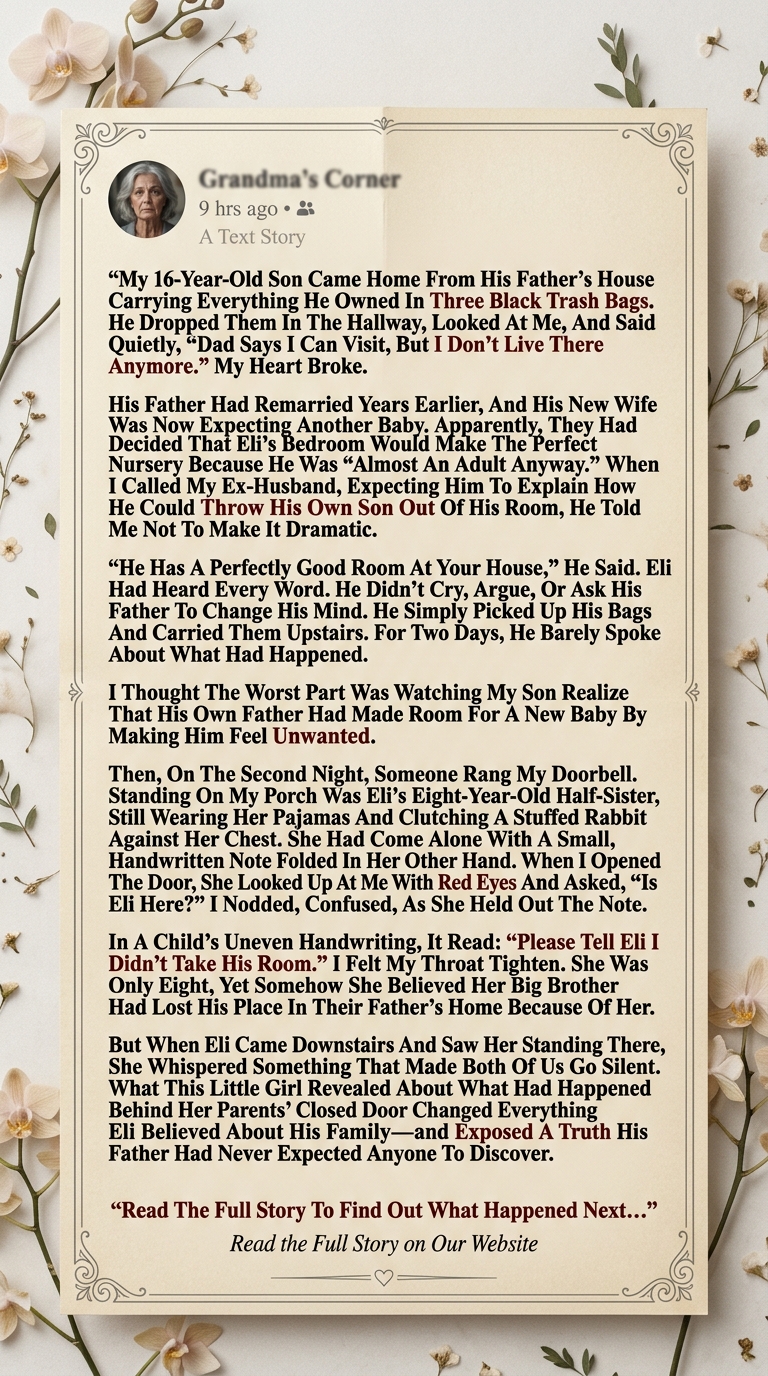
My 16-Year-Old Son Was Kicked Out of His Bedroom for a New Baby—Then His 8-Year-Old Sister Showed Up With a Note That Changed Everything
The three black trash bags sat in the middle of my hallway like something that didn’t belong in a home.
One contained Eli’s clothes. Another held his shoes, books, and school supplies. The third was filled with the little things teenagers collect without realizing how much they mean to them—old birthday cards, photographs, a battered basketball, and a stuffed dog he’d owned since he was five.
My sixteen-year-old son stood beside them, staring at the floor.
“Dad says I can visit, but I don’t live there anymore.”
For a moment, I couldn’t speak.
“I’m sorry, sweetheart. What did you say?”
He swallowed.
“His wife needs my bedroom for the nursery. They said I’m almost an adult anyway, so it makes sense.”
I pulled him into my arms, but he stood stiffly, his hands hanging at his sides. Eli had always been affectionate as a child. Lately, he’d been growing quieter, more independent, more determined to handle his problems without asking for help.
But he was still sixteen.
He was still a boy who deserved to have a place in his father’s home.
His father, Mark, had remarried four years earlier. His new wife, Lauren, was expecting their second child together, and apparently, they had decided that the easiest solution was to turn Eli’s bedroom into a nursery.
I called Mark immediately.
“Tell me this isn’t what happened.”
He sighed as though I were interrupting something important.
“Please don’t start.”
“Your son came home with everything he owns stuffed into trash bags. You told him he doesn’t live at your house anymore?”
“He has a perfectly good room at your place.”
“That isn’t the point, Mark!”
“Eli is sixteen. He’ll be eighteen before we know it. The baby needs a room, and we’re trying to make our house work for everyone.”
“Everyone except Eli.”
There was a pause.
Then Mark said, “You’re making this dramatic. He can still visit whenever he wants.”
I looked toward the staircase.
Eli was standing halfway up, holding the railing. He’d heard every word.
“Mark,” I said quietly, “you’ve just told your son that he’s welcome as a visitor in a house where he grew up.”
“He’ll get over it.”
I hung up before I said something I’d regret.
Eli picked up his bags and carried them upstairs without a word.
That night, I made his favorite dinner, but he barely touched it. He thanked me, took his plate to the sink, and disappeared into his bedroom.
For two days, he went to school, came home, finished his homework, and answered my questions with one-word replies.
I wanted to tell him that his father was wrong. I wanted to promise that nobody would ever make him feel unwanted again.
But I knew I couldn’t control what Mark did.
All I could do was make sure Eli understood that he had a home with me.
On the second night, I was folding laundry when the doorbell rang.
It was nearly eight-thirty.
When I opened the door, I found an eight-year-old girl standing on my porch in pink pajamas and mismatched slippers. Her brown hair was tangled, her cheeks were wet, and she was clutching a stuffed rabbit against her chest.
It was Sophie, Eli’s half-sister.
She looked frightened.
“Hi, sweetheart,” I said, immediately crouching to her level. “What are you doing here? Where’s your mom?”
She held out a small piece of folded paper.
“Is Eli here?”
“Yes, honey. He’s upstairs.”
Her lower lip trembled.
“Can I see him?”
“Of course. But first, are you alone? Did someone bring you here?”
She nodded, then shook her head as though she wasn’t sure how to explain.
“I walked from the house next door to Grandma’s, and Grandma brought me here. She said I could come because she was staying with me.”
That explained the short distance, but I still felt uneasy. Sophie was too young to be carrying this much worry.
I took the note from her hand.
The handwriting was uneven, with several letters written backward.
“Please tell Eli I didn’t take his room.”
I pressed my lips together, fighting the sudden sting behind my eyes.
“Oh, sweetheart. Nobody thinks you took his room.”
She looked down at her rabbit.
“Daddy said the baby needs Eli’s room because it’s the only one big enough for the crib and all the baby things.”
I gently brushed a strand of hair from her forehead.
“That’s something the grown-ups should have figured out without hurting Eli.”
Sophie began crying again.
“I didn’t ask for his room. I told Daddy he could put the baby’s crib in my room. I have a big bed, and I don’t mind sharing.”
My heart tightened.
“Did you tell him that?”
She nodded.
“He said no. He said girls need their own rooms, and Eli is old enough to understand.”
She looked toward the stairs.
“But Eli didn’t look like he understood. He looked like he was going away forever.”
I called Eli downstairs.
When he reached the bottom step and saw Sophie, his expression changed instantly.
“Sophie? What are you doing here?”
She ran to him and wrapped both arms around his waist.
“I didn’t take your room!”
Eli froze.
Then he knelt and held her.
“I know you didn’t, Soph.”
“Daddy said you were almost grown up, so you didn’t need it anymore. But you’re still my brother.”
His face crumpled.
He pulled her closer, resting his cheek against the top of her head.
For the first time since he’d arrived with those black bags, I saw him cry.
Not loudly. Not dramatically.
Just quiet tears that slipped down his face while his little sister held on to him as though she were afraid he’d disappear.
I turned away for a moment to give them privacy.
Then Sophie pulled back and looked up at him.
“There’s something else,” she whispered.
Eli wiped his eyes.
“What is it?”
She glanced at me, then back at her brother.
“Daddy said something after you left.”
Eli’s expression hardened slightly.
“What did he say?”
Sophie squeezed her rabbit.
“He told Mommy that now you can’t tell Grandma about the money.”
The room went completely still.
I looked at Eli.
“What money?”
Sophie seemed to realize she’d said something she wasn’t supposed to say. She pressed the rabbit against her chest and shook her head.
“I don’t know. Daddy told Mommy that he had everything under control, and she said she didn’t want you finding out.”
Eli slowly stood.
“Finding out what, Soph?”
“I don’t know,” she repeated, her voice getting smaller. “But they were arguing in the kitchen. Mommy said you should have been told before they changed your room.”
Eli looked at me.
I felt a chill travel down my back.
Mark had always been careless with his words, but he wasn’t usually secretive about family matters. Whatever Sophie had overheard, it had frightened her enough to make an eight-year-old walk to our house with a handwritten apology.
I brought her some warm milk and helped her settle on the couch. After checking with her grandmother, I learned that Sophie had been staying there that evening while Mark and Lauren attended a medical appointment. Her grandmother had agreed to bring her over because Sophie had begged to see Eli.
When Sophie was comfortable, I sat beside her.
“Sweetheart, you haven’t done anything wrong. Whatever the grown-ups are discussing, it’s not your responsibility to fix it.”
She nodded, but her eyes remained fixed on Eli.
“I just don’t want him to stop being my brother.”
Eli sat beside her and took her hand.
“Nothing they do can change that.”
She leaned against him, finally looking a little less frightened.
That night, Sophie stayed with her grandmother, who promised to keep her until Mark came to collect her. Eli barely slept.
The next morning, he asked me a question I hadn’t expected.
“Mom, do you remember when Dad and I used to go to Grandma’s house every summer?”
“Of course.”
“Grandma used to say she’d saved something for me. She said she’d explain when I was older.”
I searched my memory.
Mark’s mother, Helen, had been especially close to Eli when he was little. Before she died three years earlier, she’d often talked about wanting to help her grandchildren with college.
“She mentioned a college fund once,” I said carefully. “But I don’t know the details.”
Eli looked troubled.
“Dad told me Grandma left everything to him. He said there wasn’t anything for me because he had to pay her medical bills.”
I sat down across from him.
“Did you ever see any paperwork?”
“No. Dad just said it was handled.”
Suddenly, Sophie’s words made more sense.
Money. A grandmother. Something Eli wasn’t supposed to find out.
I didn’t want to jump to conclusions, so I called Helen’s former attorney, whose number I still had from the funeral arrangements. I explained what had happened and asked whether there had been any inheritance or trust intended for Eli.
He couldn’t discuss confidential details over the phone without confirming the relevant documents and parties. But after I explained the concern, he told me something that made my hands go cold.
Helen had indeed established an education trust for Eli before her death.
Mark had been named its trustee.
The attorney couldn’t tell me the balance without reviewing the authorization and records, but he confirmed that the trust had been created specifically for Eli’s future education.
I thanked him and ended the call.
Eli watched me closely.
“Mom?”
I took a breath.
“Your grandmother created an education trust for you. Your father was responsible for managing it.”
He stared at me.
“What?”
“I don’t know yet what happened to the money. We need to get the records before we assume anything.”
For several seconds, he didn’t move.
Then he said, “He told me there was nothing.”
His voice was so quiet that it hurt to hear.
I reached across the table and took his hand.
“We’re going to find out the truth. And whatever it is, you won’t have to handle it alone.”
That afternoon, Mark called.
He sounded angry.
“Why is Sophie telling people things she doesn’t understand?”
I kept my voice steady.
“She’s eight, Mark. She came to my house because she thought Eli blamed her for losing his bedroom.”
“I never said he was losing his place in the family.”
“You told him he could visit but no longer live in his room.”
“I was talking about the bedroom, not the family.”
“Then perhaps you should have explained that to your son before packing his belongings into trash bags.”
He went silent.
Then he changed the subject.
“Have you been talking to my mother’s attorney?”
“Yes.”
His breathing changed.
“That’s none of your business.”
“Eli’s education trust is absolutely his business.”
“You don’t know what you’re talking about.”
“Then show us the records.”
He hung up.
For the next several days, Mark refused to respond to messages about the trust. Eli didn’t ask to return to his father’s house. He went to school, worked on his assignments, and spent time with Sophie whenever her grandmother brought her over.
He never blamed his little sister.
In fact, he seemed more protective of her than ever.
One afternoon, I found him helping her with a school project at the kitchen table.
She was drawing a picture of their family. She had drawn herself holding Eli’s hand, with a new baby in a stroller beside them.
“Where’s your dad?” I asked gently.
She pointed to a figure on the other side of the paper.
“That’s Daddy. He’s far away because he was angry.”
Eli glanced at the drawing.
“You can draw him wherever you want, Soph.”
She thought for a moment, then added a small heart above his head.
“People can be angry and still love each other,” she said.
Neither of us knew how to answer that.
A week later, Mark finally agreed to meet us at the attorney’s office.
He arrived with a folder and an expression that suggested he’d rather be anywhere else.
The attorney reviewed the trust documents, then laid out the account statements Mark had provided.
The records showed that a significant portion of the trust had been withdrawn over the previous eighteen months. Some payments were legitimate educational expenses, but others had been transferred into an account that wasn’t identified as belonging to the trust.
Mark insisted he’d used the money for family expenses and intended to replace it.
The attorney explained that the trust had been established for Eli’s benefit, and that Mark, as trustee, was required to follow its terms. Any questionable transactions would need to be reviewed and properly accounted for.
I watched Eli absorb the information.
He didn’t shout. He didn’t accuse his father of being a criminal. He simply looked at Mark and asked the question that mattered most.
“Why didn’t you tell me?”
Mark rubbed his forehead.
“Things were difficult, Eli. The baby is coming. The house needed work, and your stepmother had medical expenses. I thought I could put the money back before you needed it.”
“So you used Grandma’s money to pay for things at your house?”
“I was going to replace it.”
“But you told me there was nothing for me.”
Mark looked away.
“I didn’t want you worrying about adult problems.”
Eli let out a short, disbelieving breath.
“You made me think Grandma didn’t leave me anything. You made me think I wasn’t wanted in your house. And you let me believe my little sister had taken my room.”
Mark opened his mouth, but Eli continued.
“She came to Mom’s house crying because she thought she had done something wrong. She’s eight, Dad. She thought she had to apologize for a baby being born.”
Mark’s expression changed.
For the first time, he looked genuinely ashamed.
“I never wanted Sophie to feel responsible.”
“Neither did I,” Eli replied. “But that’s what happened.”
The attorney brought the discussion back to the trust. Mark would need to provide a full accounting, and the questionable transfers would be reviewed. Any repayment or further action would have to follow the trust’s terms and the applicable legal process.
There would be no instant resolution.
There were documents to gather, transactions to trace, and difficult decisions ahead.
But the truth was no longer hidden.
As we left the office, Mark followed Eli into the parking lot.
“Son, can we talk?”
Eli stopped.
Mark looked older than he had a few weeks earlier.
“I made mistakes,” he said. “I thought I was doing what was best for my family.”
Eli’s eyes filled with tears, but his voice remained steady.
“I am your family, Dad.”
Mark lowered his head.
“I know.”
“Do you?”
The question hung between them.
Eli took a breath.
“I don’t hate you. But I can’t pretend nothing happened. And I’m not coming back just because you say I can visit. If I ever come back, I need to know I actually have a place there.”
Mark nodded slowly.
“I understand.”
“I hope you do.”
Then Eli walked toward our car.
I didn’t tell him what to feel. I didn’t encourage him to forgive his father or to stay angry. That decision belonged to him, and it would take time.
Over the following months, Mark began working with the attorney to account for the trust funds and address the improper transfers. He also had to confront the damage his decisions had caused.
He couldn’t repair everything with one apology.
He started by calling Eli regularly, listening when Eli spoke, and respecting the boundaries his son had set. Eventually, he arranged a separate bedroom for Eli rather than expecting him to sleep on a couch whenever he visited.
It wasn’t the old room. It wasn’t the same house Eli remembered.
But Mark finally understood that a room wasn’t simply a space with four walls. It was a message about whether someone belonged.
As for Sophie, she continued visiting us with her grandmother’s help. Eli took her to the park, helped her with homework, and promised that no matter what happened between the adults, he would always be her big brother.
One Saturday, she arrived carrying a new note.
This time, the handwriting was just as uneven, but the message was different.
“Eli, you still have a place in my family. I love you.”
Eli read it twice, then folded it carefully and put it in his wallet.
I watched him do it.
The three black trash bags were long gone. His clothes hung in the closet, his books lined the shelves, and his basketball rested beside the back door.
But something in him had changed.
He no longer believed that being loved meant accepting whatever treatment someone gave him. He was learning that family could be complicated, that adults could make serious mistakes, and that love didn’t erase the need for honesty.
Months later, when I asked whether he wanted to spend a weekend at his father’s house, he thought about it before answering.
“Maybe,” he said. “If Sophie is there.”
I smiled.
“And if you have your own room?”
He nodded.
“And if Dad understands that I’m not just visiting someone else’s family.”
I reached for his hand.
“Those are fair conditions.”
He squeezed my fingers.
“Mom, I used to think that if Dad didn’t want me there, maybe I wasn’t important enough.”
My heart ached.
“Eli, your worth was never something your father got to decide.”
He looked toward the window, where the evening light was fading.
“I know that now.”
And I believed him.
The truth about the trust had exposed more than missing money. It had revealed how easily a parent could convince himself that one child’s needs could be sacrificed for the convenience of another household.
But it had also revealed something beautiful.
An eight-year-old girl had refused to accept that her brother’s place in the family could simply disappear. She had written a note, carried it with both hands, and made sure he knew that he hadn’t been replaced in her heart.
She hadn’t understood the money, the legal documents, or the arguments behind closed doors.
She understood only that her brother was hurting.
And she had done the bravest thing she knew how to do.
She had shown up.
Sometimes, the people who remind us what family should mean are the youngest ones in the room.
And sometimes, the truth that changes everything begins with a child standing on your doorstep, holding a stuffed rabbit and a handwritten note.