My 14-Year-Old Daughter Wrote, “If I’m Thin Enough, Maybe He’ll Stop”—Then the Principal Read Her Diary and Called the Police
For three months, my fourteen-year-old daughter, Sofia, had stopped eating dinner with us.
Every evening, she offered the same excuse.
“I ate at school.”
“I’m not hungry.”
“My stomach hurts.”
At first, I thought she was going through a difficult teenage phase. Sofia had always been quiet, especially when something bothered her. I assumed she needed space, so I tried not to pressure her.
But then her clothes began hanging loosely on her body. Her cheeks lost their softness, and she started wearing oversized sweatshirts even when the weather was warm.
Whenever I asked if she was feeling okay, she looked away.
“I’m fine, Mom.”
She said it so often that I began to fear she was trying to convince herself.
One Saturday afternoon, while changing her bedsheets, I noticed a corner of a notebook sticking out from beneath her mattress.
It was a small, pink diary with a broken clasp.
I knew I shouldn’t read my daughter’s private thoughts without a serious reason. But I’d watched her grow weaker for weeks, and the worry inside me had become impossible to ignore.
I opened the diary.
The first page contained one sentence.
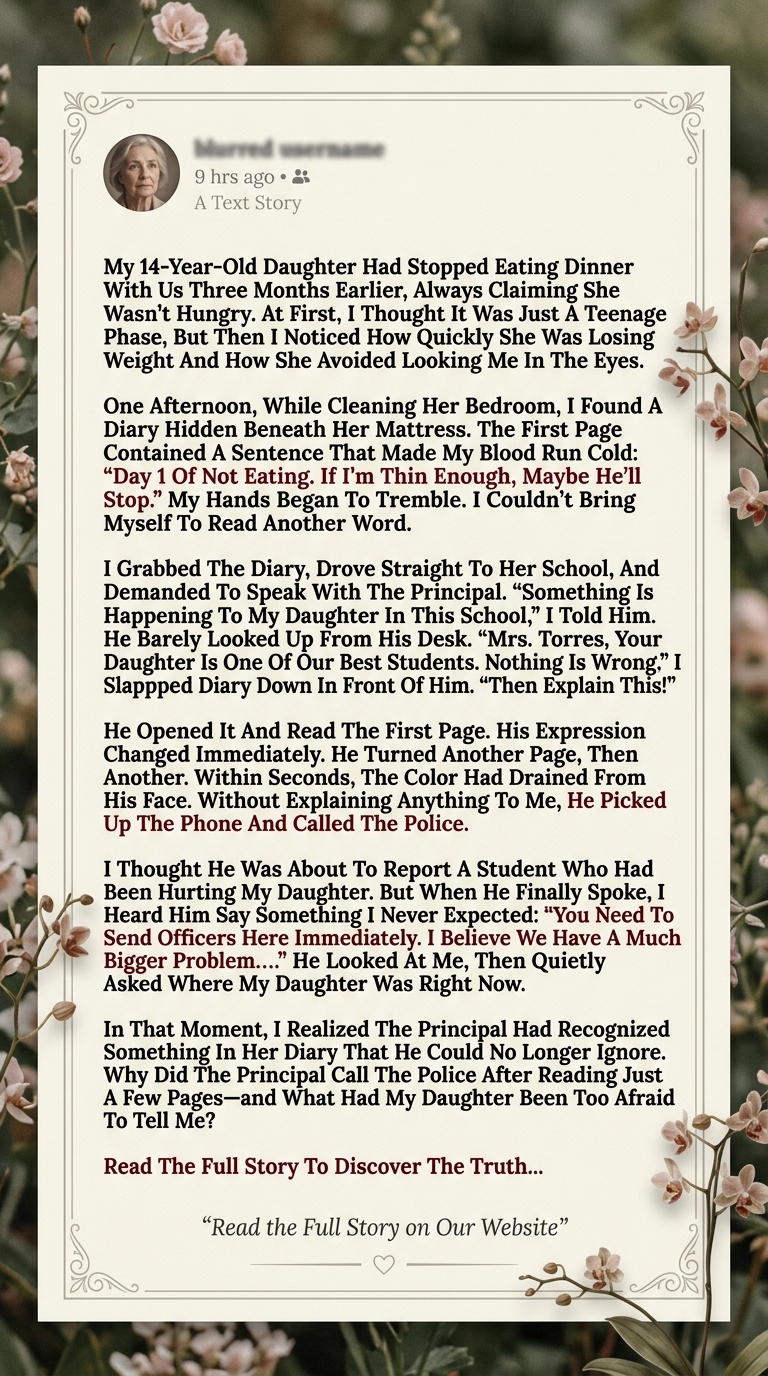
Day 1 of not eating. If I’m thin enough, maybe he’ll stop.
My hands went cold.
I read the sentence again, hoping I’d misunderstood it.
Then I saw the next line.
He said nobody would believe me if I told.
I sat on the edge of her bed, gripping the diary so tightly that my fingers hurt.
Who was he?
What had he done?
And how long had my daughter been carrying this fear alone?
I wanted to read everything, but I couldn’t bear to keep going. I called Sofia’s school and asked to speak with the principal immediately.
Within twenty minutes, I was sitting in Principal Harris’s office with the diary on his desk.
“Something is happening to my daughter in this school,” I told him. “She’s losing weight, she’s afraid to talk to me, and I found this beneath her mattress.”
He barely glanced up from his computer.
“Mrs. Torres, Sofia is one of our best students. Her teachers describe her as responsible, polite, and academically strong. We haven’t received any formal complaints.”
I stared at him.
“She’s fourteen. Do you think every child who is being hurt knows how to file a formal complaint?”
His expression tightened.
“I’m not suggesting that. I’m simply saying we need to be careful before making accusations.”
I pushed the diary toward him.
“Then read it.”
He opened the first page.
His expression barely changed.
Then he turned to the second page.
Then the third.
His face grew pale.
He turned another page, stopped, and read a paragraph twice.
Finally, he closed the diary and reached for the telephone.
“I need to speak with the police,” he said.
My stomach dropped.
“Is another student hurting her?”
He didn’t answer immediately.
Instead, he gave the receptionist the school’s address and asked her to make sure no students entered the office area.
Then he looked at me.
“Mrs. Torres, where is Sofia right now?”
“She should be in her last class. Why?”
“Please don’t contact anyone mentioned in this diary until the police arrive.”
I felt as though the floor had shifted beneath me.
“Who is mentioned in it?”
He looked down at the pink cover.
“Someone I believe we need to investigate immediately.”
Before I could ask another question, he picked up the phone again.
“You need to send officers here immediately,” he told the dispatcher. “I believe we have a much bigger problem.”
I had arrived expecting the principal to dismiss my concerns.
Instead, he was asking for police officers.
And I suddenly understood that whatever my daughter had written in those pages was far more serious than I had imagined.
Twenty-five minutes later, two officers arrived.
One spoke privately with Principal Harris. The other sat beside me and asked me to explain what I’d noticed about Sofia’s behavior.
I told her about the missed dinners, the weight loss, the oversized clothing, and the way my daughter had begun locking her bedroom door.
When I mentioned the sentence about someone threatening that nobody would believe her, the officer’s expression became serious.
“Has Sofia told you that anyone has threatened her?”
“No,” I whispered. “She won’t tell me anything.”
The officer nodded gently.
“Sometimes children are afraid that speaking up will make things worse. That doesn’t mean you have failed her, Mrs. Torres.”
I began to cry.
“I should have noticed sooner.”
“You noticed a change, and you’re here now. Let’s focus on keeping her safe.”
Then Principal Harris returned, carrying the diary inside a clear protective folder.
“Mrs. Torres,” he said carefully, “we need to talk about what Sofia wrote.”
He opened the folder to a page near the middle.
I recognized the handwriting immediately.
Day 23. He said if I told anyone, he’d make sure Mom lost her job. He knows where she works. He said he could ruin everything.
My breath caught.
I worked at a small medical billing office across town. I couldn’t imagine who would have known enough about my life to make such a threat.
The principal turned to the next page.
Day 31. I tried to tell someone, but he found out. Now he says he’s watching me.
The officer looked at Principal Harris.
“Is the individual named here currently employed by the school?”
The principal nodded once.
I felt the room tilt.
“Who?” I demanded. “Who has been doing this to my daughter?”
The officer gently raised her hand.
“We’re still establishing the facts. We need to speak with Sofia in a safe setting and investigate the information in the diary.”
Principal Harris took a breath.
“The name Sofia wrote appears several times in the entries. It’s a member of our school staff.”
For a moment, I couldn’t understand the words.
A staff member?
Someone who walked the hallways every day? Someone whose job was supposed to involve caring for children?
I thought about Sofia sitting in class, trying to concentrate while carrying a secret that had made her afraid to eat.
I thought about her coming home and telling me she was fine.
And I wanted to scream.
But the officer reminded me that Sofia needed me to stay calm enough to help her.
So I took a breath and asked the only question that mattered.
“Where is my daughter?”
Principal Harris immediately contacted the school counselor, who was asked to bring Sofia to a private room without alerting the staff member named in the diary.
When Sofia entered the office, she stopped at the sight of the police officers.
Then she saw me.
Her face crumpled.
“Mom?”
I crossed the room and held her.
She clung to me so tightly that I could feel her whole body shaking.
“I’m sorry,” she whispered.
I pulled back enough to look at her.
“Sweetheart, what are you apologizing for?”
Her eyes filled with tears.
“I didn’t know what else to do.”
I held her face gently between my hands.
“You haven’t done anything wrong. Not one thing. You don’t have to explain everything right now, and you don’t have to protect anyone who has frightened you.”
She looked toward the officers.
Then she began to cry harder.
“I was scared you wouldn’t believe me.”
My heart broke.
“Oh, Sofia. I believe that you’re scared, and I will listen to you. You are not in trouble.”
The officer explained that Sofia could speak with a specially trained interviewer in a safe environment. She would not be expected to tell her story repeatedly to different adults, and the investigation would be handled carefully.
Sofia nodded, still holding my hand.
Before we left the office, she turned toward Principal Harris.
“Are you going to tell him I wrote it?”
The principal’s eyes softened.
“We’re going to make sure the right people know what they need to know to protect you. You won’t have to confront him alone.”
She looked at me.
“Can we go home?”
I kissed her forehead.
“Yes, sweetheart. We’re going home.”
But we didn’t go straight home.
The officer first arranged for Sofia to receive an urgent medical assessment because of her rapid weight loss and prolonged restriction of food. She was exhausted, dehydrated, and frightened, and the doctor explained that she needed careful monitoring and support.
The medical team also helped us find a specialist experienced in working with teenagers who have experienced trauma and dangerous changes in eating behavior.
For the first time in months, Sofia wasn’t being asked simply to eat more or stop worrying.
Someone was asking what had happened to her.
Over the following days, the investigation moved forward.
I learned that Sofia had written the diary entries over several weeks because she was afraid to speak aloud. The person she identified was a school employee who had used his position to intimidate her and discourage her from telling anyone about his conduct.
The details were handled by the investigators, and I was careful not to question Sofia repeatedly or pressure her to provide information before she was ready.
The police interviewed relevant witnesses, secured available evidence, and worked with school officials to ensure the employee had no further contact with her while the investigation proceeded.
I later learned that another family had previously raised concerns about inappropriate behavior by the same employee. Their report had not established the full picture, and the school was now reviewing how the earlier concern had been handled.
Principal Harris called me personally.
“I owe you an apology,” he said. “When you first came to my office, I focused too much on her academic record and the absence of a formal complaint. I should have listened more carefully.”
I appreciated the apology, but I couldn’t stop thinking about how close I had come to walking out of his office without anyone reading the diary.
One person’s decision to take a child’s words seriously had changed the course of that day.
The investigation continued for months. The school cooperated with law enforcement, and the employee was removed from duties involving students while the case was reviewed. Authorities eventually brought formal charges based on the evidence they gathered.
I won’t pretend the legal process erased what Sofia had experienced.
There were difficult appointments, sleepless nights, and days when she seemed to make progress only to become frightened again after a reminder of what had happened.
Her recovery wasn’t a straight line.
Some evenings, she still struggled to eat with us. Sometimes she asked whether she had done something to cause the trouble.
Every time, I reminded her that the responsibility belonged to the person who had harmed and threatened her—not to her.
We stopped treating dinner as a test she had to pass. Her medical team guided us on how to support her nutrition safely, while her therapist helped her rebuild a sense of security and control.
Slowly, she began to talk.
Not all at once.
Not in one dramatic conversation.
Sometimes she shared a sentence while we folded laundry. Sometimes she asked a question while we drove to an appointment. Sometimes she simply sat beside me on the couch and let me hold her hand.
I learned not to rush those moments.
One evening, several months after I found the diary, Sofia came downstairs while I was setting the table.
She stood in the doorway, watching me arrange the plates.
“Mom?”
I turned.
“Yes, sweetheart?”
“Can I have dinner with you tonight?”
I had to turn away for a second because my eyes filled with tears.
“Of course you can.”
She sat in her usual chair.
We didn’t celebrate. We didn’t comment on how much she ate or ask whether she was hungry enough to finish. We simply talked about an ordinary school assignment and a funny video she’d seen.
For the first time in a long time, dinner felt like dinner again.
Later that night, Sofia brought me the pink diary.
“I don’t want to hide this anymore,” she said.
I took it carefully.
“You don’t have to keep it if you don’t want to.”
She thought for a moment.
“I think I want to keep it. Not because I want to remember being scared. Because I want to remember that I finally told someone.”
I hugged her.
“That sounds like a good reason.”
We placed the diary in a small box with photographs and other keepsakes she wanted to preserve.
It no longer had to live beneath her mattress, hidden in the dark.
Today, Sofia is still working through what happened with the help of her medical and mental health professionals. She has good days and difficult days, but she knows she can ask for help without being blamed.
I have changed, too.
I no longer assume that a child who earns excellent grades, follows every rule, and never causes trouble must be doing well. I pay attention when something changes, and I try to ask questions without making my daughter feel that she has to protect me from the truth.
Most importantly, I have learned that silence is not proof that everything is fine.
Sometimes silence means a child is frightened.
Sometimes a diary is the only place a child feels safe enough to tell the truth.
And sometimes, the most important thing an adult can do is stop defending appearances long enough to listen.
I still remember the first sentence I read in Sofia’s diary.
If I’m thin enough, maybe he’ll stop.
I wish she had never felt that desperate. I wish she’d never believed she had to change her own body to make someone leave her alone.
But I am grateful that, when the truth finally reached another adult, it wasn’t dismissed.
The principal’s phone call was the beginning of a difficult process—not a magical solution. The real work came afterward, through protection, medical care, patient listening, and helping my daughter understand that she deserved to feel safe.
If there is one thing I want Sofia to remember for the rest of her life, it is this:
She never had to become smaller to deserve protection.
She never had to earn the right to be believed.
And she never had to face the truth alone.