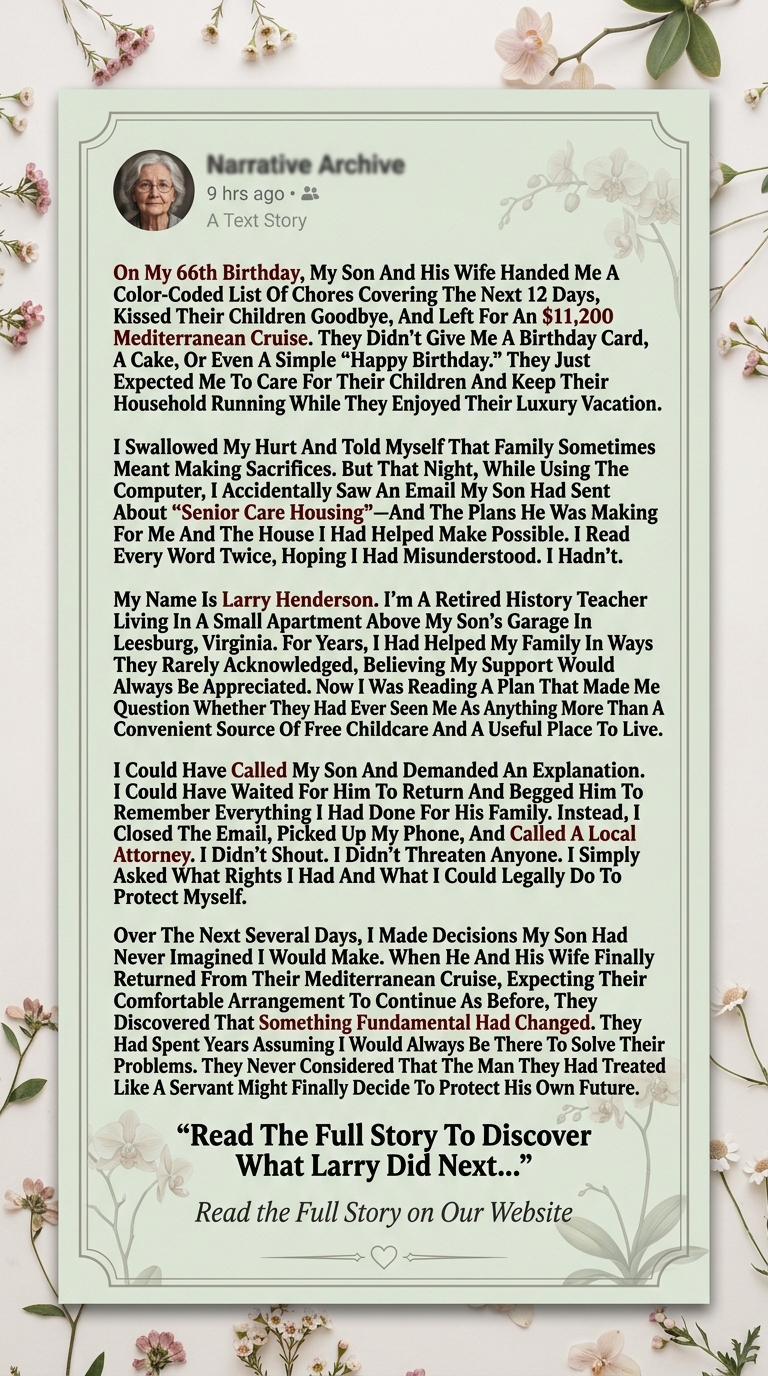
My Son Left Me a Color-Coded Chore List on My 66th Birthday Before Taking an $11,200 Cruise—Then I Discovered His Plan for My Future
My name is Larry Henderson, and I turned sixty-six on a Tuesday.
I had spent thirty-two years teaching history in public schools across Northern Virginia. I taught my students about the American Revolution, the courage it took to challenge injustice, and the importance of knowing when to stand up for yourself.
Yet somehow, after retirement, I had forgotten how to apply those lessons to my own life.
I lived in a small apartment above my son’s garage in Leesburg, Virginia. It had a bedroom, a modest kitchen, and a window overlooking the backyard. I had helped pay for the renovation when my son, Michael, and his wife, Vanessa, bought the property.
Back then, Michael had hugged me and said, “Dad, this way you’ll always have a place with us. You’ll be close to the kids, and we’ll look after each other.”
I believed him.
After my wife, Helen, died, being near family mattered more to me than having a large house of my own. I sold the home where Michael had grown up and used part of the proceeds to help him and Vanessa with their down payment.
I never demanded repayment.
I watched their children, Ethan and Lily, whenever they needed help. I drove them to school, prepared their meals, helped with homework, and attended their soccer games. When appliances broke, I repaired them. When Michael’s work kept him late, I stayed with the children. When Vanessa wanted a weekend away with friends, I volunteered to babysit.
I told myself that family meant showing up.
I never imagined that one day my willingness to help would become an obligation nobody thought to question.
On the morning of my sixty-sixth birthday, I woke up at six, made coffee, and sat by the window. I had secretly hoped Michael might stop by with a card or perhaps bring home a small cake.
I wasn’t expecting an expensive present.
I just wanted to hear him say, “Happy birthday, Dad.”
At eight thirty, I heard footsteps on the stairs outside my apartment.
Michael knocked once and entered without waiting.
Vanessa followed him, carrying a large folder. She was dressed in a cream-colored travel outfit, and her expensive suitcase stood beside the garage door.
“Good morning, Larry,” she said briskly. “We need to go over the schedule before we leave.”
I glanced at Michael.
“Leave for where?”
He looked surprised that I had forgotten.
“Our cruise, Dad. We told you about it last month. Twelve days in the Mediterranean.”
Then I remembered. They had mentioned it during dinner, but I hadn’t realized the trip was so close.
“Right,” I said. “I hope you have a wonderful time.”
“We will,” Vanessa replied, opening her folder.
She handed me a printed schedule divided into twelve days. Every task had a color.
Blue meant the children.
Green meant household chores.
Yellow meant errands.
Red meant something that could not be missed.
Monday: Prepare breakfast, pack school lunches, drop Ethan and Lily at school.
Tuesday: Pick up groceries, clean the kitchen, take Lily to dance class.
Wednesday: Wash children’s bedding, prepare dinner, help Ethan complete his science project.
Thursday: Mow the lawn, bring in the trash bins, collect the dry cleaning.
The list continued for twelve days.
There were instructions for watering the plants, feeding the dog, checking the mail, supervising homework, preparing meals, and making sure the children were in bed by eight thirty.
At the bottom, Vanessa had written in bold letters:
PLEASE FOLLOW THE SCHEDULE EXACTLY.
I stared at the paper.
“That’s quite a list.”
“It’s just easier this way,” she explained. “We don’t want you getting confused about what needs to be done.”
I had spent three decades managing classrooms full of teenagers. I had organized field trips, coached debate teams, and planned entire school semesters.
But I said nothing.
Michael glanced at his watch.
“You’re the best person for this, Dad. The kids love you, and we won’t have to worry about them.”
I looked at him, waiting for him to notice the date.
Nothing.
No card.
No cake.
No birthday greeting.
Vanessa checked her phone.
“We should go. The car to the airport will be here soon.”
She kissed the children goodbye when they came downstairs. Michael hugged them and promised to bring back souvenirs.
Then they headed toward the front door.
I stood in the hallway holding the schedule.
“Michael?”
He turned around.
“Yeah, Dad?”
I nearly asked him whether he remembered what day it was.
Instead, I said, “Have a safe trip.”
He smiled.
“Thanks. We’ll see you in twelve days.”
Then the door closed.
I returned to my apartment and placed the schedule on the kitchen table.
For a long time, I sat looking at it.
I had spent my birthday being assigned twelve days of unpaid work, and my son hadn’t even remembered to wish me well.
Still, I told myself not to be selfish.
Michael had a demanding job. Vanessa had her own responsibilities. The children needed someone they trusted. Perhaps I was making too much of a small disappointment.
I prepared lunch for Ethan and Lily, picked them up from school, and listened to their stories about their day.
They hadn’t done anything wrong.
When Lily noticed the schedule on the counter, she asked, “Grandpa, why are there so many colors?”
“Your mom likes to keep things organized,” I replied.
She thought about that.
“Did Dad forget your birthday?”
My hand stopped over the sink.
“Why would you ask that?”
“Because Mom said today was the day we had to leave, and Dad said we were going to be late. But nobody gave you a present.”
I forced a smile.
“Don’t worry about it, sweetheart.”
That evening, after the children went to bed, I went downstairs to use the computer in Michael’s home office. My laptop had stopped working the previous week, and Michael had told me I could use his computer whenever I needed it.
I intended to print the children’s school calendar so I could double-check the following day’s schedule.
When I opened the browser, Michael’s email was already displayed.
I was about to close it when a subject line caught my eye.
RE: Senior Care Housing Options for Larry
I froze.
I knew I shouldn’t read someone else’s private correspondence. But seeing my own name beside those words left me unsettled.
I stared at the screen, wondering whether the email concerned an insurance policy or some general discussion about retirement.
Then I noticed a line in the message preview.
Once the cruise is over, we should move forward before he changes his mind.
My stomach tightened.
I clicked the email.
It was a conversation between Michael and a woman from a senior-living placement service.
The first message was from my son.
“Thank you for sending the information. We’re looking at options for my father, Larry Henderson. He’s sixty-six and currently lives in an apartment attached to our property. We would prefer a place with transportation, meals, and some assistance available.”
That part, by itself, might have been reasonable. People plan for aging parents all the time.
But the next paragraph made my hands go cold.
“We’d like to have him relocated within the next few months. He currently helps with childcare and household responsibilities, so we’ll need to make alternative arrangements once he moves.”
I read it twice.
They weren’t planning a discussion about my future.
They were arranging my departure.
The placement representative had asked about my income, savings, health, and whether I could afford the monthly fees. Michael had answered questions about the apartment above the garage and the property itself.
Then I reached the sentence that changed everything.
“My father contributed a substantial amount toward the property when we purchased it, but the house and title are in my name and my wife’s. We don’t believe he has any ownership rights. We’d like to make sure the transition is handled before he becomes resistant.”
I leaned back in the chair.
I remembered the day Michael had asked for my help buying the house.
He had told me the money would give the family stability. He had said my apartment would be my home for as long as I wanted it.
I had transferred $185,000 from the proceeds of my old house.
There had been paperwork, of course, but I had trusted my son and hadn’t insisted on having an attorney review every document.
I remembered signing a document at the closing table. I had been told it was an acknowledgment of the financial contribution, not a complicated agreement about future rights.
Had I misunderstood?
Had I signed away something important?
I didn’t know.
But I knew I needed answers.
Another email sat below the first.
Vanessa had written to Michael three days earlier.
“I know this sounds harsh, but we can’t keep having him here indefinitely. The kids need their rooms, and we need the garage apartment available if my mother ever needs to stay with us. Besides, he can be difficult when he thinks people owe him something because he helped financially.”
I read that sentence several times.
Difficult.
I had never asked them to pay me back. I had never demanded that they change their lives around me. I had only wanted to be treated like a father instead of a household employee.
The final message was from Michael.
“Let’s get through the trip first. He’ll probably be fine with the arrangement if we present it as the best option for his future. If not, we can remind him that the property belongs to us.”
I closed the email.
I sat in the dark office for nearly twenty minutes.
Then I did something I should have done years earlier.
I called a lawyer.
Her name was Rebecca Collins, and I found her through the Virginia State Bar’s lawyer referral service. I explained that I was a retired teacher who had contributed a large sum toward my son’s property, lived in an attached apartment, and had discovered that my son was planning to move me into senior housing.
I made it clear that I didn’t know what rights I had.
Rebecca listened without interrupting.
Finally, she said, “Mr. Henderson, the first thing we need to establish is exactly what you signed and what the money was intended to be. The fact that your son owns the title doesn’t automatically answer every question about the arrangement, but we can’t assume your contribution gives you ownership, either.”
For the first time that evening, I felt my breathing slow.
She explained that we would need to review the closing documents, any written agreements, bank records, and communications concerning the money. We also needed to understand whether I had been promised a right to live in the apartment and whether that promise had been documented.
“Please don’t confront them or sign anything about moving until we’ve reviewed the records,” she advised. “And don’t assume the email tells the whole story. We need facts before we make decisions.”
I thanked her and arranged an appointment for the following morning.
Then I went upstairs, checked on the children, and finished preparing their school lunches.
I was still their grandfather.
They deserved my care and reassurance, regardless of what their parents had planned.
But I was no longer willing to confuse love with surrender.
The next morning, I took a folder of documents to Rebecca’s office.
I brought bank statements showing the $185,000 transfer, copies of the property closing papers I had kept, and several emails from Michael dating back to the time of the purchase.
One email was particularly important.
It had been sent shortly before I transferred the money.
Michael had written:
“Dad, I want you to feel secure here. The apartment will always be your home. We wouldn’t be buying this place without your help, and I won’t ever forget that.”
Rebecca read it carefully.
“This may be relevant evidence of what was promised,” she said. “It doesn’t settle the legal question on its own, but it gives us something concrete to investigate.”
She explained that depending on the documents and circumstances, there might be questions about whether the money had been a gift, a loan, or part of an agreement concerning my residence. She would need to review the paperwork before advising me on any claim.
She also recommended that I separate my finances from my son’s household, secure copies of my personal records, and make a plan for where I could live independently if necessary.
I left her office with a list of practical steps.
For the next several days, I followed them.
I opened a bank account in my own name at a different bank and arranged for my pension payments to go there. I gathered my passport, identification, financial statements, and medical records. I changed the passwords on my personal accounts.
I did not touch Michael’s money or interfere with his property.
I simply made sure my own life was not dependent on access to his computer, his accounts, or his goodwill.
I also stopped volunteering for every task that wasn’t necessary for the children’s well-being.
I continued preparing their meals and taking them to school because I had agreed to care for them during the trip. But I didn’t mow the lawn, clean the entire house, or run Vanessa’s personal errands.
When I needed something for the children, I used the household card Michael had left for their expenses and kept every receipt.
I documented the hours I spent caring for them.
I wasn’t preparing for revenge.
I was establishing the truth about what I had contributed and what I had been expected to provide.
On the fourth day, Michael called from the ship.
“How’s everything going, Dad?”
“Fine. The children are doing well.”
“Good. Vanessa says you haven’t been following the entire chore list.”
I looked at the color-coded paper on my counter.
“I’ve been taking care of the children and handling what they need. I haven’t had time to do every household task.”
He sighed.
“Dad, we gave you a schedule for a reason.”
“I know.”
“Can you just stick to it? We’re trying to enjoy this trip without worrying about home.”
I almost laughed.
He was on a Mediterranean cruise that had cost more than eleven thousand dollars, and he was worried about whether I had mowed his lawn.
“Michael,” I said quietly, “did you remember what day it was when you left?”
There was a pause.
“What do you mean?”
“My birthday.”
Silence.
“Oh, Dad. I’m sorry. We were rushing to catch the car. Happy birthday. I owe you a dinner when we get back.”
I looked out the window.
“Thank you.”
He seemed relieved that I hadn’t argued.
“Great. We’ll talk when we get home.”
Then he ended the call.
I sat down and let the disappointment pass through me.
I no longer needed him to admit what I already knew.
I needed to protect my future.
On the seventh day, Rebecca called with an update.
She had reviewed the initial documents and found that the transfer was described as a contribution toward the purchase, but the paperwork did not clearly establish whether it had been a gift or whether I had acquired an ownership interest.
There was also no formal agreement guaranteeing my right to occupy the apartment indefinitely.
That was a serious problem.
She explained that we would need to investigate further before deciding whether I had a viable legal claim. She also warned me that I shouldn’t assume I could remain in the apartment permanently simply because I had contributed money.
I appreciated her honesty.
For the first time, I understood how vulnerable I had made myself by relying entirely on a verbal promise.
Rebecca recommended that I consult a financial adviser about my retirement budget and consider renting a separate apartment while the property issue was being reviewed.
I had enough savings and pension income to live independently, though I would need to be careful.
I spent two days looking at small apartments in Leesburg.
One was a one-bedroom unit in a quiet senior-friendly complex near a library and a grocery store. It had a balcony, a modest kitchen, and a walking trail nearby.
The rent was higher than I would have preferred, but I could afford it without draining my savings.
I applied.
Then I waited.
By the tenth day, I had signed a lease that would begin the following month, subject to the usual conditions.
I didn’t tell Michael.
I wasn’t obligated to announce every decision about my future to someone who had already begun planning it without me.
On the twelfth day, I took Ethan and Lily to the airport to meet their parents.
The children ran toward Michael and Vanessa as soon as they came through the arrivals doors.
Vanessa hugged them tightly and asked whether they had behaved.
Michael shook my hand.
“Thanks, Dad. We really appreciate it. Everything went smoothly, right?”
“Yes,” I said. “The children are fine.”
He smiled and started talking about the cruise. He told me about the restaurants, the blue water, and a private excursion they had booked along the coast.
Vanessa showed me photographs on her phone.
I congratulated them on the trip.
Then Michael said, “We need to talk about something now that we’re home.”
I knew what was coming.
We drove back to the house, and after the children went inside, Michael and Vanessa asked me to sit down at the kitchen table.
Vanessa placed a brochure in front of me.
It was from the senior-living service I had seen in the email.
“We’ve been thinking about your future,” she began. “We found a few places that might suit you.”
Michael folded his hands.
“Dad, the garage apartment was always meant to be temporary. We think it would be better for everyone if you moved somewhere designed for seniors.”
I stared at the brochure.
“How long have you been planning this?”
They exchanged a glance.
“A little while,” Michael admitted.
“Did you plan to discuss it with me before making arrangements?”
“We were going to,” Vanessa said. “We just wanted to have some options ready.”
I looked directly at my son.
“I read the email.”
His expression changed immediately.
“What email?”
“The one about senior care housing. The one where you discussed moving me before I became resistant.”
Michael’s face went pale.
Vanessa sat back.
“You were reading our private emails?”
“I was using the computer to print the school calendar. Your email was open. I saw my name and the subject line. I should have closed it, but I didn’t. I read it, and I won’t pretend otherwise.”
Michael rubbed his forehead.
“Dad, you don’t understand. We were trying to plan ahead.”
“Perhaps. But you were planning to move me out of my home without discussing it with me. You were also discussing the money I contributed to this property as though it had never mattered.”
“That’s not fair,” he replied. “We never said your contribution didn’t matter.”
“You wrote that you didn’t believe I had any rights because the title was in your names.”
“That’s what we understood.”
“And did you ask a lawyer?”
He didn’t answer.
“I did,” I said.
Vanessa’s eyes narrowed.
“You hired an attorney?”
“Yes.”
Michael looked genuinely stunned.
“For what?”
“To understand my rights and protect my future. I’m reviewing the documents concerning the money I contributed to this property. I don’t yet know what the legal outcome will be, and neither do you. My attorney will handle that.”
He stared at me as if I had suddenly begun speaking another language.
“Dad, you don’t need to make this into a legal battle.”
“I didn’t start planning a move behind your back, Michael.”
“We weren’t trying to hurt you.”
“Then you should have spoken to me.”
Vanessa crossed her arms.
“We have two children. We need space. We need to think about the future of this house.”
“And you are entitled to do that,” I said. “It’s your home. But I am also entitled to think about my future. You cannot assume that because I am your father, I will always be available for free childcare and household work, or that my living arrangements can be decided without my participation.”
Michael looked down at the table.
I continued.
“I helped you buy this property because you told me I would always have a home here. I believed you. If we disagree about what that promise means legally, our attorneys can resolve it. But I will not sit here and pretend that the last few years have been a fair arrangement.”
Vanessa’s voice became sharper.
“We never forced you to help with the children.”
“No,” I said. “You didn’t have to. You simply came to expect it.”
For once, nobody had an immediate response.
I reached into my folder and took out a copy of the lease for my new apartment.
“I’ve arranged a place of my own. I’ll move next month, once the lease begins and my attorney has advised me on the next steps concerning this property.”
Michael looked at the document.
“You’ve already found somewhere?”
“Yes.”
“Without telling us?”
I held his gaze.
“You were planning my future without telling me. I decided to take responsibility for it myself.”
He leaned back, stunned.
I wasn’t leaving in anger. I wasn’t trying to punish him by disappearing. I was making a decision about where I wanted to live, based on what I had learned.
Michael finally spoke.
“What about the money you gave us?”
“That’s exactly what my attorney is reviewing. I won’t speculate about the legal answer before the documents have been examined. If there is a legitimate claim, it will be handled properly. If there isn’t, I’ll accept that reality and make decisions based on the resources I have.”
Vanessa glanced at Michael.
For the first time, they seemed to understand that I wasn’t bluffing.
I stood.
“There is one more thing. I love my grandchildren. I want to remain part of their lives. But I will no longer be your default childcare arrangement. If you want me to watch them, ask me in advance. I’ll tell you whether I can. I’m their grandfather, not a service you can schedule without asking.”
Michael’s eyes filled with frustration.
“So that’s it? You’re just leaving?”
I shook my head.
“No, Michael. I’m moving into a place of my own. There’s a difference.”
He looked at me for a long time.
Then he asked, quietly, “Are you doing this because we forgot your birthday?”
I thought about the question.
“The birthday hurt,” I said. “But that wasn’t the reason. It was the list, the email, the assumption that my time belonged to you, and the realization that I had spent years avoiding difficult conversations because I was afraid of losing my place in this family.”
I paused.
“I don’t want to lose my family. But I cannot keep losing myself to hold on to it.”
Nobody spoke after that.
I went upstairs to my apartment.
For the first time in years, I felt that the next chapter of my life belonged to me.
The weeks that followed were difficult.
Michael and Vanessa were angry at first. They accused me of overreacting and said I had turned a family disagreement into a legal matter.
I refused to argue through text messages.
Rebecca continued reviewing the records and advised me on the available options. We eventually reached a negotiated agreement with Michael and Vanessa after further examination of the documents and discussions between our attorneys.
The terms were private, but the outcome gave me enough financial security to move forward without depending on my son’s household.
I moved into my new apartment at the beginning of the next month.
It was smaller than the home I had sold, but it was mine to arrange. I placed my wife’s photograph beside the window, unpacked my books, and bought a comfortable chair for reading.
On the first evening, I made a simple dinner and sat down at my own table.
No chore list.
No last-minute errands.
No expectation that I would drop everything because someone else had made plans.
I ate slowly, listening to the quiet.
For the first time in a long time, the silence felt peaceful rather than lonely.
Michael didn’t call for nearly two weeks.
When he finally did, his voice sounded tired.
“Dad, can we talk?”
“Of course.”
He came over on a Saturday afternoon.
He looked around my apartment and noticed the history books stacked beside the chair.
“It looks nice,” he said.
“Thank you.”
He sat down.
“I’ve been thinking about what you said.”
I waited.
“I didn’t realize how much we were asking of you. I guess it became normal. You were always there, and we stopped thinking about what it cost you.”
I looked at my son.
That was the first honest thing he had said about the situation.
“I wanted to help you,” I replied. “I still do. But helping you cannot mean giving up my right to have a life of my own.”
He nodded.
“I’m sorry we forgot your birthday.”
“Thank you.”
“And I’m sorry about the email. We should have talked to you.”
I didn’t rush to reassure him that everything was forgiven.
Instead, I said, “I appreciate you saying that. Trust will take time, Michael. I hope we can rebuild it.”
He looked toward the window.
“Can I bring the kids over next weekend? They keep asking when they can see you.”
I smiled.
“Of course. Let me know what time works, and we’ll plan something.”
That was how we began again.
Not with a grand speech or an overnight transformation, but with small changes.
Michael started asking before making plans that involved me. Vanessa stopped handing me lists of household responsibilities. When I agreed to watch the children, they thanked me instead of treating it as something automatic.
I attended school events when I wanted to, helped with homework when I had the energy, and spent time with my grandchildren without feeling that I was responsible for keeping the entire household running.
Most importantly, I began making plans of my own.
I joined a local history group at the library. I started volunteering to help adults prepare for their citizenship examinations. I took a weekend trip to Williamsburg with two former colleagues.
I even bought myself a birthday cake three months late.
It was a small chocolate cake from a bakery near my apartment.
I lit one candle, sat beside the window, and thought about my wife.
She used to tell me that retirement wasn’t the end of a useful life. It was the beginning of a life in which you finally had the freedom to decide what usefulness meant.
I wished I had listened sooner.
On my sixty-seventh birthday, Michael, Vanessa, Ethan, and Lily came over for dinner.
Michael brought a card.
Inside, he had written:
“Dad, I’m sorry I forgot your birthday last year. More importantly, I’m sorry I forgot that you were a person with needs and dreams of your own, not just someone we could always count on. Thank you for giving me the chance to do better. Happy birthday. I love you.”
I read it twice.
Then I looked at my son.
“Thank you, Michael.”
He hugged me.
This time, the embrace felt different because I wasn’t afraid that accepting it meant surrendering my boundaries.
We ate dinner around my small table. The children argued about dessert, Vanessa told a funny story about work, and Michael helped clear the dishes.
When he reached for the plates, I stopped him.
“You can leave those. It’s my birthday.”
He laughed.
“Fair enough, Dad.”
After they left, I put the card beside my wife’s photograph.
I thought about the man I had been a year earlier: a retired teacher who believed that love required him to say yes to every request, no matter how much it cost him.
I no longer believed that.
Family should be a source of love, not a reason to surrender your independence. Helping the people you love is meaningful when it comes from choice and mutual respect. It becomes something else when your kindness is treated as an unlimited resource.
I still love my son.
I still love his wife.
And I adore my grandchildren.
But I have learned that loving my family does not require me to abandon myself.
At sixty-seven, I finally understand something I spent thirty-two years trying to teach my students:
Sometimes the most important lesson in history is the one you must learn before you can change your own future.