The Forged Deed That Exposed My Mother-in-Law’s Secret
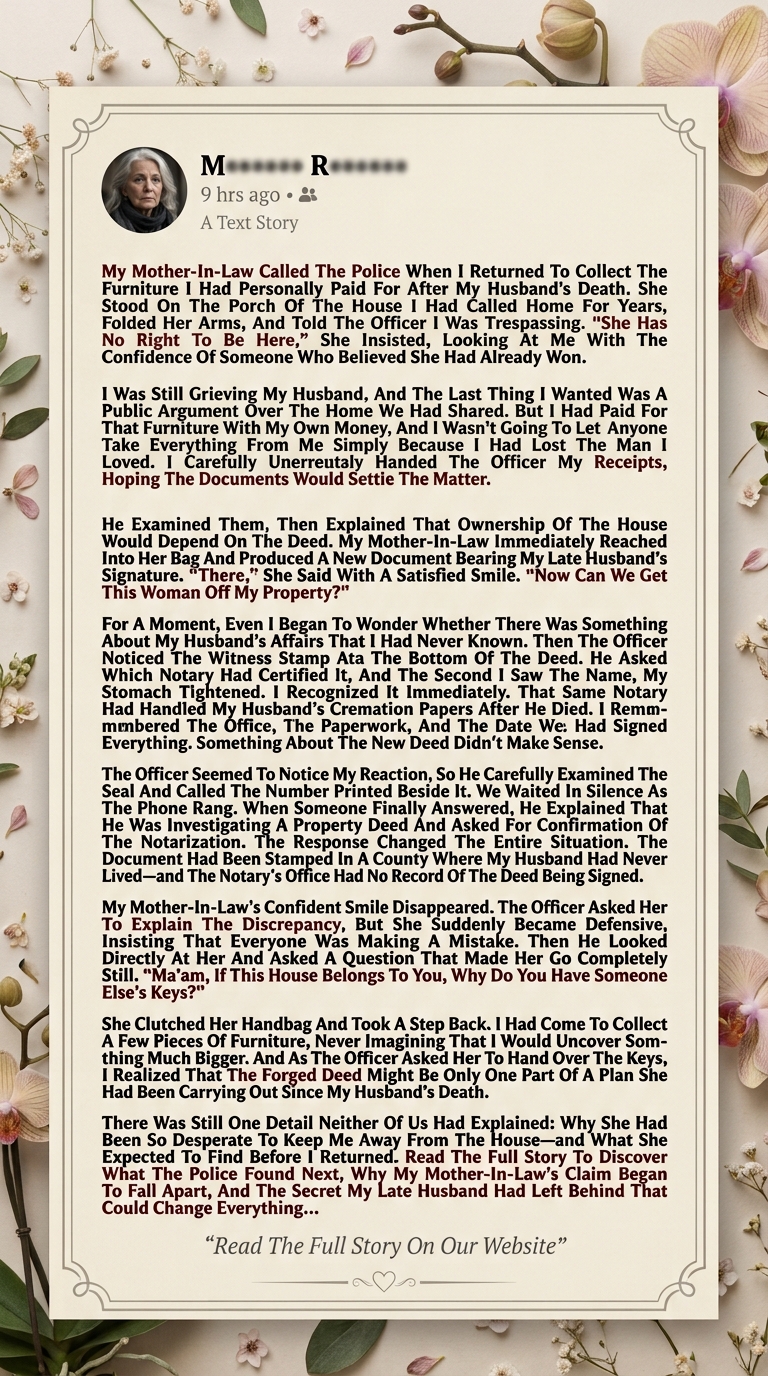
The police officer’s question hung in the air.
“Ma’am, if this house belongs to you, why do you have someone else’s keys?”
My mother-in-law, Patricia, tightened her grip on her handbag. For the first time since I had arrived, she looked uncertain.
“I have keys because I’m family,” she snapped. “My son lived here. I have every right to enter his house.”
Officer Reynolds glanced at the document in his hand.
“You just told me this property belongs to you.”
“It does!”
“Then why does the deed contain a notarization that the notary’s office cannot verify?”
Patricia opened her mouth, but no answer came.
I stood beside my car, holding the receipts for the furniture I had purchased over the years. My hands were trembling, and my heart still felt as though someone had wrapped it in wire.
My husband, Daniel, had been dead for six weeks.
I had come back to collect a dining table, a bedroom dresser, two armchairs, and a bookcase that had belonged to us. I had expected an uncomfortable conversation with my mother-in-law. I had not expected to find a police officer examining what might be a forged property deed.
Daniel and I had lived in that house for nine years. We had painted the kitchen together, planted roses beside the front steps, and spent countless Sunday mornings drinking coffee at the dining table I had bought with money from my first major promotion.
When Daniel became ill, I had used my savings to cover household expenses while he underwent treatment. After he died, Patricia had insisted that I leave the house temporarily while she organized his affairs.
She told me it would be easier for everyone if I stayed with my sister for a few days.
I was grieving. I barely slept, and even simple decisions felt impossible. I agreed because I believed she was trying to help.
But a few days became a week. A week became a month.
Every time I called to arrange collecting my belongings, Patricia found a reason to refuse.
The last time, she told me that Daniel had left everything to her.
I had never seen a will saying that.
Now, as Officer Reynolds held the questionable deed, I realized that Patricia might have been hiding far more than a family disagreement.
“Ma’am,” the officer said, “I need you to explain how you obtained this document.”
Patricia lifted her chin.
“My son gave it to me before he died.”
“When?”
“Several months ago.”
“Where was it signed?”
“I don’t remember the exact location.”
“Who witnessed it?”
She looked at me as though I had somehow caused her predicament.
“I don’t see why I should have to answer all these questions in front of her.”
Officer Reynolds remained calm.
“Because you presented this document as evidence of ownership during a police call. We have discovered a discrepancy that needs to be clarified.”
He asked her to hand over the keys she had been holding.
She refused at first, insisting that the officer had no right to take anything from her. He explained that he was not deciding ownership of the house on the porch. He was documenting the dispute and checking whether the document was genuine.
After a tense moment, Patricia placed the keys in his open palm.
There were four of them on a silver ring.
I recognized the smallest brass key immediately.
It belonged to the locked cabinet in Daniel’s home office.
I had never seen Patricia carry it before.
“Where did you get that key?” I asked.
She turned toward me sharply.
“It’s none of your business.”
“That cabinet was in our bedroom office. Daniel kept his private papers there.”
“He gave me the key.”
“When?”
“Before he died!”
Her answer came too quickly.
Officer Reynolds noticed.
He asked whether she had entered the house after Daniel’s death and whether she had removed any documents or personal property. Patricia said she had only collected a few family photographs.
The officer recorded her statement but did not accuse her of a crime. He explained that the disputed deed would need formal verification and that any question of legal ownership would have to be resolved through the appropriate property and probate procedures.
Then he turned to me.
“Do you have any other documents showing your connection to the property?”
I told him that Daniel and I had purchased the house together nine years earlier. I had a copy of the original closing statement, mortgage records, and several tax documents in my files at home.
“I can bring them,” I said.
“Please do. Don’t attempt to remove anything else until the ownership issue is clarified. And if you believe documents have been taken or altered, tell your attorney and let us know.”
Patricia gave a short, bitter laugh.
“She’s making all this up because she wants my son’s house.”
I looked at her.
“I wanted my husband back. The house was where we lived together. I never imagined I’d have to prove that I belonged there.”
For a moment, something flickered across her face.
Then it disappeared.
Officer Reynolds gave me a case reference number and explained how to provide additional documentation. He also advised both of us not to enter the property or remove disputed items until the immediate situation had been clarified.
I left without taking a single piece of furniture.
But I didn’t leave empty-handed.
I had seen the key.
And I had finally understood why Patricia had been so determined to keep me away.
That evening, I called my attorney, Melissa Grant.
Melissa had helped Daniel and me prepare our financial documents several years earlier. She knew about the house, the mortgage, and the arrangement under which we had divided certain expenses.
When I explained what had happened, she asked me to send copies of the documents I already possessed.
I emailed the original purchase records, mortgage statements, furniture receipts, and the photographs I had taken of the disputed deed.
Melissa called back less than an hour later.
“The deed needs to be verified, but there are already serious questions,” she said. “The notary’s office says it has no record of the transaction. We also need to establish the actual title history. A questionable document doesn’t automatically tell us who owns the property.”
“Can Patricia take the house?”
“That depends on the deed, the applicable inheritance laws, and whether Daniel left a valid will. We need the official records before reaching a conclusion.”
I told her about the brass key.
Melissa went quiet.
“Did Daniel have a safe, locked cabinet, or another place where he kept estate documents?”
“He had a fireproof cabinet in his office. I never had a reason to open it. He kept old tax files, property papers, and documents from his business there.”
“Was it locked when you last saw it?”
“Yes.”
“Then don’t try to access it while the situation is disputed. We need to find out what happened to its contents through the proper process.”
Before we ended the call, Melissa asked me something I hadn’t considered.
“Did Daniel ever tell you that his mother was having financial difficulties?”
I thought about it.
Daniel had always helped Patricia when she needed money. He paid for repairs to her car, covered an unexpected medical bill, and occasionally transferred money to her when her pension fell short.
But he never discussed her finances in detail.
“She was always asking him for help,” I said. “He never liked to say no.”
Melissa made a note.
“Keep any records of those payments. They may be relevant, although we shouldn’t assume they prove anything by themselves.”
After the call, I sat on my sister’s couch and looked through the photographs on my phone.
There was Daniel standing beside the roses in our garden. Daniel holding a paint roller in the half-finished kitchen. Daniel asleep in one of the armchairs I had bought after my promotion.
He looked so ordinary in those pictures that it was difficult to believe he was gone.
I had spent the past six weeks trying to understand how to live without him.
Now I had to consider whether someone had used that grief to take away the life we had built.
Three days later, Melissa contacted the county recorder’s office and obtained the official property records.
The house was still registered under the ownership arrangement Daniel and I had established when we purchased it. There was no recorded transfer to Patricia.
That didn’t settle every question about inheritance or the house’s final ownership, but it contradicted Patricia’s claim that the disputed deed had already transferred the property to her.
Melissa also obtained confirmation from the notary’s office that the seal on the document did not match its records for the date shown.
The office had no entry for Daniel signing the deed, and the notary whose name appeared on it had not been working in the county where the document claimed to have been executed.
I remembered that notary’s name because she had handled one of the administrative documents connected to Daniel’s cremation.
The same name had made the false deed look convincing to me at first.
Now it made the document even more suspicious.
Melissa advised me not to contact Patricia directly about the evidence. Instead, she sent a formal letter requesting that Patricia preserve all documents relating to the property, Daniel’s estate, and any items she had removed from the house.
Patricia responded through an attorney of her own.
Her letter insisted that Daniel had promised her the house and that she had acted in good faith. It accused me of harassing her and threatened to seek an order preventing me from approaching the property.
Melissa was not impressed.
“Promises and ownership are not the same thing,” she told me. “If she believes Daniel left her the house, she can provide the valid legal documents supporting that claim. We will respond through the proper process.”
I had hoped the official records would bring the conflict to an end.
Instead, they made Patricia more aggressive.
She called several members of Daniel’s family and told them I was trying to throw her out of the home her son had promised her. One cousin sent me a message saying I should be ashamed of myself for fighting with a grieving mother.
I didn’t answer.
I was grieving too.
But I had learned that being compassionate did not require me to surrender my rights or accept accusations that weren’t true.
Then, on Friday afternoon, Melissa called with an update.
“The police have asked for additional information about the key and the cabinet,” she said. “They have also received a report that some of Daniel’s personal records may have been removed from the house.”
My stomach tightened.
“Can they search the house?”
“Not simply because we suspect something is missing. They need a lawful basis and the appropriate authorization. For now, we are documenting the records that existed, identifying what is missing, and following the investigation.”
“What do you think Patricia was looking for?”
“I don’t know yet. But we may have a clearer answer once we establish exactly what was kept in that cabinet.”
That night, I remembered a conversation Daniel and I had shared a few months before he died.
He had been sitting at the dining table, sorting through paperwork while I prepared tea.
“Laura,” he had said, “if anything happens to me, promise me you won’t let anyone rush you into signing something.”
I had laughed gently.
“Why would anyone rush me?”
He had looked at the papers for a long moment.
“People behave differently when money is involved. Even people you love.”
I had asked him whether something was wrong.
He told me he was tired and that we would talk later.
We never did.
For months, I had assumed he was worried about his illness.
Now I wondered whether he had been trying to warn me about his mother.
The answer came from an unexpected source.
On Saturday morning, I received a call from a woman named Evelyn Price. She introduced herself as Daniel’s former bookkeeper.
I had met her only twice, but I recognized her voice.
“Laura, I heard there was a problem with the house,” she said. “I wasn’t sure whether I should contact you, but I think Daniel would have wanted you to know something.”
I sat down.
“What is it?”
“About three months before he died, Daniel asked me to organize some records connected to a private loan he had made. He wanted copies kept with his estate papers.”
“What loan?”
“To his mother.”
I closed my eyes.
“How much?”
“Over several years, Daniel transferred money to Patricia for different expenses. Some payments were gifts, but others were recorded as loans. The total balance on the records I prepared was just over $180,000.”
I could barely speak.
“Why didn’t he tell me?”
“I can’t answer that. He asked me to keep the records organized, and he said he would discuss them with you when he was ready. Then his health deteriorated.”
Evelyn explained that the largest loans had been made when Patricia was facing financial problems involving a small property she owned. Daniel had paid several overdue obligations and advanced money to prevent the property from being sold.
He had also kept records of repayments.
The outstanding balance had never been resolved.
“Did he have a written agreement?” I asked.
“Yes. I prepared a summary for him, and there were signed acknowledgments for some of the larger amounts. The complete records should be in the file he kept at home.”
The locked cabinet.
The brass key.
I felt a chill run down my back.
“Do you know whether Patricia has copies?”
“I don’t know. But shortly before Daniel died, he asked me to make an additional copy of the loan summary for his attorney. He seemed concerned about making sure everything was documented.”
I thanked Evelyn and immediately contacted Melissa.
The information did not prove that Patricia had forged the deed, and it did not automatically mean she owed the entire amount under the law. The records would have to be authenticated, and the nature of each payment would need to be established.
But they gave us a possible explanation for her desperation.
If the house passed through Daniel’s estate according to the existing title and applicable inheritance rules, Patricia might not receive what she wanted.
And if the loan records were valid, she might have a substantial financial obligation to the estate.
Melissa arranged for Evelyn to provide her records through the appropriate legal process.
She also informed the investigator about the potential missing documents.
For the first time, the case was no longer just about a disputed deed.
It was about whether someone had attempted to change property records while keeping important financial documents out of sight.
The following week, Officer Reynolds called me.
“We’ve made progress on the document investigation,” he said. “I can’t discuss every detail while it remains active, but we have reason to believe the deed was not properly executed.”
“Does that mean Patricia forged it?”
“Not necessarily. We are still establishing who prepared the document, who submitted it, and what each person knew. I don’t want you to draw conclusions before the evidence is complete.”
I appreciated his caution.
He explained that the police had documented the circumstances under which Patricia produced the deed and had referred the suspected falsification for further investigation. The property dispute itself remained a civil matter, and the probate process would determine the appropriate handling of Daniel’s estate.
Then he asked whether I would be willing to provide a detailed inventory of the furniture and personal belongings I had purchased.
I agreed.
Over the next few days, I assembled receipts, bank statements, photographs, and warranty documents. Some purchases were easy to prove. Others had been made years earlier, and I had to rely on old account records and photographs showing the items in our home.
The process was exhausting, but it reminded me that my belongings had not simply appeared in the house.
I had worked for them.
I had saved for them.
And I had every reason to expect that my rights would be respected.
Meanwhile, Melissa filed the necessary paperwork to clarify my position in the estate and requested that disputed property not be transferred while the ownership issues were unresolved.
Patricia’s attorney eventually agreed that the questionable deed could not be treated as conclusive proof of ownership while its authenticity was under investigation.
That did not mean Patricia admitted wrongdoing.
She continued to insist that she had acted on Daniel’s wishes.
But her position was becoming harder to maintain.
Then came the discovery that finally explained why she had been so desperate to keep me out of the house.
A court-authorized inspection of the relevant records and property was arranged as part of the ongoing dispute. My attorney ensured that the process was properly documented, and I did not enter the house or remove anything on my own.
When the cabinet in Daniel’s office was examined, several folders were missing.
Among them were the original loan records, the signed acknowledgments, and a sealed envelope addressed to me.
The envelope had not been found in the cabinet.
Instead, the investigators located a copy of an inventory listing it among the documents Daniel had kept there before his death. The missing envelope became part of the inquiry into the removal of his papers.
For a while, I feared I would never know what it contained.
Then Evelyn remembered something.
Daniel had sent her a scan of part of the loan summary shortly before he entered the hospital. He had also mentioned that his attorney held copies of certain estate documents.
Melissa contacted the attorney named in Daniel’s records.
The attorney confirmed that he had retained copies of the relevant documents in accordance with his professional recordkeeping practices. After verifying the proper authority to release them, he provided the records needed for the estate proceedings.
One document was a letter Daniel had written to me.
It was dated two months before his death.
I read it alone in Melissa’s office.
My darling Laura,
If you’re reading this, it means I didn’t get the chance to explain something I’ve been putting off for too long.
I’ve helped my mother financially for years. Some of that help was given freely, and I will never regret it. But some of it was money I could not afford to give away, and I recorded those amounts as loans because I needed her to understand that our future mattered too.
I should have told you everything sooner. I was afraid of upsetting you while you were already carrying so much, and I kept believing I could resolve the situation myself.
I now realize that silence has made things more difficult for you.
Please don’t feel obligated to protect anyone from the consequences of their own decisions. Be fair, but don’t let anyone use my memory to make you feel guilty for asking for the truth.
The house is the home we built together. Whatever the law determines about our property and my estate, I want you to have the records you need to protect yourself.
You gave me a life filled with more love than I ever knew how to ask for. I am sorry for the things I left unfinished.
All my love,
Daniel.
By the time I finished reading, my cheeks were wet.
I had spent weeks wondering whether Daniel had secretly intended to leave the house to his mother. I had questioned whether I had misunderstood our marriage or overlooked something important.
His letter did not answer every legal question, but it answered the question that had hurt me most.
He had not wanted me to be left helpless.
He had known there were unresolved financial problems, and he had tried—too late, perhaps—to ensure I would have the records to understand them.
I folded the letter carefully and placed it back in its envelope.
For the first time since Daniel’s funeral, I felt as though I had heard his voice again.
Not through a memory or a photograph, but through words he had chosen for me.
The next several months were difficult.
The disputed deed was examined by the relevant authorities. Investigators traced its preparation and submission, while the estate proceedings addressed the actual property rights and financial records.
The evidence ultimately established that the deed had not been validly notarized. The person whose name appeared on the document confirmed that she had not witnessed Daniel sign it. The document was referred for further legal action, and Patricia could no longer rely on it as proof that the house belonged to her.
The investigation also found evidence that Patricia had knowingly presented a document containing false information. She denied intending to deceive anyone, and the legal process took time to determine the consequences of her actions.
The police did not simply hand me the house or declare every disputed item mine. The title, estate, and personal-property questions were handled through the proper legal procedures.
The financial records were equally important.
After reviewing the documentation, the estate’s representatives determined which payments had been gifts and which were supported by enforceable loan agreements. Patricia disputed part of the balance, so those amounts were addressed through negotiation and the legal process rather than assumed to be settled by the paperwork alone.
The outcome was not a dramatic overnight victory.
It was a series of careful decisions, verified documents, and difficult conversations.
But the central truth was clear: Patricia had no valid basis to use the disputed deed to claim the entire house, and her attempts to keep me away had prevented the records from being examined sooner.
When the property questions were finally resolved, I was able to return to the house and arrange for my belongings to be collected.
I went on a quiet Tuesday morning with two movers and a representative who documented the items being removed.
The dining table was still there.
So were the armchairs, the dresser, and the bookcase.
I ran my hand over the table’s polished surface and remembered Daniel sitting across from me, laughing because I had insisted that the chairs were too expensive before buying them anyway.
For a moment, I couldn’t move.
One of the movers asked whether I needed a break.
“Yes,” I whispered. “Just a minute.”
I walked into the garden.
The roses were overgrown. Weeds had crept between the stones, and one of the wooden planters had cracked. But the small rosebush Daniel had planted on our fifth anniversary was still alive.
I knelt beside it and brushed the leaves with my fingertips.
I had come to the house expecting a fight over furniture.
I was leaving with something more important: the truth about the documents, a clearer understanding of the financial matters Daniel had left unresolved, and the knowledge that I had not imagined the life we had built together.
Patricia was not waiting on the porch that day.
Her attorney had advised her not to interfere with the scheduled collection, and she had stayed away.
I never received the apology I had once hoped for.
Perhaps she believed she had been protecting her son. Perhaps she had convinced herself that because she was his mother, she deserved whatever she wanted from his estate. I could not know what she told herself in private.
I only knew what her actions had cost me.
After the last box was loaded, I stood at the front door and looked back at the empty rooms.
I did not hate the house.
I did not hate the years I had spent there.
And I did not need to turn Daniel’s memory into a weapon against his mother.
But I finally understood that loving someone did not mean accepting every demand made in their name.
I closed the door and handed the keys to the person responsible for the property under the final arrangement.
Then I walked to my car.
I took the furniture to my new home, where I arranged the dining table beside a wide window. I placed the armchairs near a bookshelf and set Daniel’s letter in a small wooden box on my desk.
The first evening, I ate dinner alone at the table.
It felt strange.
For years, I had imagined that if I ever lost Daniel, everything that reminded me of him would become unbearable.
Instead, the familiar furniture brought back both grief and gratitude. It reminded me that we had shared something real, even if there were matters he had failed to explain.
I could miss him without surrendering my future.
I could mourn him without allowing someone else to rewrite our life.
And I could respect his mother as the woman who had raised him without allowing her to take what wasn’t hers.
The house had been the place where Daniel and I built our marriage.
But home, I finally realized, was not the deed, the porch, or the walls.
It was the life we had shared—and the courage to keep living when that life changed.