The 217 Things My Army Husband Missed—and the One He Had Never Forgiven Himself For
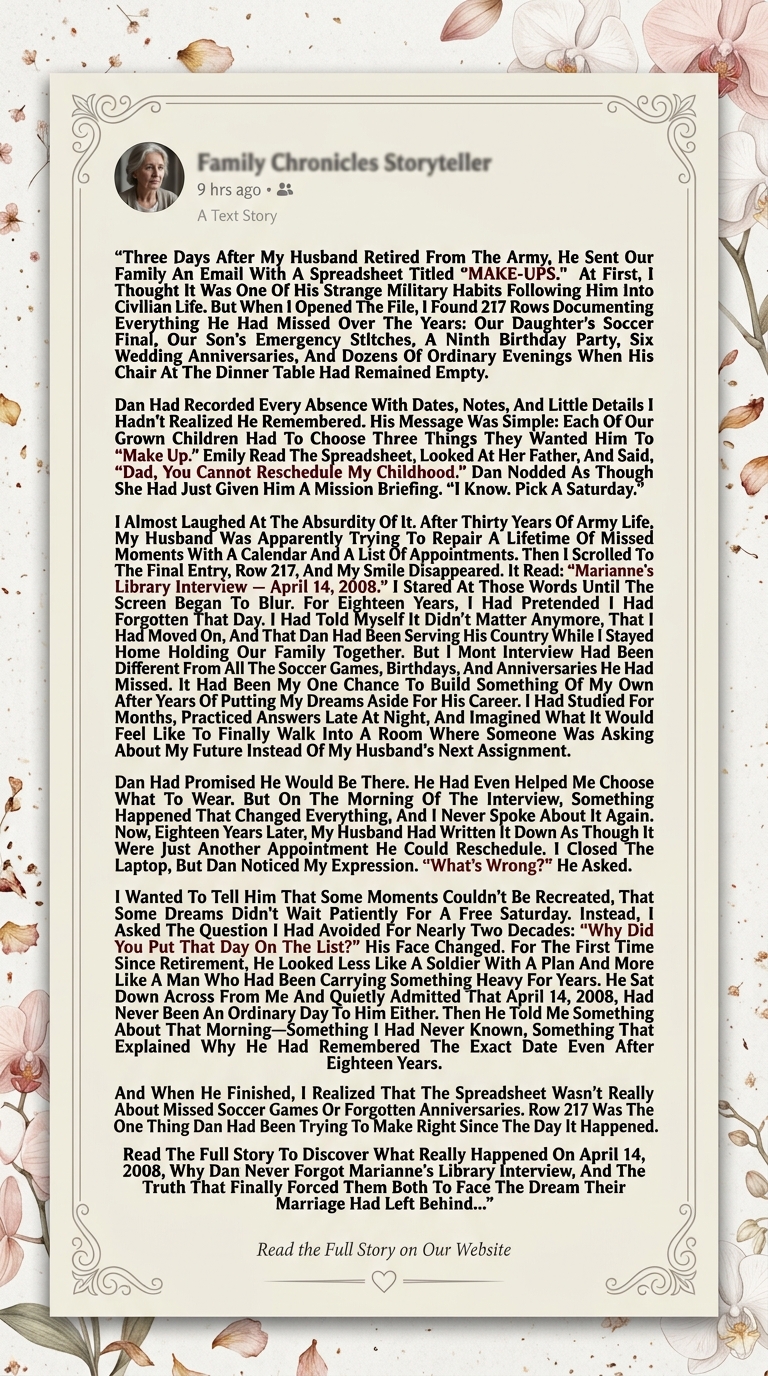
Three days after my husband retired from the Army, he sent our family an email with a spreadsheet titled “MAKE-UPS.”
I should have known Dan would approach retirement like a military operation.
Thirty years in uniform had taught him to organize everything into lists, schedules, and carefully numbered objectives. He planned grocery trips with the precision of a deployment. He labeled storage bins. He once created a three-page itinerary for a family vacation that included estimated bathroom breaks.
So when I saw the spreadsheet, I assumed it was another attempt to impose order on a life that had finally stopped moving.
Then I opened it.
Two hundred and seventeen rows.
Each one documented something he had missed while serving.
Emily’s soccer final in 2003.
Our son Michael’s emergency stitches after he fell off his bicycle.
Emily’s ninth birthday party, when she kept looking toward the front door because her father had promised to come home.
Six wedding anniversaries.
A school concert.
A father-daughter dance.
A Christmas morning when Dan had watched us open presents through a video call from another continent.
There were dozens of smaller entries, too.
“Marianne cooked dinner for four. I was overseas.”
“Michael asked if I would be home for his science presentation. Answer was no.”
“Emily stopped asking when I was coming back.”
That last one made my throat tighten.
Dan had recorded the date beside every entry. Some included the reason for his absence. Others included the words he remembered us saying.
At the bottom of his email, he had written:
I know I cannot recover the years I missed. But I am finally home, and I want each of you to choose three things you would like me to make up to you. They can be big or small. I will do my best to make them happen.
Emily, now thirty-one, read the spreadsheet at our kitchen table.
“Dad,” she said, looking up at him, “you cannot reschedule my childhood.”
Dan nodded solemnly.
“I know. Pick a Saturday.”
Michael burst out laughing.
Even Emily smiled, although her eyes were wet.
I almost laughed, too.
Then I scrolled to row 217.
“Marianne’s Library Interview — April 14, 2008.”
My smile disappeared.
For eighteen years, I had convinced myself that day no longer mattered.
I had built an entire life around the belief that it didn’t.
But there it was, written in black and white, alongside soccer games, birthdays, and anniversaries.
I closed the laptop.
Dan noticed immediately.
“What’s wrong?”
“Why did you put that day on the list?”
His expression changed.
He looked down at his hands, rubbing his thumb along the pale indentation where his wedding ring had rested for decades.
“Because I remember it,” he said.
“You remember an interview from eighteen years ago?”
“I remember everything about that morning.”
I waited.
Finally, he pulled out a chair and sat across from me.
“Marianne, there’s something I should have told you a long time ago.”
My stomach tightened.
“What?”
He took a breath.
“I knew you weren’t going to make it to that interview before you did.”
For a moment, I couldn’t understand the sentence.
“What do you mean?”
Dan looked at me.
“Your interview was at ten o’clock. At 6:42 that morning, my commanding officer called. There had been an emergency involving one of the soldiers in my unit. I was ordered to report immediately.”
I stared at him.
I remembered the morning vividly. The blue blouse I’d ironed the night before. The notes I’d placed inside my handbag. The coffee I’d made and forgotten to drink.
I remembered Dan standing in our bedroom doorway, already dressed.
“I have to go,” he’d told me.
I’d assumed he meant he had a problem at the office that he could resolve quickly.
Instead, he had kissed my forehead, promised to call, and left.
By 8:30, I had received a message from the library asking whether I would be arriving on time.
By 9:15, I was sitting on the edge of our bed, staring at the phone.
By ten, I had missed the interview.
But that wasn’t the whole story.
“Why did you say you knew I wouldn’t make it?” I asked.
Dan swallowed.
“Because I called the library.”
The room seemed to tilt slightly.
“You what?”
“I called them after I got the orders. I told the woman who answered that I was your husband and that something urgent had happened. I asked whether they could move your interview to another day.”
I stared at him.
“You called them?”
“Yes.”
“And what did they say?”
“They said they couldn’t guarantee another appointment. They had several candidates, and the position needed to be filled quickly.”
I could barely hear him over the sound of my own heartbeat.
“What did you tell them?”
Dan closed his eyes briefly.
“I told them you probably wouldn’t be able to attend.”
I felt cold.
“You told them I wasn’t coming?”
“I thought I was helping. I thought if they knew in advance, they might offer the position to someone else rather than leaving you waiting for a second interview that might never happen.”
I stood up so quickly that my chair scraped across the floor.
“You decided for me.”
“I know.”
“No, Dan. You don’t get to say you know as though that makes it smaller.”
He didn’t argue.
I walked to the kitchen window, pressing my fingers against the cool countertop.
For eighteen years, I had blamed the Army for that day.
I’d blamed the sudden orders, the distance, the unpredictable demands of military life.
I’d blamed myself for not being more flexible, more resilient, more understanding.
I’d even told myself that perhaps I hadn’t really wanted the job badly enough. If I had, surely I would have found another way.
But I had never known that Dan had called the library.
I had never known that, while I was sitting at home waiting for him to return, someone had already been told I probably wouldn’t come.
“Why didn’t you tell me?” I asked.
Dan’s voice was barely above a whisper.
“Because when I got home that evening, you were crying.”
I remembered that, too.
I’d been sitting at the dining table with my interview notes spread out before me. Dan had walked in, still wearing his uniform, and asked how it had gone.
I had told him I hadn’t made it.
He had apologized for leaving unexpectedly. He had said he wished he could have been there.
I had believed him.
Then he’d asked whether I could apply for another position.
I had told him I didn’t think so.
The library had already offered the job to another candidate.
I had cried for a while, then cleaned the kitchen and helped Michael with his homework.
The following week, Dan had been sent away again.
Life had continued.
“You could have told me,” I said.
“I was ashamed.”
“Of what?”
“Of making the call. Of deciding I could manage the situation for you. I kept telling myself that I was trying to protect you from disappointment.”
He looked at me with an expression I had rarely seen on his face.
Fear.
“Then you stopped talking about the interview. Every time I thought about telling you, I remembered how hard you’d worked for it. I didn’t want to hurt you again.”
I shook my head.
“So you let me believe I had simply missed my chance.”
“Yes.”
“And for eighteen years, you let me think it was all my fault.”
His eyes filled.
“I didn’t realize you blamed yourself that much.”
That sentence hurt almost as much as the truth.
Because he was right.
I had carried the blame quietly. I’d never told him how many times I had replayed that morning in my mind, wondering whether I should have called a taxi, borrowed a neighbor’s car, or asked someone else to take the children.
I’d never explained how humiliating it had felt to know that I had prepared for months and still hadn’t managed to show up.
I had convinced myself that a good military wife was supposed to be flexible.
I was supposed to adapt.
I was supposed to understand.
I was supposed to make room for everyone else’s obligations, even when there was no room left for my own.
“I don’t think you ever understood what that interview meant to me,” I said.
Dan lowered his head.
“I think you’re right.”
I looked at the spreadsheet still open on the table.
Two hundred and seventeen absences.
He had counted them all.
But the one thing I had needed most wasn’t listed as an absence.
It was the decision he had made on my behalf.
And he had counted it as something he could eventually repair.
“Dan,” I said, “you can’t make up that interview.”
“I know.”
“You can’t give me that job eighteen years later.”
“I know.”
“You can’t give me back the woman I was that morning, the woman who believed she might finally have something that belonged to her.”
He covered his face with his hands.
“I know.”
For the first time in thirty years, I didn’t rush to comfort him.
I loved my husband. I knew what his service had demanded from him. I knew the nights he had spent worrying about the soldiers under his command, the emergencies that had pulled him away from home, and the guilt he carried whenever duty and family collided.
But understanding his sacrifice did not mean I had to pretend mine had never happened.
We sat in silence for a long time.
Finally, Dan asked, “What do you need from me?”
I looked at him.
“I need you to stop trying to fix this before you’ve listened to what it did to me.”
He nodded.
“Okay.”
“And I need you to understand that my dreams weren’t less important because they didn’t come with orders attached.”
His eyes filled again.
“I understand.”
“No,” I said gently. “You’re beginning to understand.”
He accepted that without defending himself.
It was a small thing, but it mattered.
Over the next few weeks, the spreadsheet became a family conversation rather than a list of assignments.
Michael chose a weekend camping trip with his father, something they’d talked about doing since he was a boy. Emily asked Dan to help her restore an old wooden dresser that had belonged to her grandmother. Neither of them expected their childhoods to be returned to them.
They wanted time with the father who was finally home.
Dan did his best to give it to them.
He listened when Emily talked about the school events he’d missed. He asked Michael about the memories he had carried from childhood. He didn’t explain why he’d been away unless they asked.
Sometimes, the conversations were painful.
Sometimes, they ended with laughter.
And sometimes, Dan had to sit quietly while our children told him that loving him hadn’t made his absence any easier.
He learned to listen without treating every difficult feeling as a problem requiring a solution.
But he and I still had row 217 between us.
One Sunday morning, I found him sitting at the dining table with the laptop open.
The spreadsheet was on the screen.
“What are you doing?” I asked.
He turned the computer toward me.
“I’ve been thinking about your interview.”
I sat down slowly.
He had added a new column beside the original entry.
It read:
What I did: Called the library without Marianne’s permission and told them she probably wouldn’t attend.
Below it, he’d written:
What I should have done: Told Marianne what happened, given her the information, and let her decide.
I read the words twice.
“I should never have made that decision for you,” he said. “I was so used to receiving an order and acting on it that I treated your life as if I had the authority to make the call.”
He paused.
“I didn’t. And I’m sorry.”
I looked at him for a long moment.
“Thank you.”
He reached across the table, then stopped before touching my hand.
“Would you like me to help you find another job?”
The question was so unexpected that I almost laughed.
“Dan, I’m fifty-six years old.”
“I know.”
“I can’t simply return to the life I had before.”
“I know that, too.”
“And I don’t want you to search for something on my behalf and tell me what I should do.”
He nodded.
“Then I won’t.”
I looked at the laptop again.
For eighteen years, I’d believed that my opportunity had disappeared because the Army had called my husband away.
Now I understood that the real wound wasn’t simply the missed interview.
It was that I had never been given the chance to decide what happened next.
I’d mourned a dream without knowing the full truth about how it had ended.
And Dan had carried his guilt without ever giving me the information I needed to understand my own life.
Neither of us had known how to talk about it.
“I don’t know what I want to do next,” I admitted.
Dan smiled faintly.
“For what it’s worth, I think that’s allowed.”
I looked at him.
“Since when?”
“Since retirement. I’m learning that not every question needs an immediate answer.”
That made me laugh.
It was the first unguarded laugh we’d shared about the whole thing.
Then I closed the laptop.
“There’s something I want to do.”
“Tell me.”
“I want to volunteer at the public library.”
He looked surprised.
“Really?”
“Yes. Not because I think it will make up for the interview. It won’t. And I don’t want to pretend it will.”
“Okay.”
“But I want to see what working there feels like. I want to learn whether I still enjoy helping people find books, organizing programs, and making a place where children feel welcome.”
Dan listened carefully.
“And if I discover I want something more, I’ll decide what that is. Maybe I’ll apply for a paid position somewhere. Maybe I’ll take a course. Maybe I’ll discover that volunteering is enough.”
He nodded.
“Whatever you decide, I’ll support you.”
I studied his face.
“You understand that supporting me might mean staying home with dinner while I go to a meeting?”
“Marianne, I can operate a washing machine.”
“You once washed a red shirt with all my white blouses.”
“I have learned from that failure.”
I laughed again, and this time he laughed with me.
It wasn’t a grand reconciliation.
He hadn’t become a different man overnight, and I hadn’t suddenly stopped feeling the grief of everything we’d lost along the way.
But something important had changed.
For the first time in years, I was making plans without first calculating how they would fit around his obligations.
The following month, I began volunteering at the library.
The first day, I helped arrange a children’s reading program. I sorted picture books, checked attendance sheets, and sat with a little boy who was too shy to join the other children until he found a book about dinosaurs.
I came home tired and smiling.
Dan was waiting in the kitchen.
“How was it?”
I put my bag down.
“I loved it.”
His smile was immediate.
“Then I’m glad you went.”
He didn’t ask whether I’d made a useful connection or whether the experience would lead to something else.
He simply listened while I told him about the children, the books, and the librarian who had invited me to help plan the next month’s program.
A few weeks later, the library posted an opening for a part-time community-program assistant.
I read the advertisement three times.
Then I printed it and placed it on the kitchen table.
Dan saw it that evening.
“Are you thinking about applying?”
“I am.”
“Would you like help practicing for the interview?”
I looked at him.
The question might once have made me angry. Now I could hear the difference between offering help and making a decision for me.
“Maybe,” I said. “But first, I want to prepare on my own.”
“Of course.”
I applied.
I prepared my answers. I chose my own clothes. I practiced in front of the mirror, just as I had eighteen years earlier.
On the morning of the interview, Dan made coffee and placed a travel mug beside my handbag.
“I won’t call anyone on your behalf,” he said.
I raised an eyebrow.
“Good policy.”
“And I won’t assume you need rescuing if something goes wrong.”
“Excellent policy.”
He smiled.
“Do you want me to drive you?”
I considered it.
“No. I want to drive myself.”
“Then I’ll be here when you get back.”
That was all.
No promises to fix the outcome. No elaborate plan. No attempt to take control of a moment that belonged to me.
Just a husband offering to be present.
The interview went well.
I didn’t get the position.
For a few minutes, I was disappointed. I had allowed myself to imagine working there, helping children discover books, and contributing to a community in a way that felt like my own.
But when I drove home, I didn’t feel the old shame.
I had attended.
I had spoken for myself.
I had made the decision to try.
That evening, I told Dan the news.
He listened, then asked, “How are you feeling?”
“Disappointed,” I said. “But proud of myself, too.”
He nodded.
“Both make sense.”
I leaned against the counter.
“I’m going to keep volunteering. And I’m going to look for other opportunities.”
“I think that’s a good plan.”
Then he asked whether I’d like to go for a walk.
We walked around the neighborhood until the sun began to set. We talked about retirement, the children, and the strange experience of living in a house without waiting for the next set of orders.
At one point, Dan took my hand.
“I used to think making up for the things I’d missed meant doing those things now,” he said. “Taking the kids camping. Going to a game. Planning a special anniversary.”
“Those things matter.”
“I know. But I think I was treating our lives like a checklist. If I completed enough items, maybe the years would balance out.”
I squeezed his hand.
“And now?”
He looked at me.
“Now I think the point is to stop missing the things that are still happening.”
We continued walking.
I thought about the spreadsheet, all those numbered rows, and the husband who had tried to turn his regrets into a mission he could complete.
I would never get back the interview on April 14, 2008.
I would never know what might have happened if I had walked into that room. Perhaps I would have received the job. Perhaps I would have been rejected. Perhaps that opportunity would have led to another one.
The truth was that I would never know.
But I no longer needed to pretend that the day hadn’t mattered.
And Dan no longer needed to believe that a carefully arranged Saturday could erase what he had done.
The following week, I opened the spreadsheet one last time.
Row 217 was still there.
Beside it, Dan had added a final note:
No make-up possible. Apology owed. Decision belongs to Marianne.
I read it, then called him into the kitchen.
“You can stop updating the spreadsheet now.”
He looked almost nervous.
“Are you sure?”
“Yes. The list helped us start talking. But I don’t want the rest of our life to become another project you have to complete.”
He closed the laptop.
“Then what do we do instead?”
I reached for his hand.
“We live it. And when we get something wrong, we tell the truth and try to do better.”
He nodded.
For thirty years, Dan had served a country that taught him the importance of duty, preparation, and carrying out orders under pressure.
Now he was learning something more difficult.
How to be present without taking control.
How to apologize without demanding forgiveness.
How to love someone without deciding what was best for them.
And I was learning something, too.
Supporting the person you love does not require you to disappear inside their responsibilities. Understanding their sacrifices does not mean your own dreams stop counting.
Some opportunities cannot be recovered. Some years cannot be returned. Some apologies cannot change what happened.
But the truth can still be spoken.
A dream can still be pursued in a different form.
And a marriage can still become more honest, even after decades of loving each other imperfectly.
The spreadsheet had 217 rows.
We couldn’t change the first 216.
But row 217 finally taught us that the future wasn’t another debt Dan had to pay.
It was a life we could choose together, one honest decision at a time.