The Secret My Husband Carried for 45 Years—and the Letter He Left Me After His Death
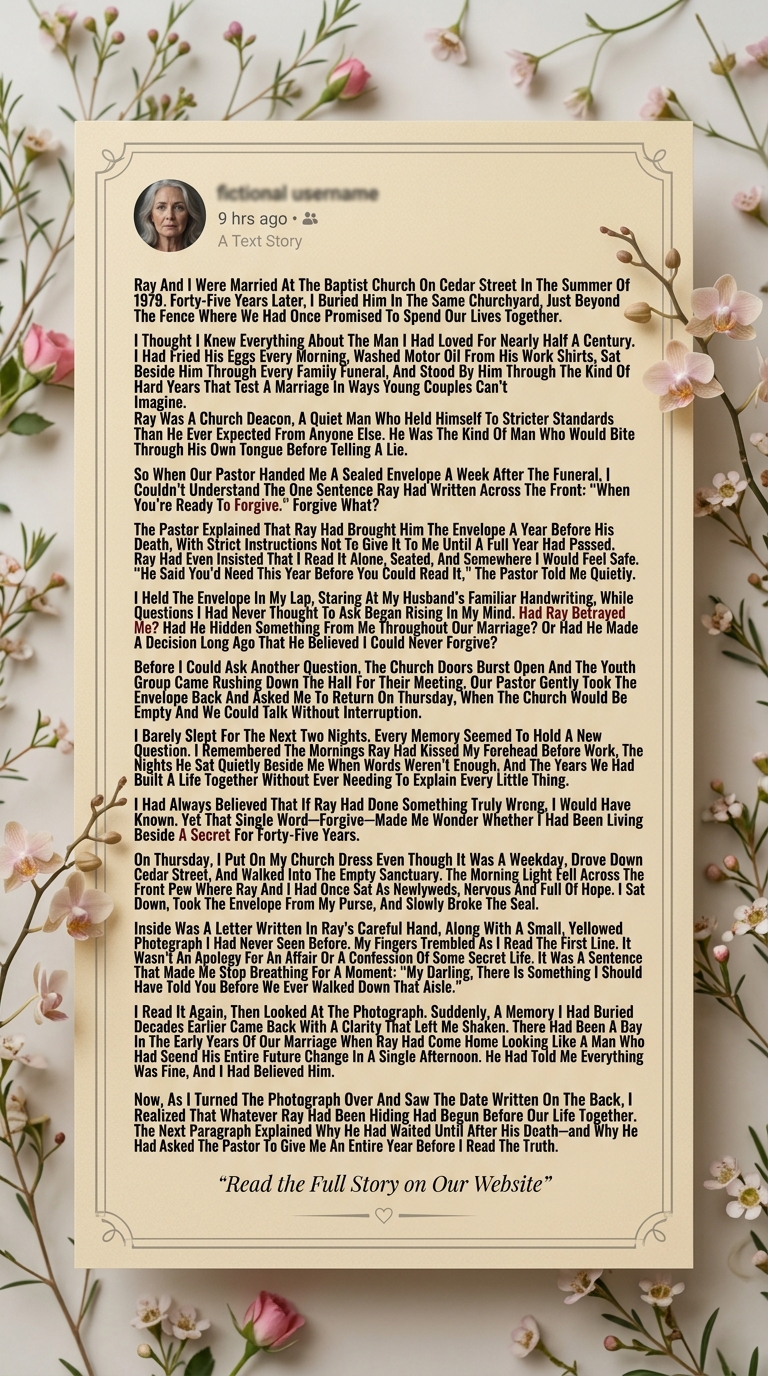
My hands trembled as I unfolded Ray’s letter.
“My darling, there is something I should have told you before we ever walked down that aisle. I have spent forty-five years wondering whether telling you would destroy the happiness we built together. I am not asking you to forget what happened. I am asking you to understand why I made the choice I did.”
I stopped reading.
Outside the sanctuary windows, the morning sun fell across the same wooden pews where Ray and I had sat as newlyweds. I could almost see him beside me, straight-backed in his dark suit, his hands folded neatly over his Bible.
For forty-five years, I had believed that honesty was the foundation of our marriage. Ray never lied about money, never made promises he couldn’t keep, and never pretended to be someone he wasn’t.
Yet here I was, holding a letter that began with an admission he had kept from me since before our wedding.
I looked at the yellowed photograph.
It showed a young Ray standing beside a woman I had never seen before. She wore a pale dress and held a baby wrapped in a knitted blanket. Ray looked barely twenty, with the same serious eyes and stubborn jaw I had known all my life.
On the back, someone had written a date: June 12, 1978.
Our wedding had been in July 1979.
I read the next paragraph.
“Before I met you, I believed I was going to marry someone else. Her name was Elizabeth. We grew up together, and our families expected us to spend our lives together. When she became pregnant, I promised I would take responsibility for the child, regardless of whether we ever married.”
My breath caught.
A child.
Ray had a child before our marriage?
I gripped the edge of the pew and continued reading.
“Her name was Anna. She was born in May 1978. I held her for the first time in a hospital room that smelled of disinfectant and baby powder. I remember thinking that I had never been so frightened or so certain of anything in my life. She was my daughter, and I would always love her.”
Tears blurred the page.
I had known Ray since we were young. We had met at a church picnic in the spring of 1978, when I was twenty-one and he was twenty-three. He had been quiet and polite, a mechanic who volunteered to fix the church van without being asked.
We had fallen in love slowly. He never spoke much about his childhood, but I knew his parents had expected him to settle down with a local girl named Elizabeth. He had told me that their relationship had ended before he met me.
He had never mentioned a baby.
I turned the page.
“Elizabeth and I were never married. We had argued about our future before Anna was born. I wanted to marry her because I believed that was what a responsible man was supposed to do, but I also knew we had stopped loving each other long before the pregnancy. I wanted to raise our daughter together, even if we could not remain a couple.”
I swallowed hard.
“What happened?” I whispered to the empty church.
The letter answered.
“Six weeks after Anna was born, Elizabeth’s parents decided she should move to Ohio, where her sister lived. They believed she needed a fresh start. Elizabeth agreed to go. I wanted to follow them, but I had no steady work there, no savings, and no way to provide for a baby. I was offered a job at a garage outside town, and I convinced myself that I could establish myself first and then bring Anna closer to me.”
Ray had been twenty-three.
Young, frightened, and trying to become the man he believed a father should be.
I could understand that.
But the next lines made my stomach tighten.
“Then I met you. You were kind to everyone, even people who did not deserve it. You listened when I spoke, and you never treated my fears as weaknesses. For the first time, I could imagine a life that wasn’t built entirely around what other people expected of me.”
I closed my eyes.
I remembered our early courtship, the way Ray would drive across town after work just to bring me a milkshake. I remembered him sitting with my father when my mother was ill, quietly fixing a loose porch step while the rest of us worried in the kitchen.
He had been gentle, dependable, and sincere.
The next paragraph began with a date I recognized immediately.
“On June 12, 1978, I received a letter from Elizabeth. She told me she was marrying a man named Thomas, who had agreed to raise Anna as his own. She said she wanted Anna to grow up with a stable home, and she believed it would be better if I stopped visiting.”
My throat tightened.
“Elizabeth asked me not to contact them unless Anna wanted to find me when she was older. She said Thomas knew about me and was willing to be her father. I was devastated, but I believed I had to respect her decision.”
I looked again at the photograph.
Ray had stood beside Elizabeth and their baby only weeks before that letter arrived.
I could almost feel the loneliness he must have carried.
Then I reached the sentence that changed everything.
“When I met you, I had already lost my daughter. I was afraid that if I told you about Anna, you would think I was asking you to enter a marriage that would always belong partly to another woman and another family. I was afraid you would leave before we had a chance to build anything together.”
I shook my head.
“Ray, you should have told me.”
I kept reading.
“I know that. I know that fear does not excuse what I did. I should have trusted you enough to let you decide whether you wanted to marry a man who had a child somewhere in the world. Instead, I made the decision for you, just as I had let fear make too many decisions for me.”
My tears fell onto the page.
“I told myself I was protecting you from a complicated past. But the truth is that I was protecting myself from the possibility of losing you.”
For a long moment, I couldn’t move.
The man I had buried only days earlier had confessed to a secret that reached back to the beginning of our marriage. He had allowed me to build a life with him without knowing something fundamental about his past.
I wanted to be angry.
I was angry.
But beneath the anger was a grief I could barely name. Somewhere, there was a woman who had once loved my husband, and somewhere, there was a daughter who had grown up without knowing the man whose eyes she might have inherited.
I turned the page.
“I tried to find Anna when she was twelve. I wrote to Elizabeth, asking whether I could send a birthday card. She replied that Anna was happy, that Thomas was her father in every way that mattered to her, and that contacting them would reopen wounds they had worked hard to heal.”
Ray had enclosed a copy of that letter.
The handwriting was faded, but the words were clear.
Elizabeth had written that Anna knew Ray’s name. She had told her that her biological father had been young and unprepared when she was born, and that he had chosen not to disrupt the life she had built with Thomas.
It was a painful description, but not an entirely unfair one.
Ray had chosen silence.
And then, apparently, he had lived inside that choice for decades.
“I wanted to write again,” his letter continued, “but every year I waited made the silence harder to break. When Anna turned eighteen, I considered finding her. Then I learned she had married and was expecting a child. I convinced myself that she had a good life and did not need a stranger arriving to explain himself.”
I pressed the letter against my chest.
A stranger.
My husband had called himself a stranger to his own daughter.
I thought about all the times he had sat at our kitchen table helping our children with homework, all the birthdays he had celebrated, all the school events he had attended whenever his work allowed it.
Ray had been a devoted father to Emily and Michael.
He had also been a father to a child whose existence he had kept hidden from them.
I couldn’t make those truths fit together neatly.
The final pages explained why he had waited until after his death to tell me.
“Three years ago, I received a message from Elizabeth’s sister. Elizabeth had died, and Anna had recently begun asking questions about her biological father. Her aunt told me Anna had found the old photograph and wanted to know whether I was still alive.”
My heart began pounding.
“Anna had a family of her own. She had two children, both grown now. She had spent years believing I had chosen to disappear because I did not want her. I could have written immediately, but I was ashamed. I feared she would ask why I had stayed away, and I would have no answer that made me look like the man I wanted to believe I was.”
I stopped reading and wiped my face.
Ray had known that his daughter was looking for him.
And he had remained silent.
The next paragraph was shorter.
“I wrote to Anna last year. I told her the truth about the choices I had made, though I did not ask her to forgive me. I told her I had married a wonderful woman, that we had raised two children, and that I had spent my life trying to be a good husband and father. I also told her that none of those things erased the fact that I had failed her.”
I stared at the page.
“What did she say?” I whispered.
Ray had included a copy of his letter to Anna, but not her response.
Instead, he had written one final section addressed directly to me.
“I am telling you now because I cannot bear the thought of leaving this world and allowing you to remember me as a man who never made a serious mistake. I loved you with everything I had, Marianne. But I also wronged you. You deserved to know the truth before you promised me your life.”
I could hardly breathe.
“I waited until after my death because I was afraid that telling you while I was alive would change how you looked at every year we had shared. I know that was selfish. I know it robbed you of the chance to ask me questions and hear my answers. I am sorry for that.”
The final sentence was written in the same careful handwriting as the rest.
“Please do not forgive me because I was a good husband in other ways. Forgive me only if, after you have been angry and after you have grieved, you decide that the whole truth is something you can carry.”
I folded the letter and sat in silence.
The church was empty.
For forty-five years, I had believed I knew the man beside whom I had built my life. Now I was faced with a truth that changed the beginning of our marriage without erasing everything that came after it.
I thought of our wedding day, Ray’s trembling hands as he slipped the ring onto my finger, and the promise we had made before God and our families.
Had that promise been built on a lie?
Or had it been built on real love, with one terrible omission hidden underneath?
I didn’t know.
But I knew I could not leave the church without asking the one person who might help me understand what had happened after Ray finally wrote to Anna.
I called our pastor.
“Do you know whether Ray kept Anna’s address?”
There was a pause.
“Yes,” he said. “He asked me to keep a copy of the correspondence. He was very particular about making sure it would reach you.”
“Do you know if she answered him?”
“I believe she did. Ray told me he had received a response, but he never showed it to me.”
My hands began to tremble again.
“Do you have her contact information?”
“Yes. I can give it to you, if you want it.”
I looked toward the front pew.
For years, I had believed that Ray’s past had ended before our marriage began. Now I understood that it had simply remained unfinished.
“Please,” I said.
That afternoon, I sat at my kitchen table with Anna’s address written on a piece of paper in front of me.
I drafted three different letters.
The first was too angry.
The second sounded as though I were apologizing for something I hadn’t done.
The third was honest.
I wrote that my name was Marianne, that I had been Ray’s wife for forty-five years, and that I had recently learned about her. I told her I was sorry for the years of silence she had endured. I made it clear that I wasn’t writing to defend Ray or to ask her to comfort me.
I simply wanted her to know that I had read his letter, and that if she ever wanted to talk, I would listen.
Then I mailed it.
For two weeks, I heard nothing.
I went to church. I cooked meals I barely tasted. I sorted through Ray’s belongings and found myself stopping whenever I came across something that reminded me of his younger years.
A faded work shirt.
An old pocketknife.
A photograph of us standing beside our first car.
I kept wondering what else I might have misunderstood.
Then, one Tuesday morning, the telephone rang.
“Is this Marianne?” a woman asked.
“Yes.”
“My name is Anna.”
I gripped the phone with both hands.
For a moment, neither of us spoke.
Finally, she said, “I wasn’t sure I should call you.”
“I wasn’t sure I should write,” I admitted.
She gave a small, nervous laugh.
“Your letter was kind.”
“Thank you.”
Another silence followed.
Then Anna asked, “Did he really love you?”
The question caught me off guard.
I looked at the photograph of Ray and me on the mantel.
“Yes,” I said. “He did.”
“How can you be sure?”
I considered the question carefully.
“Because I lived with him for forty-five years. I saw him when he was generous, and when he was stubborn. I saw him when he was patient, and when he was afraid. I know he loved me. I also know he made a terrible mistake by keeping you a secret from me.”
Anna exhaled.
“He told me he was afraid.”
“He was.”
“Did you hate him?”
I looked down at my wedding ring.
“I was angry with him when I read the letter. I still am, in some ways. But I don’t hate him.”
Anna was quiet.
Then she told me what had happened after Ray had finally written to her.
She had received his letter a little over a year before his death. At first, she had been furious. She had spent much of her life wondering whether her biological father had ever wanted to know her. His letter confirmed that he had thought about her, but it also revealed that he had allowed his fear to keep him away.
She had written back.
She asked why he had waited so long.
Ray had answered honestly.
He had said that he was ashamed, that he feared disrupting her family, and that he had spent too many years convincing himself that silence was kindness.
Anna told me she had not forgiven him immediately.
“I didn’t want him to think that one letter could fix everything,” she said.
“I understand.”
“But we started writing. He told me about his life. I told him about mine. I sent him pictures of my children.”
My eyes filled.
“Did he see them?”
“Yes. He kept them in a little envelope. He told me he looked at them every Sunday after church.”
I covered my mouth.
I imagined Ray sitting alone in his study, holding photographs of grandchildren he had never met, knowing that his own choices had kept him at a distance.
Anna continued.
“We spoke on the phone three times. The last conversation was two weeks before he died.”
“What did you talk about?”
She paused.
“He asked if I would ever consider meeting him.”
I closed my eyes.
“What did you tell him?”
“I said I wasn’t ready. I told him I needed more time.”
“And what did he say?”
“He said he understood. He told me he would wait.”
Anna’s voice broke.
“He died before I could decide.”
I pressed my fingers against my forehead.
For the first time, I understood why Ray had written the letter to me and placed it in the pastor’s care. He had wanted to tell me the truth, but he had also wanted to give Anna time to decide what she wanted from him without feeling pressured by his approaching death.
He had tried to make amends.
But he had waited so long that even his attempt had come with a deadline he could not control.
“I’m sorry,” I whispered.
“So am I.”
We spoke for nearly two hours that morning.
Anna told me about the man who had raised her. Thomas had been a good father, she said, and she loved him deeply. Learning about Ray had not diminished that love. It had simply opened a door to another part of her history.
I told her about Emily and Michael, about Ray’s work at the garage, and about the way he always burned the first pancake because he never waited long enough for the pan to heat properly.
She laughed.
“He told me he was a terrible cook.”
“He was worse than terrible.”
For a moment, we both laughed.
It was a strange thing to share with a woman who had been absent from my life for decades, but the laughter felt natural.
Before we hung up, Anna said, “I don’t know what kind of relationship we can have.”
“Neither do I.”
“But I would like to meet you someday.”
I looked around my kitchen, at the familiar table where Ray had eaten breakfast every morning.
“I would like that, too.”
We agreed to speak again the following week.
After we hung up, I sat quietly for a long time.
I wasn’t suddenly at peace with what Ray had done. His secret had changed the way I understood our marriage, and I knew there would be days when anger returned unexpectedly.
But I no longer felt that I had to choose between remembering his goodness and acknowledging his failure.
Both were true.
A month later, Anna came to visit.
She arrived carrying a small handbag and a framed photograph of Ray as a young man. When I opened the door, we stared at each other for a moment, unsure whether to shake hands or embrace.
Then Anna stepped forward and hugged me.
We stood in the doorway holding each other, two women whose lives had been shaped by the same man in very different ways.
Over lunch, I showed her our wedding album.
She studied the photographs carefully, pausing at one where Ray stood beside me in his dark suit.
“He looks so young,” she said.
“He was.”
“Did you know about Elizabeth?”
“I knew her name. I knew they had been together. I didn’t know about you.”
Anna nodded slowly.
“I used to imagine what my life might have been like if he’d come for me.”
I listened without interrupting.
“Sometimes I imagined that he didn’t care. Other times, I imagined he had been forced to stay away. The truth was harder, because he had made a choice.”
“Yes,” I said. “He had.”
She looked at me.
“Do you think he was a good man?”
I considered the question for a long time.
“I think he tried to be. I think he loved people deeply, and I think he was capable of doing real harm when he was afraid. I don’t believe either truth cancels out the other.”
Anna looked down at her hands.
“I think that’s fair.”
Before she left, I gave her the yellowed photograph from the envelope.
“You should have this,” I said. “It’s part of your story.”
She held it carefully.
“I don’t know what to say.”
“You don’t have to say anything.”
At the door, she turned back.
“Marianne, I’m glad you wrote to me.”
“So am I.”
After Anna drove away, I went to the churchyard where Ray was buried.
I stood beside his grave and placed my hand on the cool stone.
For years, I had believed our marriage was a story I understood from beginning to end. Now I knew there had been a chapter I had never read, one that had begun before our wedding and continued quietly through decades of ordinary mornings and family celebrations.
I was still angry that Ray had kept the truth from me.
I wished he had trusted me enough to tell me while he was alive. I wished he had given me the chance to ask questions, to be angry with him, and to decide for myself what his past meant for our future.
I wished he had understood that honesty would not necessarily have destroyed our marriage.
Perhaps it would have changed it.
Perhaps we would have struggled.
But we would have faced the truth together.
I couldn’t forgive him for the chance he had taken away from me—not all at once, and not simply because he was gone.
But I could begin to understand the frightened young man he had once been, and the older man who had finally found the courage to admit what fear had cost him.
I could acknowledge the love he had given me without pretending he had never failed anyone else.
And I could welcome Anna into my life without asking her to replace the father she had lost or to excuse the father who had stayed away.
Before I left the churchyard, I looked toward the church where Ray and I had promised to spend our lives together.
We had kept that promise in many ways. We had built a home, raised children, endured hardships, and shared forty-five years of love.
But our marriage had never been as simple as I believed.
No marriage is.
We carry histories we don’t fully understand, fears we don’t always know how to name, and mistakes that can shape the lives of people we love long after we have forgotten the moment we made them.
Ray’s secret had not erased our years together.
It had made me see them more honestly.
And perhaps that was the hardest kind of forgiveness: not declaring that what he had done was acceptable, but allowing myself to remember the whole man—not only the husband I had loved, and not only the man who had hurt me.
When I returned home, I placed our wedding photograph beside Anna’s picture of Ray as a young father.
For the first time, I let both images stand together.
One showed the life we had built.
The other showed the life he had left unfinished.
I could not change either one.
But I could stop pretending that only one of them had ever existed.