The Seat Behind Me
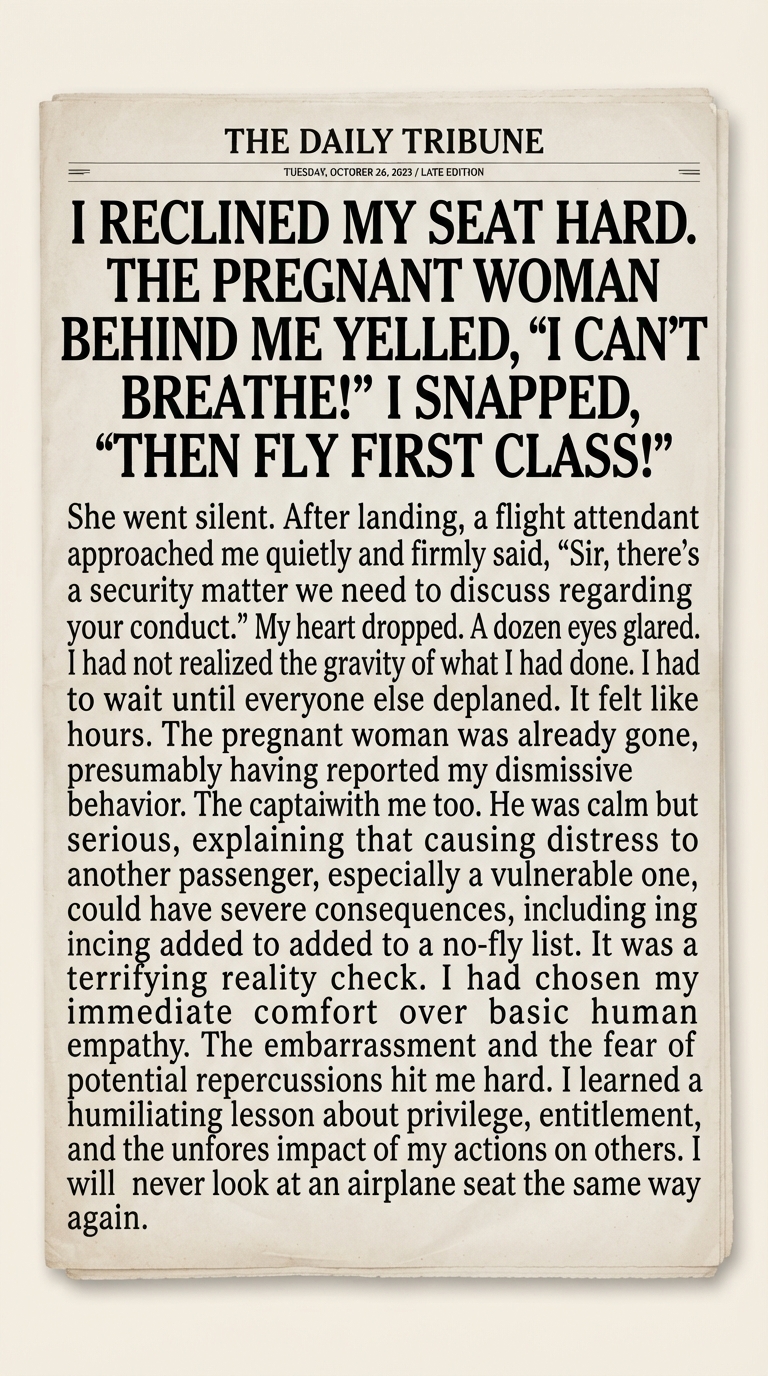
I reclined my seat hard.
The pregnant woman behind me yelled, “I can’t breathe!”
I snapped, “Then fly first class.”
She went silent.
After landing, a flight attendant approached me quietly and firmly.
“Sir, there’s a situation. Please come with me.”
I had no idea that the next fifteen minutes would expose the worst version of myself.
My name is Daniel Mercer. I’m forty-two years old, and until that flight, I considered myself a reasonable person.
Successful.
Independent.
Direct.
The kind of man who didn’t let strangers inconvenience him.
At least, that’s what I told myself.
The flight from Chicago to Denver had already been a disaster before we even took off.
My original flight was canceled.
I spent four hours sitting near Gate B17 listening to announcements about weather delays.
My phone battery was dying.
I had missed an important meeting.
And the airline had squeezed me onto the last available seat on another flight.
Middle seat.
Row 22.
I hated middle seats.
When I finally boarded, I was already angry at the world.
I threw my carry-on into the overhead compartment and dropped into my seat.
The woman beside the window immediately closed her eyes.
The aisle passenger was watching a movie.
And behind me, I heard a soft female voice.
“Excuse me?”
I turned slightly.
A young woman was sitting behind me.
She was visibly pregnant.
Very pregnant.
Maybe eight months.
Beside her sat an older woman who I assumed was her mother.
“Would you mind not reclining all the way?” the pregnant woman asked politely. “I’m having a little trouble with space.”
I looked at my seat.
Then at her.
“It’s a reclining seat.”
“Yes, I know. I’m just asking if maybe you could leave it up a little.”
I sighed.
“Sure.”
For about twenty minutes, I kept the seat upright.
Then the plane reached cruising altitude.
I wanted to sleep.
So without thinking much about it, I pressed the button and pushed my seat backward.
Hard.
Immediately, I heard a gasp.
Then:
“I can’t breathe!”
I turned around.
The pregnant woman was pressed awkwardly against her seat.
Her tray table was down, and the sudden movement had trapped her uncomfortably.
Instead of apologizing, I rolled my eyes.
“Then fly first class.”
The entire row went quiet.
The woman beside her stared at me.
A man across the aisle slowly removed his headphones.
The pregnant woman’s face changed.
Not angry.
Not dramatic.
Just hurt.
She quietly lifted the tray table.
Then she said:
“I’m sorry.”
That should have embarrassed me.
Instead, I turned around and put on my headphones.
For the rest of the flight, she didn’t say another word.
But I noticed something.
Every so often, I heard her breathing strangely.
Short.
Uneven.
Her mother whispered to her.
“Just breathe, sweetheart.”
“I’m okay.”
“Are you sure?”
“Yes.”
I told myself it wasn’t my problem.
That was the phrase I used often back then.
Not my problem.
When we landed in Denver, I stood up immediately.
I grabbed my bag.
I was halfway toward the exit when a flight attendant touched my arm.
“Sir?”
I turned.
“Yes?”
“Please come with me for a moment.”
“Why?”
“There’s a situation.”
My first thought was that the pregnant woman had complained.
I rolled my eyes.
“Seriously? Over a seat?”
The flight attendant’s expression hardened.
“Please come with me.”
I followed her toward the front of the plane.
There were two paramedics waiting near the gate.
And suddenly, I felt something shift inside my chest.
“What happened?”
The flight attendant looked at me.
“The passenger in 23B needs medical assistance.”
My stomach dropped.
“The pregnant woman?”
“Yes.”
“Is she okay?”
“We don’t know yet.”
I looked past her.
The pregnant woman was still seated.
Her mother was holding her hand.
Her face was pale.
Too pale.
A paramedic climbed aboard.
Another brought medical equipment.
For the first time, I felt afraid.
I wanted to walk away.
But I couldn’t.
Then the older woman looked at me.
Her eyes were full of tears.
“You.”
I froze.
“What?”
“You’re the man.”
I didn’t know what to say.
The pregnant woman suddenly winced and clutched her stomach.
The paramedics moved quickly.
The flight attendant stepped between us.
“Sir, please move back.”
I backed away.
“What happened?” I asked.
Nobody answered.
Then I heard the pregnant woman whisper:
“I’m sorry.”
Her mother bent close.
“For what?”
“For making everyone wait.”
That sentence hit me harder than it should have.
She was apologizing.
Again.
Even now.
I stood there watching strangers rush to help her.
And all I could think about was what I had said.
Then fly first class.
Twenty minutes later, I was still at the gate.
I had missed my meeting entirely.
But leaving felt impossible.
Finally, the flight attendant approached me.
“The passenger is being transported to the hospital.”
“Can I—”
I stopped.
What exactly was I going to say?
Can I apologize?
Would that make anything better?
The flight attendant looked at me carefully.
“Why did you say that to her?”
I stared at the floor.
“I was frustrated.”
“She was traveling to Denver because her husband is stationed here.”
I looked up.
The attendant continued.
“She couldn’t afford a different flight. She used her last travel credit to get this seat.”
My throat tightened.
“She didn’t ask you for money.”
I said nothing.
“She didn’t ask you to give up your seat.”
The attendant’s voice remained calm.
“She asked you to move your chair forward a few inches.”
I wanted to disappear.
The paramedics wheeled her past us.
For one brief second, her eyes met mine.
I stepped forward.
“I’m sorry.”
She looked exhausted.
I expected anger.
Instead, she gave me a faint smile.
Then she whispered:
“I know.”
And they took her away.
I went home that night and couldn’t sleep.
At 3:00 a.m., I was still replaying the flight.
Her voice.
Her mother’s fear.
Her apology.
The way she had smiled at me.
The next morning, I called the airline.
I asked about her.
They couldn’t tell me anything.
Privacy.
I understood.
So I asked to leave a message.
I wrote:
I’m the passenger from Row 22. I treated you terribly. There is no excuse for what I said or did. You deserved kindness, and I gave you cruelty instead. I don’t expect forgiveness. I only hope you and your baby are safe.
I gave them my number.
Days passed.
No response.
Then, one week later, I received a call from an unknown number.
“Hello?”
“Is this Daniel?”
“Yes.”
A woman answered.
“This is Anna.”
I stopped breathing.
The pregnant woman.
“Are you okay?”
There was a pause.
“My baby is okay.”
I sat down.
“What about you?”
Another pause.
“I almost wasn’t.”
My eyes closed.
She explained that she had developed a serious complication during the flight.
The doctors believed the stress and restricted breathing had worsened her condition, though no one could say exactly what caused it.
She had needed emergency treatment shortly after landing.
But both she and her daughter survived.
“I’m so sorry,” I whispered.
“I know.”
“No. You don’t understand. I can’t stop thinking about it.”
Her voice was quiet.
“Then don’t stop.”
I froze.
“What?”
“Remember it.”
Those two words changed me.
Not because she wanted revenge.
Because she was right.
Some mistakes should not be forgotten.
They should become part of the person you choose to become afterward.
Before hanging up, I asked:
“Why did you call me?”
She was silent for a moment.
Then she said:
“My mother made me.”
I almost laughed.
“Why?”
“She said people should have a chance to become better than their worst moment.”
I didn’t deserve that chance.
But I was given one anyway.
Three months later, I received another message.
A photograph.
A tiny baby wrapped in a yellow blanket.
Underneath it, Anna had written:
Meet Grace.
I stared at the photograph for a long time.
Then I cried.
Not because I had any right to feel emotional.
But because that little girl would never know how close I had come to becoming a permanent part of a terrible story.
A story where a selfish stranger made her mother’s worst day even worse.
I printed the photograph.
And placed it inside my wallet.
Not as a happy memory.
As a reminder.
Months later, I was on another flight.
This time, I was seated in an exit row.
A young mother behind me was struggling with a crying toddler.
The man beside her sighed loudly.
“Can you keep your kid quiet?”
The mother looked embarrassed.
I turned around.
“Do you want to switch seats?”
She looked surprised.
“What?”
“I’ve got more room up here.”
Her eyes filled with tears.
“You don’t have to.”
“I know.”
I moved anyway.
As I settled into the back, the man beside me looked annoyed.
I smiled.
“It’s just a seat.”
And for the first time, I truly understood what that meant.
Because sometimes, the smallest kindness costs almost nothing.
And sometimes, the smallest cruelty follows you for the rest of your life.
I never saw Anna again.
But every year, on Grace’s birthday, I send a message.
Not asking for forgiveness.
Not expecting a reply.
Just three words.
I remember her.
Because I do.
I remember the pregnant woman behind me.
I remember her asking politely.
I remember choosing pride over kindness.
And I remember the moment I realized that being tired, stressed, or inconvenienced never gives us permission to treat another human being as though they matter less.
That flight taught me something no amount of money or success had ever taught me before.
You don’t always get to undo the damage caused by your worst moment.
But you do get to decide whether it will remain your final version.
And sometimes…
The person who changes your life is someone you were too selfish to treat kindly.