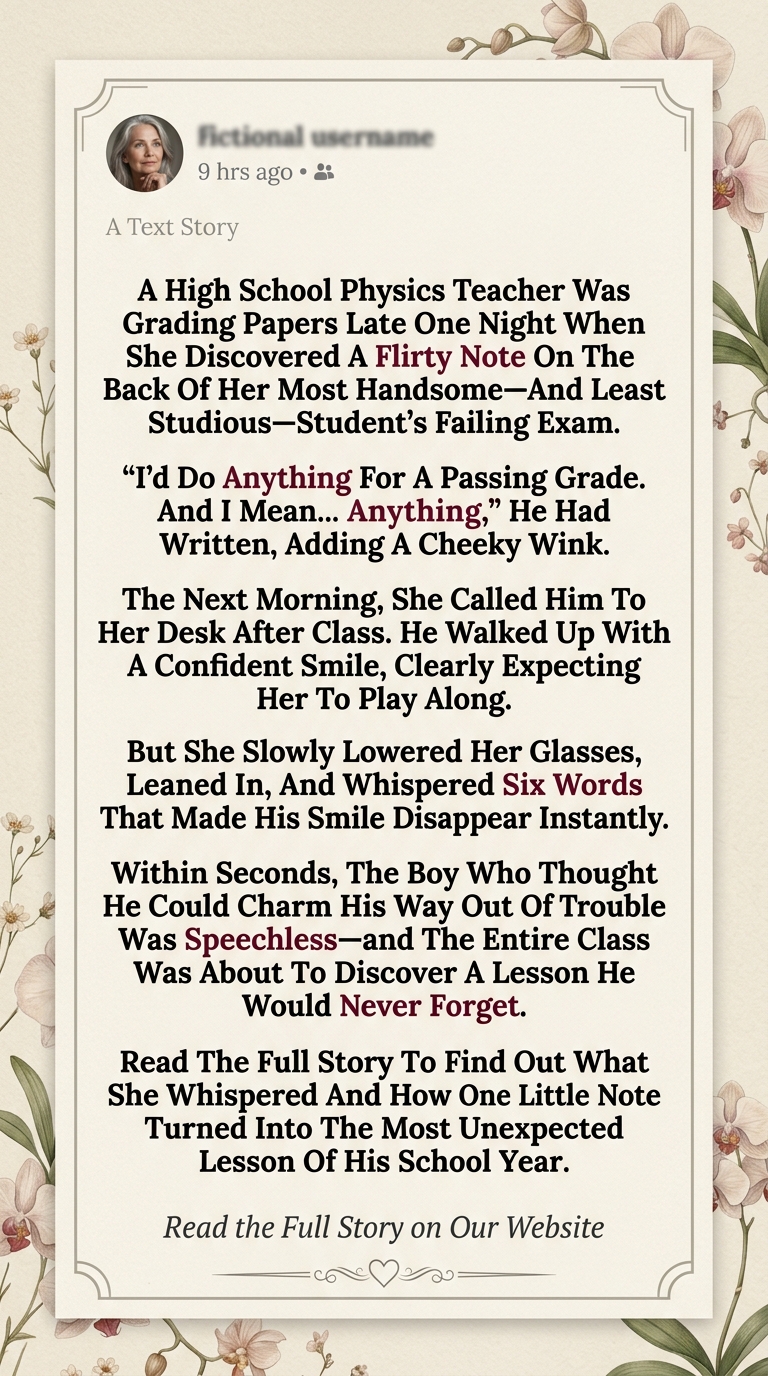
The note was so bold that I read it three times before I believed one of my students had actually written it.
“I’d do anything for a passing grade. And I mean… anything. 😉”
It was written on the back of a physics exam that had earned a miserable 42 percent.
The student was Ryan Mitchell, a seventeen-year-old senior at Westbrook High School. He was handsome, athletic, and so effortlessly charming that he seemed to believe the ordinary rules of life applied to everyone except him.
He could make half the girls in school laugh with a single grin. He could convince a substitute teacher that an unfinished assignment had mysteriously disappeared. And he had perfected the art of looking sincerely disappointed whenever someone reminded him that charm was not an academic subject.
Unfortunately for Ryan, I was his physics teacher.
My name is Claire Bennett. I was thirty-six, had taught physics for eleven years, and had learned that the students who claimed to hate science usually hated being required to think carefully about something they couldn’t solve with a quick guess.
Ryan was one of my most frustrating students.
He rarely completed his homework. He treated laboratory instructions as suggestions. During lectures, he would lean back in his chair and whisper jokes to his friends while I explained concepts that would eventually appear on his exams.
Yet whenever I asked him a question, he would flash that confident smile.
“Come on, Ms. Bennett. You know I’m trying.”
He wasn’t.
At least, not in the ways that mattered.
I had already spoken to him twice about his grades. I had offered extra help after school, provided practice problems, and even suggested that he attend the school’s tutoring sessions.
He had attended exactly one.
He spent the first twenty minutes asking whether I had ever considered making physics more entertaining.
Now I was sitting at my kitchen table at nearly midnight, grading his latest exam, when I discovered his little message.
I stared at the wink.
Then I leaned back and laughed—not because the note was charming, but because I recognized exactly what he was attempting.
He had decided that if studying couldn’t earn him a passing grade, perhaps flirting could.
He had mistaken my patience for weakness.
And he was about to learn that I had a very different understanding of education.
I turned the exam over, wrote a short note beneath his message, and placed it in my school bag.
The next morning, I arrived at school with a plan.
Not a cruel plan.
Not a humiliating plan.
A lesson.
And Ryan Mitchell was going to remember it long after he forgot the formula for calculating acceleration.
The following morning, I returned the graded exams during the final ten minutes of class.
The room filled with the usual mixture of groans, nervous laughter, and desperate attempts to peek at classmates’ scores.
Ryan sat near the back, surrounded by three friends who seemed to regard every school day as a competition to see who could do the least work while remaining popular.
When I placed his exam on his desk, he glanced at the red 42 at the top.
Then he turned the paper over.
His grin widened.
He had clearly expected me to respond to his note.
I continued distributing the papers as though nothing unusual had happened.
When the bell rang, students began packing their bags.
“Ryan,” I called.
He looked up immediately.
“Yes, Ms. Bennett?”
“Please stay for a moment.”
His friends exchanged knowing looks.
One of them whispered something that made Ryan chuckle.
He walked toward my desk with his hands in his pockets and the relaxed confidence of someone who believed the difficult part of the morning was already behind him.
“So,” he said, stopping in front of me. “Did you get my message?”
“I did.”
He smiled.
“And?”
I took off my glasses, placed them on the desk, and looked directly at him.
Then I leaned forward slightly and whispered six words.
“Your father will be hearing about this.”
Ryan’s smile vanished.
For the first time since I had known him, he looked completely speechless.
His eyes widened.
“My—my father?”
“Yes.”
I picked up his exam and turned it over so that his note faced him.
“And your mother will receive a copy.”
His face turned bright red.
“Ms. Bennett, wait. I was just joking.”
“Then I’m sure you’ll have no trouble explaining the joke to your parents.”
He glanced toward the classroom door.
Several students were still nearby, pretending to organize their backpacks while clearly listening to every word.
Ryan lowered his voice.
“Please don’t make this a big deal.”
I looked at him calmly.
“Ryan, you submitted a failing examination and then used the back of the paper to suggest that you were willing to exchange inappropriate favors for a passing grade. I am your teacher. You are my student. That is not a negotiation I will entertain.”
He swallowed.
“I didn’t mean it like that.”
“Then tell me what you meant.”
He opened his mouth.
Nothing came out.
For once, he couldn’t charm his way through an uncomfortable moment.
I continued.
“Your grade will reflect your academic work. Your message will be handled according to school policy. Those are two separate matters.”
He stared at the desk.
“I understand.”
“I hope so. Because I don’t want you to leave this classroom believing that you can buy your way out of responsibility with a clever sentence.”
I handed him a sheet of paper.
It was a notice explaining the school’s academic integrity and student conduct procedures, along with information about the opportunity to meet with the counselor and discuss the incident.
“I expect you to read this carefully. We’ll also arrange a meeting with the appropriate school staff.”
Ryan took the paper.
His confidence had disappeared completely.
“Am I going to be suspended?”
“That decision isn’t mine alone. The school will follow its procedures, and you’ll have the opportunity to explain yourself. What I can tell you is that your exam grade will not change because of what you wrote.”
He nodded slowly.
Then he turned toward the door.
Before he left, I added one final sentence.
“Ryan, being clever enough to write a note doesn’t make you clever enough to escape the consequences.”
He stopped.
For a moment, I thought he might argue.
Instead, he nodded again and walked out.
The classroom fell silent.
Then someone near the windows whispered, “What did she say to him?”
Another student replied, “I think his parents are getting called.”
I returned to my desk.
“All right, everyone. Before you leave, remember that your next physics assignment is due Friday.”
A few students laughed nervously.
But I noticed something different in their expressions.
They were listening.
By lunchtime, the story had spread throughout the senior class.
The details changed with every retelling.
According to one version, Ryan had tried to bribe me with concert tickets.
According to another, he had written an entire love letter on the back of his exam.
One particularly imaginative student claimed I had threatened to make him calculate the velocity of his own embarrassment.
I ignored the rumors.
I documented what had happened and reported the incident through the school’s established process.
Ryan’s parents were contacted, and a meeting was arranged with the assistant principal and school counselor.
I made it clear that the purpose was not to punish him for being embarrassed. It was to address the inappropriate suggestion, reinforce professional boundaries, and help him understand that his academic responsibilities could not be negotiated away.
During the meeting, Ryan initially insisted that the note had been harmless.
“It was just a joke,” he said. “I didn’t actually expect her to do anything.”
His father, a quiet man who worked as an electrician, looked at him with disappointment.
“Then why did you write it?”
Ryan shrugged.
“Everyone jokes around.”
His mother shook her head.
“That doesn’t answer the question.”
The counselor asked Ryan to explain what he had hoped to achieve.
For several minutes, he avoided the question.
Finally, he admitted the truth.
He had seen students charm teachers into granting extensions and extra opportunities. He believed that being popular made him special, and he thought a flirtatious joke might persuade me to give him another chance.
He hadn’t expected the situation to become serious.
His father leaned back.
“Son, there’s a difference between being funny and treating someone else’s job like a game.”
Ryan stared at the table.
His father continued.
“If you fail a test, you study harder. If you don’t understand something, you ask for help. You don’t put another person in an uncomfortable position and then complain when they take it seriously.”
For the first time, Ryan didn’t argue.
The school decided that the incident warranted a formal warning and a restorative meeting, along with a clear academic improvement plan. He would also need to complete the work required to demonstrate his understanding of the material.
His failing grade remained unchanged.
He was not suspended, and the school did not turn one foolish act into a permanent judgment of his character.
But he was required to take responsibility.
And that was exactly what he needed.
Three days later, Ryan appeared at my classroom door after school.
He was carrying a notebook and a stack of practice problems.
“Ms. Bennett?”
I looked up from my desk.
“Come in.”
He approached slowly.
“I wanted to apologize.”
I set down my pen.
“All right. I’m listening.”
He looked uncomfortable, but he didn’t try to smile his way through it.
“What I wrote was inappropriate. I thought it would be funny, and I thought maybe you’d give me a chance to improve my grade. I didn’t think about how it would make you feel or how it would look.”
He paused.
“I’m sorry.”
I studied him for a moment.
“Thank you for apologizing. What matters now is what you do differently.”
He nodded and placed his notebook on the desk.
“I also wanted to ask about the exam. I know you won’t change the grade, but I want to understand what I got wrong.”
That surprised me more than the original note.
“You want to go through the exam?”
“Yes.”
“Why?”
He looked down at the notebook.
“Because I don’t want to fail.”
It wasn’t a profound revelation.
But it was honest.
I pulled out a chair.
“All right. Let’s begin with question three.”
For the next forty minutes, we worked through the problems he had missed.
He struggled with the equations. He made mistakes. He tried to guess his way through a few answers before stopping himself.
Whenever he became frustrated, I reminded him to write down what he knew, identify what he was trying to calculate, and work through the steps.
By the end of the session, he had correctly solved three problems he had previously left blank.
He looked at the page with surprise.
“I actually understand that now.”
“Because you took the time to work through it.”
He nodded.
“I should’ve done this weeks ago.”
“Yes,” I said. “You should have.”
He laughed quietly, accepting the truth.
Before leaving, he asked whether he could attend tutoring twice a week until the next exam.
I told him that was an excellent idea.
And he followed through.
Over the next month, Ryan’s behavior changed gradually.
He began arriving with his homework completed.
He stopped interrupting lectures.
When he didn’t understand a concept, he asked questions instead of making jokes to hide his confusion.
His grades improved, though not dramatically at first.
His next examination earned him a 61 percent.
It wasn’t a spectacular score, but it represented genuine progress.
He earned a 74 on the following test.
By the time the final examination arrived, Ryan had become one of the students who stayed after class to check his calculations rather than one who searched for excuses to avoid them.
When I handed back his final exam, he stared at the score.
An 86.
He looked at me as though he suspected a mistake.
“Is this mine?”
I checked the name.
“Unless another Ryan Mitchell has suddenly learned physics, yes.”
He laughed.
Then he became serious.
“Thank you, Ms. Bennett.”
“You earned that grade, Ryan.”
He nodded slowly.
For the first time, I saw something more valuable than confidence in his expression.
Pride.
Not the pride of someone who believed he could get away with anything, but the pride of someone who had worked hard enough to accomplish something real.
As he gathered his things, he glanced at the old exam I had returned to him months earlier.
The note was still on the back.
“I almost forgot about that,” he said.
“I didn’t.”
He winced.
“Neither did my parents.”
We both laughed.
Then he asked whether he could keep the paper.
“Why?” I asked.
He shrugged.
“To remind myself not to be an idiot.”
I considered that.
“Keep it if you want. But I hope you’ll remember the lesson without needing the paper.”
He folded the exam carefully and placed it in his backpack.
At the door, he turned around.
“Can I ask you something?”
“Of course.”
“Did you really know what to say when you called me over that morning?”
I smiled.
“I knew exactly what I needed to say.”
“What was it?”
I picked up my glasses and put them back on.
“Your father will be hearing about this.”
He groaned.
“That was brutal.”
“No, Ryan. That was a consequence.”
He shook his head, laughing, and walked into the hallway.
I returned to my desk and began grading the next stack of papers.
For the rest of that school year, Ryan never again suggested that a grade could be earned through flirting.
More importantly, he learned that asking for help was not a sign of weakness, that accountability was not the same as humiliation, and that a second chance meant doing the work rather than finding a clever way around it.
Years later, I still remembered the note.
Not because it had been the most outrageous thing a student had ever written, but because it had revealed how easily a confident young person could mistake charm for character.
Ryan had entered my classroom believing that he could negotiate his way out of failure.
He left that year understanding something far more important than physics.
You cannot charm your way into earning something you have not worked for.
And sometimes, the most valuable lesson a teacher can give a student has nothing to do with the subject written on the board.