My Four-Year-Old Begged Me Not to Leave Him With Grandma—Then I Discovered What She Was Doing Behind My Back
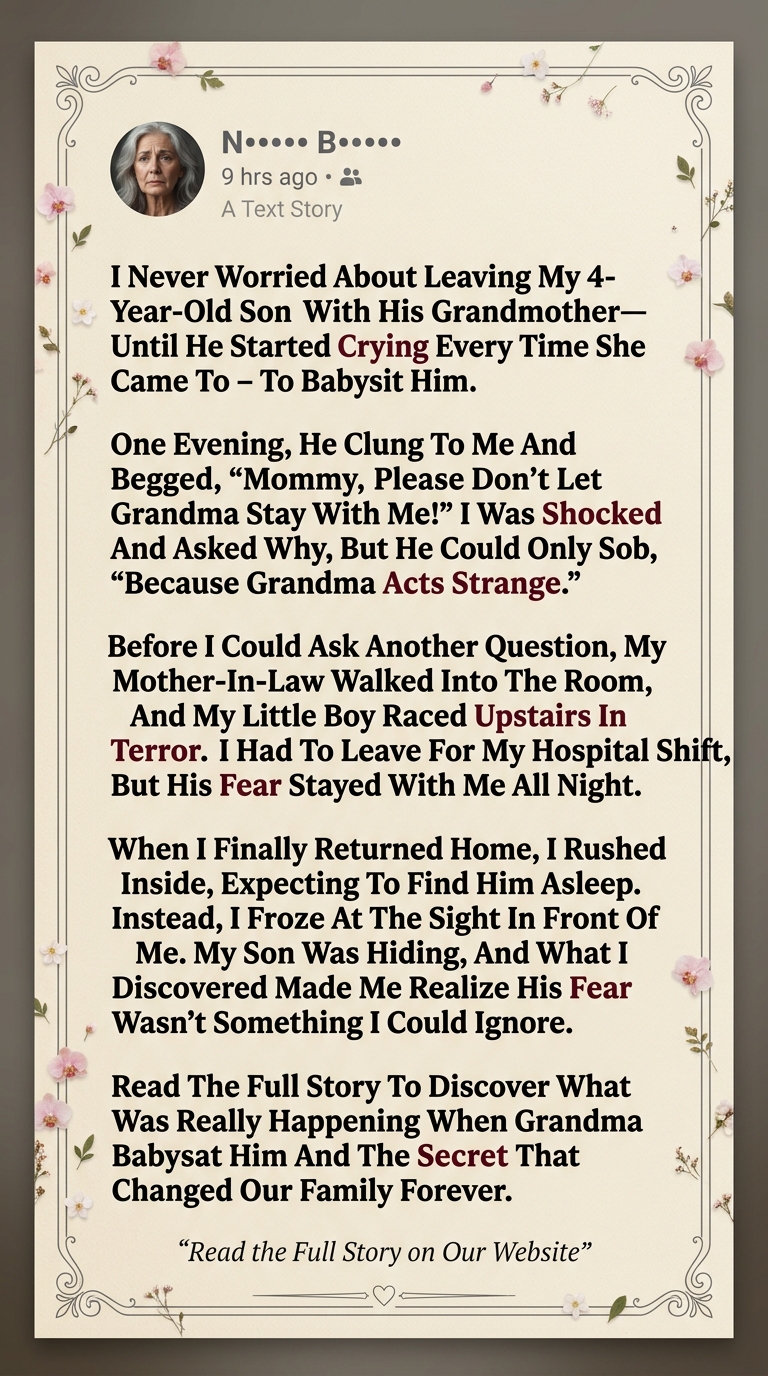
“I don’t want Grandma to stay with me, Mommy. Please don’t make me!”
My four-year-old son, Noah, clung to my waist so tightly that I could barely move. His little fingers dug into my uniform, and tears rolled down his cheeks.
I had never seen him this frightened.
For nearly a year, my mother-in-law, Patricia, had been helping us with childcare whenever my hospital shifts ran late. She was sixty-three, retired, and always insisted that spending time with her grandson was the greatest joy of her life.
At least, that was what I believed.
“Noah, sweetheart, what happened?” I knelt in front of him. “Did Grandma say something to you?”
He shook his head violently.
“Grandma acts strange.”
“What do you mean, strange?”
He opened his mouth, but before he could answer, the front door opened.
“Hello! I’m here!” Patricia called cheerfully.
Noah went rigid.
The moment he heard her voice, he scrambled away from me and ran upstairs. I heard his bedroom door slam, followed by the unmistakable sound of something heavy being dragged across the floor.
Patricia stood in the hallway holding her handbag.
“What on earth is wrong with him?” she asked, looking offended. “He’s been acting like this for weeks.”
I stared at her.
“Weeks?”
She waved her hand dismissively. “Children go through phases. He’s probably testing boundaries. You know how children are.”
I wanted to believe her. I was exhausted, had a twelve-hour hospital shift ahead of me, and desperately needed the childcare arrangement to work.
But something about Noah’s reaction made my stomach tighten.
“I’ll talk to him,” I said.
Patricia sighed. “You spoil him too much. He needs to learn that he can’t always get his way.”
I went upstairs and found Noah crouched behind his bedroom curtains, hugging his favorite stuffed rabbit.
“Baby, Mommy has to go to work,” I whispered, sitting beside him. “Grandma will stay here with you, and I’ll be home tonight.”
He grabbed my hand.
“Please don’t go.”
My heart broke.
I promised to call him during my break, kissed his forehead, and asked Patricia to keep her phone nearby. Then I left for the hospital, carrying a feeling of dread I couldn’t explain.
Throughout my shift, I checked my phone whenever I could.
Patricia sent one message.
Noah is fine. Stop worrying.
I called home twice. Both times, she answered quickly and told me he was playing.
Yet when I asked to speak to him, she said he was busy.
By midnight, I could no longer concentrate on anything except getting home.
When my shift finally ended, I drove home faster than I should have, rehearsing all the explanations I might hear. Perhaps Noah had overheard an argument. Perhaps he had seen something frightening on television. Perhaps it really was a phase.
I unlocked the front door quietly.
The living room was dark, except for the light coming from the kitchen.
“Patricia?” I called.
No answer.
Then I heard a tiny sound upstairs.
“Mommy?”
I ran.
Noah’s bedroom door was partly open. Inside, his bed was empty, and his closet door stood ajar.
I found him wedged behind a pile of blankets in the corner, shaking.
“Baby, I’m home!” I cried, pulling him into my arms. “What happened?”
He buried his face against my neck.
“Grandma did it again.”
My blood ran cold.
“What did she do, sweetheart?”
He pointed toward the hallway.
“She made the scary face. Then she said I couldn’t tell you.”
Before I could ask another question, I heard footsteps behind me.
Patricia appeared in the doorway.
“Oh, for goodness’ sake,” she said. “He’s been hiding all evening. I was just trying to get him to behave.”
Noah screamed and clutched me.
I stood up, holding him against my chest.
“Stay downstairs,” I told Patricia.
Her expression hardened.
“Excuse me?”
“You heard me.”
For the first time since I’d known her, I saw something in Patricia’s face that didn’t look like irritation or wounded pride.
It looked like panic.
I carried Noah into our bedroom, locked the door, and called my husband, Daniel, who was away on a two-day business trip.
He answered sleepily.
“What’s wrong?”
“Something is happening with Noah when your mother babysits him. He’s terrified of her.”
Daniel went quiet.
Then he said something that made my heart sink.
“Mom told me he was having nightmares. She said you were making a big deal out of it.”
“You knew he was afraid of her?”
“I didn’t know he was this afraid.”
“Daniel, I’m looking at our son hiding in a closet. I need you to come home.”
“I’ll get the first flight.”
After I hung up, I sat beside Noah and gently asked him to show me what he meant by the scary face.
At first, he shook his head.
Then he picked up his stuffed rabbit and held it in front of his face. He widened his eyes, pulled his mouth into an exaggerated grin, and began making a low, unnatural growling sound.
I stared at him.
“That is what Grandma does?”
He nodded, tears gathering in his eyes.
“She puts on the white face.”
“What white face?”
“The face in the bathroom.”
I remembered seeing a small box of theatrical makeup in Patricia’s handbag earlier that evening. She had told me she was helping with decorations for a community theater fundraiser.
A terrible thought crossed my mind.
“Did Grandma put something on her face to scare you?”
Noah nodded.
“She comes out when the lights are off. She says she’s the monster, and if I tell you, the monster will come back at night.”
I felt sick.
I wanted to rush downstairs and confront Patricia immediately, but I stopped myself. Noah needed to feel safe, and I needed to understand what had happened without frightening him further.
I held him close and told him he had done nothing wrong.
“You can always tell Mommy the truth,” I whispered. “Nobody gets to threaten you into keeping a secret from me.”
He nodded against my shoulder.
Then he said something that changed everything.
“Grandma takes pictures, too.”
I pulled back.
“What pictures?”
“Me crying.”
My stomach twisted.
“Why does she take pictures of you crying?”
He didn’t know.
I tucked him into our bed, stayed beside him, and called my sister, Rachel, who lived ten minutes away. I asked her to come over and stay with Noah while I spoke with Patricia.
When Rachel arrived, I went downstairs.
Patricia was sitting at the kitchen table, calmly drinking tea as if nothing had happened.
I placed my phone on the table and turned on the voice recorder.
“Tell me exactly what you’ve been doing to Noah.”
She looked at the phone, then at me.
“I haven’t done anything to him.”
“He says you paint your face white, turn off the lights, pretend to be a monster, and threaten him if he tells me.”
For a moment, she didn’t speak.
Then she laughed.
It was a short, disbelieving laugh, as if I’d accused her of something ridiculous.
“Oh, that. It was a game.”
“A game?”
“I was trying to make him less timid. Children need to learn the difference between make-believe and reality.”
“He’s four years old!”
“And now he knows the monster isn’t real.”
“He thinks you’ll come back at night if he tells me what happened!”
Patricia set down her cup.
“Children exaggerate. You’re letting him manipulate you.”
I felt anger rise in my chest, but I kept my voice steady.
“Did you take pictures of him crying?”
Her eyes flicked toward her handbag.
That tiny movement told me more than her words had.
“Give me your phone,” I said.
“Absolutely not.”
“Then explain why you took those pictures.”
She stood up abruptly.
“You have no right to interrogate me in my own family.”
“This is my home, and that is my child.”
She grabbed her handbag.
“I won’t be spoken to like this.”
“Fine. You’re leaving tonight, and you will not babysit Noah again.”
Her face changed.
“You can’t keep me away from my grandson!”
“I can keep him away from anyone who frightens him.”
Patricia stormed out, slamming the door so hard that a picture frame rattled against the wall.
I locked the door behind her.
Then I went upstairs, sat beside my son, and held him until he finally fell asleep.
But the next morning brought a discovery I hadn’t expected.
Daniel returned home just after sunrise. He looked exhausted, worried, and ashamed that he’d dismissed my concerns.
We sat together at the kitchen table while Noah slept upstairs.
“I need to tell you something,” Daniel said.
My stomach tightened.
“What?”
“Mom has been asking me for money.”
“How much?”
“About three thousand dollars over the last two months. She said it was for medical bills and repairs to her apartment.”
I frowned.
“Did you give it to her?”
“Some of it. But last week, I saw a charge on her credit card statement when I helped her sort out a billing problem. It was for a digital camera and a small projector. She said they were gifts for a charity event.”
I thought about the makeup, the photographs, and Noah’s description of the lights going off.
“Daniel, I think your mother has been recording his reactions.”
He covered his face with both hands.
“I don’t understand why she would do that.”
Neither did I.
We decided not to contact Patricia again until we had a clearer picture of what had happened. Daniel called his mother and asked her to explain herself, but she refused to discuss the incident and accused me of turning him against her.
Later that afternoon, she sent him a long message claiming I was unstable, that Noah was spoiled, and that I was destroying the family over an innocent joke.
Then she made a mistake.
She sent Daniel a photograph.
It showed Noah sitting on the living room floor, crying. Behind him stood a figure wearing a white mask, a black cloak, and a grotesque painted smile.
The caption read:
He finally cried less this time. Maybe he’s getting used to it.
Daniel stared at the screen, his face draining of color.
I felt as if the air had been knocked out of my lungs.
There was no longer any question that Noah hadn’t imagined what happened.
Daniel called his mother immediately.
She didn’t answer.
He sent a message telling her that she was never to come to our home or contact Noah without our permission. We saved the photograph and all related messages.
I also contacted Noah’s pediatrician, explained the sudden fear and distress, and asked for guidance on helping him recover. The doctor recommended a child therapist experienced in anxiety and frightening experiences. We arranged an appointment and documented what Noah had told us in his own words, without repeatedly questioning him.
The therapist helped us understand that Noah needed reassurance, predictable routines, and the freedom to talk without feeling pressured to provide details.
We followed that advice.
For the next several weeks, I handled childcare with the help of Rachel and a trusted sitter. Noah slowly began sleeping through the night again. He stopped hiding whenever the doorbell rang, although he still startled when someone entered a dark room unexpectedly.
Daniel struggled in a different way.
He had grown up believing his mother was a kind woman who had sacrificed everything for her family. Accepting what she’d done meant confronting the possibility that the mother he remembered wasn’t the whole person he knew.
He tried calling her several times.
Eventually, she answered.
She admitted that she’d dressed as a monster and photographed Noah’s reactions. But she insisted she had done it for fun, claiming she wanted to create a funny family video and believed he would eventually laugh about it.
When Daniel asked why she’d threatened him not to tell us, she said she didn’t want us to spoil the surprise.
“Mom,” Daniel replied, his voice breaking, “he thought you were going to hurt him.”
“He was never in danger!”
“He was four years old and terrified. You knew he was scared, and you kept doing it.”
She began crying and accused him of abandoning her.
Daniel didn’t change his decision.
He told her that any future relationship with Noah would depend on her accepting responsibility, respecting our boundaries, and demonstrating that she understood why her behavior was wrong. There would be no unsupervised visits, and no contact with Noah until we felt it was appropriate.
She refused to apologize.
For months, she told relatives that we had stolen her grandson from her over a harmless prank. Some family members believed her. Others quietly admitted that they’d noticed her increasingly strange behavior and wished they had spoken up sooner.
We didn’t argue with everyone or try to win a family-wide debate. We focused on Noah.
Over time, he grew more confident. He began drawing pictures of our family again, and the monsters that once filled his nightmares became ordinary cartoon creatures he could laugh at.
One evening, while Daniel was reading him a bedtime story, Noah suddenly looked up.
“Daddy?”
“Yes, buddy?”
“Grandma isn’t coming tonight, right?”
Daniel put down the book and sat beside him.
“No, buddy. She isn’t coming tonight.”
“And if I say I don’t like something, you’ll listen?”
Daniel’s eyes filled with tears.
“Always. You can tell Mommy or Daddy anything. You never have to keep a scary secret from us.”
Noah considered that for a moment, then hugged him.
I stood in the doorway, watching them, and realized that the most important thing we had done wasn’t exposing Patricia’s behavior or proving that our son had been telling the truth.
It was showing him that when he was frightened, the people who loved him would listen.
Almost a year later, Patricia sent a letter.
For the first time, she acknowledged that she had frightened Noah for her own amusement. She admitted that she’d mistaken his fear for harmless entertainment and that her insistence on keeping the incident secret had made it worse.
She apologized to Daniel and me, and asked whether she might eventually have the chance to apologize to Noah.
We didn’t rush the decision. We discussed it with his therapist and agreed that any contact would happen gradually, only if Noah felt comfortable, and with us present.
When the time came, Patricia met us at a quiet park. She sat several feet away from Noah and spoke gently.
“I did something wrong,” she told him. “I dressed up to scare you, and I kept doing it when you were afraid. That wasn’t kind, and it wasn’t your fault. I’m sorry.”
Noah stayed close to me.
He didn’t hug her. He didn’t say he forgave her.
He simply replied, “I don’t like the monster.”
Patricia nodded, wiping her eyes.
“I understand.”
That was all the meeting needed to be.
We didn’t pretend that one apology erased what had happened. Trust would take time, and Noah’s comfort would always come first. Whether Patricia eventually became a regular part of his life remained uncertain, but the decision would no longer be made out of guilt, pressure, or family expectations.
It would be made according to what was safe for our child.
I had once believed that leaving Noah with his grandmother was safe simply because she was family.
I learned that love and trust cannot be granted automatically because of a title. They must be earned through actions, protected by boundaries, and measured by how someone treats the most vulnerable people in their care.
And I learned something else: when a little child gathers every ounce of courage he has and says he is afraid, the most important thing a parent can do is listen.