The Envelope My Mother Brought to the Family Picnic
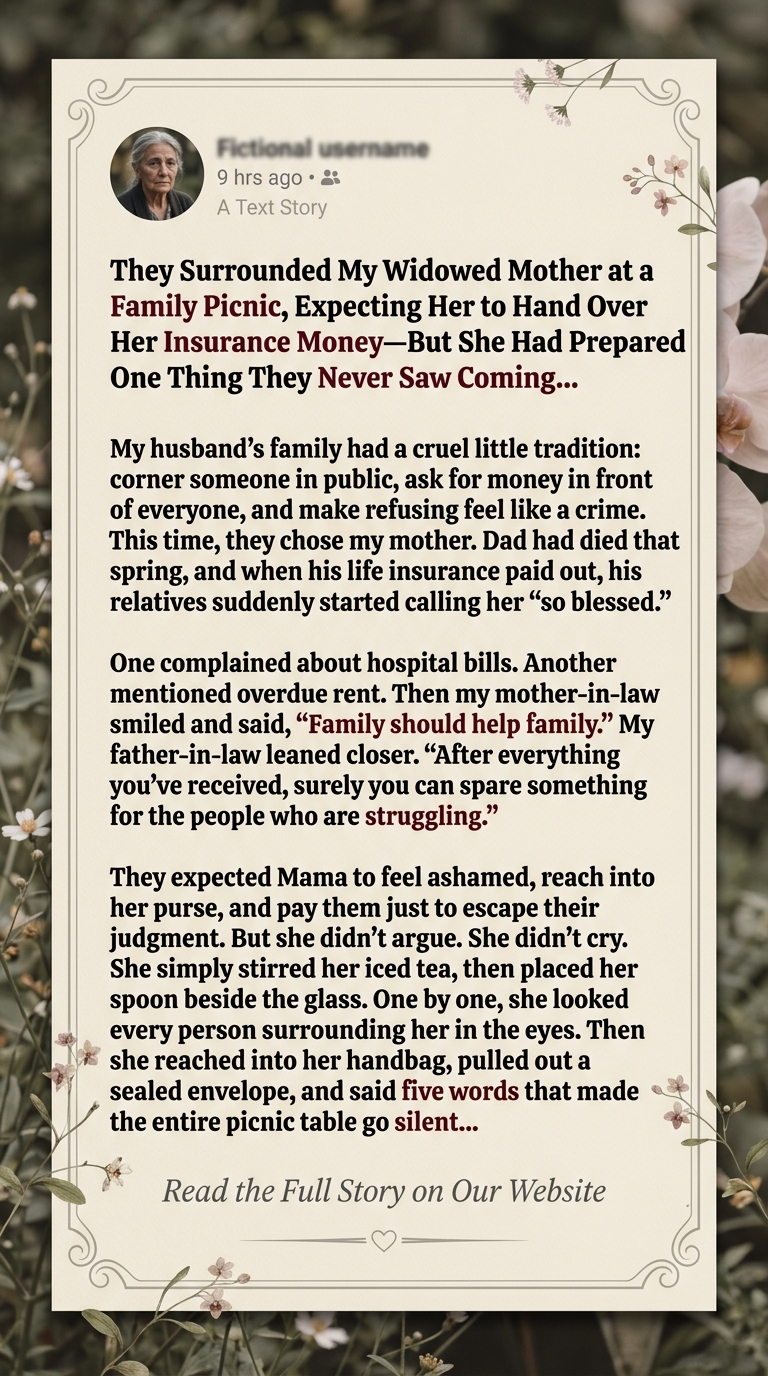
The moment my mother placed that sealed envelope on the picnic table, my mother-in-law stopped smiling.
My father-in-law slowly lowered his paper plate. My husband’s aunt froze with a fork halfway to her mouth. Even the children playing near the swings seemed to grow quieter as the adults stared at the envelope.
My mother took one calm sip of iced tea, folded her hands, and said five words.
“Before I give you anything…”
She paused, looking directly at my father-in-law.
“…you should read this.”
Then she slid the envelope across the table.
Nobody reached for it.
For three months, my husband’s family had treated my widowed mother as if my father’s life insurance payout had made her their personal bank. They had called her blessed, fortunate, and lucky. They had discussed their financial problems in front of her with the subtlety of people who believed that mentioning a hardship was the same as presenting an invoice.
And now, at a family picnic meant to celebrate the beginning of summer, they had surrounded her and demanded their share.
They thought she was alone.
They thought grief had made her weak.
They were about to discover how badly they had misjudged her.
My name is Claire, and my mother, Margaret, had spent thirty-eight years married to my father, Robert.
Dad wasn’t wealthy. He was a maintenance supervisor who worked long hours, repaired everything himself, and believed that a person should leave the world with fewer problems than they had found in it.
He and Mama raised me in a modest house with a small backyard, a vegetable garden, and a kitchen table where every family disagreement eventually ended in a conversation.
When Dad died unexpectedly that spring, Mama lost the person who had shared every ordinary part of her life.
She lost the man who made her coffee every morning, who called from the grocery store to ask whether they needed milk, and who always saved the last piece of pie because he knew she liked it.
For weeks, she barely slept.
She would sometimes walk into the garage and stand beside Dad’s workbench, touching the tools he had arranged so carefully. Other times, she would sit at the kitchen table and stare at his empty chair.
The life insurance payment arrived six weeks after the funeral.
It wasn’t a fortune, but it was enough to give Mama some security. She could pay off the remaining mortgage, cover funeral expenses, and set aside money for medical emergencies and retirement.
Dad had purchased the policy precisely because he wanted to make sure she would never have to depend on anyone else if he died first.
He had thought of everything except one thing.
He hadn’t anticipated how quickly people would begin counting his money.
My husband’s parents, Richard and Elaine, were the first to bring it up.
They visited Mama one Sunday afternoon with a pie and a sympathetic expression.
“We’ve been thinking about you,” Elaine said, squeezing Mama’s hand. “Robert would want you to enjoy your life now.”
Mama thanked her.
Richard cleared his throat.
“Of course, with the insurance money, you have a little breathing room. That’s a blessing.”
Mama’s expression remained polite.
“Yes, we’re grateful Dad planned ahead,” I said, correcting myself as I remembered he was gone. “Mama is grateful.”
Richard nodded.
“Absolutely. And speaking of blessings, we’ve had a few unexpected expenses ourselves.”
He explained that their property taxes had increased and that a plumbing repair had cost more than expected.
Elaine sighed dramatically.
“It’s been one thing after another. We don’t know how people manage these days.”
Mama listened without interrupting.
When they finally left, Elaine hugged her and whispered, “We’ll talk again soon.”
I assumed she meant another visit.
I was wrong.
Two days later, Richard called Mama to ask whether she could lend him $8,000.
He described it as a temporary loan, promised to repay her within six months, and assured her that he would put everything in writing.
Mama politely declined.
She explained that she needed to preserve the money for her own future.
Richard’s voice changed immediately.
“I’m only asking because we’re family.”
“I understand,” Mama replied. “But I can’t lend you that amount.”
He hung up without saying goodbye.
The next request came from Elaine’s sister, who claimed she was facing overdue rent. Then Richard’s nephew asked for money to cover a car repair. Another relative mentioned medical bills. Someone else talked about credit card debt.
None of them asked how Mama was coping with her grief.
None of them asked whether she was sleeping, eating, or managing the house without Dad.
They wanted to know how much money she had left.
My husband, Daniel, tried to defend his parents.
“They’re under pressure,” he told me. “Maybe they’re just asking because they trust your mom.”
“Trusting someone doesn’t mean treating their savings as available cash,” I replied.
He sighed.
“You know how my family is. They talk about money openly.”
“No, Daniel. They pressure people about money openly. There’s a difference.”
He didn’t answer.
I began to recognize the pattern. His family had used public embarrassment for years to obtain money from relatives. They would bring up a hardship in front of a group, explain how desperate they were, and then stare at the person they wanted to pay.
If that person refused, the entire table would fall silent.
Someone would ask, “How can you turn your back on family?”
Another would mention everything the family had supposedly done for the person in the past.
Eventually, many people gave in simply to escape the shame.
I had watched it happen to a cousin who paid for a relative’s car insurance, to an uncle who covered someone’s overdue utility bill, and to Daniel’s younger sister, who had once borrowed money herself and then been pressured into lending it to someone else.
I hated the practice.
But I never imagined they would use it against my mother.
The invitation to the family picnic arrived three weeks after Richard’s first request.
Elaine called Mama personally.
“We want you to come, Margaret,” she said warmly. “You’ve been alone too much. A little sunshine and family time will do you good.”
Mama hesitated.
“I appreciate the invitation, but I’m not sure I’m ready for a big gathering.”
“Oh, nonsense. Robert would want you to keep living. Come for lunch. We’ll all be together.”
Mama agreed because she didn’t want to offend anyone, and because a part of her still believed that family gatherings might bring some comfort.
The picnic took place at a public park on a sunny Saturday afternoon. Long tables stood beneath a row of trees, and children ran between the playground and the grassy field.
Mama arrived carrying a bowl of potato salad she had prepared the night before.
She wore Dad’s favorite blue cardigan, even though the weather was warm. I knew why. It still smelled faintly of his aftershave, and wearing it made her feel as if he were close.
I arrived separately with Daniel and immediately noticed something strange.
Richard and Elaine had reserved a table at the far end of the picnic area. Several relatives were already seated around it, and they had left two chairs open in the middle.
One was for Mama.
The other was for me.
I sat beside her, and Daniel took the chair on my other side.
At first, everything seemed ordinary. People talked about the weather, the children, and a cousin’s upcoming wedding. Someone brought out a tray of sandwiches. Mama smiled politely when people asked how she was doing.
Then Richard stood up.
He tapped his plastic cup with a spoon.
“Before we get too far into lunch, I’d like to say something.”
Conversation stopped.
Richard looked around the table with the solemn expression he usually reserved for church announcements.
“We’ve all had our struggles this year. Some of us have had medical expenses, some have housing costs, and others have faced unexpected bills.”
He turned toward Mama.
“But we’re family. And family should help family.”
Elaine nodded vigorously.
“Especially when someone has been blessed with a little extra.”
Mama placed her napkin on her lap.
I felt Daniel stiffen beside me.
Richard continued.
“Margaret, we know Robert left you in a comfortable position. Nobody wants you to go without anything you need. But there are people in this family who could really use a hand.”
He named the relatives who had asked for money.
One by one, they began explaining their situations.
Aunt Denise described her medical bills. Richard’s nephew talked about his overdue rent. Elaine’s sister complained about a broken furnace. Each story was delivered with just enough emotion to make refusing seem heartless.
Then Richard leaned toward Mama.
“After everything you’ve received, surely you can spare something for the people who are struggling.”
I felt heat rise in my face.
Mama said nothing.
Elaine leaned forward.
“We’re not asking you to give away everything. Just a little help. Maybe ten thousand dollars divided among the family members who need it most.”
Ten thousand dollars.
They had chosen the amount before Mama had even arrived.
I looked around the table. No one seemed surprised by the request. Several relatives nodded as if the decision had already been made.
My mother was surrounded by people who had turned her husband’s death into an opportunity.
I pushed my chair back.
“This is inappropriate,” I said. “Mama doesn’t owe anyone money.”
Richard raised a hand.
“Claire, we’re having a family discussion.”
“No. You’re putting a grieving widow on the spot in front of everyone.”
Elaine frowned.
“Don’t make this ugly. We’re only asking.”
“You’ve been asking for weeks. She has already said no.”
Richard’s voice sharpened.
“Your mother has enough to help. What kind of family refuses to help its own?”
I was about to answer when Mama touched my wrist.
“It’s all right, sweetheart.”
She sounded so calm that I stopped.
Mama lifted her glass, took a small sip of iced tea, and set it down carefully.
Then she stirred the remaining ice with her spoon.
The gentle clinking seemed unnaturally loud in the silence.
She placed the spoon beside the glass.
One by one, she looked at every person surrounding her.
Then she reached into her handbag and removed a sealed envelope.
I had never seen it before.
She placed it in front of Richard.
“Before I give you anything,” she said, “you should read this.”
Richard stared at the envelope.
“What is it?”
“Open it.”
He glanced at Elaine, then tore the flap.
Inside were several printed pages, a copy of a signed agreement, and a sheet of handwritten notes.
His expression changed as he began to read.
Elaine leaned over his shoulder.
“What are those papers?”
Richard didn’t answer.
He read the first page again, slower this time. Then he turned to the second and looked toward Mama as if he were seeing her for the first time.
Finally, he pushed the papers across the table.
“Where did you get these?”
Mama folded her hands.
“Your brother gave them to Robert years ago.”
The words landed like a stone in still water.
Daniel turned toward his father.
“My uncle?”
Richard’s face had gone pale.
The document was a written loan agreement from fourteen years earlier. Richard had borrowed $12,000 from Dad to cover a failed business venture. He had promised to repay the money within three years.
The agreement was signed by both men.
Behind it were copies of bank statements showing that Dad had transferred the money to Richard. There were also several letters in which Richard acknowledged the debt and promised to pay it back.
The last letter was dated nine years earlier.
Richard had written that he was still unable to repay the full amount but intended to settle the balance when his finances improved.
He had never paid a cent.
I stared at the documents.
I’d known Dad had occasionally helped relatives, but I had never known about this loan. He hadn’t told Mama because he was embarrassed by the way Richard had handled it, and he hadn’t wanted to create tension between the families.
Mama had discovered the papers while sorting Dad’s office after his death.
Richard looked furious.
“That was years ago.”
Mama nodded.
“Yes. It was.”
“Robert told me not to worry about it.”
“He told you that he would give you time. He never told you the debt had disappeared.”
Richard opened his mouth, then closed it.
Elaine snatched up the papers.
“This is absurd. You’re bringing up an old loan at a family picnic?”
Mama’s expression remained steady.
“You brought up my husband’s insurance money at a family picnic.”
Elaine froze.
Mama continued.
“You decided that because my husband died and left me some financial security, you were entitled to ask me for money. You made those requests in private, and when I refused, you decided to make another request in public.”
She looked directly at Richard.
“So I thought it was time we discussed the money that had already been given to this family.”
Nobody spoke.
Mama turned to the other relatives.
“I understand that people struggle. I have struggled myself. I know what it’s like to worry about bills and wonder whether there will be enough money at the end of the month.”
Her voice softened.
“But I also know that I am responsible for my own future. My husband worked for decades to make sure I could pay my bills after he was gone. That money is not a prize for surviving his death, and it is not a family fund.”
She paused.
“If I choose to help someone, I will do so because I want to. Not because they corner me at a picnic and make me feel guilty for saying no.”
Aunt Denise lowered her eyes.
Richard’s nephew suddenly became very interested in his paper plate.
Elaine tried to recover.
“So you’re saying you won’t help anyone?”
“No,” Mama replied. “I’m saying that nobody is entitled to my money.”
Then she turned to Richard.
“And if you want to talk about family obligations, perhaps we should begin with the promise you made to my husband.”
Richard shoved his chair back.
“This is humiliating.”
Mama looked at him calmly.
“Yes. It is.”
For the first time that afternoon, Richard had nothing to say.
He gathered the documents, shoved them back into the envelope, and stood up.
Elaine followed him, muttering that Mama had ruined the picnic.
But the relatives who had been demanding money didn’t leave immediately. They sat quietly, processing what had happened.
Aunt Denise finally spoke.
“Margaret, I owe you an apology. I shouldn’t have participated in that conversation.”
Mama nodded.
“Thank you.”
Richard’s nephew also apologized, explaining that he had assumed the family had already discussed the matter privately and that everyone was simply asking for help.
Mama accepted his apology without making excuses for him.
Then she began packing the potato salad she had brought.
I helped her gather her belongings.
As we walked toward the parking lot, I slipped my arm through hers.
“Why didn’t you tell me about the loan?”
She gave me a tired smile.
“Because your father didn’t want you to think badly of Richard. He believed people could make mistakes and still become better.”
“And did Richard become better?”
Mama looked toward the picnic tables.
“I don’t know, sweetheart. But I know your father wouldn’t have wanted me to use an old debt to hurt someone. I used those papers because Richard was using my husband’s death to pressure me. I needed him to understand that I wasn’t going to be bullied.”
I hugged her.
For the first time since Dad’s death, I felt that she was standing on solid ground again.
But the story didn’t end at the picnic.
Over the following weeks, Richard tried to contact Mama several times. At first, he insisted that Dad had forgiven the debt and that the papers were meaningless.
Mama refused to argue.
She sent him a copy of the agreement and a short letter explaining that she would not discuss the matter further without proper documentation of any claimed forgiveness or repayment.
She also consulted an attorney about the agreement, including whether it was still legally enforceable given its age and the applicable limitation periods. She did not assume that a signed document automatically guaranteed recovery.
That distinction mattered.
The attorney reviewed the records and advised her on the available options. The debt was old enough that its enforceability required careful legal analysis, and Mama decided not to pursue a lawsuit simply to punish Richard.
She wanted the record preserved, the pressure to stop, and her own financial boundaries respected.
Richard eventually sent a letter acknowledging that Dad had lent him the money and that he had never fully repaid it. He claimed that he had believed Dad no longer expected repayment, but he admitted that he had no written evidence of forgiveness.
He offered to make monthly payments toward the remaining balance.
Mama agreed to discuss a reasonable repayment arrangement with her attorney’s guidance. She did not treat the proposal as proof that the entire amount was legally recoverable, nor did she make repayment a condition for forgiving him.
She simply refused to pretend the history had never happened.
The other relatives reacted differently.
Aunt Denise stopped asking for money and began calling Mama just to check on her. Richard’s nephew found a payment plan for his rent and later apologized again. Elaine, however, remained resentful. She told several family members that Mama had embarrassed her husband deliberately.
Mama didn’t respond to the gossip.
She had learned that people who benefit from your silence often become angry when you begin speaking clearly.
A few months later, Mama invited me to lunch at her house.
She had planted new flowers in the garden and hung one of Dad’s old photographs beside the kitchen window.
We sat at the table where my parents had shared breakfast for decades.
“Do you miss him every day?” I asked.
Mama looked at the photograph.
“Yes,” she said. “But grief changes. At first, every room reminds you of what you’ve lost. Eventually, you start noticing what the person left behind.”
She reached for my hand.
“Your father left me memories, a home, and enough money to live without being frightened of the future. He didn’t leave me an obligation to make everybody else comfortable.”
I smiled through my tears.
“Dad would have liked what you did at that picnic.”
She laughed softly.
“Your father hated public arguments.”
“Then he would have hated the picnic.”
That made her laugh harder than she had in months.
For the first time, the memory of that afternoon no longer felt like a family disaster. It felt like the day Mama finally stopped allowing other people to define what she owed them.
The insurance money remained where it belonged: in her accounts, reserved for her living expenses, medical needs, and future security.
She helped people occasionally after that, but only when she wanted to and only in ways she could afford. Sometimes she gave a modest gift. Sometimes she offered practical advice. Sometimes she simply listened.
And sometimes she said no.
She never apologized for that word again.
As for Richard, his relationship with Mama remained strained. He eventually began repaying a portion of the old loan under their written arrangement, but it took time for the family to rebuild trust. He never again demanded that she share her insurance money.
The next year, we held another family picnic.
This time, Mama brought a simple bowl of fruit and a homemade pie. Nobody surrounded her. Nobody made a speech about who owed whom.
When someone asked whether she needed help carrying her things, three people stood up at once.
Mama smiled at me across the table.
I knew what she was thinking.
Family should help family.
But real help is offered freely, not extracted through shame. And respect is not something a person earns by handing over money.
Sometimes the strongest thing a grieving person can do is protect the life their loved one worked so hard to secure.
My father had spent his life trying to provide for my mother.
At that picnic, she made sure his final gift would serve its intended purpose.
And the sealed envelope that silenced the table was not a weapon.
It was a reminder that generosity is a choice—and no amount of family pressure can turn it into a debt.