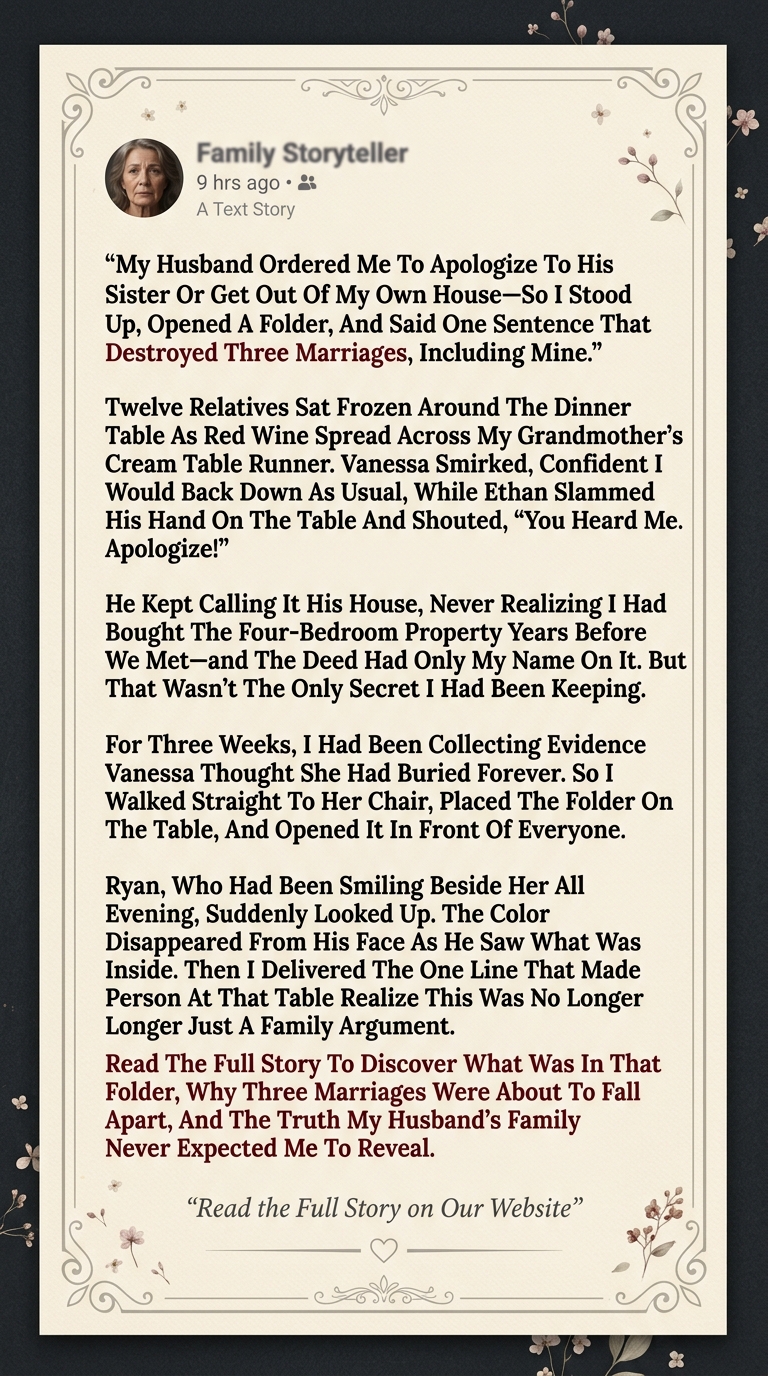
THEY DEMANDED I APOLOGIZE TO MY HUSBAND’S SISTER OR LEAVE MY OWN HOUSE—SO I OPENED A FOLDER THAT ENDED THREE MARRIAGES
The red wine spread across my grandmother’s cream table runner like a wound.
For a moment, nobody moved.
Twelve relatives sat around my dining table, staring at the stain. My sister-in-law, Vanessa, held her empty glass and wore the familiar expression I had come to hate: a little amusement, a little contempt, and the absolute certainty that everyone would take her side.
My husband, Ethan, slammed his palm against the table.
“You heard me, Claire. Apologize to my sister, or get out of my house!”
I looked at him.
Then I looked at the house around us—the four bedrooms, the oak staircase, the kitchen I had renovated, and the garden where I had planted roses with my late grandmother.
His house.
That was what he had called it for the past two years.
I had corrected him before. Quietly, privately, and without embarrassing him in front of his family.
Apparently, he had mistaken my restraint for weakness.
I placed my napkin beside my plate.
“All right,” I said.
Vanessa smiled triumphantly.
Then I stood up, walked to the sideboard, and retrieved the dark-blue folder I had prepared three weeks earlier.
Ethan frowned.
“What are you doing?”
I returned to the table and placed the folder directly in front of Vanessa.
“Before I apologize,” I said, “I think everyone deserves to know why three marriages are about to end tonight—including mine.”
The smile disappeared from Vanessa’s face.
Beside her, her husband, Ryan, slowly turned toward the folder.
He had been laughing with Ethan moments earlier. Now he looked as if someone had just told him the ground beneath his feet was about to collapse.
I opened the folder.
And the first photograph I placed on the table was not of Vanessa.
It was of my husband.
But to understand why that photograph would destroy three marriages, you need to understand how we reached that dinner in the first place.
My name is Claire Bennett. I was thirty-eight years old when I learned that the people sitting around my table had been treating my silence as permission to deceive me.
I bought my house at thirty-one, four years before I met Ethan.
My grandmother had left me a modest inheritance, and I combined it with years of savings from my job as a commercial property analyst. I found a neglected four-bedroom house on a quiet street, negotiated the price, and purchased it in my name alone.
The mortgage was paid off two years before my wedding.
The deed never changed.
When Ethan and I married, we agreed that he would contribute to household expenses while I continued paying the property taxes, insurance, and major maintenance costs. It was a practical arrangement, and at the time, it seemed fair.
Ethan worked in sales management. He was charming, confident, and very good at convincing people that his plans were better than theirs.
Unfortunately, he also had a talent for turning every disagreement into a competition he had to win.
His younger sister, Vanessa, was worse.
She was the sort of person who could insult you while smiling and then accuse you of being oversensitive if you objected.
When Ethan and I became engaged, she told me my wedding dress looked like something purchased during a clearance sale.
When I was promoted, she asked whether my company had finally run out of qualified candidates.
When I hosted family dinners, she criticized the food, the decorations, and the way I arranged the furniture.
Ethan always defended her.
“She doesn’t mean anything by it.”
“You know how Vanessa is.”
“Why do you always have to make everything personal?”
Eventually, I stopped responding.
Not because Vanessa’s words no longer hurt, but because I was tired of fighting battles my husband had already decided I would lose.
That changed six months before the dinner.
It began with a phone call from my friend Natalie, who had been married to Michael for nearly eleven years.
Natalie and I had known each other since university. She was careful with money, fiercely loyal, and the last person I would have suspected of hiding something from her husband.
She called me on a Tuesday afternoon, sounding shaken.
“Claire, I need to ask you something. And I need you to promise you won’t tell anyone until I understand what’s happening.”
I put down my pen.
“What is it?”
“Have you ever heard of a company called Northbridge Consulting?”
The name meant nothing to me.
“No. Why?”
“Michael says he’s investing in it. He told me it’s a business opportunity with two people he knows through work. But I found a bank notification for a transfer I didn’t recognize.”
“How much?”
“Twenty-four thousand dollars.”
I sat up straight.
“Did you ask him about it?”
“He said it was temporary. He said the money would come back within a month.”
“And you believe him?”
Natalie was silent.
That silence frightened me more than any answer.
She explained that Michael had been unusually protective of his phone. He had begun traveling on weekends, claiming that the company needed him to meet prospective partners. He had also started making large cash withdrawals from their joint account.
She had assumed he was under pressure at work.
Then she discovered that one of the supposed business meetings had taken place at a hotel nearly two hundred miles from his office.
“I don’t want to accuse him of something terrible if there’s an innocent explanation,” she said. “But I can’t ignore what I’m seeing.”
I understood that fear.
I also understood that when someone began hiding money, explanations often arrived only after the evidence did.
I advised Natalie to preserve the financial records she already had lawful access to and speak privately with a family-law attorney before confronting Michael. I didn’t investigate him, and I didn’t have access to his accounts.
But I did know how to recognize a financial pattern that didn’t make sense.
And the name Northbridge Consulting kept bothering me.
Two weeks later, Vanessa invited herself over for coffee.
She arrived carrying an expensive handbag and talking about a weekend trip with Ryan.
Then she asked whether I knew anyone who could help her organize a small investment portfolio.
“I’ve been trying to get more serious about money,” she said. “Ryan leaves most of it to me, but I think we need to diversify.”
I asked who managed their investments.
She hesitated.
“Someone Ryan knows. A private consultant.”
“What company?”
Her fingers tightened around her cup.
“Northbridge Consulting.”
I felt a cold sensation move through my stomach.
I didn’t reveal what Natalie had told me.
Instead, I asked a few ordinary questions about the company. Vanessa gave vague answers and quickly changed the subject.
That evening, I searched public business records and found that Northbridge Consulting had been registered less than a year earlier. Its listed business address was a rented mailbox. The company had no meaningful public track record, and the information available did not establish who controlled it.
That alone proved nothing.
Small companies were formed every day.
But the coincidence was troubling enough that I called Natalie and told her what I had learned.
She became very quiet.
“Claire, I think Michael has been lying to me.”
Over the next several weeks, more pieces surfaced.
Natalie discovered that Michael had transferred additional money from their joint savings. He claimed it was for business expenses, but he could not provide a coherent accounting.
A separate conversation with a mutual acquaintance revealed that Michael had been telling people he was close to securing a major investment deal.
Meanwhile, I noticed something strange about Ethan.
He began asking questions about my savings, the house, and whether I had considered adding his name to the property deed.
He had never shown much interest in the paperwork before.
Now he seemed fascinated by it.
One evening, while we were eating dinner, he said, “It would make things easier if the house were in both our names.”
“Easier for what?” I asked.
“For us. We’re married.”
“Marriage doesn’t automatically mean every asset needs to be jointly owned.”
His expression hardened.
“So you don’t trust me?”
“That’s not what I said.”
“You always do this, Claire. You act like you’re the only person who understands money.”
I set down my fork.
“I bought the house before we met. I paid it off before we married. If you have a specific legal or financial reason for changing the deed, we can discuss it with an attorney.”
He pushed his plate away.
“Forget it.”
But I couldn’t forget it.
A few days later, I overheard Ethan talking on the phone in his study.
He was speaking quietly, but the door wasn’t fully closed.
“She’ll come around,” he said. “Claire always backs down eventually.”
There was a pause.
Then he laughed.
“Once it’s sorted, we can move forward.”
When I entered the room, he ended the call immediately.
“Who was that?” I asked.
“A work contact.”
“What are you sorting out?”
“Nothing you need to worry about.”
That answer stayed with me.
I didn’t search his phone. I didn’t break into his accounts or secretly install anything. But I stopped assuming that my husband’s explanations were necessarily true.
I reviewed the household documents I already maintained, made sure my property records were secure, and booked an appointment with a lawyer to understand my rights if my marriage deteriorated.
Then, three weeks before the dinner, Natalie called again.
This time, she was crying.
“I found messages,” she said. “Michael admitted that the money wasn’t invested the way he told me.”
“Did he explain where it went?”
“He said he was helping someone. He won’t tell me who.”
I asked her to preserve the messages she had legitimately received and to avoid making threats or public accusations before getting legal advice.
Then she said something that changed everything.
“Claire, I saw Vanessa’s name.”
My entire body went still.
“What do you mean?”
“One of Michael’s messages mentioned a meeting with Vanessa. He said she knew the arrangement had become complicated.”
“Did he say what arrangement?”
“No. I don’t know whether she’s involved in the money or something else. I only know that her name was there.”
I couldn’t make assumptions based on one message.
But I could no longer dismiss the possibility that the people closest to me were connected to something they were hiding.
Over the following days, I spoke with Natalie and, with her permission, reviewed the messages she had received. I also examined documents I already had legitimate access to, including household financial statements and correspondence Ethan had left in a shared filing cabinet.
What I found was not one neat explanation.
It was a series of contradictions.
Ethan had told me he was working late on nights when his calendar showed no client appointments. Vanessa had claimed she was visiting her mother on a weekend when her husband believed she was attending a charity event. Michael had described Northbridge as a legitimate investment partnership, yet the documents Natalie had found suggested that the money had moved through several accounts without the clear investment records he had promised.
None of those details, by themselves, established every person’s wrongdoing.
But together, they raised questions that none of them seemed willing to answer.
Then I found the photograph.
It was in an envelope among Ethan’s papers, mixed with receipts and old business cards.
The picture showed Ethan and Vanessa seated across from Michael at a restaurant. Vanessa’s hand rested on Ethan’s wrist. His head was bent toward hers, and they were looking at each other with an intimacy I had never seen between siblings.
At first, I thought it might simply be an awkward angle.
Then I noticed the date printed on the back.
It was from a weekend Ethan had told me he was attending a regional sales conference.
The restaurant was in a city more than a hundred miles away.
I placed the photograph back in the envelope and sat at the kitchen table for a long time.
I didn’t want to believe what I was beginning to suspect.
Vanessa was Ethan’s sister. The idea that something more than ordinary family closeness could exist between them was so disturbing that my mind kept searching for another explanation.
I showed the photograph to Natalie.
She stared at it, then covered her mouth.
“I know that restaurant,” she whispered. “Michael told me he was meeting an investor there that weekend.”
That was when I understood why three marriages might be involved.
But I still needed to separate what I knew from what I feared.
Natalie consulted her lawyer. I consulted mine. We agreed not to spread rumors or confront anyone in a way that could put us at risk.
Natalie later obtained additional records through lawful means during her separation process. They included messages between Michael and Vanessa about private meetings and transfers of money. Some messages suggested the two had been involved in a relationship they had concealed from their spouses.
Other records raised questions about whether funds had been moved without the informed consent of the people whose accounts they came from.
The material was serious, but I was not a judge, and I wasn’t going to pretend that every ambiguous transaction proved a crime. I kept copies of the records that had been lawfully shared with me and left the financial questions to the attorneys and, where appropriate, investigators.
Then came the final piece.
My husband had not merely lied about his business trips.
He had been helping Vanessa manage the fallout from her secret relationship with Michael, while persuading me that I was paranoid for asking questions.
And the reason he wanted his name added to my house suddenly looked much less innocent.
My lawyer warned me not to assume that the deed alone settled every possible question about marital property. Local law and the circumstances of a marriage could matter. But the purchase records, payment history, and title gave me a strong starting point for protecting the property I had acquired before meeting Ethan.
I secured the documents and made it clear to my lawyer that I had no intention of signing anything that changed ownership without independent advice.
I also decided that if Ethan or Vanessa tried to humiliate me again, I would no longer protect their secrets merely to preserve appearances.
The opportunity arrived on Easter Sunday.
Vanessa had spilled the wine deliberately—or at least, she had knocked the glass over while gesturing dismissively at me and then refused to help clean it up.
“Honestly, Claire,” she said, watching the red stain spread. “You make everything so uncomfortable. Maybe if you weren’t so controlling, Ethan wouldn’t have to spend so much time away from home.”
I looked at her.
“What does that mean?”
She shrugged.
“Ask your husband.”
Ethan’s jaw tightened.
“Vanessa has done nothing wrong. You’re the one who keeps attacking her.”
“I asked one question.”
“And now you’re going to apologize.”
When I refused, he struck the table with his palm.
“Apologize to my sister or get out of my house!”
The room fell silent.
I looked around the table at the twelve people who had watched him speak to me that way. Some looked uncomfortable. Others seemed eager to see me surrender.
Vanessa leaned back in her chair, certain she had won.
I stood.
“All right,” I said.
Then I retrieved the folder.
Now, with the first photograph lying in front of her, Vanessa’s expression began to change.
Ryan picked it up.
He stared at the image, then turned it over to read the date.
“Where did you get this?” he asked.
His voice was almost unrecognizable.
I didn’t answer immediately.
Instead, I placed a printed copy of several messages beside the photograph. The messages had been provided to me by Natalie, who had obtained them from her own communications and records. I had removed unrelated personal information and kept the relevant material intact for the lawyers to review.
Ryan read the first page.
His face drained of color.
Then he looked at Vanessa.
“Tell me this is fake.”
Vanessa’s lips parted, but no sound came out.
Michael, sitting two chairs away, stood so quickly that his chair scraped against the floor.
“Claire, you have no right to bring private business into a family dinner.”
I turned toward him.
“Your wife has every right to know what happened to the money you took from your joint savings. And Ryan has every right to ask why your messages describe secret meetings with his wife.”
Ryan’s eyes remained fixed on Vanessa.
“What meetings?”
She shook her head.
“It’s not what you think.”
“Then explain it.”
She looked at Ethan.
That was all it took.
Ryan turned toward my husband.
“What does Ethan have to do with this?”
Ethan pushed back his chair.
“This is ridiculous. Claire is twisting everything because she’s jealous of Vanessa.”
I almost laughed.
“Jealous of what, Ethan? The secret meetings? The lies about your business trips? Or the fact that you thought I would sign over part of my house if you shouted loudly enough?”
His face tightened.
“What are you talking about?”
I placed a copy of my property deed on the table.
“This house was purchased in my name before we met. I paid the mortgage before we married. You have repeatedly called it yours, and tonight you threatened to throw me out of it. You don’t get to rewrite the facts because you’re angry.”
His father, who had remained silent until then, picked up the document.
“Ethan, is this true?”
Ethan stared at the deed.
“It doesn’t mean she can just throw me out.”
“That is a legal question for the lawyers,” I replied. “I haven’t claimed otherwise. But you will not bully me into signing over my property, and you will not use this house as a threat against me.”
Vanessa suddenly began crying.
“You’re ruining everything!”
“No,” I said. “I’m stopping the lies from being hidden behind family loyalty.”
Then I delivered the sentence I had been holding back for three weeks.
“The evidence shows that Vanessa and Michael concealed a relationship from their spouses, that money was moved under explanations Natalie says were false, and that Ethan helped keep the secrets while trying to make me believe I was the problem. If any of you want to deny it, do so with the documents in front of you—and be prepared to explain them to your spouses and your lawyers.”
The room seemed to lose its air.
Ryan sat down slowly.
Natalie’s husband, Michael, looked toward the front door, as if he were calculating how quickly he could leave.
Ethan stared at me with a mixture of fury and fear.
“You planned this,” he whispered.
“Yes,” I replied. “I planned to stop being lied to.”
“You could have talked to me privately.”
“I did. You called me paranoid. You demanded that I apologize to Vanessa. You told me to leave my own home. You had every opportunity to tell the truth before tonight.”
He opened his mouth, then closed it again.
Ryan turned toward Vanessa.
“How long?”
She began sobbing.
“I never wanted to hurt you.”
“How long?” he repeated.
She stared at the table.
“Almost a year.”
Ryan shut his eyes.
For a moment, he looked as if he might collapse. He had been married to Vanessa for nine years. He had defended her against criticism, supported her career changes, and believed her explanations when she traveled without him.
He stood, took off his wedding ring, and placed it beside her plate.
“I need you to leave me alone until I decide what happens next.”
Vanessa reached for him.
“Ryan, please.”
He stepped away.
Michael’s wife was not at the table that evening. Natalie had already separated from him and was staying with her sister while her attorney worked through their finances. She had not come because she didn’t want to be surrounded by people who had ignored her concerns.
When Michael tried to defend himself, Ryan turned on him.
“You sat in my house. You ate at my table. You shook my hand while you were sleeping with my wife?”
Michael looked down.
“I made a mistake.”
Ryan’s laugh was short and bitter.
“A mistake is forgetting a birthday. This was a choice you kept making.”
Then Ryan walked out.
Vanessa remained in her chair, crying into her hands.
But the evening was not over.
Ethan approached me, lowering his voice as if privacy could still protect him.
“You’ve made your point. Now close that folder and tell everyone this was a misunderstanding.”
I looked at him for a long moment.
“Do you love me?”
His face changed.
“Of course I do.”
“Then tell me the truth about the photograph.”
He glanced toward his sister.
“I was helping her.”
“Helping her do what?”
He said nothing.
I felt something inside me finally settle—not because I had received an answer, but because I no longer needed to invent one for him.
“I want you to leave tonight,” I said. “We can communicate through our lawyers about the next steps.”
His expression hardened.
“You can’t kick me out. I’m your husband.”
“I know. That’s why I’ll follow the proper legal process rather than make threats at a dinner table.”
I turned to the relatives who were still seated.
“I’m sorry you had to witness this. But I will not apologize for refusing to be humiliated in my own home.”
No one laughed.
Ethan collected his jacket and left with his parents. Vanessa followed several minutes later, carrying her handbag in one hand and her ruined confidence in the other.
Michael stayed behind long enough to ask whether he could speak to me.
“No,” I said. “You need to speak to your wife.”
He left without another word.
After the door closed, I stood alone in the dining room.
The wine had soaked into the table runner. The plates were scattered, the food was cold, and one of the chairs had been knocked sideways.
I expected to feel victorious.
Instead, I felt exhausted.
I took the stained runner to the laundry room and placed it in the sink. It had belonged to my grandmother, who used to tell me that a beautiful table was meaningless if the people around it treated one another cruelly.
I scrubbed the stain for several minutes before realizing I was crying.
Not for Vanessa. Not for Michael. Not even for Ethan.
I was grieving the marriage I had believed I had.
The following morning, I called my lawyer and explained what had happened. We discussed separation, the property, and how to protect my financial records. I did not change the locks or dispose of Ethan’s belongings. I followed the advice I received and allowed the legal process to determine the appropriate arrangements.
Ethan sent me a dozen messages over the next two days.
At first, he accused me of destroying his family.
Then he blamed Vanessa.
Then he apologized and promised that everything could be fixed if I would only meet him alone.
I replied once.
“I am willing to communicate through our lawyers. I am not willing to return to a marriage built on intimidation and dishonesty.”
After that, I stopped responding to emotional messages.
Meanwhile, the consequences spread beyond our household.
Ryan consulted a divorce attorney. Vanessa moved into a rented apartment and began trying to negotiate a separation. Their marriage had not collapsed because of one photograph; it had been damaged by months of deception that the photograph helped expose.
Natalie proceeded with her own separation from Michael. Her lawyer reviewed the financial records, and an independent accountant helped trace transfers from the couple’s joint funds. Some transactions remained disputed, and the parties had to determine through formal financial disclosure which expenses had been authorized and which had not.
Northbridge Consulting came under scrutiny after questions arose about its transactions and representations. I did not follow every detail, and I made no public accusations. I knew only that the people involved could no longer rely on secrecy to avoid answering legitimate questions.
As for Ethan and me, our marriage ended through a difficult but orderly separation process.
The house remained titled in my name. Its legal treatment was reviewed according to the applicable law and our circumstances, rather than decided by whoever shouted loudest at dinner.
Ethan moved into an apartment. We divided the other matters through counsel, and I made sure that all agreements were documented properly.
Months later, Vanessa asked to meet me.
I agreed to a brief conversation in a public café.
She looked tired. The expensive handbag was gone, replaced by a plain leather purse. She stirred her coffee without drinking it.
“I used to think you were trying to make me look bad,” she said.
“I was trying to understand why you kept hurting me.”
She nodded.
“I know that now.”
She told me Ryan had filed for divorce. Michael’s marriage was ending, too. She admitted that she had enjoyed being the person Ethan defended, even when he was wrong. She had convinced herself that because he always took her side, she could say whatever she wanted to me without consequences.
“I thought you’d always back down,” she said.
“I did back down,” I answered. “For too long.”
She wiped her eyes.
“Do you hate me?”
I considered the question.
“I don’t want to spend my life hating you. But I won’t pretend we’re close, and I won’t protect you from the consequences of your choices.”
She accepted that without arguing.
It was the first honest conversation we had ever shared.
I did not know whether Vanessa would become a better person. That was no longer my responsibility.
By the following spring, the three marriages had reached different endings.
Ryan and Vanessa’s divorce was finalized after they settled their financial and property issues. Natalie and Michael reached a separate agreement after their lawyers completed the financial review. Ethan and I finalized our divorce after months of negotiations.
There were no dramatic courtroom speeches. No public confessions. No magical moment when every person admitted every wrong.
There were documents, difficult conversations, financial consequences, and days when I wondered whether the truth had cost more than I could bear.
But there was also peace.
I repainted the dining room, replaced the stained table runner with a simple blue one, and invited a few close friends over for dinner. We laughed without anyone having to be the target. We disagreed without turning it into a battle. And when someone made a mistake, we talked about it instead of using family loyalty as a shield.
One evening, while putting away the plates, I found the dark-blue folder in the sideboard.
I opened it one last time.
The photograph was still there. So were the messages, the property deed, and the notes I had made while preparing for the legal consultations.
I considered throwing everything away.
Instead, I placed the folder in a locked cabinet with the other documents related to my divorce. It wasn’t a trophy. It was a record of what had happened, preserved in case I ever needed it.
Then I closed the cabinet and turned off the light.
For months, I had believed the most important thing I needed to prove was that the house belonged to me.
I was wrong.
The house mattered because it represented the life I had built before Ethan ever entered it. But the real victory was realizing that I did not have to surrender my dignity to keep a marriage, maintain a family gathering, or protect the reputation of people who had lied to me.
Ethan had ordered me to apologize because he thought I was too afraid to lose him.
Vanessa had laughed because she believed I would always remain silent.
They were both wrong.
I didn’t destroy three marriages by opening a folder. Their own choices had done that long before Easter dinner.
I simply stopped pretending I couldn’t see what was in front of me.
And when the truth finally reached the table, I was no longer the woman waiting for permission to speak.
I was the woman who knew she could stand up, tell the truth, and walk away.