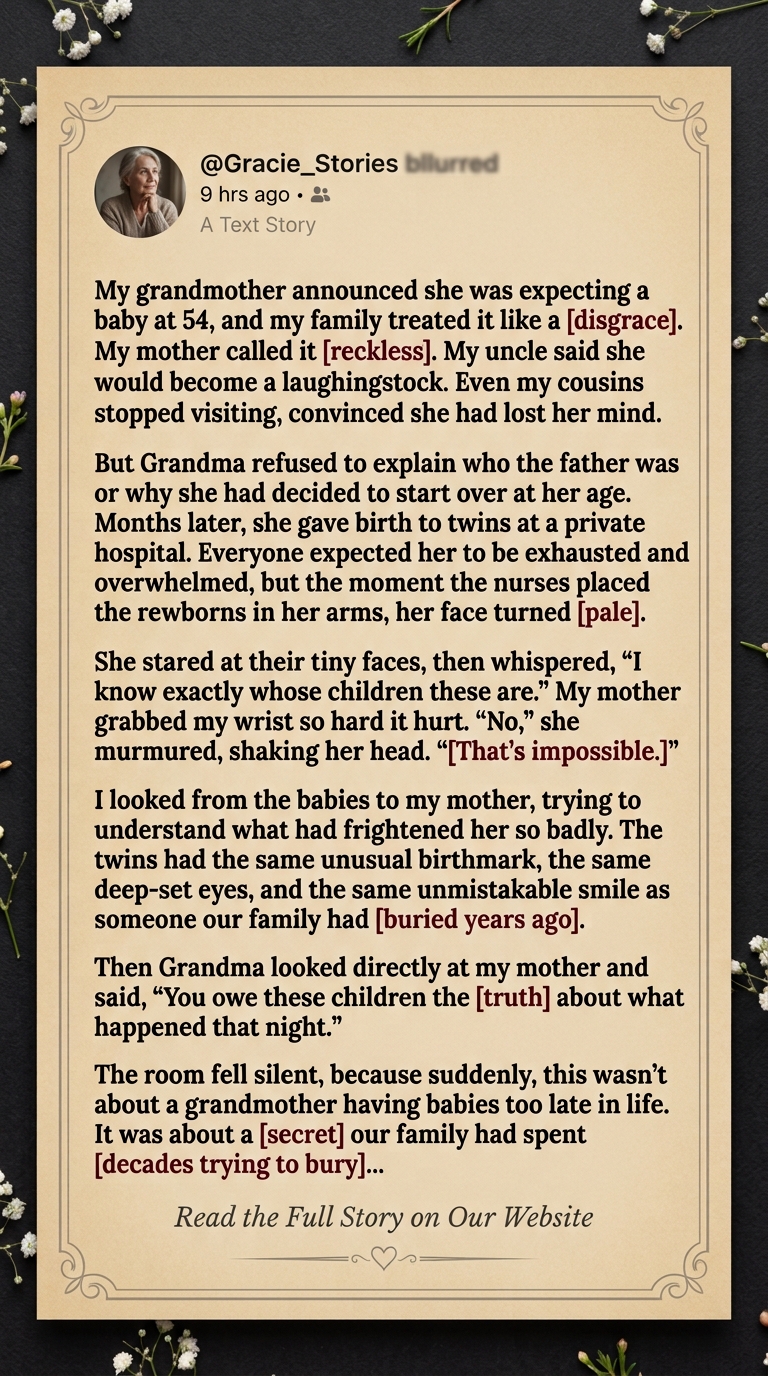
MY GRANDMOTHER HAD TWINS AT 54—THEN SHE REVEALED THE SECRET OUR FAMILY HAD BURIED FOR 29 YEARS
The first person to call my grandmother selfish was her own daughter.
“You’re fifty-four, Mother,” my mother, Elaine, said, standing in the middle of Grandma Margaret’s kitchen. “People your age are becoming grandparents. They aren’t starting over with newborns.”
Grandma sat at the table with both hands wrapped around a cup of tea. She looked tired, but she didn’t look ashamed.
“I’m not asking anyone’s permission to have this baby,” she replied.
My uncle Richard laughed from the doorway.
“A baby? At your age? What are you going to do when that child starts school? People will think you’ve lost your mind.”
My cousins stopped visiting. Neighbors whispered. Even some of Grandma’s closest friends began avoiding her, afraid that her decision would become the subject of gossip.
Nobody knew who the father was.
Grandma refused to answer every question.
“I will explain when the time is right,” she said.
My name is Sophie, and I was twenty-seven then. Grandma had practically raised me whenever my mother was working, and I knew her better than anyone else in the family.
She was not reckless. She was not confused. And she was certainly not a woman who made life-changing decisions without understanding the consequences.
That was why her silence frightened me.
One evening, I visited her and found her folding tiny yellow baby clothes on the sofa.
“Grandma, can you at least tell me who the father is?”
She stopped folding.
For several seconds, she stared at a little shirt in her hands.
“The father is someone who should have been part of this family a long time ago,” she finally said.
“Is he married?”
“No.”
“Does he know about the babies?”
Her eyes filled with tears.
“He knows.”
I sat beside her.
“Then why won’t you tell everyone?”
“Because some truths don’t just hurt the people who hear them. They expose the people who spent their whole lives making sure nobody would hear them at all.”
I wanted to ask more, but she shook her head.
“Please trust me, Sophie. When the babies arrive, everything will make sense.”
I left that evening more confused than before.
Three months later, Grandma went into labor.
Because her pregnancy was considered high-risk, her obstetric team had arranged for her to deliver at a private hospital with specialist care available. My mother insisted on coming, although she spent most of the drive criticizing Grandma’s decision.
“I hope she understands what she’s done to this family,” she muttered.
I said nothing.
When we arrived, Grandma was already in the delivery room. I waited with my mother and uncle in the corridor, listening to the distant sounds of nurses moving between rooms.
Then a doctor appeared.
“Mrs. Margaret has delivered two healthy babies,” she announced. “Both are being examined, and your mother is stable.”
My mother closed her eyes in relief.
“Twins?” Uncle Richard exclaimed. “Good Lord.”
A nurse invited us into the room once the initial checks were complete.
Grandma lay against the pillows, exhausted but smiling. Two tiny newborns rested beside her, wrapped in white blankets.
For the first time in months, she looked completely at peace.
Then the nurse gently placed the babies in her arms.
Grandma looked at the little girl first.
Her smile faded.
She studied the baby’s deep-set eyes, the shape of her nose, and a small crescent-shaped birthmark just beneath her left ear.
Then she looked at the boy.
He had the same birthmark in the same place. His eyes were just as deep-set, and when he opened his mouth in a sleepy little smile, something changed in Grandma’s face.
Her hands began to tremble.
“Oh,” she whispered.
The nurse asked if she was feeling unwell.
Grandma shook her head.
“No. No, I’m fine.”
She stared at the babies again.
Then she said, barely louder than a breath, “I know exactly whose children these are.”
My mother grabbed my wrist so hard that I gasped.
“No,” she whispered. “That’s impossible.”
I turned toward her.
“Mom? What are you talking about?”
Her face had gone completely white.
Grandma lifted her eyes.
“Elaine,” she said, “you owe these children the truth about what happened that night.”
The room fell silent.
Uncle Richard stepped backward as if the words themselves had struck him.
My mother began shaking her head.
“Mother, please. Not here.”
“Where, then?” Grandma asked. “At another funeral? At another family gathering where everyone pretends nothing happened?”
I looked from my mother to the babies.
“Who are they?” I demanded. “Whose children are they?”
Grandma took a deep breath.
“Their father is your uncle Daniel.”
I stared at her.
Daniel had been dead for twenty-nine years.
He was my mother’s younger brother, the golden child of the family, the young man everyone said would have become a brilliant surgeon. He had died when he was twenty-three, after a car accident on a rainy road.
I had been too young to remember him.
But his photograph had always stood on Grandma’s mantelpiece.
He was smiling in it, with dark eyes, thick hair, and a small crescent-shaped birthmark beneath his left ear.
The same mark the babies carried.
“That can’t be true,” I whispered.
My mother covered her mouth.
Grandma looked at her daughter with an expression that held both sorrow and anger.
“Tell her, Elaine.”
My mother shook her head harder.
“Daniel is dead.”
“Yes,” Grandma replied. “But the truth about him isn’t.”
I felt as though the floor had shifted beneath me.
“Grandma, how can Daniel be their father if he died almost thirty years ago?”
Grandma looked down at the twins.
“Because these babies were conceived using embryos Daniel and his fiancée preserved before his accident. And because I carried them after years of believing I would never have the chance to bring them into the world.”
My mother made a broken sound.
I turned to her.
“You knew?”
She didn’t answer.
“Mom, you knew?”
Finally, she sat down in the chair beside the bed and began to cry.
And then, for the first time in my life, my mother told me the story of the night that had divided our family.
Twenty-nine years earlier, Daniel had been engaged to a woman named Anna Mercer.
Anna was twenty-two, studying architecture, and deeply in love with him. They had met during their final years at university and planned to marry the following summer.
Grandma adored Anna.
My grandfather, however, had been less enthusiastic. He believed Daniel should marry into a family with money and connections. He considered Anna’s background ordinary and her ambitions impractical.
Daniel ignored him.
He and Anna became engaged anyway.
When Anna learned that Daniel had a hereditary heart condition that might complicate his future plans, they consulted specialists. The doctors explained the available reproductive options, including the possibility of preserving embryos created with their consent before his condition worsened.
Daniel and Anna decided to preserve several embryos.
They hoped to use them after their wedding, once they had settled into their careers.
They kept the arrangements private because they didn’t want every family disagreement to become a discussion about their medical choices.
Then came the night of the accident.
Daniel was driving home from a late hospital shift when his car skidded on a rain-slicked road. He suffered catastrophic injuries and died before he reached the hospital.
Anna was devastated.
She had lost the man she intended to marry and the future they had planned together.
But the family tragedy did not end there.
According to my mother, Anna had been driving behind Daniel that night. She saw the accident happen and ran toward the wreckage.
She called emergency services, but she was hysterical and could barely speak.
By the time help arrived, Daniel was unconscious.
Anna blamed herself, even though the accident investigators found no evidence that she had caused the crash.
My grandfather blamed her anyway.
He told everyone that Daniel had been distracted because of his relationship with Anna. He accused her of bringing chaos into his son’s life and ordered her never to contact the family again.
Grandma fought him.
She knew Anna was innocent.
But my mother, who was twenty-five at the time, made a choice that she would regret for the rest of her life.
She sided with her father.
“Anna was always around him,” my mother whispered in the hospital room. “Father said she was a distraction. He said Daniel would still be alive if he had never met her.”
“That wasn’t true,” I said.
“I know that now.”
“No,” Grandma interrupted. “You knew it then, too. You simply wanted to believe your father because it was easier than admitting he was cruel.”
My mother bowed her head.
After Daniel’s funeral, Anna discovered she was pregnant.
She had not yet completed the medical process required to use the preserved embryos, and she had not been pregnant at the time of the accident. Instead, she had already been undergoing fertility treatment because of concerns about Daniel’s condition and the possibility that their future options might become more limited.
The family had never been told the full details.
When Anna approached my grandparents with the news, my grandfather accused her of lying to keep herself connected to the family.
He threatened to challenge her publicly and demanded that she produce medical evidence.
Anna, already grieving, was terrified.
Grandma eventually persuaded her to meet privately with a specialist. The pregnancy was confirmed, and Anna received medical care.
But the stress, the family conflict, and the complicated pregnancy took a severe toll.
She lost the baby in her second trimester.
The grief nearly destroyed her.
A few months later, Anna left the city.
My grandfather told everyone she had moved on and that the family should never speak of her again.
Grandma never believed that was the end of the story.
She kept writing to Anna, but her letters went unanswered.
Years passed.
My grandfather died. Grandma grew older. My mother married and had me. The family carried on as though Daniel had been a tragic chapter that no one was allowed to reopen.
Then, when Grandma was fifty-two, she received a letter from a fertility clinic.
The clinic was contacting former patients and authorized parties regarding the long-term storage of preserved embryos. Daniel and Anna’s records had remained in the clinic’s files, subject to the original consent documents and the clinic’s applicable procedures.
Anna had updated her contact information years earlier.
Through the clinic, Grandma learned that Anna had never married and had never had children. She had built a quiet life elsewhere, but she had not forgotten Daniel.
She had also left instructions allowing the remaining embryos to be considered for transfer under the conditions she had agreed to with Daniel before his death.
Grandma contacted Anna.
Their first conversation lasted nearly two hours.
Anna told her that she had never stopped loving Daniel. She had never stopped thinking about the children they had hoped to have.
But she was no longer medically able to carry a pregnancy herself.
Grandma, who had long wanted another child after losing my grandfather, began to wonder whether she could carry the embryos herself.
The idea sounded impossible to everyone else.
She was fifty-two, and pregnancy at her age carried significant risks. She needed specialist assessments, extensive counseling, and a careful review of the legal and medical questions involved.
She did not rush into it.
For more than a year, she met with doctors and counselors. She spoke with Anna, consulted a lawyer, and considered what would happen if the pregnancy became complicated or if she were unable to care for the children.
Only after the specialists explained the risks and the clinic confirmed the necessary consent arrangements did she proceed.
The embryos were transferred through assisted reproduction.
The pregnancy was difficult. Grandma experienced high blood pressure and needed frequent monitoring. She spent weeks under medical supervision and knew that carrying twins at her age was far from ordinary.
But she continued because she had made her decision with open eyes.
She was not trying to replace Daniel.
She was not trying to erase the past.
She wanted to give the children he and Anna had hoped for a chance at life.
And she wanted to fulfill a promise she had made to her son before he died.
My mother stared at the blankets in Grandma’s arms.
“Why didn’t you tell us?” she asked.
Grandma’s expression hardened.
“Because when I tried to tell you the truth about Anna, you helped your father silence her. When I asked you to reconsider, you told me the family needed to move forward.”
“I was young.”
“You were old enough to know right from wrong.”
My mother began to cry harder.
Grandma continued.
“I kept this private because I would not allow you or Richard to turn these babies into another argument about reputation. I wanted them born safely before I let anyone’s judgment near them.”
Uncle Richard, who had remained silent, finally spoke.
“Mother, this is insane. You have brought Daniel’s children into the world nearly thirty years after he died. How are we supposed to explain this to anyone?”
Grandma looked at him with cold clarity.
“You are not required to explain my life to anyone.”
“But people will ask questions.”
“Then tell them the truth.”
He shook his head.
“What about the family name?”
Grandma laughed once, without humor.
“Your father spent his life protecting the family name. And what did it protect? A lie that cost Anna her place in this family and cost Daniel’s children decades they can never recover.”
My mother covered her face.
Then she said the words that finally explained her reaction to the birthmarks.
“I knew about the embryos.”
I turned toward her.
“What?”
“After Daniel died, Father found the clinic paperwork among his things. He told me Anna had no right to keep the embryos or make decisions about them. He wanted everything destroyed.”
Grandma’s face tightened.
“Your father had no authority to make that decision alone.”
“I know,” my mother whispered. “But I helped him contact the clinic. I told them Anna was no longer part of the family and that Daniel would never have wanted this.”
The room went utterly still.
Grandma looked devastated.
“You did what?”
“I thought I was protecting you. Father said Anna was trying to manipulate us. He said the embryos would keep her tied to Daniel forever.”
“And you believed him?”
My mother shook her head.
“Not completely. But I was afraid to challenge him. I was afraid of losing my place in the family.”
“You helped him interfere with something that was not yours to control,” Grandma said. “You took your brother’s future and Anna’s choices and treated them as family property.”
My mother had no defense.
For years, I had thought her silence about Daniel was simply grief.
Now I understood that she had been guarding a secret she could never bear to face.
Grandma shifted the twins carefully in her arms.
“Anna gave the necessary consent under the arrangements that were eventually reviewed and approved. The clinic confirmed that the transfer was permitted. These children were wanted, planned for, and loved before they were even conceived.”
She looked directly at my mother.
“But there is something else you need to know.”
My mother lifted her head.
“Anna is alive,” Grandma said. “She knows the babies have been born. And she is coming tomorrow.”
My mother looked as if she had stopped breathing.
Anna had not been the father of the children, of course. She was their biological mother, and Daniel was their biological father. Grandma had carried the pregnancy and given birth to the twins, making her their gestational and birth mother as well as their grandmother.
The arrangement was unusual, and the family relationships were complicated. But the medical records and consent documents made the facts clear.
Grandma had carried the children for Anna and Daniel, with the understanding that she would raise them as her own while ensuring they remained connected to the family history they had inherited.
Anna had agreed because she could not carry a pregnancy herself, but she did not want the children to grow up believing that Daniel had been forgotten or that their existence was shameful.
The twins were named Daniel James and Anna Rose.
When Anna arrived the following afternoon, I was waiting in Grandma’s hospital room.
She was in her early fifties, with silver beginning to show in her dark hair. She wore a plain coat and held a small gift bag in both hands.
For several seconds, she stood in the doorway, unable to speak.
Grandma held the twins close.
“Come in, Anna.”
Anna stepped forward slowly.
She looked at the babies, and tears ran down her cheeks.
“Oh, Daniel,” she whispered. “Look what we made.”
She didn’t try to take them from Grandma. Instead, she sat beside the bed and touched the baby’s tiny hand with one finger.
The boy wrapped his fingers around hers.
Anna broke down.
“I thought I had lost everything,” she said. “I thought there would never be any part of him left in the world.”
Grandma reached for her hand.
“You never lost him completely.”
I watched them together and understood that the story was not simply about a woman having children at fifty-four.
It was about two people who had lost the future they imagined, a mother who refused to let a cruel family decision erase that future entirely, and a daughter who had spent decades mistaking silence for loyalty.
My mother arrived that afternoon, too.
She stood near the door, looking at Anna.
“I don’t expect you to forgive me,” she said.
Anna’s expression was guarded.
“You helped them shut me out. You knew I was telling the truth about Daniel, and you still let your father treat me like I was responsible for his death.”
“I was wrong.”
“Yes,” Anna replied. “You were.”
My mother began to cry.
“I can’t change what happened. I can’t give you those years back.”
“No, you can’t.”
Anna looked down at the twins.
“But you can stop lying about them. You can tell the family who they are. And you can make sure they never grow up thinking they were born from a disgrace.”
My mother nodded.
“I will.”
It wasn’t forgiveness.
Not yet.
It was the first honest promise she had made in decades.
The next few months were difficult. The twins needed regular pediatric appointments, and Grandma had to recover from the physical strain of pregnancy and childbirth. She had help from a postpartum nurse, a trusted caregiver, and Anna, who visited regularly and gradually became part of the children’s lives in a way that honored the original plan.
The family did not transform overnight.
Uncle Richard refused to visit for several weeks. Some cousins whispered that Grandma had gone too far. One relative even suggested that the twins should be kept away from public gatherings until people had stopped talking.
Grandma refused.
“They are not a scandal to be hidden,” she said. “They are children.”
When the family eventually gathered at her home, she introduced the twins without apology.
“This is Daniel James, and this is Anna Rose,” she announced. “They are my children, and they are Daniel’s children. They were wanted before they were born, and they will never be made to feel ashamed of existing.”
No one dared laugh.
My mother stood beside the fireplace, her eyes red. When it was her turn to speak, she did not offer excuses.
“I helped keep the truth from this family,” she said. “I allowed fear and my father’s demands to decide what was right. Anna deserved better. Daniel deserved better. And these children deserve a family that tells them the truth.”
She turned toward Grandma.
“I am sorry.”
Grandma studied her daughter for a long time.
“I love you, Elaine,” she said. “But love does not erase responsibility. You will have to show me, and Anna, that you understand what you did.”
My mother nodded.
“I will.”
Over time, she began to do exactly that. She visited the twins, helped with practical tasks when asked, and learned to speak about Daniel without repeating the old accusations. She also began therapy to work through the fear and shame that had shaped her decisions.
Anna never returned to being the young woman she had been before Daniel’s death. No one could give her those years back.
But she found a place in the children’s lives. She brought them photographs of their father, told them stories about his terrible singing and his habit of buying too many books, and made sure they grew up knowing that he had been more than a face in an old frame.
Grandma, meanwhile, settled into motherhood with a determination that astonished everyone who had doubted her. She was tired, sometimes overwhelmed, and occasionally needed more help than she wanted to admit. But she was not alone, and she did not pretend that love made every challenge disappear.
When the twins turned one, our family gathered for a small birthday celebration.
Grandma sat between the two high chairs, laughing as Daniel James smeared cake across his face. Anna Rose reached for the ribbon on her grandmother’s blouse.
My mother stood nearby, watching them with tears in her eyes.
I sat beside Anna.
“Do you ever wish things had happened differently?” I asked.
She looked at the twins.
“Every day,” she said. “I wish Daniel had lived. I wish your grandfather had been kinder. I wish your mother had stood up for me. I wish I could have carried these children myself.”
She paused and smiled sadly.
“But wishing doesn’t change what happened. I can only decide what I do with the time I have left.”
Across the room, Grandma lifted Daniel James into her arms.
For years, the family had treated her decision as a disgrace because they could not understand why a woman in her fifties would choose to begin again.
Now I understood.
Grandma had not been trying to prove that age did not matter, or that pregnancy was easy, or that the past could be repaired by bringing two babies into the world.
She had made a difficult, carefully considered choice because she believed the children deserved a chance to live—and because she refused to let a lie be the final word in her son’s story.
The secret our family had buried for twenty-nine years was not that Daniel had left behind children.
It was that fear had persuaded the people who loved him to betray the very future he and Anna had planned.
And the greatest shame was never Grandma’s age.
It was the years we had spent protecting our pride instead of telling the truth.