The Wedding Contract That Exposed My Sister’s Betrayal
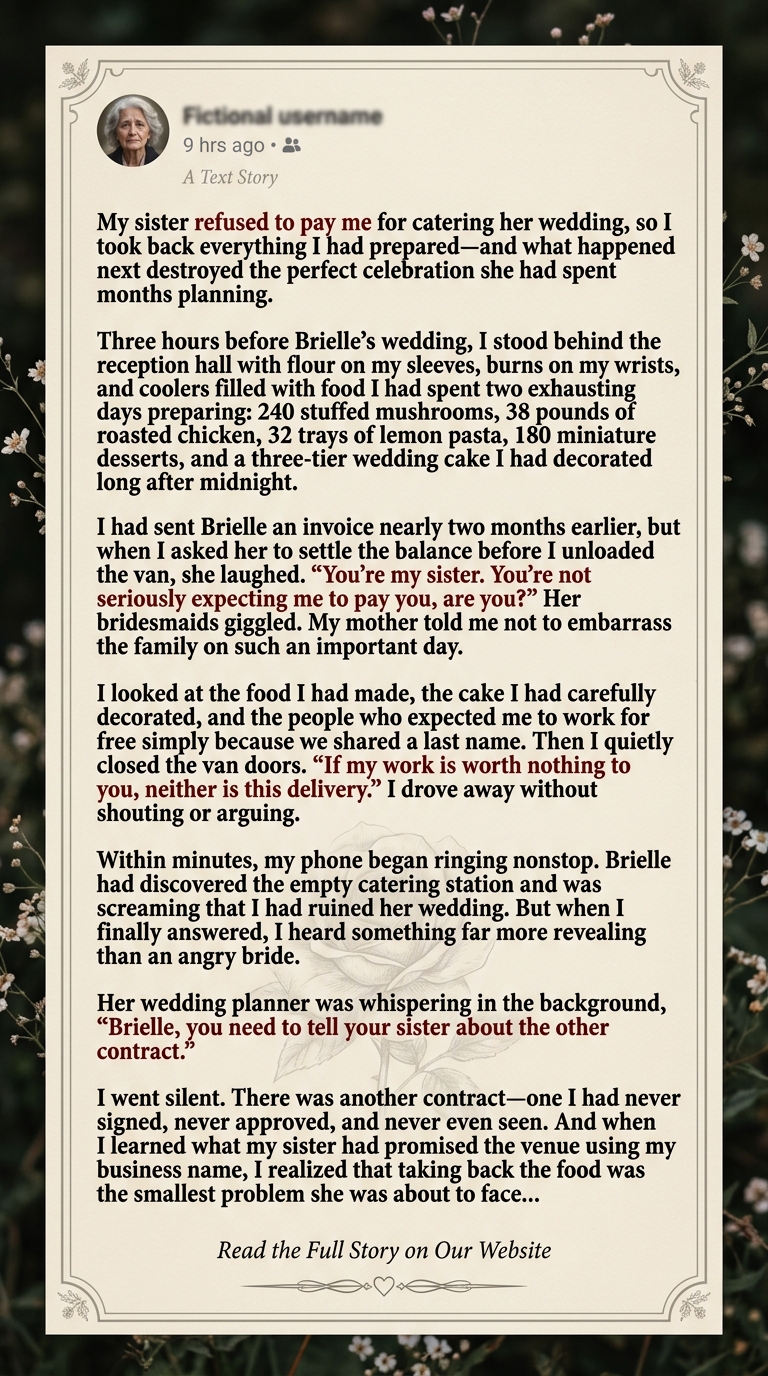
Three hours before my sister’s wedding, I stood behind the reception hall with flour on my sleeves, burns on my wrists, and two days of exhausting work packed inside my catering van.
I had prepared 240 stuffed mushrooms, 38 pounds of roasted chicken, 32 trays of lemon pasta, 180 miniature desserts, and a three-tier wedding cake decorated with sugar flowers I had finished long after midnight.
Every dish had been prepared with care. Every ingredient had been purchased with my own money. I had even paid two temporary assistants out of my business account because Brielle had promised to settle the remaining balance before delivery.
I had sent her the invoice nearly two months earlier.
When I asked her to pay before I unloaded the van, she stared at me as though I had insulted her.
“You’re my sister,” she said. “You’re not seriously expecting me to pay you, are you?”
Her bridesmaids giggled.
My mother adjusted her necklace and sighed. “Please, not today. Brielle has enough stress. You can discuss money after the wedding.”
I looked at my sister.
“We agreed on the price. You approved the menu. I paid for the ingredients, the supplies, and the staff. I can’t keep covering everything myself.”
Brielle folded her arms.
“You own a catering business. You can afford it. Besides, think of the publicity you’re getting by catering your own sister’s wedding.”
“Publicity doesn’t pay my suppliers.”
“Oh, stop acting like a stranger. Family helps family.”
I glanced through the open reception doors. White roses decorated the tables, crystal glasses glittered beneath the chandeliers, and a string quartet was preparing to welcome the guests.
Brielle had spent months planning a wedding that looked as though it belonged in a luxury magazine.
Apparently, the only person’s work she had decided was worthless was the work that made the entire reception possible.
My mother stepped closer.
“Your sister will remember this day forever. Do you really want money to be the reason you ruin it?”
I looked at the coolers, the carefully packed trays, and the cake I had spent hours decorating.
Then I closed the van doors.
“If my work is worth nothing to you, neither is this delivery.”
Brielle’s smile vanished.
“You wouldn’t dare!”
I climbed into the driver’s seat.
My mother hurried toward me, waving her hands. “Don’t you dare leave!”
I started the engine.
Brielle shouted something I couldn’t hear through the closed window. Her bridesmaids stood frozen beside the entrance as I pulled away.
I didn’t throw the food onto the pavement. I didn’t damage the cake or scream at the guests. I simply took back the food I owned and had not delivered.
Within minutes, my phone began ringing nonstop.
Brielle called repeatedly. My mother left a furious voicemail. Then an unfamiliar number appeared on my screen.
I answered.
“Hello?”
A woman’s voice sounded strained.
“This is Natalie, Brielle’s wedding planner. Please tell me you’ve left the venue.”
“I have. Why?”
There was a pause.
Then I heard Brielle shouting in the background.
Natalie lowered her voice.
“Brielle, you need to tell your sister about the other contract.”
My stomach tightened.
“What other contract?”
Silence.
“I’m sorry,” Natalie said. “I thought you knew. The venue has a separate catering agreement under your company’s name. It includes additional service staff, late-night food, and a guarantee that your company would cover replacement catering if the original arrangements failed.”
I pulled into an empty parking lot.
“I never signed a separate agreement.”
Natalie sounded genuinely alarmed.
“Then you need to speak with your attorney. The venue believes your company accepted those obligations.”
My hands tightened around the steering wheel.
“Send me a copy of everything you have.”
Within minutes, an email arrived.
I opened the attachment and read the first page.
My business name was printed across the top. My address was correct. The wedding date was correct.
At the bottom was a signature that looked almost exactly like mine.
Almost.
Someone had copied my signature from an old catering proposal and placed it on a document I had never seen.
The contract also contained a clause committing my company to provide emergency catering if the scheduled service failed. The potential cost was far greater than Brielle’s original order.
I read the document again, feeling the blood drain from my face.
My sister hadn’t merely expected free food.
She had used my business name to make promises she had no authority to make.
And if the venue believed the agreement was genuine, my company could face a serious financial dispute.
I immediately forwarded the document to my attorney, along with the original estimate, Brielle’s approval messages, the unpaid invoice, and the correspondence about the delivery.
Then I called my sister.
She answered immediately.
“What have you done?” she screamed. “The food is gone! The guests are arriving! You have ruined my wedding!”
“No, Brielle. I withdrew an unpaid delivery. Now explain why there’s a contract with my signature that I never signed.”
“It’s just paperwork!”
“It’s a contract in my company’s name.”
“You agreed to cater the wedding!”
“I agreed to provide the menu we discussed. I did not agree to the additional package, and I never signed that document.”
“I was trying to make everything work!”
“By signing my name?”
“I knew you’d help me!”
Her answer silenced me.
She didn’t say she had made a mistake. She didn’t say someone had forged the document without her knowledge.
She said she knew I would help.
“You need to tell the venue that I did not authorize this contract,” I said. “My attorney will contact them.”
“You can’t do this to me on my wedding day!”
“You should have thought about that before using my business without permission.”
I ended the call.
For several minutes, I sat motionless in my van.
I had built my catering company over three years, taking small events whenever I could and reinvesting almost every dollar I earned. My business supported my employees, paid my suppliers, and provided the income I depended on.
One unauthorized document could threaten everything I had worked for.
I called my attorney.
She told me to preserve every message and document, avoid making public accusations, and not sign or acknowledge any part of the disputed contract. She would contact the venue’s legal representative and formally dispute the signature and the additional obligations.
She also explained that the legal effect of the document would depend on the evidence and the applicable law.
That was enough.
I wasn’t going to solve this by shouting louder than Brielle.
I was going to protect my business with facts.
Meanwhile, the wedding reception was descending into chaos.
The catering station stood empty. The venue’s kitchen staff had expected the food to arrive with my van, and no independent replacement service had been arranged because Brielle’s paperwork indicated that my company had accepted responsibility.
When the venue manager learned that I disputed the contract, he contacted the venue’s legal team and began looking for an emergency solution.
Brielle insisted that the venue provide food immediately.
The manager explained that the venue had never agreed to replace the entire catering package at its own expense.
My mother began calling local restaurants, but it was already too late to reproduce the elaborate menu.
Natalie worked frantically to find a replacement supplier. A nearby restaurant agreed to provide a simplified meal, but it could not recreate the dishes, desserts, and presentation I had prepared.
The guests eventually received food, but the reception no longer resembled the flawless celebration Brielle had planned.
The cake table remained empty.
The late-night dessert station never opened.
Staff hurried between tables while the wedding planner tried to coordinate an event that had suddenly become much more complicated.
Brielle blamed me in front of anyone willing to listen.
She told relatives that I had abandoned her over money.
She did not mention the unpaid invoice.
She did not mention the contract.
And she certainly did not tell anyone that the document bearing my signature had never been approved by me.
Then one of her bridesmaids asked a question that changed the atmosphere.
“Wait. Didn’t you tell us your sister was giving you the catering as a wedding gift?”
Brielle froze.
The bridesmaid continued.
“You said she offered to cover everything because she wanted your day to be special.”
Several guests turned toward her.
My mother tried to interrupt.
“Let’s not discuss this now.”
But the question had already exposed the contradiction.
Brielle had told me that family should never charge family.
She had told her bridesmaids that I was providing the food as a gift.
And she had given the venue a contract suggesting that my company had accepted additional paid obligations.
Those stories could not all be true.
The following morning, my attorney and I began reviewing the evidence with the venue’s legal representative.
The venue provided its original records, including the email through which Brielle had submitted the disputed contract. The attachment had come from her personal email account, not mine.
The venue had never received a separate confirmation from me.
My attorney formally disputed the signature and the additional obligations and requested that the venue preserve the original electronic records.
Brielle’s fiancé, Marcus, also came forward with relevant communications.
He had believed the catering had already been paid for. Brielle had shown him a message claiming that I had agreed to accept payment after the honeymoon.
That message did not exist in my records.
When Marcus examined the planning emails, he discovered that Brielle had concealed the unpaid catering balance from him. She had also used part of their wedding budget to cover overdue personal expenses, leaving insufficient money to pay me.
She had expected me to absorb the difference rather than admit that the wedding she wanted was beyond their budget.
Marcus contacted my attorney and provided the communications he had received.
Then he confronted Brielle.
At first, she blamed the venue.
Then she blamed me.
Finally, she admitted that she had submitted the disputed document without my permission.
Her explanation was that she had panicked.
She wanted everything to look perfect, she said, and she had convinced herself I would eventually forgive her.
But the problem was no longer a simple disagreement between sisters.
A document carrying my signature had been submitted to a third party. My company had been exposed to obligations it had never accepted. And the evidence showed that the document had come through Brielle’s own email account.
The venue reviewed the records and did not enforce the disputed additional obligations against my company. It pursued its own discussions with Brielle concerning the unauthorized submission and the costs associated with the emergency arrangements.
I eventually recovered payment for the work covered by our original agreement through a negotiated settlement, although the process took time and involved legal expenses. The settlement also clarified that the additional package had never been authorized by me.
I did not recover every dollar I might have earned from the wedding.
But I protected my business from a much larger potential loss.
That mattered more.
Two weeks later, my mother arrived at my office.
“Brielle is devastated,” she said.
I put down the invoice I was reviewing.
“I’m sorry she’s upset.”
“She says you humiliated her.”
“Did she tell you about the contract?”
My mother hesitated.
“Yes.”
“Did she tell you that she submitted it without my permission?”
“She says she didn’t mean for it to become such a serious problem.”
“Mom, the intention doesn’t change what she did.”
My mother sat down.
“I know.”
It was the first time she had acknowledged the facts without immediately defending Brielle.
She looked around my office at the recipe binders, framed photographs of previous events, and calendar filled with upcoming bookings.
“I suppose I never understood how much work goes into what you do.”
“Most people see the finished meal,” I said. “They don’t see the shopping, preparation, staff wages, equipment, transportation, and hours spent making sure everything arrives safely.”
She nodded slowly.
“I shouldn’t have told you to do it for free.”
“No, you shouldn’t have.”
Her eyes filled with tears.
“I wanted the wedding to be perfect.”
“So did I. That’s why I worked so hard on it.”
She left without asking me to forgive Brielle.
That was a small but important change.
A month later, Brielle finally contacted me directly.
Her message was longer than I expected.
She admitted that she had assumed I would always rescue her because I had done so many times before. She apologized for refusing to pay my invoice, misleading her guests, and submitting the unauthorized contract.
She also admitted that she had been embarrassed by their financial situation and had chosen to hide it instead of reducing the wedding budget.
I read the message twice.
Then I replied that I appreciated her acknowledgment, but I wasn’t ready to resume our relationship as though nothing had happened.
If we were going to rebuild our relationship, I needed more than an apology. I needed her to respect my work, my boundaries, and my business.
She agreed.
For several months, we spoke only occasionally.
Marcus and Brielle had difficult conversations about their finances. They began working through a budget together, canceled unnecessary expenses, and developed a plan to repay the remaining wedding obligations.
I did not pay their bills.
I did not lend them more money.
And I did not offer to cater their anniversary dinner.
That wasn’t revenge.
It was simply the end of an arrangement in which my generosity had become someone else’s financial plan.
Several months later, Brielle came to my office to speak in person.
She sat across from my desk, looking uncomfortable.
“I know you might never trust me the way you used to,” she said.
“Trust isn’t something I can promise on demand.”
“I understand.”
She looked down at her hands.
“I keep thinking about how much you did for the wedding. You worked through the night, and I treated you like you were supposed to do it all for nothing.”
“Yes.”
“I don’t have an excuse.”
For the first time, she wasn’t asking me to rescue her from the consequences.
She was acknowledging them.
I took a breath.
“I love you, Brielle. But being your sister doesn’t mean my work is free. It doesn’t mean you can sign my name. And it doesn’t mean I have to accept disrespect just to keep the family peaceful.”
She nodded, tears gathering in her eyes.
“I understand now.”
“Then show me over time.”
We didn’t hug dramatically or promise that everything would return to normal.
We finished our conversation and agreed to start slowly.
The following year, Brielle hired my company for a small family gathering. She signed the agreement, paid the deposit, and settled the final invoice on time.
When I delivered the food, she met me at the door.
“Thank you for doing this,” she said. “I know how much work it takes.”
Those words meant more to me than the wedding photographs ever could.
I had once believed that refusing to help my sister would make me a bad person.
Now I understood the difference between helping someone and allowing them to take advantage of me.
I could love Brielle without financing her choices.
I could forgive her without pretending the harm had never happened.
And I could protect the business I had built without feeling guilty for expecting to be paid.
The wedding hadn’t fallen apart because I drove away with the food.
The celebration had been placed at risk long before that moment—when my sister decided that my labor had no value, my consent was optional, and our family relationship would protect her from every consequence.
I simply refused to carry the cost of those decisions any longer.