The Man Who Came Back After Thirty Years
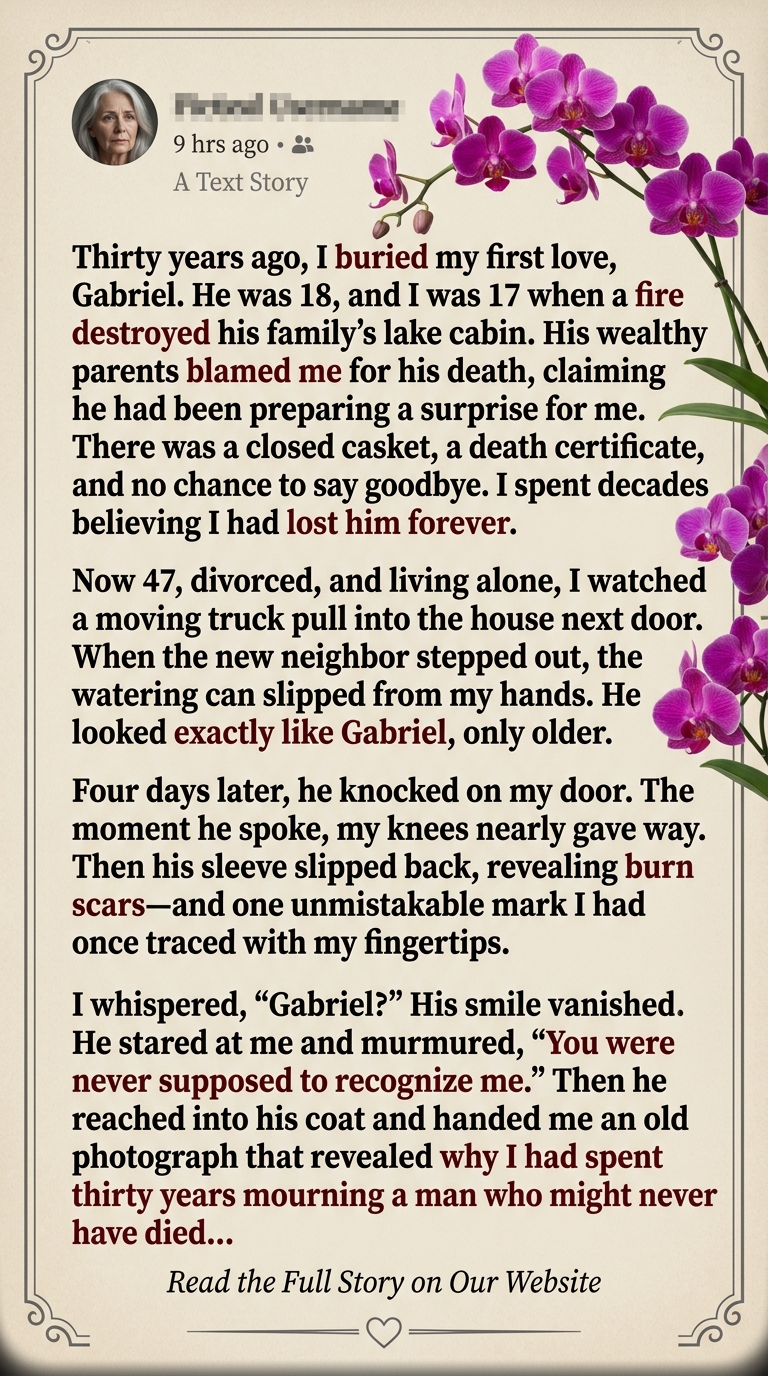
Thirty years ago, I buried the boy I thought I would love for the rest of my life.
His name was Gabriel. He was eighteen, I was seventeen, and we had been secretly planning a future together that neither of our families approved of.
Gabriel came from a wealthy family that owned several properties around the lake where we grew up. I was the daughter of a mechanic, and his parents never let me forget the difference between us.
His mother once told me, “Girls like you fall in love with boys like my son because you see an opportunity.”
I cried when she said it.
Gabriel held my face between his hands and promised, “One day, they’ll have to accept you. I don’t care how long it takes.”
He had a small birthmark just below his left shoulder, shaped almost like a crescent moon. I used to trace it with my fingertip whenever we sat together by the lake. He would pretend to complain that I was tickling him, then pull me closer and kiss my forehead.
We were young enough to believe love could solve anything.
Then, one October night, the cabin belonging to his family caught fire.
I had been supposed to meet Gabriel there. He had told me he was preparing a surprise, something that would change everything between us. But my father had needed help at his garage, and I arrived nearly an hour later than planned.
By then, the cabin was burning.
Firefighters searched the ruins until dawn. Gabriel’s parents stood behind the police line, refusing to look at me.
His father finally turned toward me.
“This is your fault,” he said. “He was preparing something for you. If you hadn’t encouraged him to sneak away from home, he would still be alive.”
I tried to explain that I hadn’t known about the fire. Nobody listened.
Several days later, his parents told me that Gabriel had died.
There was a closed casket. There was a death certificate. There was a funeral attended by people who whispered whenever I passed.
I begged to see him one last time.
His mother refused.
“You have done enough damage,” she told me.
I was seventeen years old, and I had no money, no influence, and no way to challenge a powerful family.
So I mourned him.
I kept the photograph he had given me, graduated from school, moved away, and eventually married a man who was kind but whom I never loved with the reckless certainty I had once felt for Gabriel.
That marriage ended years later.
By the time I turned forty-seven, I had learned to live alone. I worked at a small library, tended my garden, and rarely visited the lake anymore.
I thought the worst part of losing Gabriel was behind me.
Then, on a rainy Tuesday morning, a moving truck pulled into the house next door.
I was watering my roses when the new neighbor stepped out of the driver’s seat.
The watering can slipped from my hands and struck the stone path.
He was older, his hair streaked with silver, and his face carried the lines of someone who had lived through difficult years.
But I knew that face.
I knew the shape of his jaw, the slight tilt of his head, and the way his left hand curled when he was concentrating.
I had seen that face in my dreams for three decades.
I stood frozen as he glanced in my direction.
For one impossible second, our eyes met.
Then he looked away and began unloading boxes.
I spent the rest of the day telling myself I was imagining things. Grief can preserve a person’s face with cruel precision. Perhaps I had simply found a stranger who resembled the boy I had never stopped mourning.
But over the next three days, I noticed things.
He watered his garden just before sunset.
He carried his groceries in his left hand, leaving his right free to open the door.
And every time he passed my house, he glanced at the old oak tree in my front yard.
Gabriel and I had carved our initials into that tree when we were children.
On the fourth evening, someone knocked on my door.
I opened it.
The man stood on my porch holding a small paper bag.
“I brought you some lemons,” he said. “The tree in my backyard is producing more than I can use.”
His voice was lower than I remembered, roughened by age, but there was something unmistakable in the way he pronounced the word lemons.
Gabriel used to say it with a strange little emphasis on the first syllable, a habit he had inherited from his grandmother.
My knees weakened.
“What’s your name?” I whispered.
He hesitated.
“Daniel.”
I stared at him.
“No.”
His expression changed.
I reached for the railing to steady myself.
“Your name isn’t Daniel.”
For several seconds, he didn’t move. Then he set the bag down and slowly pushed up the sleeve of his coat.
A network of pale, uneven scars ran from his wrist toward his elbow.
He turned his arm slightly.
Below his left shoulder, visible at the edge of his shirt collar, was a small crescent-shaped birthmark.
My breath caught.
I had traced that mark with my fingertips hundreds of times.
“Gabriel?”
The smile vanished from his face.
He looked over my shoulder, as though checking whether someone had followed him.
Then he stepped inside and closed the door.
“You were never supposed to recognize me,” he murmured.
I couldn’t speak.
He reached into his coat and removed an old photograph, its edges yellowed and curled. He placed it in my trembling hands.
It showed Gabriel standing beside a man I recognized immediately: his father.
Behind them was a hospital bed.
And lying in that bed, his face swollen and wrapped in bandages, was the man standing in my hallway.
On the back of the photograph, someone had written a date and a sentence.
The boy died here. The son must disappear.
I looked up at him.
“What does this mean?”
He closed his eyes.
“It means the man you buried was never identified by his face.”
I felt the room tilt.
“Then who was in the coffin?”
Gabriel pulled out a chair and sat down heavily.
“The truth is worse than you think.”
He told me that the fire had started shortly after he arrived at the cabin. His father had discovered that Gabriel planned to leave home and marry me when we were older. He had threatened to cut him off, but Gabriel had refused to abandon me.
That night, Gabriel had been meeting someone who promised to help him leave town. He never told me who the person was because he wanted to keep me out of the conflict.
When the fire broke out, Gabriel was trapped beneath a collapsed beam near the back entrance. He remembered the heat, the smoke, and someone dragging him through a broken window.
He woke days later in a private hospital under another name.
His injuries were severe. His face was badly burned, and he had suffered a head injury that left him confused and unable to remember parts of the night.
His father visited him once.
“You are dead to everyone who knew you,” the older man told him. “If you return, the girl you love will pay for it.”
Gabriel said he had tried to argue, but his father showed him photographs of me leaving the funeral home. Then he told him that if he came back, he would make sure my family lost everything.
“My father had money, connections, and people who were afraid of him,” Gabriel explained. “I was eighteen, injured, and barely able to remember my own name. I believed him.”
I covered my mouth.
“So you let me think you were dead?”
“I thought I was protecting you.”
“You let me bury you.”
His eyes filled with tears.
“I know.”
I stood up, unable to remain still.
“You have no idea what those years were like. I spent my entire life wondering whether I could have saved you. I blamed myself for arriving late. I thought you died waiting for me.”
“I know,” he whispered again.
“No, Gabriel. You don’t.”
He lowered his head.
For the first time since he had entered my house, I saw not the boy I had loved, but the man who had made a decision that shaped my entire life without giving me a choice.
I wanted to embrace him.
I wanted to throw him out.
I did neither.
Instead, I asked, “Who was in the coffin?”
Gabriel reached into his coat and produced a second photograph.
This one showed a young man standing beside a motorcycle. His face was similar to Gabriel’s, though not identical.
“His name was Adrian,” Gabriel said. “He worked for my father. He was caught inside the cabin when the fire started. His body was badly burned. My father used his death certificate to convince everyone that I had died.”
I stared at him in horror.
“Your father buried another man’s body under your name?”
Gabriel nodded.
“He had Adrian’s family sign documents they didn’t fully understand. They were told he had died while working at the property, and that the company would provide financial support. They were poor, frightened, and dependent on my father’s goodwill.”
I felt sick.
“And the police?”
“My father told them I had been identified. The medical records were manipulated, and the investigation was closed before anyone could question the identification properly.”
I sank into a chair.
For thirty years, I had believed the world had taken Gabriel from me.
Now I was learning that the person who had helped raise him had constructed a lie so complete that an innocent young man had been buried under another person’s identity.
“Why are you here now?” I asked.
Gabriel looked toward the window.
“My father died two years ago. Before he died, he left behind documents that I didn’t know existed. I spent months trying to determine what had happened and whether I could prove it.”
He explained that the photograph had been among papers stored in a locked cabinet. Alongside it were copies of the original hospital records, correspondence about the fire, and financial transfers to Adrian’s family.
There was also a letter written by Gabriel’s father.
It admitted that he had concealed Gabriel’s survival to prevent him from marrying me and to preserve the family’s reputation. He had convinced himself that controlling his son was an act of protection.
But the letter contained something else.
A reference to a sealed envelope addressed to me.
Gabriel had spent months searching for it. When he found my current address, he moved into the house next door, hoping to speak to me before handing the evidence to an attorney.
“I wanted to tell you everything,” he said. “But when I saw you in the garden, I couldn’t do it.”
“Why?”
“Because you looked happy.”
I let out a bitter laugh.
“You watched me for four days and decided you knew what my life had been?”
“No,” he said. “I watched you water your roses, and I remembered how you used to talk to flowers when you thought nobody could hear you. I wanted to believe that you had found peace.”
I looked away.
“I found a way to survive. That’s not the same thing.”
He nodded.
Then he placed a sealed envelope on the table.
“This belongs to you. I think it will explain why my father was so determined to keep us apart.”
Inside was a letter from my own father.
I had not seen his handwriting in years.
My father had died when I was in my twenties, and I had always believed he knew little about the circumstances surrounding Gabriel’s death. But the letter revealed that, shortly before the fire, Gabriel had approached him for help.
Gabriel had planned to leave his family and begin an apprenticeship at my father’s garage. He wanted to earn his own living before asking me to marry him.
My father had agreed to help.
He had also confronted Gabriel’s father, telling him that two young people should be allowed to build their own lives.
Gabriel’s father had responded with threats.
The letter ended with a sentence that made me press the paper against my chest.
If Gabriel ever returns, tell him I kept my promise. The door was always open.
My father had waited, too.
He had carried the same uncertainty I had carried, wondering whether Gabriel was dead or whether the truth had been buried by someone powerful enough to silence everyone around him.
I began to cry.
Gabriel sat quietly across from me.
After a long time, I asked the question that had been burning inside me since he arrived.
“Did you ever stop loving me?”
He looked directly into my eyes.
“No.”
I wanted that answer to heal everything.
It didn’t.
Love had survived, but time had also happened. We had lived separate lives. We had changed. I had married, divorced, built a career, and learned how to sleep alone without expecting the past to knock at my door.
Gabriel had spent decades carrying a secret that had not been his to create, but had become his responsibility to confront.
Neither of us could simply return to being seventeen.
“I can’t give you those years back,” he said.
“No,” I answered. “You can’t.”
“But I can stop hiding.”
For the first time, I believed him.
Over the following weeks, we worked with attorneys and investigators to authenticate the records. The evidence was sent to the appropriate authorities, and Adrian’s surviving relatives were contacted through legal representatives. Some of the records were incomplete, and not every part of the story could be proven immediately. But enough documentation existed to reopen questions that should never have been dismissed.
Gabriel also gave a formal statement about his father’s actions.
It was painful. His family name, once a source of privilege, became connected to a scandal that had remained hidden for decades. He lost contact with several relatives who insisted that reopening the case would only damage the family further.
He continued anyway.
I didn’t forgive him all at once.
Some days, I could sit with him on my porch and remember the boy who had promised to marry me. Other days, I would look at him and feel the weight of thirty years of birthdays, funerals, and ordinary moments I had lived believing he was gone.
He never demanded that I move past those feelings.
He simply kept showing up.
He brought lemons from his tree. He helped me repair the loose step on my porch. He listened when I spoke about my marriage and the loneliness that followed my divorce.
Slowly, the stranger who had returned from the dead became someone I could know again.
One evening, nearly a year after he had knocked on my door, Gabriel asked if I would walk with him to the lake.
The old cabin was gone. In its place stood a small public shelter beside the water.
We sat on a bench as the sun lowered behind the trees.
“I used to imagine what I would say if I ever saw you again,” he admitted.
“What did you imagine?”
“That I would explain everything, and you would understand.”
I smiled sadly.
“Life rarely works that neatly.”
“No,” he said. “It doesn’t.”
He took my hand, leaving me free to pull away.
I didn’t.
We did not pretend that we were teenagers again. We did not promise to recover the life we had lost. Instead, we began with the truth, even when it hurt, and let the future remain something we could choose rather than something we owed the past.
Months later, Gabriel gave me a copy of the photograph he had brought to my house that first evening.
I placed it beside an old picture of us at seventeen.
In the younger photograph, we were laughing, certain that love meant nothing could separate us.
In the newer one, we stood beside the lake, older and scarred by lives we had never expected to live.
But we were both there.
For thirty years, I had mourned a man who was alive, and Gabriel had mourned a life he believed he could never return to.
The truth did not erase the pain. It gave the pain a name, and finally, a place to rest.
I sometimes think about the girl I was when I stood outside that burning cabin, believing she had arrived too late.
I wish I could tell her that she wasn’t responsible for the fire, or for the lies that followed. I wish I could tell her that the years ahead would be difficult, but that one day the truth would find its way home.
Most of all, I wish I could tell her that love is not always enough to protect us from the choices other people make.
But truth, once uncovered, can still give us a chance to choose what happens next.
And that was the second chance Gabriel and I finally allowed ourselves.