The Document My Husband Found After Throwing Coffee in My Face
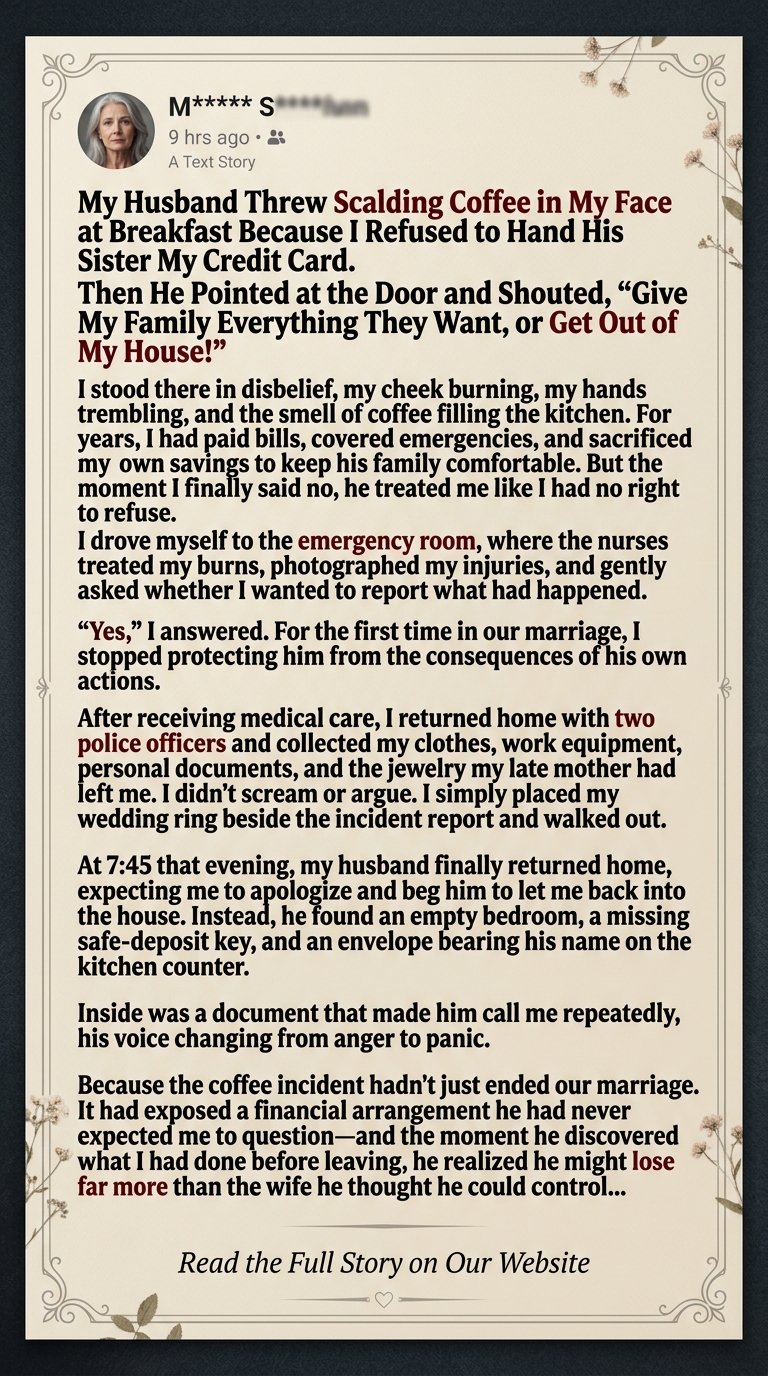
The coffee was still steaming when my husband threw it at me.
One second, I was standing beside the kitchen counter, refusing to hand his sister my credit card. The next, scalding liquid splashed across my cheek and neck, and the cup shattered against the cabinet behind me.
I gasped and stumbled backward.
My husband, Richard, didn’t apologize.
He pointed toward the front door.
“Give my family everything they want, or get out of my house!”
His sister, Melissa, stood beside the breakfast table, clutching her handbag. She looked startled for a moment, but then she turned her eyes toward the credit card lying on the counter.
“Honestly,” she muttered, “you make everything so difficult.”
I stared at both of them.
For eight years, I had helped Richard’s family whenever they needed money. I had paid overdue bills, covered medical emergencies, and contributed to repairs on his parents’ house. When Melissa lost her job, I paid several months of her expenses. When she wanted to start an online boutique, I lent her money that she never returned.
I had done those things because I believed family helped one another.
But somewhere along the way, helping had become an obligation, and saying no had become an offense.
That morning, Melissa wanted my credit card because she had found a luxury handbag she wanted to purchase. She claimed she would repay me when her business improved.
I had already lent her more money than I could comfortably afford.
“I’m not giving you my card,” I had said. “You still haven’t repaid the money you borrowed last year.”
Richard had slammed his hand on the table.
“She needs it more than you do!”
“That’s not the point. It’s my card, and I’m allowed to say no.”
He had looked at me with an expression I would never forget.
Then he threw the coffee.
As I stood in the kitchen, my cheek burning, I realized that the man I had married was not simply angry about money. He believed my refusal was an act of disobedience.
He believed that because we were married, he had the right to decide what I should give his family.
And he believed he could punish me when I refused.
I pressed a cold, wet towel against my face and reached for my keys.
Richard laughed bitterly.
“Where are you going now?”
“To get medical help.”
“Oh, stop being dramatic. It was an accident.”
I looked at him.
“You threw it at me.”
He shrugged.
“Then perhaps you should have handed over the card.”
I walked out without answering.
At the emergency department, a nurse examined the burns on my cheek and neck. The staff cleaned the affected skin, documented my injuries, and took photographs as part of my medical record.
One nurse asked whether I felt safe returning home.
I hesitated.
For years, I had protected Richard from the consequences of his behavior. I had explained away his temper, hidden arguments from friends, and convinced myself that every marriage had difficult moments.
But there was nothing ordinary about what he had done.
“I’m not sure,” I admitted.
She nodded gently.
“You don’t have to decide everything today. But you deserve to be safe.”
Another staff member asked whether I wanted to report the assault.
I looked at the photographs on the nurse’s screen.
“Yes,” I said. “I want to report it.”
The words were quiet, but they changed everything.
I gave a statement to the police and explained what had happened. I didn’t exaggerate or leave anything out. I told them about the coffee, the argument, and Richard’s refusal to take responsibility afterward.
They explained the options available to me and helped me understand how to collect my belongings safely.
By late afternoon, I had received medical care and made arrangements to leave the house.
I didn’t want a confrontation. I didn’t want Richard to have another opportunity to intimidate me.
When two officers accompanied me back to the property, I collected my clothes, work equipment, personal documents, and the jewelry my late mother had left me.
I also took the documents relating to my separate savings and investments.
Before leaving, I placed my wedding ring beside the incident report on the kitchen counter.
Then I walked out.
At 7:45 that evening, Richard returned home.
He had apparently spent the day assuming I would calm down, return to my usual role, and apologize for embarrassing him by involving the police.
Instead, he found an empty bedroom.
My wardrobe was bare. My work laptop and personal files were gone. The jewelry box my mother had given me was missing from the dresser.
On the kitchen counter lay a sealed envelope bearing his name.
Beside it sat the house keys I had been using.
Richard opened the envelope.
Inside was a letter from my attorney, followed by copies of several financial documents.
The first page informed him that I had retained legal representation and that all future discussions concerning our separation and shared finances should go through the appropriate legal channels.
The second page was a statement of account showing the money I had contributed toward the purchase and renovation of the house.
But it was the third document that made his hands tremble.
It was a copy of the financial agreement we had signed before buying the property.
Richard had forgotten that document existed.
Or perhaps he had assumed I would never use it.
When he called me, I was sitting in my sister’s spare bedroom with an ice pack beside me.
“What have you done?” he demanded.
I looked at the phone.
“I’ve left.”
“Don’t play games with me. What is this agreement?”
“The agreement we both signed.”
“You can’t just take money out of our accounts and disappear!”
“I haven’t taken money that belongs to you. My personal accounts remain in my name, and the joint accounts will be handled through the legal process. My attorney has copies of the relevant records.”
He went silent.
Then his voice changed.
“Listen, sweetheart. I think we both got carried away this morning.”
I closed my eyes.
He had called me many things during our marriage, but sweetheart had always been reserved for the moments when he wanted something.
“You threw scalding coffee at me,” I said.
“I was angry.”
“You told me to give your sister my credit card or leave.”
“I didn’t mean it like that.”
“You told me it was my fault because I refused.”
He exhaled sharply.
“Melissa was upset. I was trying to help her.”
“You could have helped her with your own money.”
“We’re married! What’s mine is yours, and what’s yours is mine!”
I stared at the wall.
That sentence had been his favorite whenever he wanted access to my savings. But when I needed help, the same man reminded me that the house belonged to him and that his family came first.
“That’s an interesting rule,” I said. “You only seem to remember it when you want something from me.”
He began speaking faster.
“You don’t understand the agreement. The house is in my name.”
“Then your attorney can explain it to you.”
I ended the call.
He rang again.
Then again.
By midnight, I had received more than a dozen calls and several messages. His tone moved from anger to pleading, then back to anger whenever I didn’t respond.
The next morning, my attorney contacted his representative to arrange the next steps.
The financial agreement was not a magic document that automatically gave me ownership of everything. It did, however, establish important terms concerning our respective contributions and the handling of certain assets if the marriage ended.
The property title, mortgage, bank records, and the agreement itself all needed to be reviewed under the law governing our marriage and home.
Richard had spent years treating the title as the only document that mattered.
He was about to discover that financial reality was more complicated.
But there was another reason he was panicking.
For months, I had been reviewing our finances because several payments had appeared on our joint statements that I couldn’t explain. Richard always dismissed my questions.
“Business expenses,” he would say.
Or, “I moved some money around.”
I had trusted him enough not to demand immediate answers.
After the coffee incident, I no longer felt obligated to accept vague explanations.
My attorney helped me organize the records I already had lawful access to. Together, we identified repeated transfers from our joint account to a company registered under Melissa’s name.
Some transfers were small. Others were substantial.
The total was far greater than I had imagined.
I had assumed I was helping Melissa occasionally. The records suggested that Richard had been using our shared money to support her expenses and business, often without discussing the amounts with me.
The payments included rent, equipment purchases, credit-card balances, and transfers that had no clear explanation in the records available to me.
I couldn’t determine from the statements alone whether every payment had been authorized improperly or whether some had legitimate explanations. That was for the financial review and legal process to establish.
But I could no longer pretend I hadn’t seen the pattern.
I had contributed my income to our household in good faith, believing we were working toward shared goals. Richard had repeatedly assured me that our finances were stable.
Now I had reason to question whether he had been honest about where the money was going.
When his attorney contacted mine, Richard initially insisted that I had no right to question his financial decisions.
My attorney responded by requesting a full accounting of the relevant joint transactions and supporting documentation.
That was when Richard’s panic became unmistakable.
He called me again.
“Why are you doing this to me?”
“I’m asking for an accounting.”
“It’s family money!”
“Our money was used to support your sister without my informed agreement. I want to know exactly what happened.”
“She needed help!”
“And I needed honesty.”
He fell silent.
Then he said something that revealed just how little he understood the situation.
“If you keep pushing this, Melissa could lose her business.”
I felt a strange calm settle over me.
“Then perhaps she should have built her business without relying on money she couldn’t afford to repay.”
“You’re going to destroy my family over a few transfers?”
“No, Richard. I’m refusing to let your family destroy my financial security while you tell me I should be grateful.”
He hung up.
For the first time since I had left, I felt no need to call him back.
The days that followed were difficult. My injuries needed time to heal, and even after the burns began improving, I felt anxious whenever I heard a cup strike a table or smelled freshly brewed coffee.
My sister helped me find a temporary place to stay. I returned to work when my doctor said I was ready, and I began seeing a counselor to help me process what had happened.
I also learned that leaving an abusive situation could bring mixed emotions. I missed the good parts of my marriage. I remembered the man who had once brought me soup when I was sick and held my hand at my mother’s funeral.
Those memories were real.
So was the man who had thrown coffee at me.
I stopped trying to make one version cancel out the other.
Richard’s family began contacting me.
His mother said I should forgive him because he had been under stress. Melissa sent a message claiming I was overreacting and that she had never asked him to throw anything at me.
I didn’t argue with either of them.
I simply stated that the incident had been reported and that any financial matters would be handled through my attorney.
Melissa eventually sent another message.
“You’re making everyone choose sides.”
I read it twice before replying.
“I didn’t ask anyone to choose sides. I asked for my credit card back, and your brother threw hot coffee at me.”
I didn’t respond to anything else she sent.
Over the following months, the financial review established that Richard had directed substantial sums from our joint finances toward Melissa’s expenses without the level of disclosure and agreement our financial arrangement required.
The exact consequences were resolved through the legal process. The property and financial settlement accounted for the relevant records, our respective contributions, and the applicable law. I received the amount awarded under the settlement, and Richard remained responsible for obligations assigned to him.
The police investigation into the assault proceeded separately. I cooperated, provided my medical documentation, and gave a truthful account of what had happened. Richard faced legal consequences for his conduct rather than having the incident quietly dismissed as a marital argument.
I didn’t celebrate his difficulties.
I wanted accountability, not revenge.
By the time the separation was finalized, I had found a small apartment of my own. It wasn’t luxurious, but the keys belonged to me, the bills were manageable, and no one could demand my credit card or threaten to throw me out because I said no.
The first night I slept there, I made myself a cup of coffee.
I stood beside the kitchen counter, holding the mug in both hands.
For a moment, the memory returned so vividly that I almost put it down.
Then I took a breath and sat by the window.
It was just coffee.
I was safe.
And I could decide for myself what happened next.
Several months later, Richard sent me a letter.
He wrote that he had begun counseling and that he was trying to understand why he had treated my refusal as a betrayal. He admitted that he had used his family obligations to justify decisions he should have discussed with me.
He apologized for the assault without blaming stress, Melissa, or me.
I read the letter carefully.
Then I put it in a drawer.
I didn’t owe him an immediate answer, and I didn’t owe him reconciliation simply because he had finally acknowledged what he had done.
I could accept that he might be trying to change without placing myself back in a situation where my safety depended on his mood.
One afternoon, I visited my mother’s grave.
I brought the small gold pendant she had left me, the one I had taken from the house before leaving. I held it in my palm and remembered her advice whenever I faced a difficult decision.
“Never let someone convince you that love means you must abandon yourself.”
I had heard those words many times when I was younger.
I had not understood them until now.
For years, I had believed that being a good wife meant being endlessly patient, endlessly generous, and willing to sacrifice my comfort to keep everyone else happy.
I had confused peace with silence.
I had confused kindness with surrender.
And I had mistaken my husband’s access to my life for ownership of it.
The coffee incident changed all of that.
It didn’t make me stronger overnight. It didn’t erase my fear or make every decision easy.
But it forced me to stop protecting someone who had chosen to hurt me.
The document Richard found in the envelope was important because it protected my financial interests. The records mattered because they exposed questions that needed answers.
Yet the most important decision I made that morning wasn’t financial or legal.
It was the decision to stop pretending that being married meant I had to accept being mistreated.
I had entered the marriage believing we were building a life together.
I left understanding that a life worth building must have room for both people to say no.
And if someone responds to that word with violence, the problem is not the person who refused.
It is the person who believes love gives them the right to control another human being.
I never returned to that house.
I didn’t need to.
I had taken my belongings, protected my rights, and reclaimed the one thing Richard had tried hardest to take from me: the belief that my life belonged to me.