The Receipt That Ended My Son’s Dependence on Me
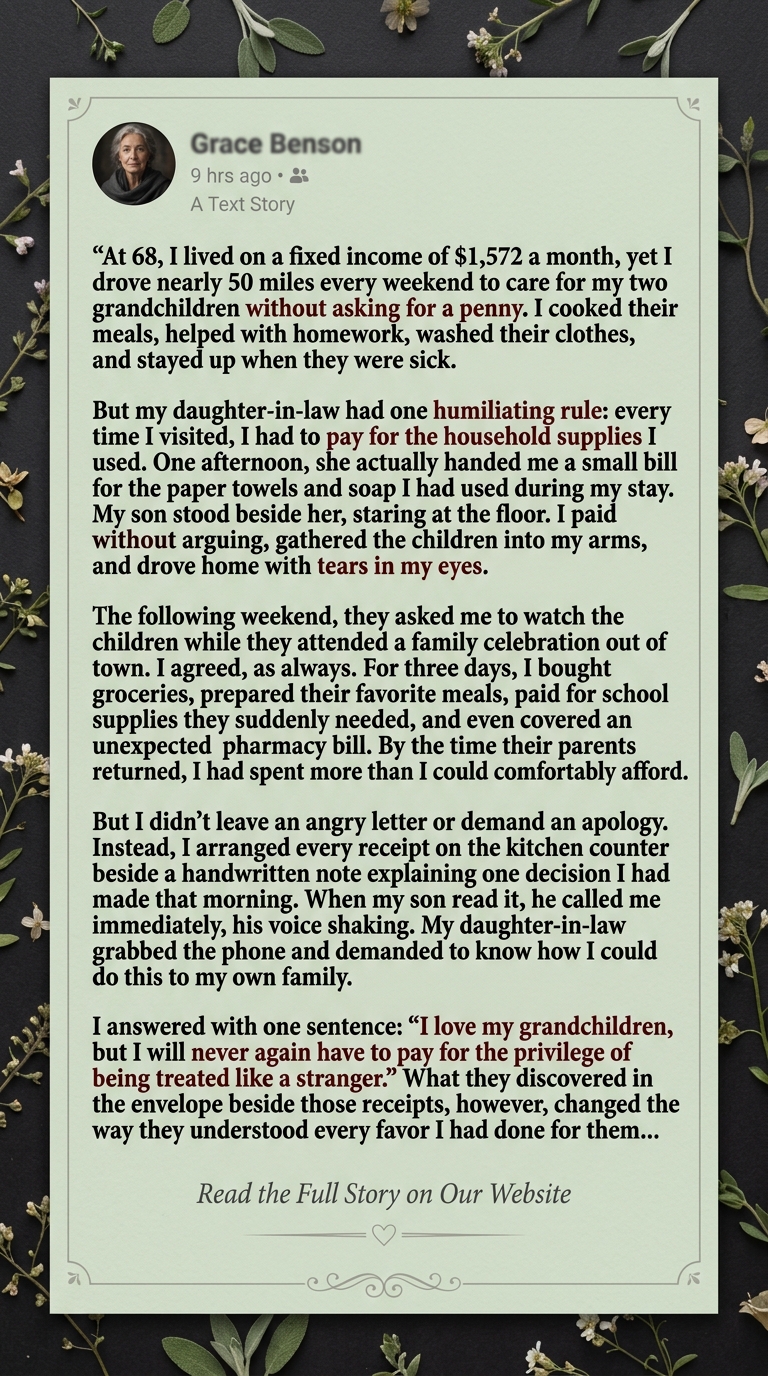
At sixty-eight, I lived on a monthly pension of $1,648, yet I drove nearly fifty-five miles every weekend to care for my two grandchildren without ever asking for payment. I cooked their favorite meals, helped with schoolwork, washed their clothes, and sat beside their beds whenever they were sick.
I never expected my son and his wife to reward me. I was their grandmother, and I loved those children more than anything.
But my daughter-in-law, Vanessa, had a different way of looking at things.
“Since you use our supplies when you stay here, I think it’s only fair that you contribute,” she told me one Saturday, handing me a handwritten bill for laundry detergent, dish soap, paper towels, and toilet paper.
I stared at the little piece of paper.
“Vanessa, I only used a few things while looking after the children.”
“And those things cost money,” she replied. “We have a household budget.”
My son, Michael, stood beside the refrigerator, studying the floor as though something fascinating had appeared between his shoes.
I waited for him to say something.
He didn’t.
So I opened my purse, counted out the money, and placed it in Vanessa’s hand.
Then I hugged my grandchildren goodbye and drove home with tears running down my face.
I cried because of the money, but not because I couldn’t afford a few dollars for soap. I cried because I had spent years believing that my presence made their lives easier, only to discover that my daughter-in-law had begun measuring my love in household expenses.
Still, the following weekend, when Michael called and asked if I could watch the children for three days while he and Vanessa attended a family celebration out of town, I agreed.
“How could we manage without you, Mom?” he said.
I wanted to believe that he meant it.
On Friday morning, I arrived with my overnight bag and a container of homemade chicken soup. Vanessa had left a list on the counter.
It included the children’s meals, laundry instructions, school schedules, and several reminders about keeping the house tidy.
At the bottom, she had written, “Please replace anything you use.”
I folded the list and put it in my purse.
For three days, I did everything I had always done.
I prepared pancakes for breakfast, packed lunches, washed uniforms, helped with a school project, and read bedtime stories. When my grandson developed a fever, I stayed awake beside him until his temperature finally came down.
On Saturday, I discovered that the children had run out of several groceries. I bought milk, fruit, bread, eggs, and the cereal my granddaughter loved.
Then I received a message from Michael.
“Mom, could you pick up the school supplies Lily needs for Monday? Vanessa forgot to order them.”
I went to the store and bought the supplies.
Later that evening, my grandson began complaining about an earache. I called his parents, but they were attending a formal dinner and couldn’t leave immediately.
“Could you take him to the pharmacy and get something for the pain?” Michael asked. “We’ll pay you back.”
I took the boy to the pharmacy, paid for the medicine, and brought him home.
By Sunday afternoon, my purse contained a collection of receipts. Groceries. School supplies. Pharmacy expenses. A few household items I had needed to replace.
When I added everything together, I had spent more than I could comfortably afford.
I looked at my bank balance and felt a familiar knot tighten in my stomach.
That money was supposed to last until the end of the month. It covered my electricity, medication, groceries, and the occasional small pleasure I allowed myself.
I was not a wealthy woman.
I was simply a grandmother who had never learned how to say no to her family.
But that afternoon, something inside me finally changed.
I sat at the kitchen table after the children went to bed and opened the folder I had brought from home. Inside were years of records I had kept without thinking much about them: receipts for birthday gifts, school shoes, winter coats, groceries, and emergency expenses I had covered whenever Michael said they were short of money.
There were also copies of bank transfers I had made when he and Vanessa had struggled to meet their mortgage payments.
I had never kept those records to hold over their heads. I had kept them because I was careful with money and liked knowing where it went.
Now, looking through them, I realized something painful.
My son and his wife had become accustomed to receiving my help, but they had somehow stopped seeing it as help.
They treated it as an obligation.
I took a sheet of paper and began writing.
I did not write an angry letter. I did not accuse Vanessa of being cruel or Michael of being weak. I simply explained what I could no longer continue doing.
Then I made a decision that had been waiting inside me for years.
I placed the letter, the receipts from that weekend, and a second envelope containing several important documents on the kitchen counter.
When Michael and Vanessa returned on Monday morning, the children were safe, their lunches were prepared, and the house was clean.
I had already packed my things.
Michael entered the kitchen first. He saw the papers arranged neatly beside the coffee maker and began reading.
His face changed with every paragraph.
“Mom?” he called, his voice suddenly unsteady.
Vanessa walked in behind him and snatched the letter from his hand.
“What is this?” she demanded.
I stood by the doorway, holding my purse.
“It’s a decision I should have made a long time ago.”
Michael looked at me.
“You’re saying you won’t watch the kids anymore?”
“I’m saying I won’t keep paying to do it.”
Vanessa’s expression hardened.
“How can you do this to your own family? We trusted you with the children!”
I looked at her steadily.
“I love my grandchildren, but I will never again have to pay for the privilege of being treated like a stranger.”
She opened her mouth to argue, but Michael was staring at the second envelope.
“What are these documents?” he asked.
I took a slow breath.
“Open it.”
Inside was a copy of a legal agreement, a bank statement, and a letter from my attorney.
Three years earlier, Michael and Vanessa had been close to losing their home after Michael’s business suffered a serious setback. They had fallen behind on their mortgage, and the bank had begun sending warnings.
Michael had called me late one evening, barely able to speak.
“Mom, I don’t know what we’re going to do. The children could lose their home.”
I had spent nearly two decades saving for retirement. I had never owned an expensive car or taken a luxurious vacation. Every month, I put a little money aside.
When my son needed help, I withdrew a substantial portion of those savings and used it to help clear the arrears on their mortgage.
It was money I could not easily replace.
I did not ask them to repay me immediately. Instead, we signed a written agreement stating that my contribution would be treated as a private loan, with repayment postponed until their finances stabilized.
Michael had insisted on signing it.
“I want everything to be clear,” he had told me then. “I don’t want you to worry about your money.”
I had believed him.
But the agreement had never been mentioned again.
The documents on the counter included a recent statement from my attorney confirming that the loan remained outstanding. I had not demanded repayment before because I had hoped their financial situation would improve and that our relationship would remain loving.
Now I had decided to stop pretending that silence was helping anyone.
Michael stared at the statement.
“You’re asking us to pay you back?”
“I’m asking us to acknowledge the agreement we made.”
Vanessa’s face flushed.
“You never said you expected the money back now!”
“I didn’t say I expected it immediately. I said I expected us to honor what we agreed to. I have my own expenses, and I need to protect my retirement.”
“You know how expensive everything is,” she snapped. “We have two children!”
“Yes,” I replied. “And I have one life to live on a fixed income.”
For once, she had no immediate answer.
Michael lowered himself into a chair.
“How much have you spent on us?” he asked quietly.
I shook my head.
“That isn’t the point. I’m not presenting you with a bill for every birthday present, every meal, or every time I helped because I wanted to. Those were gifts. I gave them willingly.”
I paused.
“But the mortgage money was different. And the care I provide every weekend is something I have been choosing to do out of love. It cannot remain an obligation that you both take for granted.”
Vanessa folded her arms.
“So what do you want from us?”
I had spent the previous night thinking about that question.
“I want three things. First, I want the loan handled according to our agreement. We can work out a realistic repayment schedule through the attorney. Second, I will no longer cover household expenses or unexpected bills unless I freely offer to help. Third, if you want me to care for the children, we will discuss the arrangements respectfully beforehand. I am their grandmother, not your unpaid household staff.”
Michael looked up sharply.
“You think we’ve been using you?”
I could have softened the answer. I could have reassured him that he was a good son and that none of this was his fault.
But I had spent too many years protecting him from uncomfortable truths.
“I think you both became comfortable accepting everything I gave you. And when Vanessa handed me a bill for soap, you stood there and said nothing.”
His eyes filled with tears.
“I was embarrassed.”
“So was I.”
He covered his face with his hands.
“I should have said something.”
“Yes,” I said gently. “You should have.”
Vanessa turned toward the window, refusing to look at either of us.
For a moment, I thought the conversation would end in another argument. Then a small voice came from the hallway.
“Grandma?”
My granddaughter Lily stood there in her pajamas, holding the stuffed rabbit she slept with every night.
“Are you going home because we did something wrong?”
My heart broke.
I knelt and opened my arms.
“Oh, sweetheart. No. You and your brother have done absolutely nothing wrong.”
“Are you still going to visit us?”
I held her close.
“Of course I want to see you. Nothing in that letter changes how much I love you.”
She rested her head on my shoulder.
“Mom said you might be angry because we cost too much money.”
I closed my eyes for a moment.
Then I looked at Vanessa.
She had gone completely still.
I did not want my grandchildren to grow up believing that love was something they had to earn or that their existence was a burden.
So I held Lily’s hands and explained carefully.
“Taking care of a family costs money, but you are never a burden to me. The grown-ups just need to learn how to treat one another fairly.”
Lily nodded, though I wasn’t sure she fully understood.
Her older brother appeared behind her and wrapped his arms around us.
I stayed until both children had calmed down. I helped them get dressed, made breakfast, and kissed their foreheads before leaving.
At the door, Michael followed me outside.
“Mom, please don’t disappear from our lives.”
I turned to face him.
“I am not disappearing. I am changing the way I help. Those are two very different things.”
He nodded, wiping his eyes.
“I don’t know how to fix this.”
“Start by being honest. Talk to your wife. Make a plan to repay the loan. And learn to say thank you before someone has to remind you that they deserve it.”
I drove home alone.
For the first time in years, I did not feel guilty for leaving.
I felt exhausted, sad, and strangely relieved.
I had drawn a boundary, and I knew there would be consequences. But I also knew that if I continued giving until I had nothing left, resentment would eventually destroy the very relationships I was trying to protect.
The next few weeks were uncomfortable.
Vanessa did not call. Michael sent a few brief messages asking how I was, but our conversations remained strained. I missed the children terribly, especially on Saturday mornings when I would normally be driving toward their house.
Still, I did not change my decision.
I began planning my monthly budget carefully. I scheduled an appointment with my financial adviser to review my retirement savings and make sure I could cover my future expenses. I started taking a weekly art class at the community center, something I had postponed for years because I was always busy helping someone else.
For the first time in a long while, I had time to think about what I wanted.
Then, one Thursday evening, Michael called.
“Mom, can we come over this weekend?”
I hesitated.
“Is something wrong?”
“No. I just want to talk. Vanessa does, too.”
They arrived on Saturday afternoon without the children. Vanessa carried a small bouquet of flowers. She looked uncomfortable, but she did not hide behind her usual sharpness.
We sat around my kitchen table.
Michael spoke first.
“We reviewed our finances. We’ve arranged a repayment plan with your attorney, and we’ve set up automatic monthly payments. It will take time, but we intend to honor the agreement.”
I nodded.
“Thank you.”
Vanessa placed her hands together.
“I owe you an apology.”
I waited.
She swallowed.
“When I gave you that bill for the supplies, I told myself I was being fair. I was worried about money, and I wanted to feel that I had control over our household. But I never stopped to think about what you were already contributing.”
She looked down.
“You were caring for our children, doing our laundry, cooking our meals, and spending money you couldn’t easily replace. Then I charged you for soap.”
Her voice faltered.
“I made you feel like a visitor in a home where you had been helping us build a life.”
I felt tears gathering in my eyes, but I let her continue.
“I was wrong. I’m sorry.”
The apology did not erase the humiliation I had felt. It did not undo the years of unspoken expectations or make everything instantly comfortable.
But it was the first time Vanessa had acknowledged what I had done for them without attaching a condition to it.
I accepted her apology, though I told her that rebuilding trust would take time.
Michael reached across the table and held my hand.
“I should have stood up for you. I was afraid of arguing with Vanessa, and I let you carry the hurt instead. You didn’t deserve that.”
“No,” I said. “I didn’t.”
We talked for nearly two hours. We discussed childcare arrangements, household expectations, and the difference between helping because I wanted to and being expected to help because everyone assumed I would.
We agreed that I would continue spending time with my grandchildren, but not every weekend by default. Sometimes I would visit for lunch. Sometimes I would take them to the park. If their parents needed a full weekend of childcare, they would ask in advance and respect my answer.
And I would never again feel obligated to pay for ordinary household supplies simply because I was visiting my own family.
A month later, I returned to their house for Sunday lunch.
Vanessa greeted me at the door and took my coat. The children ran into my arms, chattering about school and a science project they wanted me to see.
On the kitchen counter sat a small basket of homemade cookies and a handwritten card.
Inside, Vanessa had written:
“Thank you for loving our children so faithfully. We should have treated your love with more care.”
I put the card in my purse.
After lunch, Lily asked if I could help her with a school assignment. Her brother wanted to show me a new soccer trick in the garden. I spent the afternoon laughing with them, and when it was time to leave, I hugged them both tightly.
Michael walked me to my car.
“Mom,” he said, “I used to think you would always say yes because you loved us.”
I looked at him.
“I will always love you. But love doesn’t mean I have no limits. It means I want us to have a relationship that doesn’t depend on me exhausting myself to prove it.”
He nodded slowly.
“I understand that now.”
As I drove home, I thought about the receipts I had left on the kitchen counter that Monday morning. They had not been a weapon or a demand for gratitude. They had simply been the moment I finally acknowledged that my generosity had become unsustainable.
The real decision had been written in the letter beside them: I would continue loving my family, but I would no longer sacrifice my financial security or dignity to keep everyone comfortable.
My grandchildren still visited. I still baked their favorite cookies and listened to their stories. I still helped when I could.
But now, when I arrived, Vanessa welcomed me with a smile instead of a bill. Michael no longer looked away when a difficult conversation needed to happen. And I had learned that saying no to an unreasonable expectation did not mean saying no to the people I loved.
At sixty-eight, I finally understood something I wished I had learned decades earlier.
Being generous is a beautiful thing. But generosity without boundaries can quietly turn into an obligation, and love should never require someone to make themselves poorer, smaller, or less worthy of respect.
I had not stopped being a devoted grandmother.
I had simply stopped believing that I needed to pay for my place in my family’s life.