The $386 Million Inheritance My Neighbor Left Me
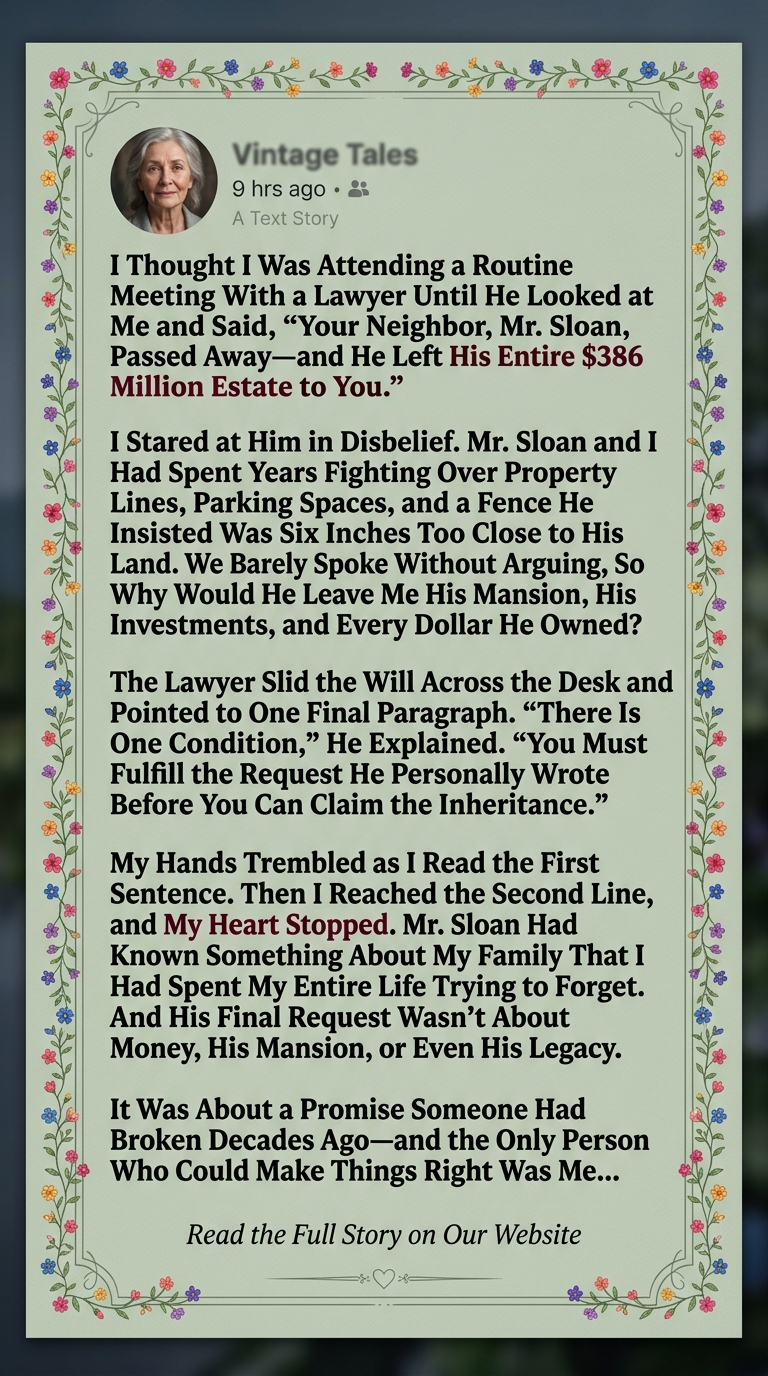
I had spent eleven years arguing with my neighbor, Arthur Sloan, over everything from property lines to parking spaces. So when a lawyer called and asked me to attend a meeting concerning Arthur’s estate, I assumed there was another dispute to settle.
I never imagined he would look across his desk and tell me that Arthur had left me his entire $386 million fortune.
“I’m sorry,” I said. “You must have the wrong person.”
The attorney, Mr. Bennett, adjusted his glasses.
“You are Daniel Brooks, correct?”
“Yes.”
“And you lived next door to Mr. Sloan for eleven years?”
“Unfortunately.”
Mr. Bennett didn’t smile.
“Then I assure you, Mr. Brooks, you’re exactly the person he named.”
I stared at the folder in front of him.
Arthur Sloan had been the most difficult neighbor I’d ever known. He had complained about my hedges, measured the distance between our driveways, and once sent me a formal letter because a branch from my maple tree had crossed his property line.
When I replaced a section of fence, he hired a surveyor to prove I’d moved it several inches too far.
We had argued so often that I had stopped waving when I saw him.
Now this same man had left me his mansion, his investments, his businesses, and a fortune large enough to change the lives of generations.
“Why me?” I finally asked.
Mr. Bennett opened the will.
“Mr. Sloan’s instructions are unusually specific. He wanted you to receive the estate, but only after completing a personal request.”
He slid a sealed envelope across the desk.
“There is one condition. You must fulfill the request he personally wrote before you can claim the inheritance.”
My hands trembled as I opened it.
The first line read:
Daniel, if you are reading this, then I have finally run out of time to ask you for something I should have asked years ago.
I swallowed and continued.
You have spent most of your life believing your father abandoned your family. He didn’t. And the woman who helped make you believe that is the same woman who has spent decades trying to bury what happened to your older brother.
I stopped reading.
My father had disappeared when I was nine.
My mother, Eleanor, told me he had left after a terrible argument and never wanted to see us again. She raised me alone, working long shifts at a hospital laundry and reminding me that we had survived because we didn’t need anyone who had chosen to leave.
I had believed her.
For thirty years, I had carried the shame of being the abandoned child, even after I became a successful contractor and built a family of my own.
But there was another part of my childhood I rarely discussed.
Before my father disappeared, my parents had an older son named Michael.
Michael was five when he died.
That was what my mother had always told me.
He had suffered an accident near an old railway bridge, she said, and despite the doctors’ efforts, he had not survived. She refused to discuss the details. Whenever I asked where he was buried, she told me the family had chosen a private arrangement.
After a while, I stopped asking.
Now Arthur Sloan was telling me that my father hadn’t abandoned us and that my brother’s death might not have happened as I’d been led to believe.
I looked up at Mr. Bennett.
“What did Arthur know?”
“The letter explains the condition. Mr. Sloan instructed me not to reveal anything else until you visited a specific address.”
He handed me a small brass key and a second envelope.
The address belonged to an old property on the edge of town.
“Why didn’t he tell me this while he was alive?”
Mr. Bennett looked at me carefully.
“I believe he was afraid you would refuse to listen.”
I almost laughed.
Arthur Sloan had never been afraid to speak his mind.
But I took the key.
That afternoon, I drove to the address.
The property was a narrow brick house behind a row of neglected trees. It looked as though no one had lived there for years. The windows were dusty, the front steps were cracked, and the mailbox leaned sideways.
The key opened the front door.
Inside, everything had been left almost exactly as it must have been decades earlier. A wooden table stood near the kitchen window. A child’s drawing hung crookedly on the wall. On the mantel sat a photograph of a young man holding a little boy on his shoulders.
I recognized the man immediately.
My father.
The little boy was Michael.
I picked up the photograph with shaking hands.
On the back was a date from the year before my brother supposedly died, followed by a message in Arthur’s handwriting.
I should have spoken sooner.
I searched the house until I found a locked cabinet in a small study. The brass key opened it.
Inside were several folders, old newspaper clippings, bank statements, and a thick envelope bearing my father’s name.
The first document was a hospital report.
It showed that Michael had been admitted to a regional medical center after an accident. But the report did not record his death. Instead, it documented a transfer to a specialized pediatric facility several hours away.
The next document was a court petition concerning temporary guardianship.
Then I found a letter written by my father.
Arthur, I need you to keep these records safe. Eleanor has told Daniel that Michael died, but I have reason to believe she knows he survived. I cannot prove it yet. I have tried to contact her, but she refuses to answer. If anything happens to me, please make sure Daniel learns the truth.
I sat down hard.
My brother might have been alive after the accident.
My father might have spent years trying to find him.
And my mother might have known.
The final folder contained the name of a care facility that had since closed. Beside it was the name of a social worker: Margaret Ellis.
I called the number printed on an old business card in the folder. After several transfers, I reached a retired social worker who agreed to meet me.
Her name was Margaret.
She was in her late seventies and lived in a modest apartment across town. When I showed her the documents, she stared at them for a long time.
Then she asked, “Did Arthur Sloan send you?”
“Yes.”
She closed her eyes.
“I wondered when he would finally find the courage.”
Margaret explained that after Michael’s accident, he had suffered a serious brain injury. He survived, but his recovery required long-term specialist care. My parents were overwhelmed by medical expenses and the emotional strain. My father wanted Michael transferred to a rehabilitation program that offered a better chance of recovery.
My mother disagreed.
She feared that Michael’s condition would permanently change their lives, and she became convinced that placing him in a specialist facility would be the only way to protect the family. The disagreement grew bitter. My father eventually left the house to arrange care for Michael and seek legal help.
But before he could return, my mother told relatives that he had abandoned the family.
“What happened to Michael?” I asked.
Margaret hesitated.
“He was transferred to a specialist program. Your father visited him regularly. Later, Michael was placed with a family experienced in caring for children with complex medical needs. It was supposed to be temporary, but the arrangement became complicated.”
“Was he adopted?”
“Eventually, yes. The records were sealed after the guardianship proceedings. Your father continued trying to establish contact, but your mother challenged his efforts. There were allegations on both sides, and the court restricted access while the case was reviewed.”
I felt sick.
“My father never abandoned us?”
Margaret shook her head.
“He was trying to keep his son alive and find a way to bring him home. I cannot tell you everything he did or why he made every decision. But the records do not support the story that he simply walked away.”
I stared at the paperwork.
“What about my mother? Did she know Michael was alive?”
Margaret’s expression tightened.
“She knew he had survived the initial accident. Whether she understood the later arrangements is harder to establish. She was grieving, frightened, and angry. But she was also capable of making choices that harmed other people.”
I thought of my father disappearing from our lives, my mother’s refusal to answer questions, and the years I had spent believing that I wasn’t worth staying for.
Now I understood that the story I had grown up with was incomplete.
But I still didn’t understand Arthur.
Why had he kept these records? Why had he left me a fortune? And why had he waited until his death to reveal the truth?
I returned to Mr. Bennett’s office the following morning.
He listened carefully as I described what Margaret had told me. Then he removed another document from the file.
“Mr. Sloan’s personal request was not merely that you investigate your brother’s history,” he said. “He asked you to locate Michael and give him the opportunity to decide what he wants to do with the truth.”
I looked at him.
“Arthur knew where Michael was?”
“He had information about a possible identity and a location. But he could never be certain without independent verification. He wanted you to find your brother before you accepted the inheritance.”
I opened the second envelope.
Inside was a letter from Arthur.
Daniel, I owe you an explanation.
Your father was my closest friend. We grew up together, built businesses together, and made promises we believed we would keep. When Michael was injured, I helped your father pay for his treatment. I also helped him gather evidence that your mother had withheld information about the guardianship arrangements.
I thought I could fix everything quietly. Instead, I became afraid of being drawn into a family dispute that might destroy my own life. I told myself that staying silent was not the same as taking sides.
I was wrong.
Your father died before he could finish what he started. I spent years regretting that I had allowed his son to remain a mystery.
I watched you grow up next door, and I recognized your father’s stubbornness in you. I also recognized the way you protected your family, even when doing so cost you peace.
I left you the estate because I have no children of my own, and because I want you to use what I built to finish what I failed to do.
Find Michael. Tell him the truth. Do not force him to forgive anyone, and do not assume that money can repair what was taken from him.
If you fulfill that request, the estate is yours. If you decide not to, the assets will pass to the charitable foundation named in my will.
I sat quietly after reading the letter.
Arthur had not left me his fortune because we were friends. We weren’t.
He had left it because he believed I could do something he had failed to do himself.
I could have walked away. The inheritance was enormous, and the condition was emotionally painful. I had spent years building a life that no longer depended on my childhood.
But I couldn’t stop thinking about Michael.
If he was alive, he deserved to know that someone had spent years searching for him.
I agreed to continue.
The attorney’s investigators traced the care facility records to a small town in Oregon. A man named Michael Reed lived there with his wife, Sarah. He worked as a woodworking instructor and volunteered with a local program for adults recovering from brain injuries.
The birth date matched my brother’s.
So did a medical record that referenced the original accident.
I wrote him a letter, explaining who I was and what I had discovered. I included copies of the records but avoided making claims that we could not yet verify.
He replied three weeks later.
His letter was brief.
I have wondered about my birth family for years. I was told I had been injured as a child and that my early records were incomplete. I don’t know what to believe, but I am willing to meet you.
We arranged to meet in a public garden.
I arrived early and sat on a bench, rehearsing what I would say. When a man with graying hair and a slight limp approached, I recognized him from the photograph immediately.
He stopped several feet away.
“Daniel?”
I stood.
“Yes.”
He looked at me with an expression I couldn’t read.
“You look like the man in the picture.”
“My father?”
Michael nodded.
For a moment, neither of us knew what to do.
Then I showed him the photograph of our father holding him on his shoulders.
Michael took it carefully. His fingers trembled as he studied the image.
“I remember a man who used to sing to me,” he whispered. “I don’t remember his face clearly, but I remember the song.”
He began humming a few notes.
I recognized it. Our father used to sing the same melody to me at bedtime.
My eyes filled with tears.
“That’s him,” I said.
Michael sat down beside me.
We spent hours talking. He told me about the accident, the hospitals, and the years he spent moving between care arrangements. His memories were fragmented, and he had spent much of his adult life trying to understand why his earliest records contained so many gaps.
He had been adopted by a couple who cared for him deeply. They had never pretended to be his biological parents, but they had been told little about his history.
When they died, he began searching for answers.
“I don’t know what I feel about our mother,” he admitted. “I don’t even know what to call her. I spent years believing I had been given away because I was too much trouble.”
I shook my head.
“You were a child who needed help. None of this was your fault.”
He looked at me for a long time.
“Did our father look for me?”
I placed the letters in his hands.
“He did. He never stopped trying.”
Michael read them slowly. By the time he reached the final page, tears were running down his face.
“I thought nobody wanted me,” he whispered.
I sat beside him, unable to find words that could make up for the years he had lost.
Finally, I put my hand on his shoulder.
“You were wanted, Michael. You were loved. And I’m sorry you spent so long believing otherwise.”
He leaned forward and covered his face.
We didn’t become brothers in a single afternoon. We were adults with separate histories, different habits, and decades of missed experiences between us. But we began calling each other, sharing photographs, and asking questions.
He told me about his wife and their daughter. I told him about my own family. We discovered small similarities that made us laugh: we both hated being late, both preferred fixing things ourselves, and both kept old tools long after they should have been replaced.
Eventually, Michael agreed to meet our mother.
By then, she was living in an assisted-living community. Her health had declined, and she spent much of her time looking through old photographs.
When I told her I had found Michael, she went completely still.
“No,” she whispered.
“He’s alive, Mom.”
She began to cry.
For a long time, she refused to see him. She said she was frightened, that she didn’t know what she could tell him, and that she couldn’t bear to have her choices judged after so many years.
I told her that Michael was not coming to punish her.
“He wants to understand what happened.”
After several days, she agreed to meet.
The reunion was painful.
Michael sat across from her in a quiet room, his hands clasped tightly together. My mother looked at him as if she were seeing a ghost.
“I’m sorry,” she whispered.
Michael’s eyes filled with tears.
“Why did you let me believe nobody wanted me?”
She tried to explain the fear, the financial pressure, and the anger that had consumed her after the accident. She admitted that she had told me our father abandoned us because she wanted to protect her version of the story and avoid answering questions she could not face.
She did not remember every detail clearly, and some parts of her account conflicted with the surviving documents. We could not reconstruct every decision or determine exactly when she had learned the full truth.
But she admitted that she had been wrong to let both of us grow up without the information we deserved.
Michael did not immediately forgive her.
“I need time,” he said.
She nodded.
“I understand.”
That was all he could offer her that day, and she accepted it.
In the months that followed, Michael and I continued building our relationship. He visited me with his wife and daughter, and I learned what made him laugh, what frightened him, and what he hoped to do with the years ahead.
I also learned that Arthur’s fortune came with responsibilities. His attorney helped establish the inheritance according to the will’s terms, and I worked with financial advisers to protect the estate and honor Arthur’s remaining charitable commitments.
I didn’t use the money to try to buy my brother’s forgiveness or compensate him for his lost childhood. Some losses cannot be measured in dollars, and I had no right to decide what would make his life whole.
Instead, I helped him obtain independent legal advice about his records and medical history. I also funded a small scholarship through Arthur’s foundation for people rebuilding their lives after serious childhood injuries.
Michael helped me choose the program.
“Arthur wanted you to finish what he started,” he told me one afternoon. “I think he’d be glad you’re doing something useful with all that money.”
I smiled.
“I think he would have argued with me about the paperwork.”
Michael laughed.
“Probably. He sounds like the kind of man who would measure a fence with a ruler and then argue about the ruler.”
I laughed harder than I had in months.
It was the first time we had joked about the man who had left me the fortune, and it felt like a small step toward peace.
I still think about Arthur whenever I pass the old boundary fence between our houses. For years, I believed our arguments defined him. Now I understand that his silence over my family’s secret had defined him far more deeply.
He had been afraid to act when it mattered, and he spent the rest of his life trying to correct that failure.
His money changed my financial future, but his final request changed my understanding of my own past.
I had spent decades believing my father had abandoned me and that my brother had died. Neither belief was as simple as I had been told. The truth was painful, incomplete in places, and impossible to fix entirely.
But it gave Michael and me the chance to know each other.
A year after I received the inheritance, I visited Arthur’s grave. I placed the old photograph of my father and Michael beside the flowers, then stood quietly for a few minutes.
“I found him,” I said. “And I told him the truth.”
There was no answer, of course.
But for the first time, I didn’t feel angry with Arthur.
I felt grateful that he had finally found the courage to stop hiding.
The estate made me wealthy. The truth gave me my brother.
And that was the inheritance I never knew I had been missing.