The Secret My Husband Hid While Our Son Was Fighting for His Life
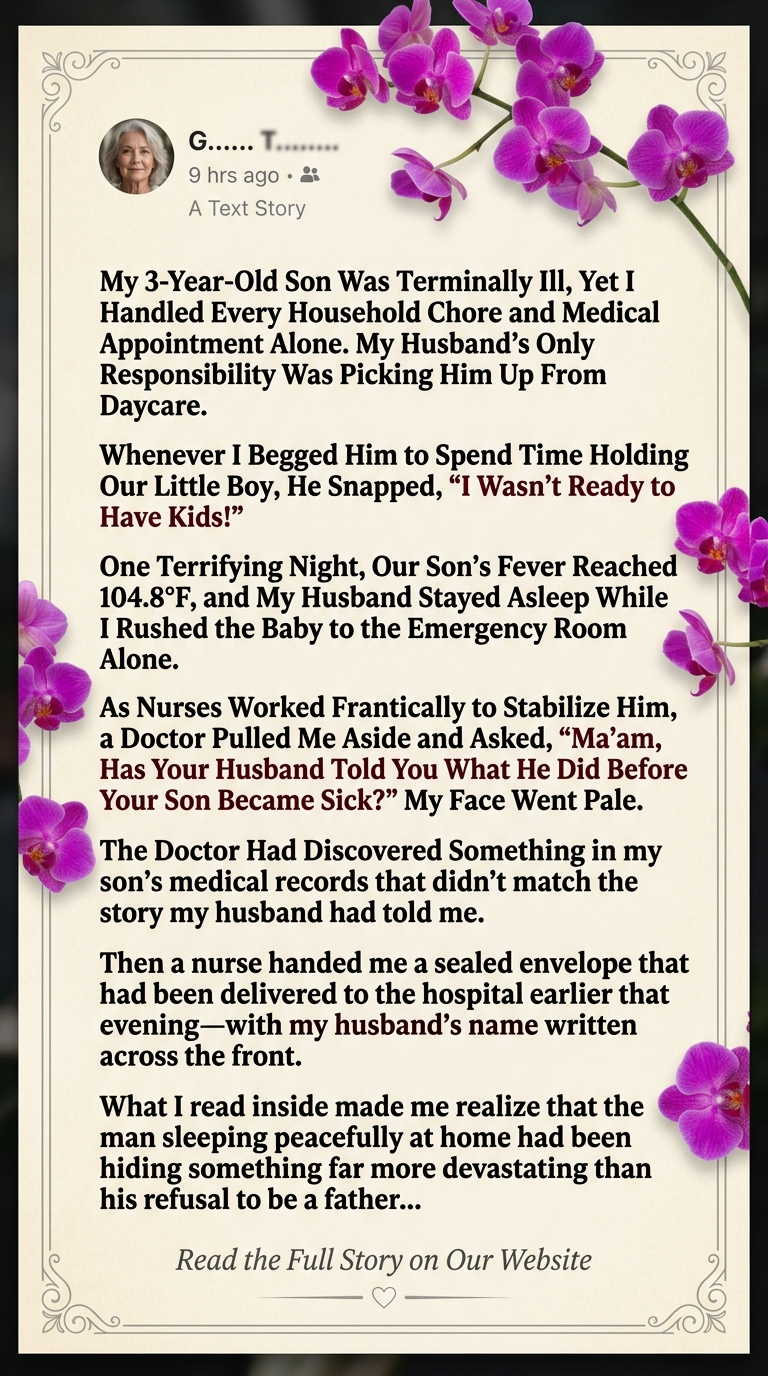
My three-year-old son was dying, and I was the only parent who seemed to understand how little time we might have left.
Every morning, I woke before sunrise to prepare his medication, pack his daycare bag, wash the clothes he stained during the night, and organize the medical records his specialists needed. I handled every appointment, every insurance call, every sleepless night when his little body trembled with pain.
My husband, Marcus, had exactly one responsibility: picking our son, Noah, up from daycare.
Even that seemed to exhaust him.
Whenever I begged him to sit beside Noah, read him a story, or simply hold him while he slept, Marcus would stare at me with cold irritation.
“I wasn’t ready to have kids!” he snapped one evening when I asked him to help Noah eat dinner.
Noah sat in his high chair, clutching a stuffed elephant, too tired to lift his spoon.
“He’s your son, Marcus,” I whispered.
“And I’m doing the best I can.”
“No. You’re doing the bare minimum while our child is dying.”
He slammed his hand against the counter.
“Stop making me feel guilty for something I can’t fix!”
Then he walked away.
I stayed at the table, feeding Noah one tiny spoonful at a time while tears ran silently down my face.
Our son had been diagnosed with a rare genetic disorder that caused progressive damage to his nervous system. His specialists had warned us that his condition was serious and that his future was uncertain. Some treatments might slow the progression, but there were no guarantees.
Noah didn’t understand any of that.
He understood that his legs sometimes refused to carry him. He understood that hospital rooms smelled strange and that needles hurt. He understood that Mommy always came when he cried.
And he understood that Daddy was usually somewhere else.
I tried to protect Noah from Marcus’s indifference. I told him Daddy was tired when he didn’t come to bedtime. I told him Daddy had work when he missed another appointment.
But sometimes, Noah would look toward the front door and ask, “Daddy coming?”
Every time, I answered yes.
I hated myself a little more each time I said it.
Then came the night everything changed.
It was nearly two in the morning when Noah began crying in his bedroom.
I hurried to his bedside and touched his forehead.
He was burning.
I grabbed the thermometer.
104.8°F.
My hands shook as I checked again, hoping I had made a mistake.
The reading barely changed.
Noah’s breathing was fast, and he seemed unusually weak. I called the emergency medical line, described his condition, and followed the instructions to seek immediate emergency care. Within minutes, I had him wrapped in a blanket and carried him to the car.
Marcus was asleep in our bedroom.
I shook his shoulder.
“Marcus, wake up! Noah has a dangerously high fever. We need to go to the hospital.”
He groaned and pulled the blanket over his head.
“Call an ambulance if it’s that bad.”
“I need you to come with us!”
“I’m exhausted, Claire. Just go.”
I stood beside the bed, staring at the man I had married.
Then Noah whimpered against my shoulder.
I stopped waiting for Marcus to become the father our son deserved.
I drove to the hospital alone.
The emergency department staff rushed Noah into a treatment room. Nurses attached monitors, drew blood, and began working to stabilize him. A doctor asked me questions while another clinician examined my son.
I answered everything I could.
When had the fever started? What medications was he taking? Had he recently been exposed to an infection?
Then one question made me pause.
“Has Noah received any new medication or treatment outside his prescribed care?”
“No,” I answered. “Not that I know of.”
The doctor studied me for a moment.
“Are you certain?”
I looked at Noah, who lay beneath a thin hospital blanket with a monitor clipped to his finger.
“I’m his mother. I manage all his medications.”
The doctor nodded slowly.
“We need to review something in his records. Could you come with me for a moment?”
I followed him into a small consultation room.
He closed the door.
“Mrs. Bennett, I want to be careful about what I say until we have confirmed all the facts. But we found a discrepancy in Noah’s medical records that concerns us.”
My heart began pounding.
“What kind of discrepancy?”
“Several months ago, a medication-related incident was documented in his chart. The notes indicate that a caregiver reported giving Noah something that wasn’t part of his prescribed treatment. The information provided at the time doesn’t match what you’ve told us tonight.”
I felt the blood drain from my face.
“Who reported it?”
The doctor glanced at the file.
“Your husband.”
For several seconds, I couldn’t speak.
Marcus had told me that he had never administered Noah’s medication without me. He had repeatedly complained that the instructions were too complicated and insisted that I handle everything.
“What did he give Noah?”
“We’re reviewing the original documentation. I don’t want to draw conclusions before we have the complete picture. But I need to ask whether you know anything about an incident involving an unprescribed product.”
I shook my head.
“No. Nothing.”
The doctor looked troubled.
“Then we need to understand why the information was recorded this way.”
Before I could ask another question, a nurse appeared at the door.
“Dr. Harris, there’s something else.”
She held a sealed envelope.
“This was delivered to the front desk earlier this evening. It’s addressed to Marcus Bennett, but the sender asked that it be placed in the patient’s file if the family came in.”
I stared at my husband’s name written across the front.
“Who delivered it?”
“The person didn’t leave their name.”
The doctor examined the envelope, then handed it to me.
“Given what’s happening, you should decide whether to open it. But please understand that anything relevant to Noah’s safety needs to be shared with the medical team.”
My fingers trembled as I broke the seal.
Inside was a handwritten letter and several photocopied pages.
The letter began with a sentence that made my knees weaken.
Marcus, I gave you every opportunity to tell Claire the truth. If you continue pretending that what happened to Noah was unavoidable, I will have no choice but to give her these documents myself.
I gripped the edge of the desk.
The letter continued.
You told me you were terrified when Noah became sick. You said you couldn’t handle watching him suffer. But fear doesn’t excuse what you did, and it certainly doesn’t excuse blaming the doctors when you knew there was more to the story.
I looked at the photocopied pages.
The first was an appointment summary from a private clinic. The second was a laboratory report. The third was a message exchange between Marcus and someone named Dr. Elaine Foster.
One message had been underlined.
The genetic test confirms the diagnosis. You need to tell Claire what you learned before she makes any more decisions based on incomplete information.
Marcus’s reply was written beneath it.
She can’t know yet. She’ll never forgive me.
I reread the words.
The doctor stood quietly beside me.
“Mrs. Bennett, do you recognize this clinic?”
I shook my head.
“No.”
“Dr. Foster?”
“No.”
I turned to the next page.
It was a genetic testing report with Noah’s name at the top. I couldn’t understand every medical term, but one section had been marked in red.
A note beside it read:
Parental testing recommended. Counseling offered. Family has not returned for follow-up.
I looked up.
“What does this mean?”
The doctor took the page and examined it carefully.
“It suggests that additional genetic testing was recommended for the family. I can’t tell you the full implications from this document alone, but the report should be reviewed by a clinical geneticist.”
I felt a terrible chill spread through me.
Marcus had known more about Noah’s condition than he had ever admitted.
But the letter suggested something else.
He had done something he was afraid I would discover.
I looked at the name on the envelope again.
Marcus Bennett.
Then I turned to the last page.
It contained a short statement signed by Dr. Elaine Foster.
I am documenting that Marcus Bennett was advised of the potential consequences of withholding the family’s genetic information from his wife. He acknowledged that he understood the recommendation but declined to participate in further counseling.
Below that was a handwritten note.
He said he needed more time.
I stared at the page until the words blurred.
My husband had been given information about our son’s illness and had chosen not to tell me.
I couldn’t understand why.
And then I remembered something from the months before Noah’s diagnosis.
Marcus had insisted that we stop discussing having another child. He had become angry whenever I asked whether he wanted to try again someday. Once, when I mentioned genetic counseling, he had snapped, “We already have enough problems. Why would you want to drag this out?”
At the time, I thought he was simply overwhelmed.
Now I wondered what he had been afraid of.
The doctor gently took the papers from my hands.
“We’re going to focus on stabilizing Noah tonight. We’ll also arrange for the appropriate specialists to review his records. If there is information that could affect his care, we need to establish exactly what it means.”
I nodded, barely able to breathe.
I returned to Noah’s bedside.
He was awake now, his eyes heavy with exhaustion. When he saw me, he lifted one small hand.
“Mommy?”
I took it.
“I’m here, sweetheart.”
“Daddy coming?”
The question nearly broke me.
I kissed his forehead.
“I don’t know, baby. But Mommy isn’t going anywhere.”
For the first time, I didn’t promise that his father would come.
I stayed beside him while the doctors treated his fever and monitored his condition. As the hours passed, the medical team explained that the fever could have several possible causes and that Noah’s underlying disorder made the situation especially concerning. They were running tests to determine whether an infection or another complication had triggered the crisis.
No one claimed that Marcus’s secret explained the fever.
But I knew the secret mattered.
At dawn, Noah’s temperature began to come down. His breathing settled, and the nurse told me that he was responding to treatment. He was not out of danger, but he was stable enough for the doctors to continue their investigation without the immediate fear that he would deteriorate.
I finally allowed myself to cry.
Then I called my sister, Rachel, and asked her to come to the hospital.
When she arrived, I showed her the letter.
She read it twice, her expression growing darker with every line.
“Claire,” she whispered, “you can’t go home and pretend nothing happened.”
“I won’t.”
“Do you want me to stay with Noah while you talk to Marcus?”
I looked through the glass at my son.
“No. I’m not leaving him again tonight.”
I called Marcus instead.
He answered on the fourth ring, sounding irritated.
“Why are you calling so early?”
“I’m at the hospital with Noah.”
A pause.
“Is he okay?”
“He’s stable. The doctors found something in his records. They also received a letter addressed to you.”
Silence.
Then his voice changed.
“What letter?”
“Don’t pretend you don’t know.”
“Claire, listen to me—”
“Did you know more about Noah’s diagnosis than you told me?”
He didn’t answer.
“Marcus?”
“I can explain.”
“Then explain.”
He breathed heavily into the phone.
“Not over the phone.”
I closed my eyes.
“That’s what you’ve said every time I’ve asked you to be honest with me. Not now. Not later. Not when I’m ready. You have always decided when I deserve the truth.”
“I’m trying to protect you.”
“No,” I replied. “You’re protecting yourself.”
I ended the call.
For the first time in our marriage, I felt no urge to soften my words or apologize for upsetting him.
I had spent years making his discomfort more important than my own exhaustion. I had made excuses for his absence because I believed that if I carried enough of the burden, he might eventually choose to carry some of it himself.
But Noah didn’t have years to wait for his father to grow up.
And neither did I.
Later that morning, a clinical geneticist reviewed the documents and explained what they actually meant.
Noah’s disorder was caused by a genetic change that could be inherited or arise spontaneously. The available report did not prove that Marcus had caused his illness, nor did it establish that any action by either parent had made the condition worse.
However, the private clinic’s records showed that Marcus had received genetic counseling before Noah’s diagnosis was fully explained to me. He had been advised to share the information with me and to arrange further testing, but he had declined to continue the process.
The specialist also explained that the report contained a preliminary finding requiring confirmation. It was not enough to determine every aspect of Noah’s prognosis, and it certainly could not establish the cause of his fever.
The secret was not that Marcus had deliberately made our son sick.
It was that he had known our family might be facing a serious inherited condition, had been given professional guidance, and had chosen to conceal that information from the person who was managing nearly all of Noah’s care.
I felt both relieved and devastated.
Relieved because I had feared something far worse.
Devastated because the truth revealed how completely Marcus had abandoned me emotionally, even while our son was fighting for his life.
The letter’s sender turned out to be Dr. Foster’s former office administrator, who had discovered that Marcus had failed to follow up on the recommended counseling. She had not been authorized to share private records indiscriminately, and the hospital referred the circumstances of the delivery for review. The medical team obtained the appropriate records through proper channels, rather than treating the envelope alone as proof of what had happened.
By that afternoon, Marcus finally arrived at the hospital.
He stood outside Noah’s room with his hands shoved into his pockets.
When he saw me, he looked as though he hadn’t slept.
“Claire.”
I didn’t move toward him.
“Tell me the truth.”
He glanced through the window at our son.
“I was scared.”
“So was I.”
“I didn’t know how to handle it.”
“Neither did I. But I showed up.”
His eyes filled with tears.
“I thought if I didn’t talk about it, maybe it wouldn’t become real.”
I shook my head.
“You let me attend every appointment without telling me what the clinic had already explained to you. You let me believe I was the only person who could manage his care because you didn’t want to face what was happening.”
“I know.”
“You watched me beg you to hold your own child.”
His shoulders collapsed.
“I know.”
“And when he was burning with fever last night, you stayed in bed.”
“I thought you could handle it.”
That sentence hurt more than anything else he had said.
I stared at him.
“Of course I could handle it. I had to. But being capable of surviving something alone doesn’t mean I should have to.”
Marcus began to cry.
For once, I didn’t rush to comfort him.
He told me that the private clinic had warned him Noah might have an inherited condition. He had been terrified that the diagnosis would mean his child would suffer and that he would somehow be blamed. Instead of facing those fears, he had avoided the follow-up appointments and buried the paperwork.
He had convinced himself that ignorance would protect him.
Then, when Noah’s condition worsened, Marcus became increasingly resentful of the demands of fatherhood. He had never admitted how frightened he was. He had simply withdrawn, leaving me to manage the medical reality while he pretended it wasn’t happening.
“What about the letter?” I asked.
“Dr. Foster’s office contacted me again. They said the information needed to be reviewed and that you should be involved. I ignored them. I thought if I waited long enough, I could figure out what to say.”
“You had years.”
“I know.”
I looked at the man standing in front of me.
I could see his fear. I could even understand it.
But understanding was not forgiveness, and fear was not an excuse for abandoning his family.
“I need you to understand something,” I said. “You don’t get to decide whether Noah deserves a father. You don’t get to decide whether I can handle the truth. And you don’t get to disappear whenever life becomes painful.”
He nodded, wiping his face.
“Tell me what to do.”
For years, I had wished he would ask that question.
Now I understood that I couldn’t provide him with a simple set of instructions that would turn him into the father Noah needed.
“You start by telling the truth,” I replied. “You attend every appointment. You learn his care plan. You speak to the specialists. You stop treating our son’s illness as something that happens to you rather than something he is living through.”
“And us?”
I looked back at Noah.
“I don’t know yet.”
That was the honest answer.
Over the following months, Noah continued receiving care from his medical team. His condition remained serious, and the doctors were careful not to promise outcomes they couldn’t guarantee. We received genetic counseling, clarified the family’s medical history, and developed a better plan for managing complications.
Marcus began attending appointments. At first, he sat silently in the corner, avoiding eye contact whenever the doctors discussed Noah’s future. But he kept coming.
He learned how to prepare the medication correctly. He learned which symptoms required urgent attention. He learned how to hold Noah comfortably when his body hurt and how to read the stories our son loved.
One afternoon, I watched Marcus sit on the floor beside Noah’s bed, carefully helping him build a tower of wooden blocks.
Noah knocked it down and laughed.
Marcus laughed, too.
Then Noah reached for him.
“Daddy, again!”
Marcus picked up the blocks and started over.
I stood in the doorway, unable to tell whether I was watching the beginning of a real change or simply a man trying to repair the damage after being confronted with it.
I decided not to judge him by a single afternoon.
Our marriage did not magically recover. We began counseling, and I made it clear that staying together was not a reward he could earn merely by attending appointments. He needed to take responsibility for the years he had withdrawn, and I needed space to decide whether trust could be rebuilt.
We also established practical boundaries. Medical information would be shared openly. Neither parent would make decisions about Noah’s care alone unless an emergency required it. And I would no longer carry every household responsibility while Marcus treated fatherhood as an obligation he had never agreed to.
Some days, he followed through. Other days, old habits returned, and we had to confront them honestly.
I stopped measuring progress by apologies.
I measured it by what he did when nobody was watching.
Noah’s illness remained the hardest part of our lives. There were better days and frightening nights. There were moments when he was strong enough to laugh at his favorite cartoons and others when even sitting up exhausted him.
I couldn’t promise him a future free from pain.
But I could promise that he would not face it without people willing to show up.
One evening, several months after the hospital crisis, I tucked Noah into bed. Marcus sat beside him, reading the same picture book for the third time because Noah kept asking to hear it again.
When the story ended, Noah reached for both of us.
“Mommy. Daddy. Stay?”
I sat on one side of the bed. Marcus sat on the other.
“We’re here,” I whispered.
And for that night, we were.
I still didn’t know whether my marriage would survive. I didn’t know how much of the damage could be repaired or whether Marcus would eventually become the partner I had needed all along.
But I knew one thing with absolute certainty.
My son’s life was not a lesson designed to teach his father how to love.
Noah deserved love before the crisis, during the crisis, and long after the fear had faded.
And I deserved a partner who understood that being a parent meant showing up even when the truth was terrifying.
The envelope had not revealed that Marcus had caused our son’s illness.
It had revealed something almost as devastating: that while I was fighting to understand our child’s condition, my husband had been hiding from it.
I could not change the years we had lost.
But I could stop pretending that silence was the same as peace.
And whatever happened to our marriage, I would never again let the burden of keeping our family together fall entirely on my shoulders.