The Glass of Water That Ended His Marriage
After dinner, Claire and her husband, Michael, settled onto the couch to watch television. Michael stretched his legs across the cushions while Claire gathered the empty plates and carried them toward the kitchen.
Before leaving the room, she turned to him with a gentle smile.
“I’m going to the kitchen. Do you want anything?”
Michael didn’t even look away from the screen.
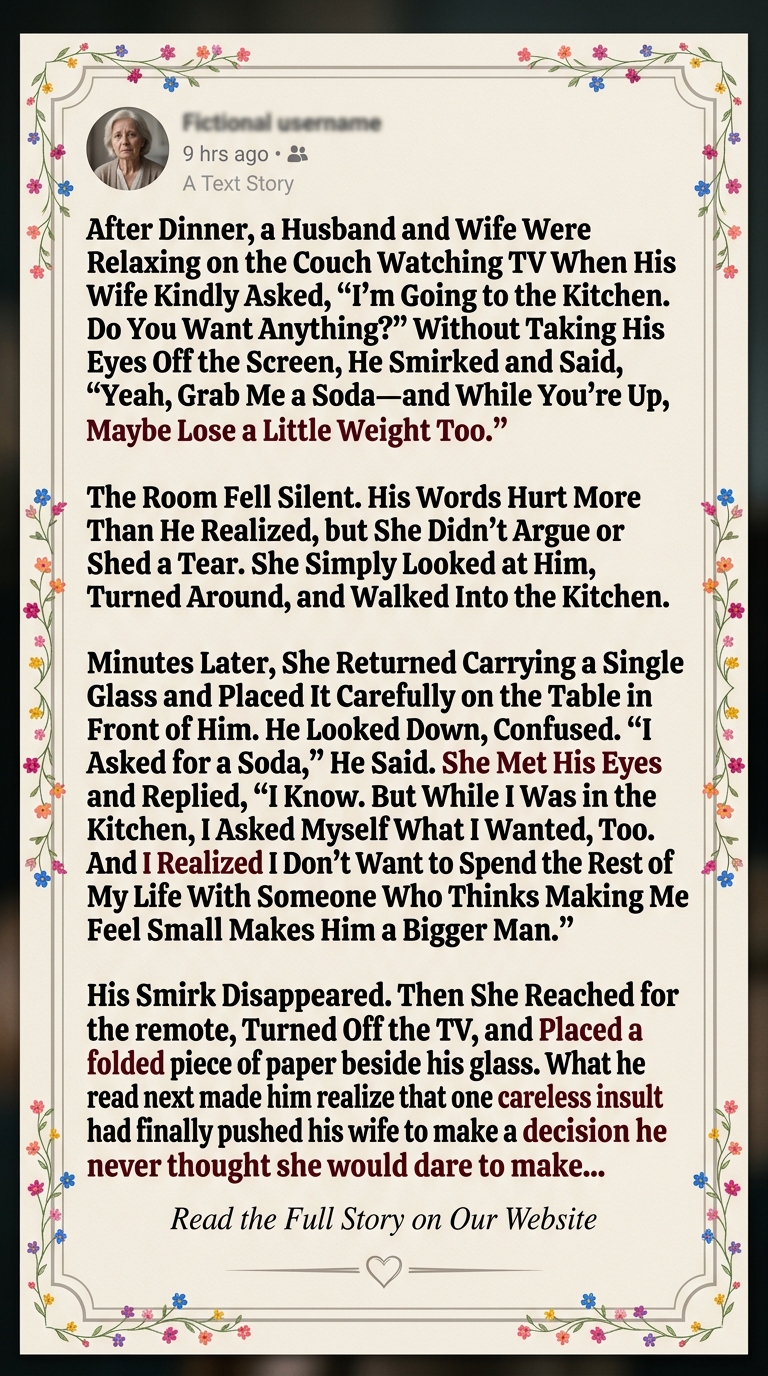
“Yeah, grab me a soda—and while you’re up, maybe lose a little weight too.”
He chuckled at his own joke.
Claire stopped moving.
For a moment, the only sound in the living room was the television.
They had been married for fourteen years. She knew Michael could be sarcastic, but lately, his remarks had become sharper. He criticized her clothes, joked about her appearance in front of friends, and complained whenever she seemed tired after a long day at work.
Whenever she told him his words hurt, he dismissed her feelings.
“Relax. You can’t take a joke.”
So Claire had learned to smile when she wanted to cry. She had learned to change the subject instead of starting another argument. She had even started avoiding photographs because Michael’s comments had made her self-conscious about her own appearance.
But something about that evening was different.
Perhaps it was the exhaustion of another long day. Perhaps it was the way he had delivered the insult without even looking at her, as though her feelings were too insignificant to deserve his attention.
Whatever the reason, Claire didn’t argue.
She simply turned and walked into the kitchen.
Michael returned his attention to the television, satisfied that the moment had passed.
A few minutes later, Claire came back carrying a single glass of water.
She placed it carefully on the coffee table in front of him.
Michael glanced down.
“I asked for a soda.”
“I know.”
“Then why did you bring me water?”
Claire sat in the armchair opposite him.
“Because while I was in the kitchen, I asked myself what I wanted, too.”
Michael gave an impatient sigh.
“Claire, don’t start.”
“I realized I don’t want to spend the rest of my life with someone who thinks making me feel small makes him a bigger man.”
His smirk disappeared.
She reached for the remote, turned off the television, and placed a folded piece of paper beside his glass.
Michael stared at it.
“What is that?”
“Read it.”
He unfolded the paper.
At the top was the name of a family lawyer. Beneath it was a brief note stating that Claire had scheduled a consultation to discuss separation, financial arrangements, and the division of their shared property.
Michael looked up sharply.
“Are you serious?”
“Completely.”
“You’re talking about leaving me over a joke?”
Claire took a slow breath.
“No, Michael. I’m talking about leaving you because of fourteen years of jokes.”
He stood up, shaking his head.
“This is ridiculous. I’ve always teased you. You used to laugh.”
“I used to laugh because I didn’t want to spend the rest of the evening defending myself.”
“That’s not fair.”
“Neither was making me the punchline every time you wanted to feel funny.”
Michael paced toward the window and back.
“You could have told me you were this unhappy.”
“I did.”
“When?”
“Last Christmas, when you joked about my weight in front of your family. Three months ago, when you told our friends I had let myself go. Last week, when I asked you to stop commenting on my appearance and you told me I was becoming too sensitive.”
He opened his mouth, then closed it.
Claire continued.
“Every time, I told you I was hurt. Every time, you told me I couldn’t take a joke. So I stopped explaining. I thought if I became quieter, more patient, and less demanding, maybe you would remember how to be kind to me.”
She looked at him steadily.
“But you didn’t.”
Michael glanced at the folded paper again.
For the first time, the possibility that she might actually leave seemed real to him.
He sat down slowly.
“Claire, I didn’t know you felt this way.”
“You knew I was hurt. You just didn’t believe it mattered.”
He rubbed his face.
“I was only kidding. I never thought you would take it this far.”
“That is exactly the problem. You thought I would tolerate anything as long as you called it a joke.”
Silence settled between them.
Then Michael said something that surprised her.
“Is there someone else?”
Claire blinked.
“No.”
“Then why would you throw away our marriage?”
She looked at him sadly.
“Why does there have to be someone else before you believe a woman has a reason to leave?”
He had no answer.
Claire rose from the armchair and walked toward the hallway. Michael followed her.
“Wait. We can talk about this. I’ll stop making those comments.”
She turned around.
“I hope you do. But I can’t make my decision based on another promise.”
“Fourteen years, Claire. Fourteen years together, and you’re willing to end it over something I said on the couch?”
“No. I’m willing to end it because of what I’ve been telling you for years, and what you kept choosing to do.”
She went into the bedroom and closed the door.
That night, she slept in the guest room.
Michael lay awake until dawn, replaying the conversation. He remembered Claire asking him to stop making jokes about her appearance. He remembered rolling his eyes, telling her to relax, and changing the subject.
He had always assumed she would eventually get over it.
He had never considered that she might eventually stop trying.
The next morning, Michael found Claire at the kitchen table with a cup of coffee and a notebook.
“Can we talk?” he asked.
She nodded toward the chair opposite her.
He sat down.
“I don’t want you to leave,” he said.
Claire looked at him.
“Then I need you to understand that wanting me to stay is not the same as treating me well.”
He swallowed.
“I know I hurt you.”
“Do you understand why?”
“Because I made you feel bad about your appearance.”
“That’s part of it. But it wasn’t only about my weight. It was about knowing that the person who promised to love me would use something personal to embarrass me, then blame me for being hurt.”
Michael stared at his hands.
“I never thought of it that way.”
“I know.”
He looked up.
“Can we try counseling? I’ll go. I’ll do whatever you want.”
Claire was quiet for a long time.
Then she closed her notebook.
“I am willing to consider counseling. But I want us to separate for now. I need space to understand what I want without being pressured to reassure you.”
His face tightened.
“So that’s it? You want me out?”
“I want us to stop pretending everything is fine because we are afraid of what happens if we admit it isn’t.”
Michael wanted to argue, but the words wouldn’t come.
For the first time, Claire wasn’t threatening to leave during an argument. She wasn’t asking him to change while hoping he would eventually listen.
She had made a decision.
Over the following weeks, Michael moved into a small apartment nearby. They arranged their finances through their lawyers and began counseling separately before deciding whether to attend sessions together.
At first, Michael focused on convincing Claire to return.
He sent flowers. He wrote long messages promising to change. He reminded her of their wedding, their vacations, and the difficult years they had survived together.
Claire appreciated the memories, but she didn’t mistake them for proof that their present relationship was healthy.
Eventually, she agreed to attend one counseling session with him.
The counselor asked Michael to describe what he believed had happened.
“I made a stupid joke,” he said. “She took it seriously, and now we’re separated.”
Claire looked at him.
“That is still what you think happened?”
He frowned.
“What do you mean?”
“You are still making my reaction the problem.”
The counselor asked him to consider what he might have done differently.
Michael struggled to answer.
Then Claire spoke.
“I didn’t need him to tell me I was beautiful every day. I needed him not to use my insecurities as entertainment. I needed him to care when I said something hurt me.”
Michael looked down.
For the first time, he began to understand that the insult about her weight had not created the problem. It had exposed the pattern she had been trying to explain for years.
He began individual counseling and worked on understanding why he used sarcasm to avoid vulnerability. He learned that he often felt insecure himself and tried to regain control by making other people the target of his humor.
That explanation did not excuse his behavior, but it gave him something concrete to address.
He also began to change how he spoke to people around him. When a friend made a cruel joke about his own wife’s appearance, Michael no longer laughed along.
“That’s not funny,” he said. “You should stop.”
It was a small moment, but it showed him that kindness required a choice, even when cruelty would have been easier.
Claire noticed his efforts, but she did not rush back into the marriage.
She spent time with friends she had neglected, returned to a painting class she had abandoned years earlier, and began rebuilding the confidence that had slowly eroded.
She discovered that she enjoyed quiet evenings alone. She liked cooking meals without worrying whether someone would criticize her. She liked choosing clothes because she loved them, not because she hoped to avoid a sarcastic remark.
One afternoon, she looked at herself in the mirror and realized she had stopped rehearsing imaginary arguments in her head before seeing Michael.
That was when she understood how much emotional space the relationship had occupied.
Six months after their separation, Michael asked to meet her for coffee.
He arrived without flowers or a prepared speech.
“I want to apologize,” he said. “Not because I want you to come home, although I do. I want to apologize because I finally understand that I kept hurting you and then making you responsible for my behavior.”
Claire listened quietly.
“I treated your feelings like an inconvenience,” he continued. “I thought that if I called something a joke, I didn’t have to take responsibility for how it affected you. I was wrong.”
For the first time, he didn’t follow his apology with an excuse.
Claire felt the ache of fourteen years together. She remembered the man who had held her hand when her father died, who had helped her through a difficult job change, and who had once made her laugh until tears ran down her cheeks.
Their marriage had not been unhappy every day.
That was what made the decision so difficult.
But good memories could not erase years of hurt, and an apology could not obligate her to return.
“I believe you’re trying to change,” she told him. “And I’m glad you’re taking responsibility. But I don’t know whether I want to rebuild our marriage.”
Michael nodded, his eyes shining.
“I understand.”
She reached across the table and briefly held his hand.
“I hope you become the person you say you want to be. Whether we’re together or not.”
They continued counseling for a while, but Claire eventually decided not to resume the marriage. They handled the divorce respectfully, dividing their property through the legal process and allowing themselves to grieve what they had lost without turning every conversation into another argument.
It was painful, but it was also peaceful.
A year after the night of the glass of water, Claire moved into a smaller home with a sunny kitchen and a little balcony where she kept pots of herbs. She began painting again and spent Sunday afternoons with friends who made her feel welcome without requiring her to earn their kindness.
One evening, she made herself a glass of sparkling water, carried it to the couch, and settled down with a book.
She smiled at the quiet room.
She no longer needed to prove that she was worthy of respect.
She had always been worthy.
The glass of water had not ended her marriage by itself. It had simply marked the moment she stopped ignoring the truth she had been trying to face for years.
Sometimes, the final straw is not the cruelest thing someone has ever said.
Sometimes, it is the moment you realize that you have explained your pain so many times that you have begun to believe you must be the problem.
Claire had finally stopped believing that.
And once she did, she found the courage to choose a life in which kindness was not something she had to beg for.