The Detective Who Saved Me Was Sitting Across From the Woman Who Destroyed My Childhood
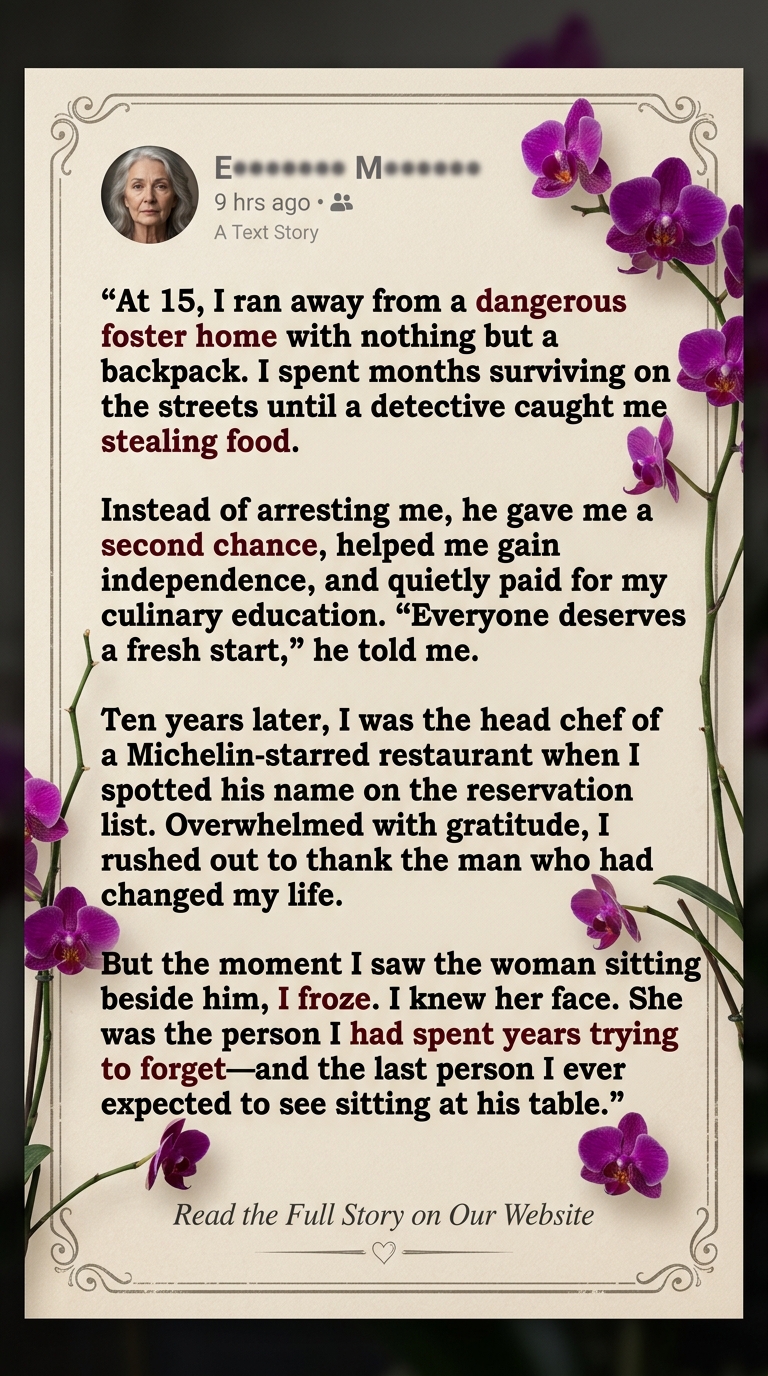
At fifteen, I ran away from a foster home with a backpack, twelve dollars, and a fear so deep that I would rather sleep beneath a bridge than return.
For months, I survived on whatever I could find. I slept in abandoned buildings, washed in public restrooms, and learned which shopkeepers threw away food before closing. I stopped trusting adults because every time I had trusted one, I had paid for it.
Then, one freezing evening, I made a mistake.
I slipped a loaf of bread and two cans of soup beneath my jacket and tried to leave a small grocery store without paying.
A hand caught my shoulder.
“Easy, kid,” a man said. “Don’t run.”
I turned, ready to fight.
He was a detective named Daniel Hayes. He had tired eyes, a weathered face, and a voice that didn’t sound angry.
“Are you going to arrest me?” I asked.
“I’m trying to figure out why a fifteen-year-old is stealing dinner instead of sitting at home eating it.”
I said nothing.
He took me to a nearby diner, bought me a hot meal, and listened while I told him enough of the truth to make him understand that sending me back to the foster home wasn’t an option.
Detective Hayes contacted the appropriate child-protection authorities and helped me get placed somewhere safe. He didn’t promise to rescue me himself. Instead, he made sure the people responsible for my care knew what had happened and followed up until I was somewhere I could begin to recover.
He kept checking on me afterward.
When I turned sixteen, he helped me find a youth employment program. When I graduated from high school, he showed up in the audience, clapping louder than anyone else.
And when I told him I wanted to become a chef, he didn’t laugh at my ambition.
He helped me find scholarships, connected me with a culinary mentor, and quietly contributed to a training fund when my financial aid fell short.
I discovered the money years later, after I had already started working in a professional kitchen.
I confronted him about it.
He shrugged.
“Everyone deserves a fresh start, kid.”
“You didn’t have to do that.”
“No,” he agreed. “I didn’t.”
Then he smiled.
“But someday, when you have the chance to help somebody else, I expect you to remember how it felt when someone helped you.”
I never forgot.
Ten years later, I was the head chef of a Michelin-starred restaurant in Chicago. My name appeared in food magazines, critics requested my tasting menu months in advance, and I had a small apartment with a refrigerator full of food I never had to steal.
I still kept the old backpack in my closet.
Not because I wanted to remember being hungry, but because I wanted to remember how far I had come.
Then, one Thursday afternoon, my maître d’ brought me the reservation list.
“Chef, there’s a guest arriving tonight who specifically requested that you know he’s coming.”
I scanned the names.
Daniel Hayes.
For several seconds, I simply stared at the page.
Detective Hayes had never asked for special treatment. He rarely visited the restaurant, and when he did, he insisted on paying his own bill. I had tried to thank him countless times, but he always brushed it aside.
Now he had made a reservation.
I felt my eyes sting.
“Give them the best table,” I told my maître d’. “And tell me the moment they arrive.”
At seven fifteen, the host announced his arrival.
I stepped out of the kitchen, wiping my hands on a clean towel, already rehearsing what I would say.
But when I reached the dining room, I stopped so abruptly that a waiter nearly collided with me.
Detective Hayes was seated at a corner table.
And across from him sat a woman with short auburn hair, a silver necklace, and a familiar scar near her left eyebrow.
I knew that face.
I had spent years trying to forget it.
Her name was Vanessa Cole.
She had been the foster mother who made my childhood unbearable.
The woman who locked the pantry and told me I had to earn every meal. The woman who smiled at social workers while hiding the bruises beneath long sleeves and insisting I was a troubled child who lied for attention.
The woman whose home I had fled that freezing night.
Now she was sitting across from the man who had helped me escape the life she had created.
My hands began to shake.
Detective Hayes noticed me standing there.
His smile faded.
“Ethan?” he said, rising from his chair. “What’s wrong?”
Vanessa turned.
The moment she saw me, the color drained from her face.
“Oh,” she whispered.
I couldn’t move.
Ten years of anger, fear, and buried memories rushed back so quickly that I could barely hear the restaurant around me.
Detective Hayes looked from her to me.
“You two know each other?”
Vanessa opened her mouth, but no sound came out.
I finally found my voice.
“She was my foster mother.”
The detective went completely still.
“What?”
“She was the reason I ran away.”
Vanessa grabbed her water glass with trembling fingers.
“Ethan, please,” she said. “You don’t understand what happened back then.”
I stared at her.
“I remember enough.”
Detective Hayes slowly pulled out his chair and sat down again.
“Vanessa,” he said quietly, “you told me you had never met Ethan.”
She looked at him in horror.
And in that moment, I understood something far worse than the coincidence of finding her at his table.
She hadn’t simply recognized him.
She had lied to him about me.
I turned toward the kitchen.
“I’m sorry,” I said to Detective Hayes. “I thought tonight would be a chance to thank you.”
He stood immediately.
“Ethan, wait.”
But I couldn’t remain there another second. I walked back into the kitchen, shut myself inside my office, and gripped the edge of the counter until my hands stopped shaking.
A few minutes later, there was a knock.
“It’s me,” Detective Hayes said.
I opened the door.
He looked shaken.
“I’m sorry,” he said. “I had no idea.”
“Why are you here with her?”
He took a breath.
“Vanessa contacted me about six months ago. She said she’d been trying to make amends for mistakes she’d made while working in foster care. She told me she’d completed counseling, left the system, and wanted to support a program for young people leaving foster care.”
I felt a bitter laugh rise in my throat.
“She wants to help foster kids?”
“That’s what she told me.”
“Did she tell you why she left the system?”
“No. She said she had been dismissed after a disagreement with her agency.”
I shook my head.
“She wasn’t dismissed because of a disagreement. There were complaints about the way she treated children. I tried to tell people, but she convinced them I was a liar.”
Detective Hayes listened without interrupting.
When I finished, he asked, “Did you ever give a statement about what happened in her home?”
“Yes. A caseworker interviewed me after I ran away. I told them everything.”
“Do you remember the caseworker’s name?”
I did.
He wrote it down.
“I need to be careful here,” he said. “What you’ve told me is serious, but I can’t assume every detail without checking the records. I won’t ask you to confront her, and I won’t let tonight turn into a public spectacle.”
I looked toward the dining room.
“She shouldn’t be sitting here pretending she’s a good person.”
“I agree that you deserve answers. But let’s get the facts first.”
He paused.
“And Ethan? You don’t owe her a conversation. Not tonight. Not ever, if you don’t want one.”
Those words gave me room to breathe.
I had spent years believing that if I ever saw Vanessa again, I would need to make her admit what she had done. I had imagined confronting her, forcing her to look at me, and demanding an apology.
But standing there in my restaurant, I realized I didn’t want to give her control over another evening of my life.
“I don’t want to speak to her,” I said.
“Then you won’t.”
Detective Hayes returned to the table and informed Vanessa that the dinner was over. I didn’t hear their entire conversation, but I saw her reach for his arm and watched him gently move away.
She left without looking toward the kitchen.
Before Detective Hayes departed, he came to my office.
“I should have checked more carefully before trusting her story,” he said.
“You didn’t know.”
“I should have asked more questions.”
I shook my head.
“You gave a frightened kid a chance when you didn’t have to. I won’t blame you for not knowing what happened ten years later.”
He looked at me for a long moment.
“I’m proud of you, Ethan.”
That was when I finally cried.
Not because Vanessa had appeared, and not because I had finally been given an opportunity to expose her.
I cried because the man who had helped me survive was standing in front of me, still treating me like the boy who had needed someone to believe him.
And this time, I was no longer powerless.
The following week, Detective Hayes helped me locate the old case records through the appropriate channels. I also contacted an attorney who worked with former foster children. Together, we learned that several complaints had been filed against Vanessa while she was a foster parent. Her agency had documented concerns about food deprivation, intimidation, and inappropriate punishment, but the records showed that the complaints had not all been handled consistently.
My account had been part of the file.
Vanessa had left the foster-care system years earlier. There was no evidence that she was currently caring for children, but her recent attempts to establish a charitable program required closer scrutiny because she had represented her past differently to potential partners.
Detective Hayes did not use his position to force a particular outcome. He referred the information to the appropriate authorities and let the review proceed.
Vanessa eventually sent me a letter.
She wrote that she had been under stress, that she had lacked support, and that she regretted how things had unfolded. She said she hoped I could forgive her someday.
I read the letter once.
Then I placed it in a drawer.
Her explanation might have helped her understand herself, but it didn’t change what I had experienced. I didn’t owe her forgiveness simply because she had finally decided to acknowledge part of the truth.
A month later, I invited Detective Hayes back to the restaurant.
This time, he came alone.
I prepared a special menu inspired by the foods I had learned to cook during my training: slow-braised short ribs, roasted seasonal vegetables, and a warm apple tart with cinnamon cream.
When I brought the dessert to his table, he looked at it with amusement.
“Are you trying to make me emotional?”
“Absolutely,” I said. “It’s the chef’s privilege.”
He laughed.
We talked for hours. I told him about the restaurant, the staff I was mentoring, and the young cook I had recently hired who had been sleeping in his car after leaving an unsafe home.
Detective Hayes listened carefully.
When I explained that I had helped the young man find temporary housing and connect with a support organization, he smiled.
“Looks like you remembered.”
I nodded.
“Everyone deserves a fresh start.”
He lowered his eyes for a moment, visibly moved.
Then he reached across the table and squeezed my hand.
“You didn’t just survive, Ethan. You built something.”
For the first time in years, I thought about Vanessa without feeling as though she was standing in the doorway of my past.
She had been part of my story, but she didn’t get to decide how it ended.
The boy who had once stolen bread to stay alive had grown into a man who could feed hundreds of people, build a team, and offer another frightened kid the chance to start over.
And the detective who had stopped him that night had become something far more important than the person who caught him stealing.
He had become proof that one compassionate choice can change the direction of a life.
I couldn’t erase what happened in that foster home.
But I could decide what happened next.