The Divorce Announcement at My Retirement Party Cost My Husband Everything He Thought He Deserved
At sixty-four, after thirty-five years of marriage, I thought I knew every way my husband could disappoint me.
I was wrong.
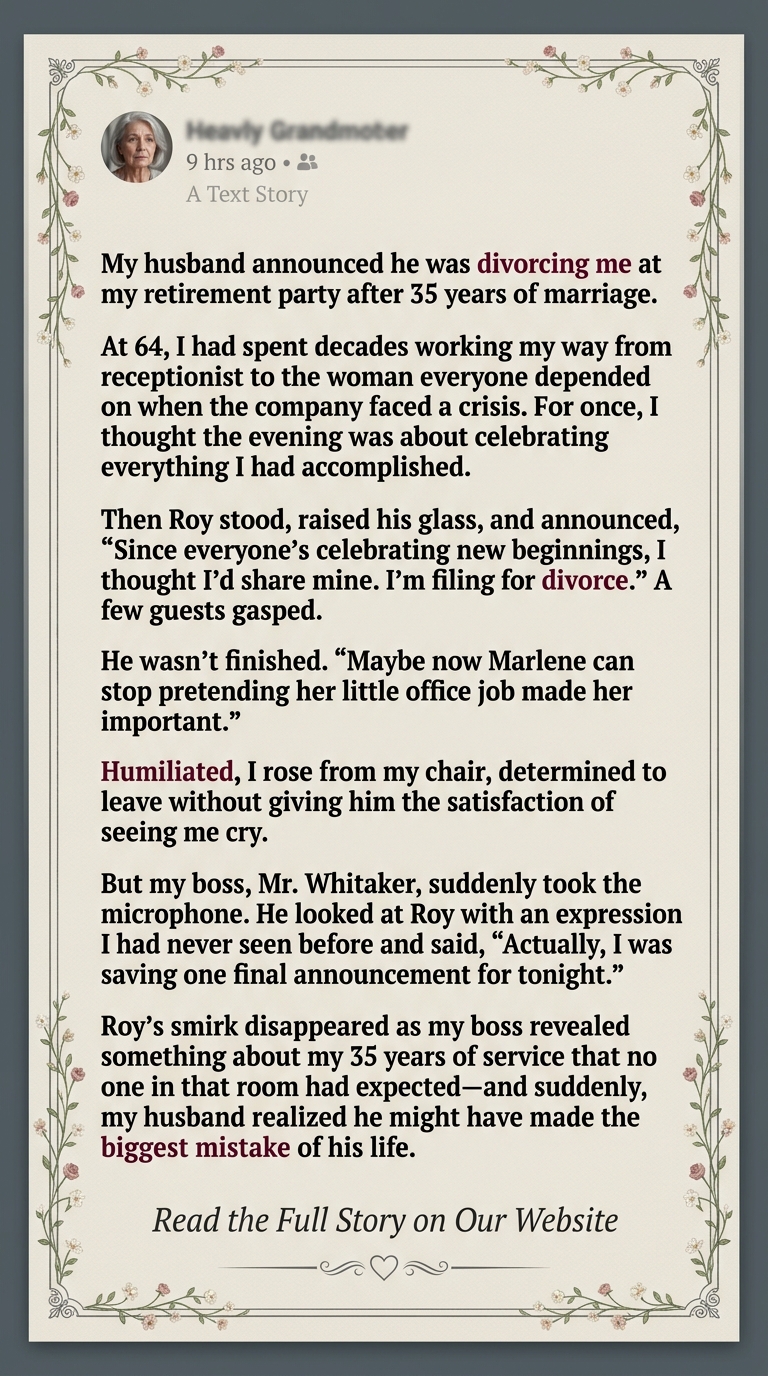
Roy announced he was divorcing me in front of nearly a hundred colleagues at my retirement party, then laughed as though humiliating me were the perfect ending to my career.
“Since everyone’s celebrating new beginnings,” he said, raising his champagne glass, “I thought I’d share mine. I’m filing for divorce.”
The room went silent.
Then he looked directly at me.
“Maybe now Marlene can stop pretending her little office job made her important.”
A few people shifted uncomfortably. Someone near the back whispered my name.
I sat frozen, my hands resting in my lap.
For thirty-five years, I had been Roy’s wife. I had supported him through career changes, helped raise our two children, cared for his mother during her final illness, and kept our household running while he pursued opportunities that always seemed to require my sacrifices.
And for thirty-five years, I had worked, too.
I had started as a receptionist at Whitaker Industrial Group, answering phones in a cramped office where the heating barely worked in winter. I learned the company’s systems, memorized client accounts, and stayed late whenever someone needed help.
When a senior administrator resigned without warning, I took over her responsibilities.
When a major supplier threatened to cancel a contract, I found the missing paperwork and negotiated a solution.
When a financial reporting error nearly cost the company one of its largest clients, I spent three sleepless nights tracing the mistake to its source.
Over the decades, I became the person everyone called when a crisis threatened to overwhelm the office.
Yet Roy always described my work as a hobby.
“You push papers around,” he would say whenever I mentioned a difficult day. “It’s not exactly saving the world.”
I had learned to smile and change the subject.
But that evening, standing beneath a banner that read Congratulations, Marlene! Thirty-Five Years of Excellence, I finally understood how little my husband thought of the life I had built.
I rose from my chair.
I wasn’t going to cry in front of him.
I wasn’t going to beg him to reconsider.
I simply wanted to leave with whatever dignity I had left.
Then my boss, Mr. Whitaker, took the microphone.
“Roy, before you go any further,” he said, “I believe we have one final announcement to make tonight.”
Roy smirked.
“By all means. I’m sure it’s another certificate for my wife’s paper-pushing.”
A few guests stared at him in disbelief.
Mr. Whitaker didn’t smile.
“Actually, Roy, this announcement concerns the woman you have just insulted.”
He turned toward me.
“Marlene, would you please come back to the front?”
I hesitated.
Then I walked toward the stage.
Mr. Whitaker waited until I stood beside him before addressing the room.
“Many of you know that Marlene has spent thirty-five years with this company. What you may not know is that, during that time, she helped save this organization from a financial disaster that could have cost hundreds of people their jobs.”
A murmur passed through the guests.
Roy lowered his glass.
Mr. Whitaker continued.
“Eleven years ago, our company was facing a serious liquidity crisis. A major client had withheld payment, our bank had frozen a credit facility pending a review, and several senior executives believed we would have to close two departments.”
I remembered those weeks vividly.
I’d stayed at the office until midnight, reconstructing years of transaction records and matching invoices against delivery confirmations. While others argued about whose department was responsible, I quietly followed the money.
Eventually, I discovered that a series of payments had been incorrectly classified. The mistake had made our financial position look far worse than it actually was.
Correcting the records didn’t solve every problem, but it gave the company the accurate information needed to renegotiate its credit arrangement and retain its employees.
Mr. Whitaker looked around the room.
“Marlene found the discrepancy, documented it, and helped our finance team present the corrected figures to the bank. She never demanded a promotion or special recognition. She simply did what needed to be done.”
He paused.
“Because of her work, we preserved jobs, retained our major client, and kept this company operating while we rebuilt our finances.”
The room erupted in applause.
I stood there, stunned.
Roy’s face had lost some of its color, but he still seemed convinced that the speech was merely ceremonial.
Mr. Whitaker raised one hand.
“And that brings me to the announcement I had planned for tonight.”
He reached beneath the lectern and removed a dark blue folder.
“Our board approved a retirement package recognizing Marlene’s exceptional service. In addition to her full retirement benefits, she will receive a substantial performance award and a continuing advisory contract, should she choose to accept it.”
The applause grew louder.
Then he said the words that changed everything.
“The board has also approved Marlene’s appointment to our newly established employee mentorship foundation. She will help train the next generation of administrators and operations leaders, and the foundation will be named in recognition of her contribution to this company.”
I covered my mouth.
For thirty-five years, I had done my work because I believed it mattered, even when the person closest to me insisted it didn’t.
Now, in front of everyone, my employer was telling me that it had mattered more than I had ever realized.
Mr. Whitaker handed me the folder.
“Marlene, this company is better because you were here. We are proud of you, and we hope you know that.”
I couldn’t speak.
I simply nodded as tears filled my eyes.
The guests stood and applauded.
Everyone except Roy.
He stared at the folder in my hands.
Then he leaned toward me and whispered, “How much is the award?”
I turned to look at him.
That was his first question.
Not whether I was all right.
Not whether his announcement had hurt me.
Not even whether I wanted him to stay.
How much money was involved?
I stepped away from him.
Mr. Whitaker noticed and gently guided me toward a quiet corner of the ballroom while the guests returned to their conversations.
Roy followed us.
“Marlene, we need to talk.”
I looked at him.
“You announced our divorce in front of my colleagues. I don’t think we need to discuss anything here.”
He glanced at Mr. Whitaker, then lowered his voice.
“I was upset. I didn’t mean for it to come out that way.”
“You stood up, raised your glass, and made a speech.”
“I was trying to make a point.”
“You made one.”
He swallowed.
Then his eyes dropped to the blue folder.
“What’s in there exactly?”
I felt something inside me settle.
For years, I had wondered whether Roy simply failed to understand my work or whether he deliberately minimized it because acknowledging my accomplishments would require him to reconsider his own importance.
Standing there, watching him calculate what my retirement package might mean for him, I finally stopped trying to answer that question.
“It’s about my future,” I said. “And that future is no longer yours to plan.”
He stared at me.
“You can’t be serious.”
“You just announced that you’re divorcing me.”
“I thought we could handle it privately afterward.”
I almost laughed.
“You chose the audience, Roy. Don’t complain about the setting now.”
He looked around the ballroom. Several guests had clearly overheard enough to understand what was happening.
For the first time that evening, he seemed embarrassed.
But embarrassment wasn’t remorse.
He took my arm.
“Let’s go home. We can work this out.”
I gently pulled away.
“I’ll be staying with my daughter tonight.”
His expression changed.
“Don’t involve the children.”
“You involved an entire ballroom.”
I turned toward Mr. Whitaker and thanked him for the announcement. Then I collected my coat and left.
Outside, the night air was cold. I sat in my car for several minutes before calling my daughter, Emily.
She answered immediately.
“Mom? How was the party?”
I tried to speak, but my voice broke.
“Dad announced he’s divorcing me.”
There was a long silence.
Then Emily said, “I’m coming to get you.”
She arrived twenty minutes later and found me sitting in the driver’s seat, still wearing the dress I had bought for my retirement celebration.
She didn’t ask me to explain everything immediately. She simply hugged me.
That night, I slept in her guest room.
Roy called repeatedly. First, he accused me of overreacting. Then he said he had been joking. Finally, he sent a message claiming that he had only announced the divorce because he wanted to force me to take our marital problems seriously.
I read the message twice.
He had publicly announced the end of our marriage, but somehow he still expected me to treat his behavior as a problem I needed to solve for him.
The next morning, I contacted a family lawyer.
I had no intention of making reckless decisions while hurt, but I also wasn’t going to let Roy’s announcement determine the terms of my future. The lawyer explained that the divorce process would require a full review of our finances, property, retirement accounts, and other marital assets under the applicable law.
I gathered my records, secured copies of our financial statements, and began documenting our assets and liabilities.
Roy seemed shocked that I had acted so quickly.
“You’re actually hiring a lawyer?” he demanded during our first phone conversation.
“Yes.”
“We’ve been married for thirty-five years.”
“I know. You reminded me in front of a hundred people.”
He exhaled sharply.
“Don’t make this uglier than it needs to be.”
“Then we can keep it respectful and let the lawyers handle the details.”
He went quiet.
Then he asked, “What happens to the retirement money?”
I closed my eyes.
Even now, he was thinking about the money.
The divorce proceedings took months. We negotiated through our attorneys, and the final agreement addressed our marital property and retirement assets according to the applicable rules. I didn’t attempt to punish Roy, but I also didn’t surrender anything simply because he expected me to remain accommodating.
The award from Whitaker Industrial Group was reviewed separately as part of the financial process, and my lawyer advised me on how it should be treated under the circumstances.
Meanwhile, I began my new advisory role.
At first, I worried that retirement would leave me feeling useless. Instead, I found myself mentoring young employees who reminded me of the person I had been when I first walked through the company’s doors.
One young woman, Priya, came to me after a difficult meeting with a senior manager.
“He spoke over me the entire time,” she said. “I had the correct figures, but nobody listened.”
I smiled gently.
“Then we’ll make sure the figures are presented so clearly that nobody can ignore them. And next time, you won’t walk into that room alone.”
As I helped her prepare, I realized that my new role was not simply a reward for the years I had spent working.
It was a chance to pass on what those years had taught me.
I had learned how to solve problems without humiliating people, how to lead without demanding obedience, and how to recognize the difference between confidence and arrogance.
Those lessons mattered far beyond an office.
Several months after the retirement party, Roy asked to meet me at a café.
I agreed because we still had practical matters to discuss.
He arrived looking tired. His usual confidence had been replaced by a guarded expression.
“I owe you an apology,” he said.
I waited.
“What I said at your party was cruel. I wanted to embarrass you because I felt like you were moving into a life where you didn’t need me anymore.”
I looked at him.
“Why would my retirement make you feel that way?”
He rubbed his hands together.
“Because you were always the dependable one. Everyone called you when something went wrong. Your colleagues respected you. And I suppose I got used to thinking that your work wasn’t important because it made me feel less important.”
It was the first time Roy had acknowledged that his behavior might have come from his own insecurity.
But I wasn’t ready to confuse honesty with reconciliation.
“You could have told me you were frightened about getting older or about our future,” I said. “Instead, you chose to humiliate me.”
He nodded.
“I know.”
“Do you still want a divorce?”
He looked down.
“I don’t know what I want anymore.”
I took a breath.
“I do. I want a life where I don’t have to make myself smaller to protect your pride.”
He looked at me, and I could see that he finally understood the seriousness of what he had done.
“Is there any chance we could start again?”
I thought about our thirty-five years together. The children we had raised, the holidays we had shared, the years of companionship, and the countless small disappointments that had slowly become a wall between us.
I didn’t hate Roy.
But I no longer believed that the length of a marriage was proof that it should continue.
“Maybe one day we can have a better relationship than we have now,” I said. “But I can’t promise you that we’ll be married again. I need to learn how to live for myself before I can decide what I want from anyone else.”
He nodded, though disappointment crossed his face.
We finished our coffee and went our separate ways.
The divorce was finalized later that year.
I moved into a smaller home near a park, where I could walk in the morning and spend quiet evenings reading. I began taking short trips with friends and enrolled in a photography class I had postponed for years because Roy thought it was a waste of money.
My children remained close to both of us, though they made it clear that they would not pretend their father’s behavior at my retirement party had been acceptable.
Roy and I eventually learned to communicate civilly. We attended family celebrations without turning every gathering into a battle, and we stopped using the children as messengers.
But we did not remarry.
I discovered that I could remember the good years without returning to a relationship that had made me doubt my own worth.
On the anniversary of my retirement party, Whitaker Industrial Group invited me back to speak to a new group of employees.
As I stood before them, I thought about the young receptionist I had once been, sitting at a desk near the drafty office entrance, afraid to ask for a raise because she didn’t want to seem ungrateful.
I looked at the faces before me.
“Never measure your value by the person who benefits from keeping you small,” I told them. “Do your work with integrity, learn everything you can, and remember that you deserve respect even when nobody is applauding.”
Afterward, Priya approached me with a smile.
“I’m going to remember that.”
I hugged her.
On my way home, I stopped at a small restaurant and ordered dinner for one. I sat beside the window, watched the evening traffic, and realized I wasn’t lonely.
I was at peace.
For thirty-five years, I had believed my marriage was the most important proof that I had built a successful life.
Now I understood that my life was larger than my marriage.
Roy had announced our divorce at my retirement party because he thought it would reduce me to the woman he had always described: insignificant, dependent, and easy to dismiss.
Instead, he gave me the moment when I finally stopped accepting his definition of me.
And the greatest reward of my retirement wasn’t the money, the title, or the applause.
It was discovering that I could begin again at sixty-four—and that I no longer needed anyone’s permission to feel proud of the woman I had become.